Category Archives: On the cover

On the cover

What happened to put Spain on the verge of intervention?

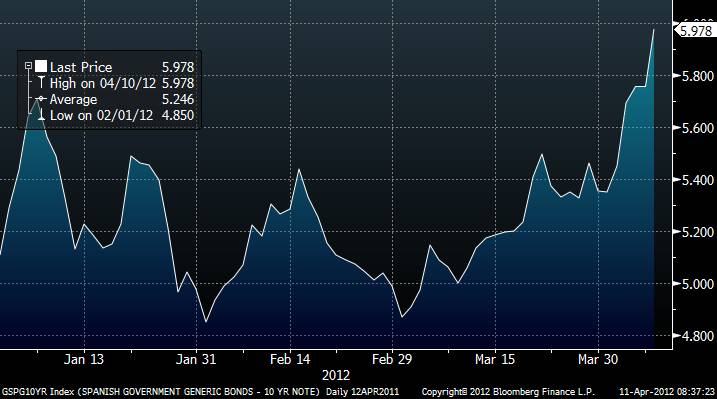
Spanish 10 year

(This article was published in Cotizalia on April 7th 2012)

“Italy is not Spain”. This is the most repeated sentence in Italy this past week. However, along with Spain at 430bps, Italian bond spreads against the Bund rose to 400bps. Does this remind you of anything? Rewind to July 2011. When we heard “Spain is not Greece”, “we don’t have a problem of public debt”, “we are doing our homework.”. Anyway … time puts everything in context. We talked about it here months ago (read).

However, after the announcement of Spain’s budget, the Ibex (at the close of this article), plummeted to 7,500 points, reaching the lows of 2009, while the risk premium exceeded 430 basic points. We have spoken many times about the Ibex’s troubles. An ultra-leveraged index, the most heavily subsidized in Europe, with very poor earnings growth expectations, to which we must add a tax measure that aims to raise 5 billion euros from an index that reported a net income of 30 billion euros in 2011.

But what really intrigues me is what is happening in the debt market. I am optimistic and believe this government is willing and open to listen, so here’s my contribution.

We do not want to admit it, but in the bond market there are three major challenges:

a) The risk premium and as such, the cost of borrowing, will continue to grow if no capital is repaid
b) The effect of deleveraging, ie the decreased amount of money available to invest in sovereign debt, is accelerating and…
c) The crowding-out predator effect of massive public debt and giant state refinancing requirements on the availability of credit and financing for the private sector, the one that pays taxes and generates GDP growth, undermines the prospects for recovery.

The spread with Bunds at 430 bps is a problem. Because it shows that massive injections of liquidity do not work. As well as being a disastrous measure that takes money from the pockets of taxpayers and savings to give it to the overgeared inefficient zombies, these liquidity injections support and rescue those who have done wrong, and moreover, the placebo effect has a lower impact each time. It shows that default risk does not change. As we explained here, debt is not solved with more debt (Read here)

The fact that state bond auctions cannot even be absorbed by the underwriters is a big problem. We have been saying it for months. There is no relevant international institutional demand for government debt and auctions are gobbled between European central banks, local financial institutions and citizens, either through the Social Security or other public entities.

But … Why? If the Spanish budget was “very tough” and the government is doing the right thing, why does the market run in the opposite direction?.

First of all, it is worth highlighting a very important thing. The market does not want Spain to do badly. No way. Because Spain is not Greece. Spain is the 4th economy of the Eurozone and several times the size of Greece and as such it can not be “rescued”. If Spain falls, goodbye friends, nice to meet you. Say goodbye to the S&P 500, the Eurostoxx, Germany and the EU.

So if the market does not want Spain to fall and the budget is very conservative helping Spain to reduce the deficit … What’s the problem?

That neither the one nor the other. Investors of sovereign debt by definition are the most conservative investors in the market, and they are not convinced by the budget, either on the side of the revenues, which seem very optimistic, nor on the side of the expenses. On the revenues, the Spanish government expects to increase revenues in 2012 by 4.7% from the income tax (73 billion versus 69.8 in 2011). However, in the first two months of the year, revenues in this item have fallen 2.8%. Even in February, with the tax increase already in place, revenues from this item only grew by 1%. In an article, in Spanish, my friend Juan Carlos Barba points out the challenges of the budget and the differences of estimates, which could lead to a deficit that actually reaches 7% versus the target of 5.3% (Read here). The Laffer curve in all its glory. More taxes, less revenues. That is why I believe that the government has to be harder and more aggressive on expenditures, which is the lion share of the problem in Spain. They can.

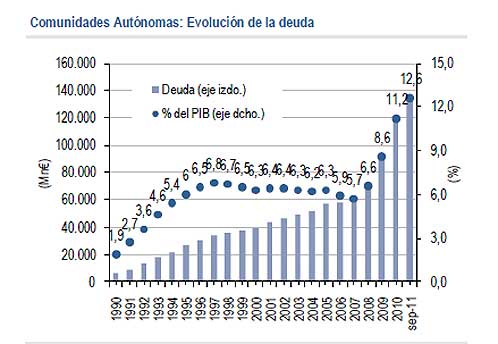
2012021796a1(chart above shows regional communities’ debt, which is not accounted as state debt)

The problem of the budget for investors is that it does not reduce the weight of the state in the economy, which is already way above 50%, the debt to GDP rises to 78%, which is almost 120% including private debt, autonomous regions and state-guaranteed debt, tariff deficit, unpaid bills etc. The total saving that the Spanish budget targets, 27 billion euro, is equivalent to the amount that Spain will spend on paying interests from the massive debt, not more. So, if the total debt continues to rise, budget cuts and tax increases only to pay interests the big elephant in the room, the big problem, is unsolved. An unsustainable and hypertrophied public sector and the massive burden of the regions, seventeen “small kingdoms” that have already increased their expenditures in the middle of “austerity measures” in 2011 by 10%, and will increase spending yet again in 2012. In some regions the public sector is larger than 55-60% of the region’s GDP, for example in Andalucia or Extremadura. This would all be fine if the expenditure had generated growth or jobs. But it has been the opposite. Money has been wasted in vast quantities and employment has plummeted. This is not austerity, it is keeping public spending orgy. Only a radical change on this point would improve Spain’s credit rating.

Investors make their numbers. Just a deviation in the estimated income of 3-5% down, could make the deficit skyrocket to between 8 and 10% above the government target.I assure you that markets have high hopes that this government, with absolute majority at the national level and in almost all regions, would be reducing total debt and the weight of the public spending, not to reduce its growth, cut subsidies and worthless megalomaniac expenditures and repay capital, stop capitalizing interests constantly. And the disappointment is greater when there is trust and hope placed but the government maintains the status quo. But they still have time to rectify. A hundred days are a hundred days.

Politicians are ignoring the effect of deleveraging of financial institutions on demand for sovereign bonds, not least because banks, their advisers, do not comment it. The Norwegian investment fund just reduced further their exposure to Europe. Not only governments have to do the right things, curtail political spending and encourage private job creation, which is the one that pays taxes, the public sector consumes taxes… States must take account that the pie of money available to invest in sovereign bonds continues to decline. And that makes what we consider “our rights”-unlimited access to debt, and cheap- unaffordable unless we change radically the structure of public spending.

The funds available for European debt have been reduced by an average of 20 billion euros a year every year since 2007, according to our own studies. Not only the cake has reduced, but competition is fierce, as no country has reduced its debt-issuing voracity. And of course, by increasing the money supply by 6% pa, we only have placebo effects. Because the increase in money supply is clearly inadequate compared with the increase of public and private indebtedness, but in addition it generates stagnation, deflation in the goods, products and services from our economy and much higher inflation in raw materials and imported foreign goods. In fact, most of the inflation generated in the EU between 2007 and 2011 is from commodities and foreign goods. The states are still in debt, but practically nothing of the additional money supply goes to the real economy, industries or households. It stays in zombie banks that purchase sovereign debt with ECB funds (paid by current and future citizens in taxes) and use the difference to keep zombie companies alive “until it stops raining.”

Of the 200 billion taken by the Spanish banks of the ECB all have been consumed in bond buying, cover the fall of deposits (-7.5% in 2011) and cover their own debt maturities, but neither the state’s nor private balance sheets have improved. Many investor are surprised at why very few companies and banks have taken the injection of Draghi liquidity and the “placebo effect – stock market euphoria” to raise capital and cut debt. Why? Better to be a zombie among zombies than victim of the greed of the of the hunger of the undead. Like Japan, but with a difference. A private and public debt that no one has reduced “because the recovery is coming.” UBS recently commented “the banking stresses are not yet addressed: We see the system as undercapitalised, poorly-funded and badly reserved …”.

No wonder that many companies do not generate free cash flow in the IBEX. Because when you generate it, it is seized by the governments in taxes. At least when the company generates no free cash flow it enters the list of “rescue-able”. And they keep as much income as possible in tax havens. I always say that there are no tax havens, there are tax hells.

But the problem is that Spain can not be rescued. The cost would exceed 500 billion euro and that cannot be afforded by the EU. Especially because as we talk about Spain, France is also close to the territory of danger, with a debt to GDP that will reach 100% soon.

A bond investor cannot accept just 5.9% for a 10-year bonds of a state+region apparatus that will swallow + 10% of expected revenues, because as we review the growth rates to more logical levels (-2 % in 2012 and -0.4% in 2013) the investor asks himself “where will the money come from?”.The Spanish institutions, constantly talking of acquired rights, seem to think that money is free and that we deserve it “at any cost”. It seems that public spending (political, not public) that is advocated so insistently by the political parties was not paid through taxes and borrowed money at an interest rate. And those who lend money have a nasty habit of expecting to receive that money back.

The investor asks only that expenses match revenues. Those who decide to cut essential services like education and healthcare but maintain more advisers than Obama, more official cars than the UK and France together, countless regional TV stations and zombie semi-state owned companies, 17 separate governments, regional embassies, grants and 5% of GDP in subsidies are those that we voted to manage these resources. All an investor asks is that resources be managed based on a reasonable income and based on the demand for bonds that the country can take. Spain can not be, even if it wanted, more than 30% of the European supply of bonds. And let’s see when we start implementing zero-based budgeting. Budgets that can only grow are a fallacy of “bull market”.There is, of course a solution. Curtail political spending and zero based budgeting. With courage. Adjust expenses to income.

Bill Gross, from PIMCO, said “Greece is a Zit, Portugal a Boil, but Spain is a Tumor”.Spain is the bridge between recession and the Euro recovery. Spain is much more important than we think. I am a Spanish citizen and I cannot believe that we can not reduce a bloated state. It’s time to raise awareness and decide where we go. History will not forgive us.Here is an excellent blog that details the Spanish debt evolution at regional and state level:

http://javiersevillano.es/BdEDeuda.htm#BCE

and the Economist:

http://www.economist.com/node/21551520

This from Ahorro Corporacion, one of the best Spanish brokers:

Spanish public debt sales by foreign investors (€53,538Mn since November) have been offset by the resident sector’s purchases, especially by domestic banks (€71,965Mn during the same period). However, the pace of public debt purchases by domestic banks (€25,000Mn/month) doesn’t appear sustainable over the long term (especially without expectations of additional ECB liquidity injections). As a result, the key factor for a sustainable decline in Spanish interest rates appears to be the recovery of foreign demand, which is only likely to occur if there are deeper structural reforms and the government meets public deficit targets.‬
Without any recovery of foreign demand we don’t foresee a sustainable downtrend in Spanish interest rates albeit the impact of carry trade deals and possible secondary market purchases by the ECB could help set a cap. Assuming a scenario without purchases of new Spanish debt issues by foreign investors in 2012e and renewal of only 50% of their Spanish debt positions which mature in 2012, the resident sector would need to purchase 100% of the Spanish Treasury’s net issues this year (€38,826Mn) plus maturities not renewed by the foreign sector of €24,635Mn (total Spanish public debt maturing in 2012 of €149,300Mn * 33% held by foreigners * 50% non-renewal hypothesis). In total, the resident sector would need to finance €61,461Mn, which we believe is possible given liquidity provided to domestic banks by the ECB’s two 3-year LTROs (Spanish banks received around €250,000Mn from the two LTROs, which should be used for: meeting banks’ 2012 debt maturities of €106,100Mn, meeting 2013 maturities of €79,900Mn, and purchasing public debt to take advantage of carry trade opportunities).‬

‪ More: ABC in Spain reports here that:

The cost of the public sector in Spain exceeds 200 billion euros a year . That’s the cost structure to hold the public sector in Spain as: central government, regional and local communities, municipalities, county councils and town councils and the long list of public companies, agencies and entities linked to them all. More than three million public employees from all levels of government and its agencies and public enterprises. In keeping with the extensive machinery of its public sector, Spain spends right now almost a quarter of its Gross Domestic Product (GDP). Just to pay the salaries of public employees, this year Spain will spend about 100 billion. The figure includes not only officials but also the long list of political appointees and consultants , temporary workers and contractors in the extensive network of public companies and agencies. The bulk of all that spending on salaries is for the autonomous communities, some 60 billion euros, with nearly two million workers on the payroll.

To watch my interview in Al Jazeera about the Spanish banking issues go: (Quicktime or Oplayer required) http://dl.dropbox.com/u/62659029/iv_daniel_lacalle_250512_0.mpg

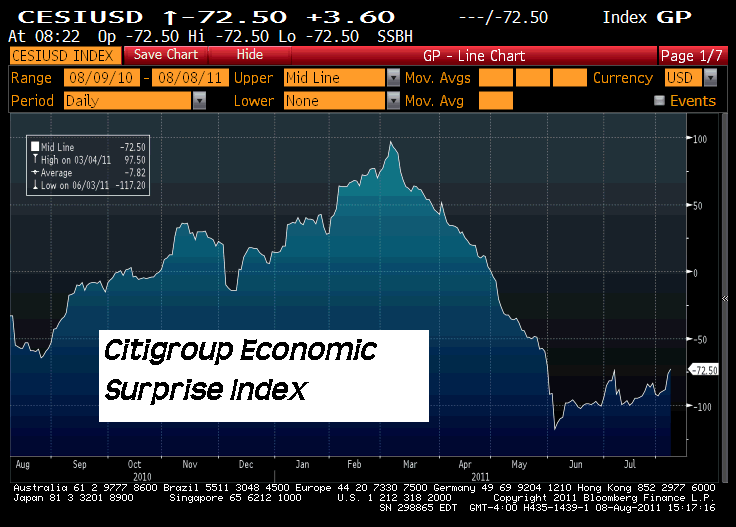
The Recession Trade: Back By Popular Demand

econ_surprise1
(published in Cotizalia on November 12th)This past week I had meetings with investors and funds in Geneva and Zurich and the mood remains sombre.
Europe is increasingly giving worse news, the Super Committee is getting nowhere and investors see the market collapse only to recover a fraction of what it lost.The United States and Europe are in recession. The current uncertainty lies only in the magnitude of such recession. In this environment a group of friends from hedge funds and investment houses have chosen the stocks and assets that, from their point of view, can win in a recession. It is an exercise we did for the first time with a group of 35 professionals in 2001 and repeated in 2008 with very positive and interesting results. Of course, the following list is just an illustrative sample of what a group of experts think.The initial premise of the survey assumes a stagnant economy and rising inflation on the side of commodities because of the monetarist policies of the governments of the OECD. In this environment, we look for companies that have chosen a precise and inflexible approach to increase margins, competitive position and high cash flow, lower costs and greater return on capital. Well, here are the favorites:

The favorites (by number of votes):

Philip Morris . The business is a cash machine, with a captive market and growing in emerging countries and a dividend paid entirely from free cash, with a Return on Equity (ROE) of 242%.

McDonald’s . The fast food giant sales increased by 5-7% in all its markets, opening a restaurant every two days in China with an aim to reach a day in 2012. A business that sells in hard times more units of higher-margin product (cheapest burgers), with a return on equity (ROE) of 40%.

Campbell: Campbell Soups generate strong growth with good quality products and very low price. A Return on equity (ROE) of 76% and almost no debt.

Walmart: A favorite of the last recession, impressive handling of costs and low prices. Generates a return on assets that increased in harsh environments and a return on equity of 22% with $10.6 billion in cash.

McKesson. Solid healthcare favourite, fully oriented to improving profit margins. A 23% Return on Assets and $3.200 billion of cash.

Exxon, accumulating $9 billion in cash, with a return on capital employed of 25% at $70/bbl (compared with 12% of its competitors) and totally inflexible when protecting investors against attacks from governments, which has been especially evident during the Obama administration. Wrongly seen as a value trap by some, this is by far the safest bet in energy for a recession. in Europe, Shell is the favourite due to its outstanding cash-on-cash-returns and discipline in capex, added to low exposure to “value destructing” diversification businesses.

KBR, Halliburton’s former subsidiary generated a lot of criticism from the press for its contracts in Iraq and its military support division. All this is behind us and today it’s a machine of positive returns (19% in a negative environment) and winning contracts despite the economic difficulties of many countries. No debt.

Seadrill: 11% dividend yield and winning contracts at day-rates that come 15-17% above competitors. A safe bet on the tightening deepwater drilling market.

G4S. The British company offers security services, with a return on equity of 20% and good dividend, the business has gotten only better in recent years.

The Spanish:

With the highest number of votes, the only stock in the Top 25 is Inditex . It has better return on capital than Walmart, attractive growth and €3 billion in cash, a business model that has nothing to envy even from Exxon.

Finally, most opt for ETFs in gold, coal and platinum.

The Shorts of this anti-recession portfolio are dominated by the CAC Index (France) for its excessive debt, high weight of problematic banks, strong state intervention in their businesses and risk of infection of the Euro debt crisis. This is followed by environmental services companies (Veolia, etc..) still seeing deterioration in returns, lost margins and increasing debt, plus the European telecommunications companies (Telecom Italia, Deutsche Telecom, France Telecom) that see their returns fall to levels dangerously close to cost of capital, and the equipment sector in renewable energy (solar and wind turbines, Vestas, Gamesa, Solarworld…), which are seeing disappearing subsidies worldwide while the over-capacity eats away returns, working capital requirements increase and growth collapses.

From my point of view, this exercise in choosing the companies that win in a recessionary environment also helps to understand how important it is to have global leaders that focus their strategy to generate better returns on capital employed, not creating overcapacity and that forget the dream of “improving cost of capital” by increasing debt.

Surprisingly the main difference between the stocks ​​mentioned and their European competitors lies both in cash as in returns and margins. And that is fundamentally a strategic and cultural difference regarding the importance of margins and returns, as traditionally Europeans favour “growth for growth sake.”

Hopefully the macroeconomic scenario is different and that everyone who voted is wrong, but I also hope that our companies learn to deal with a recessionary environment, and not only look elsewhere or expect to be rescued.

Note: Daniel Lacalle can invest in the companies mentioned in the blog, the opinions reflected here are personal and not professional recommendations. The above list comes from a survey, and is not a personal recommendation to buy or sell.

China Shale Gas… The New Frontier

china shale gas

China is really pushing its shale gas resource opportunity. And this will likely be another nail in the coffin for renewables in the country.

The NDRC (http://en.ndrc.gov.cn/) has unveiled its strategic plan to explore and develop China’s huge shale resources. The plan sets a very ambitious growth and drilling plan, that will most surely find itself challenged by the lack of infrastructure and the technical issues, but nothing that will not be surmounted with a huge amount of international oil companies’ money and government incentives. What shale gas in China will likely do is have the same devastating effect  on coal and renewable energy growth (as we discussed here in “Has Cheap Gas Killed The Renewable Star?”) as abundant and cheap gas is likely to reduce coal demand and push back the subsidies to wind or solar.

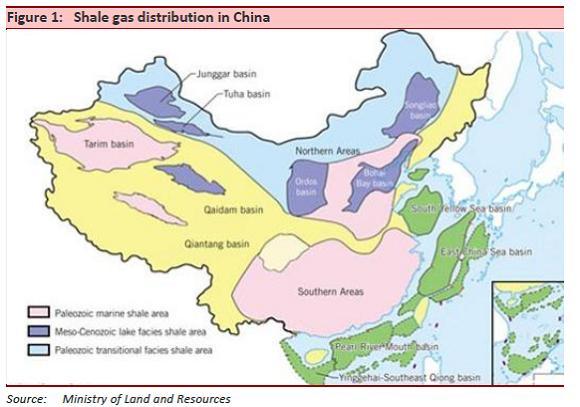
China has the world’s largest shale gas reserves with the potential resources of 134.42TCM and recoverable reserve of 25TCM (exclude Tibet), according to the 12th Five-Year Plan for shale gas. This is mainly distributed in five regions: the south areas, northwest, north, northeast, and Qinghai-Tibet.

china gas demand

Inland shale gas covers an area of 20,000-25,000 sq km, mainly in the Junggar, Tuha, Bohai Bay, Ordos, and Qaidam basins. Sea-land transition shale gas covers an area of 15,000-20,000 sq km in northern China. Marine shale gas underlie 60,000-90,000 sq km in southern China, north China, and the Tarim basin. The south and the northwest have the most favourable reservoir conditions and are the areas of main concentration.
China’s production targets are 6.5BCM/yr by 2015 and  up to100BCM/yr by 2020. The country’s drilling target aims to 200 wells by 2013.
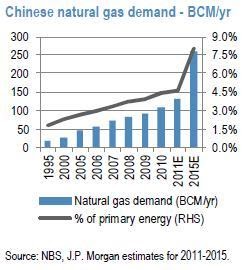
With Chinese gas demand expected by NDRC to reach 260BCM/year, shale gas would not make a massive impact on the country’s imports. Last year, China imported about 12m tonnes of LNG, equivalent to approx. 4.9% of global traded LNG and current estimates suggest that the country will import approx. 50m tonnes per annum by 2015.

However, the demand growth estimates of NDRC look optimistic, as always, and I would expect the figure to stay close to the +2-4% pa level. Even in that case, shale gas would not make a massive impact on imports assuming the 2020 targets as realistic, and in any case, I also find that shale gas production growth targets seem very challenging .

As JPMorgan comments:

Lack of domestic technology for horizontal multi-stage hydraulic fracturing, deep gas deposits with complex geology, and high human population density, contributing to the difficulty of drilling for shale gas and lower economic returns. Significant capital investment and longer lead time to commercial production may result in slower capital recovery, while government incentives are not yet in place. Reserves are in central and west China, far from demand and more pipeline capacity and coverage is needed.

PetroChina so far has completed 11 appraisal wells in four blocks and four discoveries had commercial flow rates, while Sinopec completed five appraisal wells with two having commercial flow rates in three blocks and the most exposed to the resource growth vs capex, CNOOC, started preliminary work related to exploration, while Shaanxi provincial-owned Yanchang Petroleum discovered shale gas in three wells in Yan’an in the province. Agreements for future cooperation have been signed with companies including Statoil, ConocoPhillips, BP, Chevron, and ExxonMobil.
Shell signed a production-sharing contract with China National Petroleum Corp. to explore for and produce shale gas in China. The area covered under the contract is about 3,500 square kilometers in the Fushun-Yongchuan block in the SichuanBasin. Shell is looking to jointly develop more shale-gas resources with CNPC.
The Sichuan Basin has a well-developed network of natural gas pipelines. In 2008, Chevron assumed operation and 49% ownership (CNPC 51%) of the 1,969-km2 Chuandongbei block in the Sichuan Basin. Shell announced it and CNPC had jointly submitted a 30-year PSC application to the government, targeting the 4,000km2 in the Jinqiu region and this block is now under exploration for shale gas. Also, EOG Resources holds a gas PSC in the Sichuan Basin that may also be prospective for shale gas.
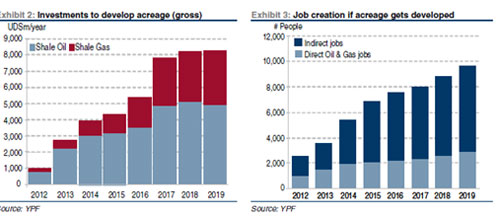
To achieve the 2020 targets, 1,200-1,500 wells will be needed. The cost of wells using domestic technology ranges from US$3.5m for a vertical well to US$7-8m for a horizontal well involving multi-stage fracturing. Just to compare, a horizontal well costs US$3.5-3.8m in the US.
Interestingly, China is also pushing ahead with its support for natural gas vehicles. Westport Innovations announced the introduction of China’s first natural gas engine featuring Westport high pressure direct injection (HPDI) technology. Based on the Weichai Power WP12 engine platform, the 12-litre engine features Westport HPDI technology which maintains the power and performance of the base diesel engine, but allows the replacement of up to 95% of diesel fuel with cleaner burning, less expensive natural gas.
How to play this?
. Equipment manufacturers and service companies, particularly the large US names who will benefit from the massive capex requirements to develop these assets.

. Resource plays: Careful as capex likely to eat away returns for a long time.

Thanks: NDRC, JPMorgan, NSBO

Attack Iran? Is It A Good Idea?

Naval_Update_03-14-12

The picture above shows the recent move of warfare ships in the region (via zerohedge).

According to Israel’s NRG and CNBC, Netanyahu has achieved a majority (8 over 6) supporting an Iran attack. NRG also notes that at this point Israel has decided to not wait until the US elections in November before proceeding with an attack.

I believe Israel is trying to push the US administration and Europe to be more forceful and strong in its sanctions against Iran, but as my friend David Simantob mentioned in my Facebook account:  “I think what we are dealing with is a lot of noise from Israel to push Obama and others to act to isolate Iran. Remember nobody did anything until Israel started threatening to attack. Now we have a EU embargo, Swift (the international financial transaction system) kicking Iran out and soon we may even have an embargo on Iranian imports of refined petroleum. I don’t think Israel wants to attack Iran and I don’t think any attack by Israel will sufficiently delay a nuclear weapons program in that country. What Israel wants and what will work is strict sanctions combined with efforts for regime change in Iran. Iran ruled by sane people like a western democratic movement would not be a threat even if it did have nuclear weapons”.
I would like to highlight a few issues:
a) Iran cannot shut down the strait of Ormuz easily. It would be like shooting itself in the foot as the country would be undersupplied and unable to export, but it would also mean a declaration of war against Oman, as Ormuz is in its waters too, which is equivalent to an attack on Saudi Arabia and the Arab League.
b) The strait of Ormuz only moves 11% of world oil output now, so the impact on crude suppl would be very limited before the alternative route (the horn of Africa) is used by tankers.
c) Iran total oil exports average 2.15mbpd, of which virtually nothing goes to the US, 10% go to Italy, c18% to the rest of Europe, while most Iran’s exports go to Asia (China, Japan, India and South Korea in particular). Spain imports c196kbpd from Iran. France (58kbpd) and Germany (15kbpd) can play hardball with Iran and not bear any real cost. So the EU embargo is not a real issue. The IEA estimates 2011 Iranian crude imports into Europe at 792k bopd (Italy 185k, Spain 196k, Belgium 36k, France 58k, Greece 103k, Germany 15k, Holland 15k).
d) So far in 2012, Saudi Arabia ouput increase has more than compensated the drop of Iran supplies. To the point that OPECsupply is at record highs, while OECD inventories, as we have explained here ( http://energyandmoney.blogspot.co.uk/2012/03/us-talks-of-releasing-strategic.html#) remain at very high levels, so it seems the world has been quietly preparing for a disruption of Iran supplies at least, whether there is conflict or not.

e) Israel is not defenseless, as it has more than two hundred atom bombs that can destroy Iran’s facilities. The issue is that Israel does not want to be bullied and pushed to attack by Iran’s threats and promises to “wipe Israel from the face of the Earth”, and then “blamed” for the deaths of innocent civilians. Iran has carefully placed its nuclear facilities as close to population centres precisely to prevent such a situation. But Israel cannot live easily with the idea of a nuclear-powered country that promotes forums to debunk “the myth of the Holocaust”, and that vows to destroy the jewish country.

Interestingly enough, all the problem would disappear with a moderate Iran and if Ahmadinejad stopped promising the destruction of the jews as a core part of his political agenda.

The problem of an attack on Iran is that it would be extremely costly, around $100m per day, a logistical nightmare, as Azerbaijan will not allow other countries to use its territory to launch an attack on Iran (according to Defence Minister Safar Abiyev) and probably highly ineffective as it would probably cause a popularity surge for Ahmadinejad, which is what we have seen so many times in the past. Former Bush administration National Security Advisor Stephen J. Hadley has already warned against an attack on the Islamic Republic yesterday. “If something needs to be done, it is not military action,” said Hadley. “There’s a wide spectrum between sheer diplomacy and military action.”
On the other side of the analysis, some think an attack on Iran is the “least bad option”, as this article highlights  http://www.foreignaffairs.com/articles/136917/matthew-kroenig/time-to-attack-iran . My concerns remain both on the risk of a surge in support for the Iran regime among muslim countries and also on the threat to the civilian population of Israel, and Iran.
If the issue is to halt the Iran nuclear programme, I believe the way is to impose really strict sanctions as well as promoting a true regime change at the same time, using the threat of an attack to its nuclear facilities as a threat, sort fo a multiple diplomatic attack, but I must say that the proposals I have read so far (here) don’t seem too convincing.
In this article (http://www.haaretz.com/print-edition/opinion/sanctions-alone-won-t-stop-iran-s-nuclear-work-1.265981) the journalist warns against the resignation to an inevitable nuclear Iran:

.The Chinese are still opposed to sanctions and the Iranians are enriching their uranium to a higher level. Obama’s response is that he has had it and the time has come for sanctions and immediately – which means within a few weeks, perhaps by the end of March. In March, however, Gabon will assume the presidency of the Security Council, and it is not certain that Iran is at the top of its agenda. And there are still the problems with the Chinese.
And if we assume that ultimately there will be sanctions, so what? The involvement with sanctions, who’s for and who’s against, when, why and to what extent, deflects from the primary problem – the absence of an American strategy for tough negotiations with Iran. Even more serious, however, is that there are worrying signs that the Obama administration is beginning to resign itself not only to the fact that Iran will continue to enrich uranium, but also to recognition that the Islamic republic could ultimately build a nuclear bomb.

Credit Suisse had an interesting feedback from Dr Mohammed ElBaradei, the recent ex-head of the International Atomic Energy Agency (IAEA – ie the nuclear weapon inspectors) and Noble Peace Prize awardee. His view is that:
  • There is extremely low probability of an Israeli attack on Iran.
  • Iran is still a distance from actually making a nuclear weapon even if they have the technology, as, at the very least, they do not have enough nuclear material and obtaining it will alert the inspectors.
  • He feels the US and Iran ‘probably’ will negotiate directly in Obama’s, potential, second term. The deal would need to allow the Iranian leadership to claim retention of the technology to its population but privately stop the reality of a weapon.
  • Iran has the ability to be extremely disruptive if/when the sanctions bite in Iran, Saudi border, Afghanistan, Palestine, Syria and the UAE – none of the western powers want this.
  • China and Russia do not believe that a military or sanction approach will work and publicly and privately will rebuke them.

Let’s hope there is no attack or any relevant conflict and that Iran allows inspectors to its nuclear facilities while we see a transition to a less aggressive government in the beautiful Persian country.