Category Archives: On the cover

On the cover

Central Banks and the Pyromaniac Firefighter

This week we heard the Governor of the Central Bank of Japan warn that low interest rates are sowing the seeds of the next crisis, which made me think of the pyromaniac fireman term I explore in “Escape from the Central Bank Trap”.

It is, at the very least, hilarious that the governor of the same Central Bank  that already accumulates 55% of Japan’s ETFs and 42% of Japan ‘s debt , in addition to keeping rates at zero for more than fifteen years, talks of low interest rates as if they were a UFO that has fallen unexpectedly from the sky. Who cuts interest rates to unsustainable levels, completely disconnected from the real risk? Central banks themselves.

Of course, there is always someone who will say that central banks cut rates and increase money supply because markets demand it. Oh, please.  It is a fallacy that the governor of the Russian central bank explained in an excellent interview on CNBC … If low rates were requirements from companies and markets to invest more, real productive investment would have skyrocketed in the past 600 rate cuts, and it did not.

What happens is that central banks mistakenly assume that there is a problem of demand and not of overcapacity and they assume a ratio of savings to investment that their teams deem too high because they use a bubble period as base. Central banks end up seeking to perpetuate economic imbalances by blaming the decline in investment on an abnormal behaviour of the private sector.  And it is incorrect. Companies do not invest as much as the bureaucrats would desire -because invest, they do- because there is no need.

Thinking that a group of politicians and academics in a central bank know more about the required rate of investment than the private sector is pure lunacy. They do not have more or better information about the economy than companies putting their money at risk.

In a devastating article, a former member of the Federal Reserve recently warned that systemic risk in the markets has multiplied because of the actions of central banks. The mainstream academics who populate the decision-making bodies of central banks ignore financial risk and do not understand the distortions they create in the market.

That is the problem of the “pyromaniac firefighter” policy of central banks. Its objective is not to avoid a crisis, but to perpetuate the bubbles looking for inflation at any price. For this, they use the excuse of “employment” because if they said their actions aim to”inflate financial asset prices” it would look bad. As if buying bonds created jobs. Stimulating bubbles destroys a lot more jobs than it creates, when they burst. And they do.

All this is irrelevant to central bankers.

Junk bonds at the lowest rates of the past 35 years? No problem,”because there is no inflation”.

Government bond yields at completely unjustified levels compared with the solvency of States? No problem,”because there is no inflation”.

A central bank buys up to 10% of a bankrupt European country’s total debt? No problem, “because there is no inflation.

Bad loans refinanced to infinity? No problem, because “there is no inflation”.

But there is … A huge inflation in financial assets that has generated the largest bond bubble in history.

Now, inflation has arrived… And -oh, surprise- we find that central banks are trapped and cannot stop their policies. The Federal Reserve says that there is uncertainty about Trump’s fiscal policy … Surprising, because the Fed had no “uncertainty” about the wonderful estimated impact of monetary policy, even if they revised their growth expectations lower every year.

Ignoring bubbles is not new. I invite you to search for a single comment from central bank governors warning about the housing or internet bubbles… None. They justify them as a “new paradigm” and continue fuelling the fire.

It is not a coincidence that these mainstream academics mentioned before ignore financial risks while fund managers and real investors identify them. Almost no academic has ever suffered from denying a bubble. And, as Paul Romer showed , there are many perverse incentives to defend any policy adjusting the analysis to the desired result. I recommend you to read the numerous “it would have been worse” papers that appear every time monetary policy fails.

In Europe, at least, we have a president of the ECB who constantly warns that “monetary policy does not work without structural reforms”, but no one listens. Faced with the evidence of multiplying risk, the only thing that mainstream academics can articulate is to recommend carrying out a much more aggressive policy, to generate a government bubble on top of the financial one. As if no one had thought about it before.

The pyromaniac firefighter keeps these bubbles by manipulating the cost and amount of money and, when it fails, the blame – do not doubt it – will be of “the markets”. “Take risk, nothing happens, the central bank supports you” and then “it’s you, you took too much risk.”

The solution? “Solve” it with a few thousand pages of regulation. Sure, the problem is “regulation”, not artificially low rates and financial repression forcing investors to take more risk for lower returns. Sure, the problem is “regulation”, yet the laws in Europe state that lending to governments has no risk. No amount of rules and directives can mask the lunacy of zero interest rate policies and saying that government borrowing has no risk.

Data for December show that, in Europe, there were € 78.2 billion of outflows in debt. Foreign direct investment outflow was €52 billion (according to BNP). The fragile European recovery may suffer a major setback if the monetary laughing gas continues and, above all, if the imbalances that can lead to a major crisis remain. The financial system that was demanding and applauding “expansive policies” now sees in horror that this policy sinks margins and banks’ solvency.

The exit of this huge bubble will not be easy , because central banks believe they have many “tools” to combat deflation and inflation, but they have no clue how to fight stagflation. The pyromaniac who started the fire in the basement, saying that a few flames were not bad because the building was too cold, will now present itself as the fireman to control the disaster. 


Daniel Lacalle. PhD in Economics and author of “Life In The Financial Markets”, “The Energy World Is Flat” (Wiley) and forthcoming “Escape from the Central Bank Trap”.

Image courtesy Google Images

Bond Market and Hyperinflation

Special contribution from Amit Tal:

Something disturbing is happening in the bond markets. It seems to me that the bubble that developed in the last 45 years is coming to an end. This process will likely lead to negative consequences in the form of fast inflation -in the best case- or hyperinflation -in the worst case-. In my opinion, central banks are clueless.

The beginning of the credit bubble happened between 1981 and 1982. We can identify this point in a number of markets: the stock market, bond markets and traded foreign exchange. This bubble has continued over the past 45 years and I really believe that most policy makers and economists know of no other way to manage the economy.

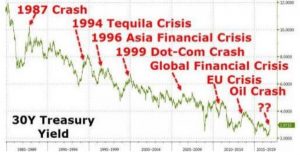
But first, I want to illustrate how the mechanism of credit bubbles works. I will do it with parallels between all economic agents and markets (government, companies, households) and the average citizen. For example, let’s say that a person is interested in taking a loan and when the time comes and he or she has to pay the bank, the person doesn’t have the financial possibility at the moment. The person faces two options: bankruptcy or a bigger loan on more favorable term (lower interest rate). In the past 45 years, all markets have prefered the second option.

If we can understand this mechanism, we can understand this chart: 30y treasury yield. Any increase of interest rates (which could cause the mechanism of credit markets to stop working), caused a crisis in the market. Do these crises suddenly look better from a different perspective? They actually helped prevent the greatest crisis of them all – the explosion of the credit bubble.

Is there a chance that central banks know this and try to do everything in their hands to prevent this explosion? A looki at the bond market proves so.

For me, it looks like the market must have crises to prevent a very high rise in interest rates that would cause an explosion of the big bubble. Have central banks created these crises in recent years: the answer is YES.

So what has changed now?

I think this time it will end differently. Mostly due to the actions of central banks in the last 8 years. Once inflation started to build in the United States, the Federal Reserve wanted to raise interest rates. However, this action will no longer work, and brings more inflation.

How It Works?

US raises interest rates. Money out of other countries (Japan, China, Eurozone) escapes, interest rates of those countries rise, and central banks inject even more money to their bond markets to prevent the explosion of the big bubble. This creates even more inflation. This would require the United States to raise interest rates again. This is a circle that feeds itself. Using interest rates no longer works. I don’t think the Federal Reserve understands this and probably will raise rates in March.

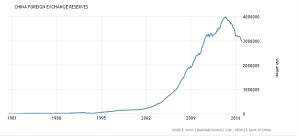
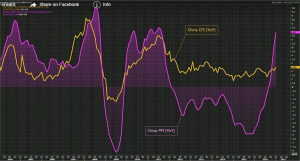
Let’s take China as example. US moves cause it to burn its foreign exchange reserves. The Chinese understand their currency is going to hell, and start to buy any property, creating wild inflation, which requires the United States to raise interest rates again. And it repeats itself.


Fast inflation. Just the beginning. China CPI


This circle is happening in all countries .
 

So is there an alternative?

If the central banks leave the bond market alone, it will complement the shortfall. In other words, lead the way to an explosion of the credit market. 2008 would be a holiday trip compared to what will happen in this case.  I do not think this option is realistic, so the bubble will be fed.

So how to trade in the current situation?

When there is an inflationary situation, the last thing you want is to be out of the market.

It means: Long aggressively on indices (which have risen a lot already, but it’s nothing). But keep an eye on the debt crisis. The US dollar will be the king in this situation.

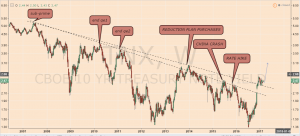
Finally, I would like to share two graphs that help to show the break deviation in the bond market.

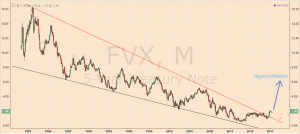
The first chart is 5y treasury yield over ץthe past 45 years. We can say it is breaking a pattern of 45 years. This is just the start.

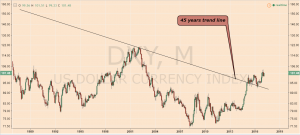
The next chart is DXY. Breaking a pattern of 45 year


Conclusions

I think that the markets have opened the Pandora’s Box. The result can be hyperinflation (if central banks launch new programs), followed by the collapse of the largest bubble in history.

Or we are already heading for an explosion of the biggest bubble in history.


A Special contribution from Amit Tal “The Big Shorts trade”
@amital13

Video: Earnings Season, Europe Risk Rises and Why the German Surplus is not a Negative

In this short video we explain

. Earnings Season: So far, better… But let´s be cautious.
. Europe Risk Rises: French elections and Greece back on the map.
… and Why the German Surplus is not a Negative.

Daniel Lacalle. PhD in Economics and author of “Life In The Financial Markets”, “The Energy World Is Flat” (Wiley) and forthcoming “Escape from the Central Bank Trap”.

Video courtesy Tressis Gestion

The End Of Earnings Recession in Europe?

It seems that the earnings season in Europe is showing us its kind face after more than six years of disappointments and constant downward revisions (read). The earnings recession has been evident in domestic turnover, tax bases and the ability to repay debt, which did not improve in Europe despite the low interest rates – because cash generation was deteriorating more quickly.

According to Morgan Stanley, out of the 75 companies that have reported – although it is only a small part, 15% of the market capitalization – 43% have beaten estimates by 5% or more, while only 29% have disappointed. The rest were”in line” with expectations. So far, these have been the best results of the past 6 years.

Faith in earnings recovery is centered on four pillars:

. Better commodity prices – which helps oil companies and electricity generators -,

. improvement in the performance of banks with more inflation and less provisions,

. upward revisions of global growth

. …and widespread margin improvement.

There are still many results to analyze, but it is worth noting that this recent improvement is promising, albeit not without risks.

– It is true that a little inflation would help the financial sector to get their head above water and breathe a little. Banks are trying their own medicine. They spent years demanding monetary expansion and now they suffer the collapse of margins due to negative real interests. But the European banks’ writedown trend is far from over, and the burden of NPLs (non-performing loans), which exceeds €200 billion, still require a large number of capital increases. The recent results by Deutsche Bank show that the pain is far from over.

– The recent increase in commodities has not generated the positive results that consensus expected in energy. The results of the large European conglomerates are, so far, quite poor, with only one exception, Total, that has been doing its homework for many years.

– We have to pay attention to the negative surprise in the earnings of Consumer Staples, a 7% negative surprise and 5% overall decline, as European growth expectations come mainly from the hope of higher consumption.

Of course, analysts and investment banks are encouraged by the increase in inflation. However, we have to pay more attention to core inflation, since we may encounter a stagflation problem if prices rise due to food and energy while the economy remains anemic.

In any case, we must highlight the good news. If the positive surprise in earnings is maintained until the end of the results season and extended to 2017 guidance, we could be facing the end of the earnings recession, which is an essential factor to believe in a true recovery.

If this profits recession is not reversed in 2017, we could face a much greater problem. Why?

If profits do not start to grow in Europe in 2017, the “tailwind” effect of low interest rates and cheap commodities will dissipate before companies have improved their ability to reduce debt.

European companies can be the positive surprise of 2017 despite the political turmoil and the likely ECB tapering.

Many investors tell me all this does not matter, because European stocks are cheaper than the US market. Let me give a warning. It’s almost always the same. Apart from the fact that the composition of the indices is very different -technology and high added value in the US compared to low-growth banks and conglomerates in Europe-, investors must remember that when US companies have excess cash and liquidity, they buy back shares and increase dividends. European companies, the vast majority, don’t.

We have to follow the earnings trend. It’s tedious and less sexy than talking about political conspiracies, but without an obvious and unquestionable improvement in corporate profits, the European rebound will be nothing but a mirage… again.

Daniel Lacalle. PhD in Economics and author of “Life In The Financial Markets”, “The Energy World Is Flat” (Wiley) and forthcoming “Escape from the Central Bank Trap”.

Graph courtesy Morgan Stanley