Category Archives: Sin categoría

Video: Chinese Bubble Is Exploding In Slow Motion (CNBC)


The China housing bubble was encouraged directly by the authorities. In 2014 the Chinese Central Bank massively reduced restrictions on credit and interest rates. At the same time, the Securities Regulator removed restrictions on real estate developers to raise capital and sell bonds and stocks, sending the market to price increases of 20% a year.

The answer was immediate. In October 2016, the 196 Chinese listed real estate developers more than doubled their debt, from 1.3 trillion Yuan in 2013 to around 3.3 trillion Yuan. Household debt soared from 31% to 41.5% of GDP.  Anyone can see that falling prices and a domino bankruptcies would have a huge impact on secondary markets and large cities. It would be virtually impossible to control the impact.

That said, Chinese debt is mainly denominated in local currency and held in local banks, which leads us to think that the contagion effect to the rest of the world could be low, financially, but not in terms of growth and inflation expectations.

That the Yuan has depreciated against the dollar so much and Chinese exports have fallen shows another of the great problems of the Chinese economy, its low competitiveness and poor added value.

China’s problem is no longer debatable. The brutal increase in debt in 2016 coincides with a strong dollar and a US administration aimed at breaking the huge trade benefit that China has with the US.

If China does not do something really drastic to stop the debt orgy, the problem will be bigger in the medium term. The big dilemma is that the Chinese government seems not only unable to control the debt of semi-state enterprises, but is actually encouraging it via lower interest rates and softer conditions, and that taking measures to stop the housing bubble inevitably leads to a contagion effect. But it clear now that mild measures will not work.

Like all bubbles, which are always generated in assets that are widely considered safe or very low risk. China’s one has been created under the religious belief that the government can control everything because it is an intervened economy. The Chinese risk is not reduced because it has not ‘exploded’ in 2015 or 2016, it is increasing.

Daniel Lacalle is PhD in Economics and author of “Life In The Financial Markets” and “The Energy World Is Flat” (Wiley)

@dlacalle_IA

Video: The EU needs a new paradigm, policy (CNBC)


If EU countries get used to ultra-low rates the risk of multibillion nominal and real losses in bond portfolios and pension funds is enormous, because the tiniest tilt in inflation will make the house of cards collapse. Goldman estimates losses of $2.5 trillion worldwide from a 1% rise in inflation. It is so relevant that if interest rates raised a stunted 1% in the EU it would lead to massive budget cuts to maintain current deficits.

Of course, Draghi does not stop repeating, and he did it again on Thursday, that this period of excessive liquidity must serve to correct imbalances and implement structural reforms. But no one seems to listen. Cheap money calls for cheap action. More “fiscal stimulus” and more spending.

Draghi, knowing that almost no eurozone economy could absorb the rate hikes and increased risk if the repurchase program ended in March 2017, as it was announced, decided on Thursday to extend it until December although “reducing” the pace of purchases. That is, kick the can forward and an optical reduction because tapering from 80 to 60 billion per month is irrelevant when excess liquidity in the system has soared from about $ 125 billion to $ 1 trillion in the QE program period.

With this measure, Draghi seeks to achieve two things: That governments reconsider their positions and put structural measures in place without creating a serious liquidity problem. On the other hand, to help the yield curve reflect a slight rise that helps banks out of the hole  in which they are with negative interest rates.

The problem is that the structural challenges of the European economy -demography and overcapacity- are not solved by perpetuating imbalances because governments and economic agents simply get used to seemingly temporary measures as if they were eternal.

Daniel Lacalle is a PhD economist and author of “Life In The Financial Markets” and “The Energy World Is Flat” (Wiley)

@dlacalle_IA

Daniel Lacalle, the Fund Manager that got the Trump rally right

The Adriza International Opportunities fund has risen by 12% since early November

  • The portfolio includes mostly US companies and defence, healthcare and industrial companies.
  • The pharmaceutical and military industry sectors have boosted this year´s net asset value
By Oscar Giménez Bolsamania

“The world was gloomy and there was no hope before my victory. Now, the market is going up by about 10% and consumers will spend around a trillion dollars at Christmas, “says Donald Trump, who has been riding the Wall Street rally in recent weeks. An opinion shared by Daniel Lacalle, the Fund manager who predicted this wave with Adriza International Opportunities, the fund that he manages at Tressis.

The fund accumulates a rise of 4.5% in 2016.

“The fund is overweight in US securities that are not very typical for the vast majority of managers, with companies that have come to be ignored by analysts,” Tressis’ investment director tells Bolsamanía.

Lacalle insists that they are companies that “both in terms of valuation and business positioning would be very well positioned for a Trump win”. Although “if Clinton had won, we would have made instant changes to the portfolio, with a reduction in weight in the United States. Now, the fund will remain focused on the US economy, “he admits.

The fund has the investment universe all over the world, but 80% of the portfolio is invested in US companies. 10% in the Eurozone, 6% in the United Kingdom and the rest in Asia, according to Morningstar statistics updated as of November 30, and the manager confirms that they have not changed.

The main position of the vehicle is the US health insurance company UnitedHealth , with 7.2% of the portfolio, followed by the group of aerospace and military industry Lockheed Martin , with 6.7%. Its competitors General Dynamics and Orbital ATK , with more than 4%, also have an important weight.

The other major side of the fund is the pharmaceutical sector, with one in five euros invested. In addition to UnitedHealth, the main investment also appears McKesson Corp with 3.7%. The list of stocks that have more exposure are McDonald’s , with 4.25%; the engineering and construction holding company KBR , with 4.1%; And food multinational Campbell Soup, with 3.9%. In all cases, US stocks.

“They are companies that benefit from the expectations that the demand-side policies of Barack Obama will shift to supply-side policies,” says Lacalle. A rotation he believes would necessarily have happened “The United States needs supply-side policies such as tax cuts and private-financed infrastructure spending aimed at the defence industry and capital-intensive sectors , ”  says Lacalle.


“In my micro analysis, Obamacare is going to have to be eliminated or restructured. The change will benefit companies in the sector, which will have more market discipline and competition, lowering premiums”.

The stock selection philosophy used by the Adriza International Opportunities Fund is neither value nor nor growth. According to Lacalle the orientation it is to look for companies in terms of ‘total shareholder return’ (TSR) . “These are stocks that combine respect for the shareholder with a sound balance sheet, that distribute dividends through surpluseswithout resorting to debt or capital increases,” he points out.

Before identifying a stock that fits his vision, he performs a macro analysis to “identify opportunities by sectors, and looking for companies that match our philosophy.” With these criteria, he anticipates that by 2017 he will increase the weight in European consumer companies, although he will remain “underweight Europe, where there are many political risks”.

In addition, he believes the Federal Reserve will take a more aggressive stance next year, with changes in the annual committee rotation (FOMC). “It is urgent that the Fed raises rates and returns to a reasonably appreciated dollar. I expected two hikes in 2016, but they always fall short. In 2017 there will be more hawks in the Fed, which should be supportive for my views”.

Article published in Bolsamania.com in Spanish

Daniel Lacalle is PhD in Economics and author of “Life In The Financial Markets” and “The Energy World Is Flat” (Wiley)


. “

China, Capital Flights and Contagion Risks

“I got a plan. Run away fast as you can “Kanye West

China’s capital outflows have increased 51% since the first months of the year, averaging $ 43 billion in December. In the last twelve months the figure, according to Goldman Sachs, exceeds one trillion, and Natixis estimates the number for 2016 at 900 billion dollars.

China is once again the great challenge for world growth in 2017 and the decisions of the Chinese economic agents themselves show the risk of a huge devaluation, higher than estimated, and an economy that has added more debt so far this year than the US, EU and Japan combined.

The Chinese bubble is exploding in slow motion and it is normal for Chinese companies and savers to expatriate capital – either via acquisitions or directly with deposits – as there is increased likelihood that the Chinese government will decide to solve the huge imbalances of the Chinese economy via financial repression.

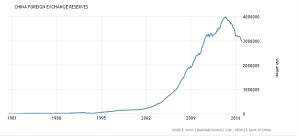
The defenders of the wrong Chinese model always come to two fallacious messages. GDP growth and the country’s huge foreign exchange reserves.

A country that needs four times more debt per unit of GDP growth than eight years ago is clearly unsustainable. And China has already abandoned its “target” to grow by 6.5% in 2017.

By 2016 China’s debt already exceeds 250% of GDP, led by semi-state companies – which count as “private debt” – and the housing bubble. China already spends a third of its GDP on interest payments.

The other reason some use to justify the Chinese imbalances is the huge amount of savings and assets of the Chinese economy. Savings including deposits of 205% of GDP and assets held by Chinese corporations equivalent to 550% of GDP. This argument will sound familiar to the Spaniards, because it was repeated again and again during the bubble of 2007. “The debt of companies and families is not worrisome because it is supported by assets that can be sold to reduce debt “.

There are only three problems.

  • The price paid by these companies for the assets has been absolutely disproportionate with their current value, making acquisitions at inconceivable multiples that today would entail enormous write-downs.
  • Second, the vast majority of the assets of the semi-state enterprises – responsible for much of the increase in indebtedness – are simply unsaleable in the face of a Chinese slowdown and unstoppable devaluation.
  • And third, the debts associated with the real estate bubble becomes unpayable when the asset falls, because the ability to sell these properties is very low.

When some say that the vast majority of outflows of capital are for acquisitions and, therefore, it is a good move, another reality is disguised. Many companies will make any acquisition at any price and in any sector to reduce exposure to the Chinese bubble.

The China housing bubble was encouraged directly by the authorities. In 2014 the Chinese Central Bank massively reduced restrictions on credit and interest rates. At the same time, the Securities Regulator removed restrictions on real estate developers to raise capital and sell bonds and stocks, sending the market to price increases of 20% a year.

The answer was immediate. In October 2016, the 196 Chinese listed real estate developers more than doubled their debt, from 1.3 trillion Yuan in 2013 to around 3.3 trillion Yuan. Household debt soared from 31% to 41.5% of GDP.  Anyone can see that falling prices and a domino bankruptcies would have a huge impact on secondary markets and large cities. It would be virtually impossible to control the impact.

That said, Chinese debt is mainly denominated in local currency and held in local banks, which leads us to think that the contagion effect to the rest of the world could be low, financially, but not in terms of growth and inflation expectations.

That the Yuan has depreciated against the dollar so much and Chinese exports have fallen shows another of the great problems of the Chinese economy, its low competitiveness and poor added value.

China’s problem is no longer debatable. The brutal increase in debt in 2016 coincides with a strong dollar and a US administration aimed at breaking the huge trade benefit that China has with the US.

If China does not do something really drastic to stop the debt orgy, the problem will be bigger in the medium term. The big dilemma is that the Chinese government seems not only unable to control the debt of semi-state enterprises, but is actually encouraging it via lower interest rates and softer conditions, and that taking measures to stop the housing bubble inevitably leads to a contagion effect. But it clear now that mild measures will not work.

Like all bubbles, which are always generated in assets that are widely considered safe or very low risk. China’s one has been created under the religious belief that the government can control everything because it is an intervened economy. The Chinese risk is not reduced because it has not ‘exploded’ in 2015 or 2016, it is increasing.

Daniel Lacalle is PhD in Economics and author of “Life In The Financial Markets” and “The Energy World Is Flat” (Wiley)

Chart courtesy Morgan Stanley

Article published in Spanish in El Español