“Escape from the Central Bank Trap” out now

Escape from the Central Bank Trap. 

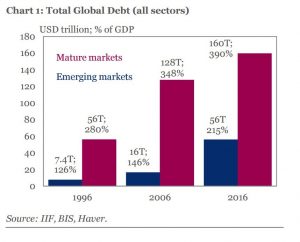
How to Escape From the $20 Trillion Monetary Expansion Unharmed
Daniel Lacalle

Available NOW:

“The central bank trap is clearly anything but an easy one to get out of.” “In addition to structural reforms to promote lower government spending and higher efficiency, Lacalle recommends tax cuts to let households and SMEs thrive”.

Continue reading “Escape from the Central Bank Trap” out now

Tesla vs GM. Value or Bubble?

Surely you have read the headlines. “Tesla is worth more than Ford,” “Tesla surpasses General Motors in market value”. The question is, are we in front of a bubble or a reality? A little of both.

Let’s start with the reality. The electric car, as we explained in ” The Energy World Is Flat” (Wiley) is an unstoppable alternative and part of the process of flattening the world of energy and using less oil. There is no doubt that the future of transportation will come from a combination of electric, alternative and hybrid vehicles.

Global electric vehicle sales totaled 222,000 units in 2016, and growth – while positive – has proven to be well below the overly optimistic market estimates. How does this affect Tesla?

Let us forget arguments like “it’s a good company”, “it’s a new paradigm” or “it grows a lot” and go to the data.

Tesla has sold, in 2016, about 77,000 vehicles. To give you an idea, the Renault-Nissan Alliance alliance  sold more than 94,000 electric cars.

Tesla’s revenues are around $ 7 billion, which means it trades at more than 6.5 times sales, and an enterprise value of eight times its sales, 164 times its EBITDA (Earnings before Interest, Tax, Depreciation and Amortization). That is, it discounts that sales and profits will multiply exponentially without resorting to more debt or sell new shares.

In 2016, Tesla reported a loss of $725 million, and has only recorded two quarters of clean positive results. Along the way, it has carried out capital increases and convertible bond issuances at almost $ 1 billion a year, increasing its debt to 12.3 times its EBITDA. Tesla does not pay dividends, of course. All in its valuation comes from expectations of growth.

If we compare it with General Motors, revenue is about $166 billion, which means that it trades at about 0.3 times sales (enterprise value is 0.24 times sales, since it has no debt, and 1.9 times its EBITDA). A net positive result of $9.9 billion, and a dividend yield of 4.4%.

General Motors generates $7.3 billion in free cash flow, a Free Cash Flow Yield of 13.3%. Tesla consumes $1 billion of cash a quarter, and its working capital requirements lead to the increased debt.

Since all the difference between one and the other come from estimates of the future, we must analyze what that future costs and its probability.

The reality is that the race for the electric cars market is not a matter of innovation or ideology, but of the ability to manufacture and sell them massively, in addition to offering them at a competitive price.

If our analysis is who will reach one million electric vehicles sold and what is needed to achieve it, we will not be surprised to see that Tesla will need at least three further capital increases similar to those already made, or a disproportionate increase in debt. As its shares are at historic highs, the best way to finance Tesla’s growth will be issuing new equity. You can, therefore, expect that demand for new shares to be greater or not.

The reality is that the investment to reach that same million electric vehicles in General Motors does not suppose neither an increase of debt nor impact in its dividend or a significant reduction in its enormous free cash flow. Of course, with more than nine million cars sold, General Motors has a manufacturing, development, sales and after-sales network that is already operational and can be adapted to new technologies with very little investment. In the case of Renault-Nissan, also with more than nine million cars sold, the burden to reach massive electric car sales is also very low. Therefore, the technological or innovation premium may seems exaggerated in Tesla while it is discounted at zero in its competitors. Interesting, because that “premium” needs capital, a lot, to become tangible sales.

The most optimistic estimates of investment in capacity for Tesla are $5 billion over the next few years, and others exceed $8 billion, which will continue to burn cash.

Many expect Tesla will be sold to one of those conglomerates that deserve to trade at such low multiples. What investors should analyze is whether that acquisition will be made before or after the day of reckoning. Betting on the “greater fool” theory is always dangerous.

Make no mistake. Tesla surely deserves a premium to the sector, just as any focused, innovative company deserves higher multiples than integrated conglomerates. The question is, what premium? And how much will it cost investors in capital increases?

The achievement of its objectives, to justify such multiples, may require almost 20% of its market capitalization in new equity, and estimates a 100% success rate.

We are faced with a case where the market seems to discount the perfect future in a stock that, moreover, has neither the cash nor the balance sheet to undertake it, while the markets values negatively that same business in its established incumbent competitors, which can massively develop electric vehicles without blinking.

No, it’s not the same as Apple or Amazon, Netflix or Google. Tesla’s multiples need, anyway you look at it, a massive capital investment to turn the idea into reality. Another completely different thing is whether shareholders accept such risk. While other technology companies have a much higher return on capital employed, their investment needs are much lower to get the estimated sales into reality. One thing is technology and another, cars.

Tesla’s shares can continue to rise, of course. Euphoria and fear are essential market factors. But what investors must analyze is whether the euphoria discounts a perfect scenario, and whether the market is willing to participate in the following capital increases and dilutions that are necessary to undertake the expansion of the company.

If it is a credible scenario, it is worth that Tesla uses the current environment to clear the balance sheet concerns. Working capital can be a big risk.

In investment it is essential to differentiate technology from business model, and not fall into quasi-religious faith arguments when it comes to buying a stock.

Do you remember the solar stocks trading at a premium on future installations? Hundreds of bankruptcies later, the mirage has dissipated. And what about the wind manufacturers and developers discounting the “pipeline“of estimated projects? Gone. Do you remember the valuations of technology stocks discounting earnings on future emails? Goodbye.

The bankruptcy of ‘bubbles’ in solar, technology, financials, oil and gas or wind has always been due to two common factors. Excess debt and impossible expectations.

We have to be careful not to confuse a technology and its support, from an emotional or ideological point of view, with a stock and a business model.

Tesla is and should be smarter than all of its competitors and use its valuation to strengthen its balance sheet. I would love to see them succeed, not defend a bubble.


Daniel Lacalle is a PhD in Economics, fund manager and author of Life In The Financial Markets, The Energy World Is Flat (Wiley) and Escape from the Central Bank Trap (BEP).

Image courtesy Google Images

The Fed vs the ECB. A Risky Bet Against the Curve

Last week, the Federal Reserve announced three rate hikes in 2017, and another three in 2018, with a $600 billion reduction in its balance sheet ($420 billion in treasuries and $ 180 billion in mortgage-backed assets).

The announcement has sparked the concern of inflationists and bubble defenders. A downsizing of the Federal Reserve’s balance sheet! Anathema. As if it had not risen from $900 billion to the terrifying figure of $4.5 trillion, and mainstream analysts are worried about a small decrease. None of them seem to worry about the huge bubble in bonds nor the excess of risk taken looking for a little yield.

Mainstream is so concerned that they have invented a direct correlation of the size of the Fed’s balance sheet to warn of a massive crash in the markets… Except it does not happen. Rates are rising, the dollar is strengthening, the Fed’s balance sheet is shrinking… and stocks are soaring.

Stocks soar because earnings are better, leading indicators improve and financial conditions strengthen, not only because of money supply. Quantitative easing generated inflation on financial assets, while dividends and buybacks created multiple expansion, and now earnings are back to the rescue.

What consensus is worried about is that, between 2017 and 2018, the composition of members of the Federal Reserve will change to a majority that defends sound money, that is, to end the assault on savers and the middle class that QE meant. In the past eight years, fiscal policy in the US has meant an increase in taxes of $ 1.5 trillion and destroyed a similar figure in the value and purchasing power of the main source of wealth of the United States citizen: deposits. The largest transfer of middle-class wealth to the government seen in over fifty years.


The Federal Reserve is already almost 300 basis points behind the curve. It should to have raised rates much faster.

Meanwhile, in Europe, the ECB is not just behind the curve. It is so far away it does not see the curve.

If the ECB continues with its monetary policy while normalization accelerates in the US, the vacuum effect will multiply.

What is the “vacuum effect”? The world’s US dollar supply shrinks as demand for the currency soars, generating capital outflows in countries that are not a global reserve currency and into the US. This vacuum effect, added to the repatriation of dollars from US companies, is a major risk for the European Union. With more than 1.3 trillion euros of excess liquidity in the ECB, the EU would face the opposite scenario. Supply of euros massively exceeds demand.

Some will say it is an opportunity to export more. It just does not happen. European exports outside of the Euro Zone have stalled since the ECB started its quantitative easing program. But what does happen is that international confidence in risky assets denominated in euros diminishes. If it also coincides with a deterioration of solvency indicators – deficit, net issues, interest payments over GDP – this deterioration in confidence can generate a significant risk that, today, few are analysing.

We must remember that the vast majority of global trade transactions are made in US dollar (87.6%, according to the BIS).

Contrary to what many people think, the percentage of global transactions in US dollars is not only high, but has recently risen. In the same period, since 2008, transactions in euros have fallen eight points. It is no coincidence that this collapse in the use of the euro in global transactions, accelerated with the so-called “monetary expansion”.

As we mentioned, the euro risks losing relevance in global trade, and the alleged “export-effect” is inexistent. If the United States finally puts the policy of defending sound money and the savings of its citizens as the center of its policy, it can create enormous uncertainties for a euro that is now used in fewer transactions globally.

You will say that the US cannot survive a strong dollar, but we already dismantled that argument here (“Is the US dollar the new gold?”).

Almost all governments and parliaments in European countries are seized by the single thought the Japan-style futile policy of negative real rates and excess liquidity must continue, despite evidence of the risks it generates, but Japan has huge savings in foreign currency and an enviable financial inflow. The European Union, does not.

If the ECB resists raising rates, when it is an emergency, and reducing asset repurchases, when it has 1.3 billion euros of excessive liquidity, there could be significant risks in a global economy where the euro is an anecdote. If this is a risk with a strong currency, backed by economic powerhouses, imagine what would happen with unsupported currencies, as the European populists want. A disaster.

If we forget the need to strengthen economies before monetary excess ends, the negative consequences will be serious. Of course, when a new crisis arises, some will blame lack of regulation, not reckless policy.

Daniel Lacalle is a PhD in Economics, fund manager and author of Life In The Financial Markets, The Energy World Is Flat (Wiley) and Escape from the Central Bank Trap (BEP).

Image courtesy Google Images

Euro Zone Banks. Value or Value Trap?

“I check my bank account more than you check your Instagram” Kid Ink

Is the recent rally of European banks an opportunity or a trap? A minority investor told me on Friday that “every time I buy banks, they are going up, but then I lose everything.” He did not understand the volatility and risk , especially when the press would not stop talking about banks “healthy” balance sheets and adequate results.

Let’s start with a general consideration. No, European banks are not fully cleaned up. They continue to accumulate more than 900 billion euros of non-performing loans (NPLs), and generate a return on net assets below their cost of capital. That is, they lose money.

It is true that valuations are not exaggerated, at 0.8 times price to adjusted book value, which is not expensive if you estimate a 9.9% ROTE (return on tangible assets) in 2017 and a dividend yield of 5.4%. The question is whether that ROTE and yield is achievable or sustainable.

European banks are trading at almost a 40% PE discount to US banks, but this discount is justified by the high exposure to European sovereign risk, the burden of NPLs and the very low profitability (Net Income margin is almost zero). In fact, the mistake investors make when talking about “value” with respect to US banking may lead to losses, because that discount has existed since 2001 and has moved close to an average of 20-30%, justified by lower profitability, less flexibility and the valuation of their loans with debatable criteria (instead of valuing them at market-to-market).

But there are positive elements as well as caution. The excess liquidity is at record levels since the European Central Bank Quantitative Easing started, and already reaches 1.3 trillion euros, showing the weakness of the program and its low effectiveness. Negative interest rates have sunk banking profits, with historic declines in consensus estimates. But that monetary ruin is about to end.

Rates are already rising and that means that an increase of 1% can improve EPS of banks by up to 17% , according to the average consensus sensitivities (Bloomberg).

60% of European banks now have more than twice the core capital than in 2012, which means that they are much more healthy, although the problems are not over. In addition, European banks have more than double the amount of short-term liquid assets than in 2012, which can be used for divestments and to undertake capital strengthening.

Today, deposit rates are negative and that is devastating for the financial sector. A higher deposit rate would improve the spread, and this is particularly beneficial for banks in peripheral countries. According to Morgan Stanley, a rise of 70 basis points in the deposit rate would raise the earnings per share of peripheral banks by more than + 15%. Interest rates would remain extremely low, so the impact on the economy would be non-existent, but financial repression would not jeopardize the sustainability of the banks.

Risks should not be ignored.

Today, banks are rallying due to different factors. The positioning of investors is extremely cautious and underweight in the financial sector and even more so in Europe, which can lead to significant capital flows to banks when that negative weighting is reduced in the portfolios.

The banks’ rally is based on a bet on an increase in inflation that may disappoint those who play to it now that oil remains in a lateral-bearish trend and underlying inflation expectations are not being revised upward.

In addition, this rally in banks is supported by another non-fundamental external expectation. The bet that the European Central Bank will aggressively change its monetary policy. All the indicators tell us that it should, that it is urgent and that maintaining it does more harm than good, but we must not forget the risk of maintaining financial repression and real negative rates because European governments are unable to tolerate on increase in cost of debt of 50 basis points. It is important, at least, to know that the rally in the stock market is explained by an inflationary bet and increases in rates in addition to the supposed cheap valuation (banks are always “optically cheap”). Because that “reflation trade” can reverse very quickly.

Let’s not forget another factor. With higher rates and inflation, non-performing loans rise as well, as companies continue to suffer from overcapacity and tax increases.

Banks demanded the ECB’s monetary expansion program, until they realized in horror that negative rates shattered their balance sheet and income statement. The monetary expansion that they applauded until their hands bled almost sent them to the cemetery.

It is not wrong to say that the banking system is much healthier than it was four years ago . Nor is it a lie to say that its structure of balance sheet and profitability is extremely fragile, and that its core capital ratios can evaporate with a small change of the cycle. Therefore, to assume that the era of  huge provisions is over is to be very optimistic. To think that there are no additional capital needs is reckless.

The combination of valuation, improvement of the cycle in Europe, change of monetary policy and return to a certain sanity with interest rates are factors that put banks’ head above water.

As a good friend, investor in the financial sector, once told me “you do not buy banks, you rent them”. Cycles are getting shorter and the challenges of the financial sector are not over, so active trading is recommended.

Daniel Lacalle is a PhD in Economics, fund manager and author of Life In The Financial Markets, The Energy World Is Flat (Wiley) and Escape from the Central Bank Trap (BEP).

Image courtesy Google Images, starecat.com