China, Capital Flights and Contagion Risks

“I got a plan. Run away fast as you can “Kanye West

China’s capital outflows have increased 51% since the first months of the year, averaging $ 43 billion in December. In the last twelve months the figure, according to Goldman Sachs, exceeds one trillion, and Natixis estimates the number for 2016 at 900 billion dollars.

China is once again the great challenge for world growth in 2017 and the decisions of the Chinese economic agents themselves show the risk of a huge devaluation, higher than estimated, and an economy that has added more debt so far this year than the US, EU and Japan combined.

The Chinese bubble is exploding in slow motion and it is normal for Chinese companies and savers to expatriate capital – either via acquisitions or directly with deposits – as there is increased likelihood that the Chinese government will decide to solve the huge imbalances of the Chinese economy via financial repression.

The defenders of the wrong Chinese model always come to two fallacious messages. GDP growth and the country’s huge foreign exchange reserves.

A country that needs four times more debt per unit of GDP growth than eight years ago is clearly unsustainable. And China has already abandoned its “target” to grow by 6.5% in 2017.

By 2016 China’s debt already exceeds 250% of GDP, led by semi-state companies – which count as “private debt” – and the housing bubble. China already spends a third of its GDP on interest payments.

The other reason some use to justify the Chinese imbalances is the huge amount of savings and assets of the Chinese economy. Savings including deposits of 205% of GDP and assets held by Chinese corporations equivalent to 550% of GDP. This argument will sound familiar to the Spaniards, because it was repeated again and again during the bubble of 2007. “The debt of companies and families is not worrisome because it is supported by assets that can be sold to reduce debt “.

There are only three problems.

  • The price paid by these companies for the assets has been absolutely disproportionate with their current value, making acquisitions at inconceivable multiples that today would entail enormous write-downs.
  • Second, the vast majority of the assets of the semi-state enterprises – responsible for much of the increase in indebtedness – are simply unsaleable in the face of a Chinese slowdown and unstoppable devaluation.
  • And third, the debts associated with the real estate bubble becomes unpayable when the asset falls, because the ability to sell these properties is very low.

When some say that the vast majority of outflows of capital are for acquisitions and, therefore, it is a good move, another reality is disguised. Many companies will make any acquisition at any price and in any sector to reduce exposure to the Chinese bubble.

The China housing bubble was encouraged directly by the authorities. In 2014 the Chinese Central Bank massively reduced restrictions on credit and interest rates. At the same time, the Securities Regulator removed restrictions on real estate developers to raise capital and sell bonds and stocks, sending the market to price increases of 20% a year.

The answer was immediate. In October 2016, the 196 Chinese listed real estate developers more than doubled their debt, from 1.3 trillion Yuan in 2013 to around 3.3 trillion Yuan. Household debt soared from 31% to 41.5% of GDP.  Anyone can see that falling prices and a domino bankruptcies would have a huge impact on secondary markets and large cities. It would be virtually impossible to control the impact.

That said, Chinese debt is mainly denominated in local currency and held in local banks, which leads us to think that the contagion effect to the rest of the world could be low, financially, but not in terms of growth and inflation expectations.

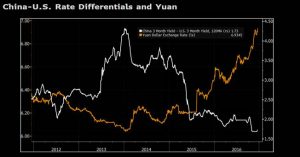
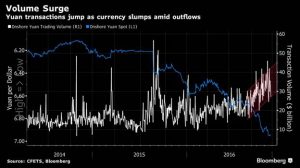
That the Yuan has depreciated against the dollar so much and Chinese exports have fallen shows another of the great problems of the Chinese economy, its low competitiveness and poor added value.

China’s problem is no longer debatable. The brutal increase in debt in 2016 coincides with a strong dollar and a US administration aimed at breaking the huge trade benefit that China has with the US.

If China does not do something really drastic to stop the debt orgy, the problem will be bigger in the medium term. The big dilemma is that the Chinese government seems not only unable to control the debt of semi-state enterprises, but is actually encouraging it via lower interest rates and softer conditions, and that taking measures to stop the housing bubble inevitably leads to a contagion effect. But it clear now that mild measures will not work.

Like all bubbles, which are always generated in assets that are widely considered safe or very low risk. China’s one has been created under the religious belief that the government can control everything because it is an intervened economy. The Chinese risk is not reduced because it has not ‘exploded’ in 2015 or 2016, it is increasing.

Daniel Lacalle is PhD in Economics and author of “Life In The Financial Markets” and “The Energy World Is Flat” (Wiley)

Chart courtesy Morgan Stanley

Article published in Spanish in El Español

Japan´s Budget Highlights Abenomics Failure

Let me tell you a story to chill the bones About a thing That I saw ” Janick Gers Steve Harris

Japan has just published its budget and is on its way to another year of pauper growth and high debt. The estimates of the Government and the Bank of Japan appear, again, overly optimistic.

Japan should matter to all of us. Because it is an example of what we should not do in the rest of the world, after two decades of stagnation and repeating stimulus after stimulus.

The Economist places Japan again among the 20 economies with lowest growth for 2017, and estimates 0.5% GDP growth per year between 2017 and 2021.

This budget is yet another example of Abenomics as a total failure. The plan launched by PM Shenzo Abe to boost growth and fight deflation has delivered, as expected, the poorest results imaginable.

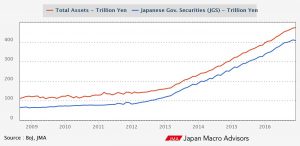
The first problem of the budget is the enormous debt. Revenues cover about 60% of the expenses in the budget. The rest will be financed by issuing more debt, which already exceeds 229% of GDP. Neo-Keynesians who repeat that we should not care “because rates are low” ignore that almost 20% of the budget goes to interest payments even though Japan´s cost of debt is very low (today the 10-year bond is c0.10 %). However, it is dangerous to ignore that the Bank of Japan will “eat” the vast majority of those bonds , and now accumulates more than 35% of the bonds issued by the Government as well as owning the largest share of ETFs in the country. The central bank of Japan is on the path to being the largest shareholder of 55 companies in the Nikkei by end of 2017 and is already one of the top five shareholders in 81 . Seriously, this is as close to a pyramid scheme as one can imagine.

The published budget shows the demographic time bomb facing the country, one that Europe should learn … A rapidly aging population is not solved by monetary laughing gas. More than 40% of the budget goes to pensions and health care.

But above all, monetary policy and government stimulus does not guarantee pensions, which will be cut again in 2017-2018 due to the unsustainability of the system. This should be yet another warning sign to those who say pensions are guaranteed by raising taxes and monetary policy. It does not even happen in Japan.

Of course Japan has a low unemployment, but it has always been that way. And the combination of an ageing population and cultural challenges for immigration keep the work force tight. However, Social Security contributions fail to cover even a portion of the expenditure in public pensions. Additionally, at 36%, Japan has one of the lowest replacement rates in the world (the percentage of the last salary paid as public pension).

And that is the big problem, we try to solve with monetary measures the impact of much more relevant trends, such as demographics. Increasing taxes and disguising the problem, introducing massive useless stimulus plans   only postpones the inevitable.

Some might say “who cares” because there is no inflation. However, real wages in Japan are at a two-decade low and  disposable income continues to erode . The only real beneficiary of Japan’s monetary mirage – which is a slow robbery of the saver under the false pretence of the “social contract” – is the Government, which keeps increasing debt without addressing structural reforms, and the challenges of productivity and “special interests”.

We should see Japan as a warning sign, because in the EU we are copying the same mistakes but without Japan´s labour discipline and technology.

@dlacalle_IA

Daniel Lacalle is PhD in Economics and author of “Life In The Financial Markets” and “The Energy World Is Flat” (Wiley)

Chart courtesy Japan Macro Advisors

Article published in Spanish in El Español
Why does Trump want more nuclear capability?

“The United States must greatly strengthen and expand its nuclear capability until such time as the world comes to its senses regarding nukes” Donald J Trump

This tweet from President Elect Trump has caused quite a controversy today. Let´s see the facts and reasons behind it.

Nine countries in the world hold a total of 15,375 nuclear weapons. The United States and Russia account for 93 percent of them.

Russia 7,300
USA 6,970
France 300
China 260
UK 215
Pakistan 130
India 120
Israel 80
North Korea 15

So Donald Trump´s message about more nuclear capabilities might sound strange considering the sheer power of the US military. However, there is a reason. If we put together US and Israel as allies and we look at the nuclear programs of other nations, the deterrence factor that the US stockpile represents is diminishing in a world where terror is spreading and China and Iran are under no circumstance transparent about the purpose of their nuclear programs. The size of the stockpile might be insufficient as a defence and deterrence mechanism. We explained here the dangers of the Obama agreement with Iran (read).

But there is another reason. The separation between nuclear for electricity needs and defence ones is too thin. And in the world there are 437 nuclear reactors operating , with another 66 are under construction, mainly in Asia .

Take for example China’s decision to double its nuclear capacity to 23GW more and plans to build another 50GW as part of their search for leadership in nuclear technology. But Russia is following on the same path.

Apart from the 66 nuclear reactors under construction, the world plans to build another 166 , China, India, Russia, the US, and Middle East countries are among the major promoters.

If we add the nuclear capacity planned for the next ten years, there is a relevant risk to the world stability because US potential enemies could increase the stockpile of nuclear weapons at light speed.

Iran, for example, will keep 6,104 IR-1 centrifuges for 10 years, but the Minister for Foreign Affairs, Javad Zarif, has confirmed that Tehran will use their (IR-8) next-generation centrifuges, which enrich uranium up to 20 times faster than the current IR-1s.

The former Director of the CIA Michael Morell and a whole group of geopolitical analysts have warned of the error that the Obama administration made basing the Iran agreement on the number of centrifuges. “5,000 centrifugues is more than enough to build nuclear weapons, but not for an energy programme”.
According to the International Atomic Energy Agency, a nuclear bomb only needs 25 kilograms of enriched uranium U-235. And although it is more difficult to produce 90% enriched uranium, it is not much more complex than the 4-5% uranium required to generate electricity.

The US, which has been lagging in terms of nuclear technology compared to countries such as France, therefore, needs to step up and take action to lead the technology development, both for energy and defence requirements. And make the deterrence factor stronger.

So Trump´s message is both a warning to other nations and an action plan. Unless other countries quickly change their nuclear development plans and accelerate decommissioning, the US will likely expand its defence system. At the end of the day, as Vegetious stated in the Roman times “If you want peace, you need to be prepared for war”.


Daniel Lacalle is a PhD in Economics, and author of The Life In The Financial Markets and The Energy World Is Flat (Wiley)