All posts by Daniel Lacalle

About Daniel Lacalle

Daniel Lacalle (Madrid, 1967). PhD Economist and Fund Manager. Author of bestsellers "Life In The Financial Markets" and "The Energy World Is Flat" as well as "Escape From the Central Bank Trap". Daniel Lacalle (Madrid, 1967). PhD Economist and Fund Manager. Frequent collaborator with CNBC, Bloomberg, CNN, Hedgeye, Epoch Times, Mises Institute, BBN Times, Wall Street Journal, El Español, A3 Media and 13TV. Holds the CIIA (Certified International Investment Analyst) and masters in Economic Investigation and IESE.

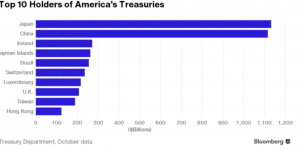
Who Owns the US debt? No, not China. Not even close

US total debt is $19.9 trillion. China owns c$1.1 trillion. Nowhere close to being “the largest holder of Treasuries”, not even the largest foreign holder -that would be Japan-, and far from being “a threat”.

In fact, the US and foreign mutual funds would absorb the entire Chinese holdings in three days. China has reduced its holdings by $41.3 billion in 2016, the lowest level since 2010, with no discernible impact on the market and demand for Treasuries.

Here’s the detailed breakdown (source, as of December 31, 2016).

  • Social Security (Social Security Trust Fund and Federal Disability Insurance Trust Fund) – $2.801 trillion
  • Office of Personnel Management Retirement – $888 billion
  • Military Retirement Fund – $670 billion
  • Medicare (Federal Hospital Insurance Trust Fund, Federal Supplementary Medical Insurance Trust Fund) – $294 billion
  • All Other Retirement Funds – $304 billion
  • Cash on Hand to Fund Federal Government Operations – $580 billion. (Source: Treasury Bulletin, Monthly Treasury Statement, Table 6. Schedule D-Investments of Federal Government Accounts in Federal Securities, December 2016)
  • Foreign – $6.281 trillion (of which Japan, $1.13 trillion, and China, $1.1 trillion)
  • Federal Reserve – $2.463 trillion
  • Mutual Funds – $1.379 trillion
  • State and Local Government, including their pension funds – $874 billion
  • Private Pension Funds – $544 billion
  • Banks – $570 billion
  • Insurance Companies – $304 billion
  • U.S. Savings Bonds – $169 billion
  • Other (individuals, government-sponsored enterprises, brokers and dealers, bank personal trusts and estates, corporate and non-corporate businesses, and other investors) – $1.349 trillion. (Sources: Federal Reserve, Factors Affecting Reserve Balance, January 18, 2017. Treasury Bulletin, Ownership of Federal Securities, Table OFS-2, as of June 2016.)


China is NOT the largest holder of US debt, not even by a mile. It is not even the largest foreign holder (read).

Meanwhile, foreign institutions’ holdings of China government bonds fell 1.9bn yuan in January to 421.75bn, according to data from China Central Depository & Clearing Co. The first drop since October 2015. However, foreign investors had increased their stakes in China’s government bonds by 70 percent in 2016, bringing the total to the current 421.7 billion yuan.

Daniel Lacalle is PhD in Economics and author of “Life In The Financial Markets”, “The Energy World Is Flat” (Wiley) and forthcoming “Escape from the Central Bank Trap”.

Graph courtesy Bloomberg. Sources thebalance.com, Bloomberg

France. Europe’s biggest problem… and its solution

Forget about Brexit or Trump. The big problem that threatens the European Union is France.

The French elections are much more important to the future of the EU than any other global geopolitical event.

On Monday we will know in detail the economic programs of the main candidates, but unfortunately, we can imagine that most promises will come on the side of increasing imbalances and magic solutions. Announcing reforms that are not followed and continue with an unsustainable model of stagnation has become the norm.

Of course, Le Pen promises to get out of the Euro in an orderly fashion, which is like saying that you’re going to stab yourself gently. A joke. Proponents of populism always try to solve structural problems destroying the country, devaluing and decimating the middle class with rampant inflation.

France is both the big problem and the solution for Europe.  An unsustainable economic model that presidential candidate Macron himself has called “sclerotic“.

A huge part of the problem is a public sector that exceeds 22% of the workforce and accounts for almost 48% of the budget, with one of the largest public expenditures of the OECD – the seventh largest in the world. But that would not be a problem if the country grew and improved its international position. The serious mistake is that this model of “directed economy”, socialist no matter who wins, has led to stagnation for more than two decades, high debt and excessive deficits for a leading economy and, in addition, France has been losing positions relative to Germany, its main comparable.

The other challenge is that, in order to finance this huge public expenditure, it always raises taxes, with a tax burden that is the highest in the Eurozone. A labour market rigidity and tax burden that limits growth, business creation, employment and competitiveness.

Despite constant tax increases, the country continues to miss its deficit targets because the economy, after a few brief quarters of hope, falls again and again into stagnation.

France has not only seen its exports lose weight globally, but its neighbour Germany reach a record historical trade surplus while reducing unemployment to all-time lows. That is, almost full employment.

The worst is that the massive labour rigidity does not protect,  and youth unemployment remains above 24%, France’s unemployment rate is double that of Germany or the UK, and it creates fewer jobs than any of its comparable economies. The government itself recognises that between 1998 and 2015, labour costs have risen by more than 50% but productivity has barely grown by 20%.

It is worrying and at the same time sad that much of the French parliament, instead of analysing the weakening economic power versus Germany or the world’s leading countries, prefers to justify itself stating that peripheral countries fare worse.

On Thursday I was in a conference on the Brexit opportunities with representatives of the main cities bidding to attract capital from the process, Frankfurt, Paris and Dublin. The representative of Paris, when asked about labour rigidity and high taxes, could only respond diplomatically, saying that France offered “security.” A member of the audience later commented “security that taxes will rise”.

But France is also the solution for Europe. It has all the ingredients to carry out a revolution like the one that Schroder carried out in Germany, taking the country from being the “sick man of Europe” to the leader of the continent. It can set in motion a real reform plan that puts France in par with leading economies, not justifying itself with the data of the worst performers.

If France recovers its economic leadership by putting competitiveness, attracting capital, strengthening disposable income, cutting axes and spending slack, and eliminating the perverse incentives of the dinosaur conglomerates, it will save Europe.

If France insists on remaining in denial, and ignore the imbalances that separate it each year further from the leading economies, it will destroy the European Union. Because, meanwhile, the “aristocrats of public spending” and the governments of the periphery compare themselves with France, as always, in how much spending and taxes have to rise, with the slogan that “we are below average.” An EU average that disproportionately rises because of France, and leads others to perpetuate, with the applause of populists, wasteful spend, debt and becoming a tax hell. Meanwhile, France perpetuates its stagnation with the excuse that the periphery does worse. It looks like a competition of students to see who fails more exams, only to blame the teacher.

If France thinks that denying reality and perpetuating an unsustainable model will be solved with magic solutions of printing money and devaluing, it will fail -again- and destroy the EU with it.

No, the problem of Europe and the euro is not Brexit nor Trump. It’s France. The problem, and the solution.


Daniel Lacalle is PhD in Economics and author of “Life In The Financial Markets”, “The Energy World Is Flat” (Wiley) and forthcoming “Escape from the Central Bank Trap”.

Article published in Spanish in El Español.

Cartoon courtesy Globecartoon.com, Chappatte

Video: Trade War with China? Implications

In this short video we explain the main risks of a trade war between the US and China, the figures at stake and the possible impact on global GDP growth, trade, overcapacity and inflation.

Daniel Lacalle is PhD in Economics and author of “Life In The Financial Markets”, “The Energy World Is Flat” (Wiley) and forthcoming “Escape from the Central Bank Trap”.

Video courtesy Tressis Gestión

Forget the Wall… The Opportunity for Mexico and the EU is elsewhere

Keep calm. The controversy around the US wall with Mexico – the one that Bill Clinton, Bush Jr. and Obama reinforced without anyone saying anything – has set off again the fear of a trade war.

The media focuses on the risks and impact of a disruption of US-Mexico trade relations, but they have fallen into the magician trap. “Look at the hand” while the trick occurs elsewhere. The trick is the UK-US tax and trade superstructure.

The figures at stake are relevant, but we must be cautious.

The US exported to Mexico 267 billion dollars in 2015 and imported 316.4 billion. Therefore, the trade deficit with Mexico was 49.2 billion dollars. According to other sources, 60 billion in 2016.

First point: $ 12.5 billion comes from crude imports. In fact, that figure has been cut by half due to the fall in the price of Mayan crude oil and the increase in local production in the United States.

Second: Almost 40% of that trade deficit comes from North American companies that produce goods in Mexico and sell them back in the United States.

Therefore, we can say that the risks for the two economies are relevant. Another completely different thing is that the trade agreements are renegotiated with a mutually beneficial solution, which is what I expect.

Let us talk about opportunities. They are not small. Mexico has one of the largest commercial networks with the world. It has twelve Free Trade Agreements with 46 countries. It is an important difference with other countries that have less trade options.

But the biggest opportunity for Mexico is to dust off the sadly forgotten energy reform and recover oil production by attracting foreign investment, granting licenses to efficient international operators, strengthening and opening PEMEX to foreign investment, and reducing costs to become a high added value operator withincreased productivity.

This “wall” episode should be an opportunity to revive reforms to improve the economy, taking advantage of the existing trade agreements to guide the Mexican economy out of rent-seeking and inefficiency, to prevent Pemex from becoming another PdVSA (the Venezuelan oil company, ruined by Chavez) and to open up the economy with more attractive contracts and concessions for investment … Any geologist knows that the energy potential of Mexico is spectacular -reactivating Cantarell, boosting exploration, more effective recovery-. In shale gas, the potential of Mexico is enormous as well.

The Opportunity for Europe

Theresa May was applauded in Philadelphia when she recalled that the US-UK relationship is special and will continue to lead the world. But we must not miss an important element. President Trump stated that “getting permits in the country was quick and efficient”, but the EU is a “bureaucratic and meddling consortium”.

Theresa May promises to convert the United Kingdom into the Singapore of the West. The words of Moscovici and Schaeuble telling the UK that it “cannot lower taxes” nor “close bilateral treaties” do not help the EU image or those in the Remain camp too much. A good friend in London said to me ” it seems that in the EU they have joined the Brexit campaign”.

The strength of the United States and the United Kingdom, if the announced fiscal revolution is launched, lies in attracting more than $95 billion out of the European Union and becoming global investment centers. Any analyst in the world can see that it is not difficult to take advantage of the weaknesses of the European Union -bureaucracy, high taxes and political risk- to capture global investment opportunities.

With a challenge like that, the European Union cannot use its traditional “ostrich policy” and enroute itself in a model that goes against logic. The undoubted advantages of the single market and the Union must be taken into account, focusing on job creation and attraction of investment. Not because a committee says so, but because the EU shows that it is more attractive.

The European Union has shown that replicating French dirigism and being a tax hell is not precisely the path to growth. It has torpedoed itself by making energy costs almost twice as expensive as those in the US, but all of it can change. The same with the bureaucratic and fiscal obstacles.

Using the “external enemy” is very tempting for the bureaucrat. But global challenges can become big gains if we think about families and businesses.

The European Union, like Mexico, has a huge trade surplus, excellent companies and great professionals. It’s time to change the chip. More freedom, more business. There is plentyh of room in the EU to lower taxes and stop drowning businesses and families in bureaucracy.

Forget the wall. It already exists. It is a subterfuge. The important thing is the fiscal and commercial alliance that is being woven between the leading powers. To meet this challenge, we need less bureaucracy and more competitiveness.

Daniel Lacalle is PhD in Economics and author of “Life In The Financial Markets” and “The Energy World Is Flat” (Wiley)

Article published in Spanish in El Espanol