All posts by Daniel Lacalle

About Daniel Lacalle

Daniel Lacalle (Madrid, 1967). PhD Economist and Fund Manager. Author of bestsellers "Life In The Financial Markets" and "The Energy World Is Flat" as well as "Escape From the Central Bank Trap". Daniel Lacalle (Madrid, 1967). PhD Economist and Fund Manager. Frequent collaborator with CNBC, Bloomberg, CNN, Hedgeye, Epoch Times, Mises Institute, BBN Times, Wall Street Journal, El Español, A3 Media and 13TV. Holds the CIIA (Certified International Investment Analyst) and masters in Economic Investigation and IESE.

Austerity and Growth. Why It Works

(This article was published in El Confidencial and  Cotizalia on April 4/2012)

The great debate in modern macroeconomic analysis focuses on whether the processes of public spending cuts that are being carried out are consistent with fostering growth or whether spending cuts threaten economic development.

Many anti-austerity economists like Krugman, who calls for more spending but also massive wage cuts, or Stiglitz warn of austerity as a driver of deepening crisis.

I’d like to give a summary of the talk I gave a few months ago in Austin and Dallas called “Austerity Works” and why it is in Spain and Southern Europe where budget control is most needed.

The first thing worth to note is that Europe is not undertaking true austerity measures, but very modest cost savings. In fact, in most cases the cuts have only slowed down the speed of spending growth. As we explained here to reduce the “deficit” from 8.9% to 5 % is not austerity, it’s just fiscal prudence. It is not the same to aim for debt reduction than to reduce its increase.

The first argument often used by those who attack the austerity programs is to compare this process with what happened in the 30’s, that is, a worsening of the crisis. But these arguments tend to forget the differences between both periods.

* In the thirties there was a combination of austerity with protectionism , a lethal combination that our rulers should avoid. In a globalized world it is very difficult that we can see the wild U.S. protectionism of the 30s. Unfortunately, this is where Europe can err seriously, since political intervention and protectionism is growing, but not alarmingly.

* In the thirties interest rates were extremely high and the financial capacity of the systems was very limited. That is not the case today. The role of central banks and the globalization of the financial systems has changed this risk dramatically.

* In the thirties quantitative easing was not used as a tool to mitigate the risk of deflation and stagnation. But there is a huge problem to solve. The QE (quantitative easing) that the U.S. Fed makes floods the system with money directly, skipping the banks as an intermediary. In Europe, the monetary policies have been directed solely at banks, which hold on to the funds, buying sovereign debt, without extending credit to the real economy.

The current problem is that the increased liquidity provided by the ECB fails to reach businesses and families. As the chief executive of a large Spanish company said to me “credit crunch here is affecting the small and efficient businesses, not the inefficient overgeared large companies.”

The reasons why I believe that more spending is equivalent to a shot in the foot is as follows:

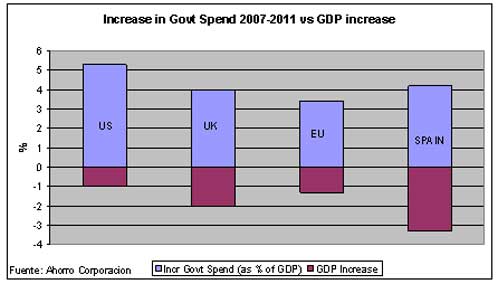
* Spending more did not work, repeating it is suicidal . Spain increased public spending by 67.2 billion euros between 2007 and 2011, 6.4% of GDP, to generate a GDP decline of 3.3% and a fall of industrial output of 12.7%, with an increase in unemployment to 24%. That increased spending also meant a cost of additional debt equivalent to 0.3% of GDP. Spain SA not only did not stop the crisis spending, but rather deepened it. The figures in Spain are devastating, but the U.S., UK and the Eurozone demonstrate the same principle, that increased spending has not produced a real positive impact on GDP.

I always speak about the debt saturation model. When an additional unit of debt does not generate additional GDP, but negative . We have saturated the dubious benefit of spending. A clear example of this aspect is the infamous Plan E of the Spanish government, 13 billion euros, only generated debt, job losses and lower GDP.
govt spend

As we have seen in the past years, “lack of austerity” is expensive, but indiscriminate spending is even worse. I always say that if Krugman was able to read the details of expenditure items in many European general budgets he would join the Austrian school in a minute. We are not just talking about tens of billions dumped in phantom cities, unused airports, useless infrastructure and outright subsidies and grants. The problem is that all these expenses are not supported by an equivalent income (no ROIC, Return on Invested Capital) thus leaving behind them not just a non-existent value, but an unpayable debt that must be covered with higher taxes destroying other activities and productive sectors.

Useless infrastructures and subsidies are not only wasteful, but the debt they leave behind is also crowding out and taxing the profitable and productive sectors. The subsidy and uneconomical public spend culture also becomes a private “investment deterrent” . No one dares to put a penny in an economy in which taxes generated by productive sectors will be used to cover liabilities of unproductive wasted capital.

Why does austerity work:

* It frees financial resources from unproductive to productive activities. Today, almost 70% of financial resources available are used to purchase public debt and finance government expenditure. It is the crowding out effect of a State that accounts for more than 50% of Europe’s economy. If the State stops monopolizing the majority of credit availability, and also stops spending on unproductive activities, private investment activity and high productivity activities return. It is no coincidence that the states that have cut public spending are the ones that create more jobs.

* It accelerates the transformation to a more productive economy. It is no coincidence that productivity falls with increasing public spending. Most public spending stimulus plans are directed to subsidies and to rescue declining industries (mining, automobile) and very low productivity activities (construction, civil engineering), and it monopolizes scarce financial resources which precludes private investment in high productivity areas. If countries rescue the inefficient by taking from the efficient one’s pocket, investors fly away from the country and moves to more attractive places.

* It helps create real jobs, not subsidized labour. When the State spends on pointless companies and investments with no return, it does not create employment, it subsidizes it by borrowing. And that cost comes from taxpayers until the State runs out of other people’s money and the pyramid collapses. Europe has seen the destruction of more than 80,000 small and medium enterprises annually while governments subsidize spending that also destroys public jobs in the medium term, when money runs out.

* The increase in interest expenses from more government debt hinders recovery and generates tax increases that discourage consumption and investment as well as repel capital. If Europe stopped issuing new debt to pay interests on old debt it would start to solve its problems.

It is relatively easy, austerity would help: Not only stop paying unnecessary subsidies and reduce billions of euros of cost of additional debt, but austerity attracts capital and reduces the loss of tax revenue by bringing new investors. And instead of removing 0.3% of GDP increasing debt, GDP would be up reducing the financial burden.

The well-intentioned recipes of Krugman and Stiglitz start from incorrect assumptions:

. That most European governments would spend taxpayers’ money more efficiently and wisely than private investors.

. Even worse, they assume that those European governments would base their investment criteria in a capitalist, return-driven, open-market, Anglo-Saxon way.

. And much, much worse, they assume that the investment decisions of most European governments are compatible with private investment, when often they aren’t.

Most of these “growth plans” have proven to crowd-out private investment, prevent competition, unfairly defend unproductive and declining sectors, and aim at safeguarding inefficient low productivity oligopolies. As such, in many cases European government spending has proven to be in most cases more damaging than helpful for economic recovery, and it widens the funding hole.

We need to escape the spiral of spending, of favors owed, protectionism and subsidies, we need to stop rescuing the unproductive and, through lower taxes and lower spending, foster investment private capital, innovation and growth.

Further read:

My article in The Wall Street Journal:
http://online.wsj.com/article/SB10001424052702304782404577488283442408896.html?mod=WSJEUROPE_hpp_sections_opinion

also here:

http://energyandmoney.blogspot.co.uk/2012/06/recipe-for-spanish-comeback.html#frameId=uWidget20a9e6e60130f5c6a6f0&height=131

The Myth Of European Austerity

What If Germany Turns Off The Funding Tap?

The European House Of Cards

http://energyandmoney.blogspot.co.uk/2012/06/euro-house-of-cards-and-greek-temporary.html

Real Austerity Does Work

http://pompeunomics.com/2012/07/09/real-austerity-does-work/
Recipe for a Spanish Comeback

(This article was published in The Wall Street Journal on June 26th, 2012 copyright WSJ)

The recent pullback in Spanish bond yields has been heralded locally as almost a victory. But if so, it’s probably a pyrrhic victory, as Spain’s 10-year sovereign bond yield still stands at 6.5%, and five-year credit default swaps remain at historic highs of 563 basis points. Meanwhile, the question in investors’ minds is the same: How will Spain repay its public debts, which have more than doubled since early 2008 to 72% of GDP as of the first quarter of 2012?
Before Spaniards elected the Rajoy government last year, the previous government had denied the crisis for years and failed to act swiftly upon it, leading foreign investors to avoid the country’s bonds. Spanish public debt owned by non-residents has fallen to 37.3% today from 54.5% in 2010. The real figure is even lower, as a significant portion of that 37.3% represents debt bought by the European Central Bank.
The slump in international demand has been mostly offset by bond buying by domestic institutions, including the Spanish social-security and public-pension funds, and mostly from Spanish banks. These Spanish banks now loading up on sovereign bonds are the same ones that have used €288 billion of the ECB’s discount-lending facility so far this year. This is a truly dangerous move, as the vicious circle of risk-contagion between bank balance sheets and sovereign risk affects every asset class. This has also created a credit crunch for the real economy, particularly unhelpful in a country in which small and medium-sized businesses generate 70% of value added and almost 80% of employment.

According to Spanish Finance Minister Luis de Guindos, investors are not taking Spain’s “growth potential” into account. There is truth in that assessment, but Spanish authorities seem resigned to the notion that they can do no more to actualize this “potential.” I believe there is a lot more they could do.Given its potential, Spain can do better, it can do more and it can do it now.

Spain has failed to restore investor confidence in its ability to repay its debts predominantly because the reforms pushed by the Rajoy government so far have focused mostly on revenues, namely tax increases, while the government’s bloated administration and massive subsidy culture remain in place. As such, the economy deteriorates and taxes go up, while debt continues to grow.
Spain seems stubbornly intent on restoring tax revenues that were the product of a giant real-estate bubble, and those will not return easily. Tax collections per capita increased almost 40% between 2003 and 2008 due to the housing bubble, driving a similar increase in government spending. Spain created a public sector perfectly suited for an economy that would grow 2% per year forever. It didn’t. Once the bubble burst, those revenues disappeared but the spending stayed. That funding gap, which took Spain to an 8.9% deficit in 2011 from a 2% surplus in 2007, can not be tackled through taxes, but only through cuts in spending.
When discussing possible cuts to Spanish public spending, one always hears that every reduction is only a drop in the ocean. True, but a million “drops” would add up quickly in a country with 17 regional administrations, thousands of loss-making public enterprises, tens of billions in subsidies, and a complex web of regional and national regulatory bodies.
The Spanish economy, centered on services, industry, tourism and construction, is strongly cyclical. As such, the burden of the state and the maximum debt it can sustain need to be smaller than its less cyclical peers. Spain could restore confidence and reduce its bond yields by achieving this through a four-step, zero-cost program focused on:
1. Structural public-administration reforms: Eliminating duplicative public administrations, chiefly in regional, island and county councils, could save up to €20 billion, according to Spain’s Circle of Entrepreneurs think-tank and the Conservative Party. Additionally, selling off Spain’s dozens of public television and radio networks, and ridding taxpayers of thousands of loss-making companies owned by regional governments, could save €10 billion.
2. Tax Reform: Increasing Spain’s standard value-added tax rate to 20% from 18%, while reducing the employer portion of social-security taxes by 3.5 percentage points, could boost GDP by between 1-1.3% without any decrease in government revenue, according to a recent study by domestic banks. Spain scores 69.1 out of 100 in the Heritage Foundation’s Index of Economic Freedom, significantly below its peers. It needs a long-term sustainable plan of tax incentives for new businesses, and a unified system of regulation instead of the current patchwork of rules, to allow small and medium-sized businesses to grow into large corporations.
3. Cut subsidies by half: Spain spends more than 2% of its GDP per year on corporate subsidies and grants (not including its aid to banks). So far these have only been lightly trimmed throughout the crisis. The subsidy culture keeps zombie businesses in place and puts up a barrier to the development of more productive enterprises. End it.
4. Attract capital: Spain’s private-equity funding of companies is below 0.1% of GDP, according to the national stock-exchange regulator. This is partly due to regulatory instability, along with its protectionist regulation of foreign capital, as any fund that has tried to open an office there knows. By opening its doors to foreign investment, Spain could erase the view that all major deals there must happen between friends and behind closed doors, thus improving its public image in financial markets.

Sovereign-bond investors are by definition the most risk-averse of the world’s financiers. Markets want clarity, sustainability and no surprises. Spain needs to prove to them that it can not only meet its current economic estimates, but beat them. The country has done it many times in the past, and it still possesses all that “potential” that Mr. de Guindos talked about. Spain can do better, it can do more and it can do it now.copyright The Wall Street Journal. Published with permission.

How to Save the Spanish Banking System

(This article was published in Cotizalia on June 23rd, 2012)

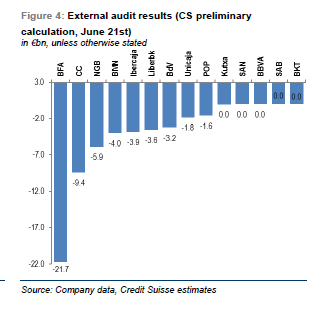
The big news of the week was the presentation of the independent assessment of capital needs of Spanish banks. It is interesting, but on Tuesday I was at a dinner with several managers and analysts of the financial sector, and all of them were spot on about the figure that would be published: A maximum of 60 billion euro.”A solvent banking system” read one of the local press headlines. The ones that have proven to be solvent are the usual suspects: Santander, BBVA, etc… And a positive surprise in Sabadell, which came off better than expected by the market. The savings banks have proven again to be the main problem, because a financial hole of tens billions is frightening.

What angers me is that this tremendously harmful process of “pretend and extend” the problem has led to cast doubt on the solvency of some banks that never should have been doubted. Not all the savings banks are a problem either. It should be noted that Caixabank, made the transition from savings bank to commercial bank and proved to be better-prepared within the national economic disaster.

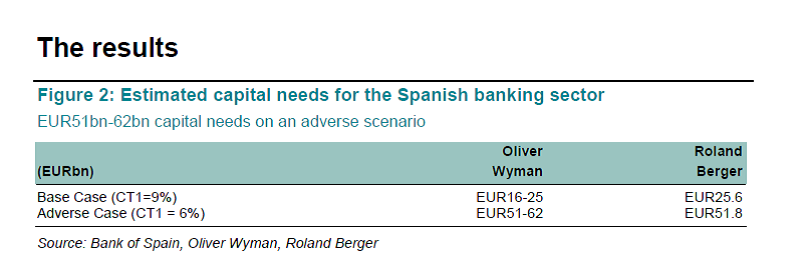
It is worth to note that at least for the first time, the Government has sought to manage expectations. Hence, the chain of events: 1) The IMF says that the capital needs of banks are 40 billion euro. 2) The State requests a loan of 100 billion euro, and 3) independent consultants put capital needs between 15 and 62 billion, depending on macroeconomic conditions. All happy, instead of changing numbers every three months.

However, if we go into detail, this is another “stress test” I am afraid that leaves more questions than answers.

All prior stress tests have started from the premise that they were very conservative, but the market misses ​​a genuine exercise in “cleaning up the closet.” Let us not forget that all entities that have gone bankrupt – Dexia-, or have been intervened, passed the “stress tests” with flying colours. And do not forget that in 2006 one of the consultants, Oliver Wyman, said that Anglo Irish Bank was the best bank in the world . And it went bust.

Everyone can make mistakes, of course, but what is important to note is that these reports are neither aggressive nor conservative in their estimates. That is the premise from which we must start the analysis.

spanish banks I

The Positives:

Spain is the only country that has made ​​the exercise of bringing independent consultants. It is an important exercise in transparency.

. Now no one doubts that losses in the “adverse” scenario would reach about 250 billion euro, with recapitalization needs of 51-62 billion. And forget about the other scenarios. The independent reports themselves provide many clues and reasons to consider that the “base” scenario is the least relevant, starting with bank profits estimates, GDP growth and estimate of fall in home prices.

. If recapitalization needs remain in the medium scenario, the State would not use much of the 100 Billion loan granted by Europe, reducing the negative impact.

. Listed banks are saying they would not need to access the loan and provisions will be made ​​against their results. Let us see if I banks make the necessary capital increases, as Italian banks did.

. The Government itself, as part of the committee preparing the basis of the report, has allowed some macroeconomic estimates for the base and adverse scenarios that in many other countries would have not been allowed.

The criticisms:

– The consultants have not analysed corporate risk, liquidity, and sovereign risk. There is no review or analysis of the substantial portfolio of sovereign bonds, or the DTA (deferred tax assets), or industrial holdings losses, when latent losses are very important, estimated at 20 billion euros, according to Merrill Lynch. This is very important because in some cases more than 70% of the core capitalization ratio (CT1, Tier 1) is made of government bonds.

– The acceptable solvency ratios are calculated at very low levels: They use an acceptable ratio of core capital (CT1) of only 6% in the adverse scenario, while 9% is used in the base scenario. If the economy is going to deteriorate further, would financial institutions be allowed to reduce their capital ratio from 9 to 6%? This difference alone can enlarge the capital needs by 50 billion euros, according to BNP or Credit Suisse.

– The estimated “new profit generation ability” clearly seems benign for the banks, at approximately 64 billion of profits in the adverse scenario. It seems at least optimistic, since the entire sector generated 100

billion in the last three years. If the economy collapses it is very difficult to estimate this level of profits as “conservative.”

Spanish banks IIHow to save the system from another “stress test” in a year:

I have participated in the documentary, “Fraud.Why the great recession” , which outlines some of the essential measures to prevent further financial shocks from a liberal perspective. It is worth listening to some of these ideas and leave behind the old arguments of “that’s impossible” or “it has never been done” to find sustainable solutions.Using core capital ratios of 6% or 9% is simply putting patches. Banks cannot be so thinly capitalized and risk going bankrupt with any small change in the markets. Banks must be capitalized at least 25%, and ideally build a cash to deposits reserve ratio that gets as close as 100% as possible.

The risk spiral “sovereign debt-bank balance sheet” should be cut. They cannot keep gorging on Treasuries, because when bond yields rise it impacts the credit quality of the bank through the cumulative risk in the sovereign portfolio.

The spiral of corporate risk should be limited and provisioned at market prices. Industrial stakes, with millions in latent losses, should be reviewed and banks should get rid of those that are not profitable.

In the absence of wild credit to feed the bubble that created the Spanish network of industrial holdings, the cycle of “debt rises -> GDP falls -> stock market falls -> industrial stakes stocks fall -> quality of bank assets deteriorates -> bank stocks fall -> loans to the real economy fall -> debt rises -> GDP falls -> start again” is repeated over and over again.

Don’t bail out banks. The bail-in alternative we always mention is the logical one. Bailing out banks perpetuates the incentive to lend recklessly, to continue to take risk “suggested” by politicians and fail again. Use the EU loans to guarantee bank deposits and liquidate the insolvent ones or we will have another round of “bailouts” in a year.

Leave any intermediate solutions. There are no partial provisions for zombie loans. Provisioning “part” of Non Performing Loans does not cut the risk. It perpetuates it. And old school bankers know it.

Finally, conduct a continuing review of the loan portfolio by independent entities and increase international transactions.

If the entities base their risk analysis less on PowerPoint, and less on optimistic own research, banks will see the beginning of the solution and the return to a banking model that has made some of our institutions and managers global models. Do not forget that the solution is not so crazy, because we have it in the past.

You can’t get Blood from a Stone

In the hope that someone in the EU reads it:I: Inflation is a tax. Create inflation when salaries are stale and spending will collapse

II: Printing money is stealing funds from savings and from efficient companies to give it to inefficient and indebted governments.

III: Trying to increase tax revenues to bubble-period figures is impossible. Those revenues disappear when the bubble bursts. You have to bring spending to pre-bubble levels.

IV: Increasing spending and debt means passing the bill or the consequences of a default to our children.

V: Offsetting private investments with government spending assumes that politicians are better managers and investors than private entrepreneurs.

VI: More taxes, less growth, less revenues. Same spending, more deficit. More debt, bigger hole.VII: Increasing debt today is to assume that we deserve to spend today the expected productivity and efficiencies of the future.

VIII: If our policy is that countries don’t have to worry about debt because governments don’t need to pay it we shouldn’t be surprised with increased cost of borrowing.

IX: Increasing public spending today assumes that the same governments that made spending mistakes in the past will now change their way and do it well.

X: If a country’s debt is “low” and its cost “manageable” yet demand for its bonds is collapsing and costs soaring, the debt is neither low nor manageable.