All posts by Daniel Lacalle

About Daniel Lacalle

Daniel Lacalle (Madrid, 1967). PhD Economist and Fund Manager. Author of bestsellers "Life In The Financial Markets" and "The Energy World Is Flat" as well as "Escape From the Central Bank Trap". Daniel Lacalle (Madrid, 1967). PhD Economist and Fund Manager. Frequent collaborator with CNBC, Bloomberg, CNN, Hedgeye, Epoch Times, Mises Institute, BBN Times, Wall Street Journal, El Español, A3 Media and 13TV. Holds the CIIA (Certified International Investment Analyst) and masters in Economic Investigation and IESE.

Unsustainable energy policy, higher debt, higher unemployment

(This article was published in Spain’s Cotizalia on 31st March 2011)

Beware. The European Union, Germany and the UK have implemented some of the most harmful energy measures both for their economies and, ironically, for the objectives they strive to achieve.Let us review the measures and their consequences:

. 20-20-20 Roadmap : The goal that forces to impose a 20% of renewable energy in the electricity mix hides behind its seemingly ambitious and unanimous goals the danger of percentages. As absolute targets are not specified, the cost of the measure is higher for smaller countries. 20% of renewables in a generation park like the German, 120GW (giga watts) is not the same in cost (subsidies, tariffs, investment in new transmission networks) than for a country like Portugal, Spain or Greece. Even more if we compare it relative to GDP.

Achieving that goal will cost Germany (if they implement it) that is an economy 2.8 times larger than the Spanish, the same as for Spain in subsidies and extra-cost of networks, but only 0.3% of GDP, while in Spain it’s almost 1%. This restricts the competitiveness of small countries compared to its EU partners, but even worse compared to the rest of the world. It removes the ability to recover the economy and therefore create jobs. In energy, costs are everything.

Studies of the Universidad Juan Carlos I (“Study of the Effects on Employment of Public Aid to Renewable Energy sources”), and six other universities at European level have quantified the loss of jobs by the introduction of the so-called green economy (badly called green, because it does nothing but increase the consumption of coal, which had been deemed obsolete) in 1.8 jobs lost for each created.

. Decommissioning or closure of nuclear plants : If 7GW of closed nuclear plants in Germany do not return to work, this means increasing by 8 million additional tons of coal imports to Germany. If they stop all new nuclear projects globally, coal consumption will increase by 80,000 tonnes between 2010 and 2020. And nuclear generation is “base-load” (ie, works almost without a break), so can not be replaced by renewables in its entirety. And this leads us to gas. The importance of natural gas as back-up in the energy mix will make energy dependence (a term I find ridiculous) increase. An Ostrich type of anti-nuclear policy, because in the middle of the EU we have France with 58 nuclear reactors, but some seem to think that if there is a radiation accident it will stop short at the border.

. Minimum price for CO2. The UK does things as badly as anyone, and has shown it this week. Intervening in the market and imposing a minimum price of CO2 while raising taxes on gas production in the North Sea has managed to increase consumption of gas by 15% at a higher price. In addition, the UK has increased dependence on foreign energy by forcing the closure of several projects, over $10 billion, in exploration and production in the North Sea. And a loss of 120 jobs in the first day. Success!.

The European Union plans as if the world was limited to our 27 countries. The EU is 13% of world coal consumption and 16% of natural gas. But supports 100% of the cost of CO2 and 70% of the cost of premiums for renewables worldwide. Thus the effect of their actions is amplified by the loss of global competitiveness in a group of highly indebted countries.

. Remove petrol and diesel transport by 2050. Again, without calculating the cost or impact on the economy. We are “only” talking about a cost close to twenty-six billion euros only in costs of network infrastructures. But most importantly, these do not reduce energy dependence or improve costs. Electrifying the park could reduce oil consumption (paradox, to be more competitive again), but will increase coal and natural gas prices, and adding to the renewable premiums, taxes lost from petrol and diesel, over 56% final price, will be transferred to the consumer of electric cars in the power bill.

We must not forget the impact of these measures and their cost of implementation, the impact on budget deficits and on the battered state of European countries’ debt. To add a cost to the system involving another 1-1.5% of GDP on debt with “supposed” benefits in 2050 has an enormous impact on employment and working conditions. At the end of the day in most companies the four major costs include energy, taxes, debt costs and wages. If the first three parts rise disproportionately, the third invariably suffers.

Besides, these measures have a minimal effect at European level, let alone globally. Only the planned investments in coal plants in China offsets all efforts of the EU to meet the Kyoto targets. Thus, the weight of coal as global primary energy source increased by 1.3% in 2010 to 52.3%.

And do not forget that apart from xenophobic arguments about good and bad countries, which are embarrassing, the cost of the “ostrich policy” of energy self-sufficiency that they want to impose far exceeds (all costs included) the equivalent of $700/barrel (source: CERA, Utilities Weekly). And who do we expect to sell the haemorrhage of debt we will issue to achieve the above objectives? … the oil-producing countries, China and the U.S… Amazing.

It is rather sad that the “success” of Europe in its emissions reduction target is due mainly to the displacement of its energy intensive industries to the Far East, with the consequent loss of European jobs, and the effect of reducing industrial demand runaway that the debt orgy has generated. A success. And to close the circle, it has increased the energy dependence from Russia, Qatar (gas) or Australia and South Africa (coal).

What about pollution? We forget that the rare earths required to manufacture solar panels and batteries pollute hundreds of thousands of tons of water per year. But it pollutes in China (97% market share), so no problem.

These measures give off a smell of stale paternalism, or as Professor Dieter Helm would say, “the addiction of politicians to” roadmaps “that set the future direction of energy with Soviet precision”. And with the same disastrous results as the ridiculous five-year plans.

Until governments stop trying to plan and intervene in the energy market like the rest of the world did not exist, they will be doomed to failure. And we have spent many years with dreadful results. The green economy, which seems phenomenal, as long as it doesn’t have to be paid by my grandchildren, will only succeed if it is competitive. Governments should only create a reasonable and stable regulatory framework for technology and let the market offer solutions. Competing.
War in Libya and the possible Algerian black swan

(This article was published in Cotizalia on 24/3/2011)

The UN resolution 1973, supported by the Arab League and accepted by Russia and China, has a clear immediate goal: Overthrow the Qaddafi government. What is not clear is what the ultimate goal is and what will be the position of the West after supporting a rebellion without defined leaders, common goals or government project. As we discussed in this column, the reality of Libya and its many tribes is more complex than we would like to admit. As a friend of mine says, “careful what you wish for,” because we are still regretting the support to the “freedom fighters”, the Taliban, in Afghanistan.I commented several weeks ago to our readers that the information that came from friends in companies based in the area, Schlumberger, Halliburton, Petrofac, Saipem and Technip were not encouraging for those who expected a quick fix. And my fear that this conflict will lead to a long, bloody and difficult transition with multiple factions similar to the Iraq and Afghanistan examples is increasing. I hope I’m wrong.

Indirectly, the two powers that derive benefit from all this are Russia and China . Russia has gone from being viewed, unfairly in my view, as a country in which western investment was a big risk to be a huge opportunity, and Gazprom is now the best source of security of supply of gas, with annual volumes of 136BCM that are cheap and safe for the European Union. The agreement between Total and one of my favourite companies, Novatek, which is likely to include Statoil, is a clear example. China has very little presence in Libya, a few Petrochina exploratory wells, but benefits in two sides . On the one hand, less international competition in Sudan, Uganda, Nigeria and West Africa, where they continue accumulating reserves, and on the other, potential access to new licenses, as they did in Iraq.

In Libya, the fact that rebel forces are multiple and with no clear leaders means that the balance of power in a future without Qaddafi depends largely on the support of Western countries, becoming with Iraq as a second vertex of control and strategic deterrence both to contain Iran and to protect Saudi Arabia and Israel. Libya is not only important for its production 1,660,000 barrels of daily exports, but as a test scenario of the fragile process of a possible change to democracy .

The exposure to Libya of major energy companies is relatively small, except in the case of ENI, OMV, where Libya is 20% and 24% of their net assets, and Repsol, with 7%. From other oil companies the most exposed are Marathon (12% of its production), Gazprom (less than 6%), and to a much lesser extent, Conoco Phillips (USA), Total (France), Hess, Statoil (Norway) and Occidental (USA).

But I have the feeling that the ultimate goal of an operation of this size, without forgetting to support the civilian population, which is obvious, is to have an operations center that allows to monitor Algeria and other neighbors that can potentially be a greatest destabilizing factor.

Libya has gone from being acclaimed in 2006 by our countries to the Chair of the Human Rights Commission of United Nations (the only vote against was the USA) to a regime to remove. But the danger of intervening, with a weekly cost, according to the Daily Telegraph , of $500 million for the allies, is that the war goes on forever and then it becomes more difficult to support other countries. And this brings us to Algeria, a country of enormous strategic importance , with 4,500 million cubic meters of proven gas reserves, the tenth country in the world, and 12 billion barrels of proven oil reserves.

Algeria is essential for Spain. It’s almost 30% of the natural gas consumed in the country according to official sources. But it is a relationship that benefits both countries, and Portugal. The joint venture of Repsol-Gas Natural, has the Algerian national company, Sonatrach, as one of its main suppliers. And, despite the legal dispute that the two companies hold (€ 1.5 billion in arbitration) and the loss by Repsol-Gas Natural of the Gassi Touil contract in 2007, there is no doubt that Spain is very important for Algeria, and that both parties are bound to understand each other. Additionally, a consortium involving Endesa (12%) and Iberdrola (20%) with France’s GDF Suez and Sonatrach, among others, has invested in the Medgaz pipeline that links Algeria to Spain. Spain’s energy investments in Algeria are around $5 billion. The Algerian company also holds shares in the Portuguese EDP (and hence its subsidiary in Spain, Hidrocantabrico) and provides another 2BCM of annual gas supply to Portugal. Algeria, therefore, is not at all irrelevant to the Iberian Peninsula.

In Libya, the opposition is tribal, and the religious-ideological content is limited, but in Algeria strategists perceive that the risk of a revolt against the regime of Abdelaziz Bouteflika can not only affect the supply of gas to Spain, with the devastating effect that this could have on the battered economy of the EU and its credit risk, but there are also fears that moderate opposition can again be dominated by radicals. In Algeria, in addition, the impact on Western investments extend to many more countries than those mentioned in Libya. Therefore, it is hard to think of the action on Libya as an isolated event.

Further read:

Lybia in Flames:
http://energyandmoney.blogspot.com/2011/02/lybia-in-flames-and-clash-of.html

Egypt and MENA risk:
http://energyandmoney.blogspot.com/2011/01/here-is-summary-of-my-views-on-egypt.html

Anti-nuclear State of Fear. Japan and the impact of the tsunami

(This article was published in Cotizalia on 19/3/2011)

Let me begin this article by sending a heartfelt remembrance to the great country of Japan, and to all those affected by the disaster and their families. We don’t forget them.

But my job is to talk about energy and the disaster has a huge importance for the market of oil, gas, nuclear energy and CO2.

The perceived risk of nuclear energy has soared , even leading to Angela Merkel to take the populist measure of ordering to stop the seven nuclear plants built before 1980 for a period of at least a month. This implies a loss of about 7.1 giga watts of electricity generation in a country that has not seen a nuclear accident of any relevance in many decades.

What has been achieved with this measure has been to make the country poorer as energy prices soared, but also impacting the EU, as wholesale electricity prices in UK, France and other countries, which remained depressed for months, are up 11%, coal is up 14%, gas (NBP) is up 12% and CO2 prices, which had not moved for nearly eighteen months, have risen 10%, above the expected increase in thermal generation, thus slashing any remote possibility of meeting the Kyoto targets, in addition to giving a blow to competitiveness. The price of uranium plummeted 19% to $ 54/lb on the risk of loss of at least 7% of annual demand. All for the perception of political risk, ie that the European Union will take action against nuclear energy.

The Fukushima Daiichi’s accident is very important. But it is an exception. And if there is proof of the security and reliability of nuclear power, it is shown by the fact that out of the 11 reactors affected by the earthquake, only two have suffered an accident. And this exception originated in the midst of a natural disaster which unfortunately coincided other unusual circumstances, such as the blackout of eight hours. To make wild and hasty conclusions about the rest of nuclear power stations, particularly in a country, Germany, where there is no seismic risk, is incredible. That does not mean that we should not review and improve all security systems. But … stop 30% of nuclear power stations in Germany due to an accident in Japan?.

The loss of the capacity of 11 nuclear plants in Japan has an immediate effect of increasing demand for liquefied natural gas (LNG) by substitution effect. In 2007, when Japan closed the Kashiwazaki-Kariwa nuclear plant, 40% of the lost capacity was immediately replaced by gas.

The impact on the demand for LNG (liquefied natural gas) caused by the loss of nuclear plants mentioned can be up to 0.7 BCF/ day, ie, absorbing 50% of the current excess capacity of the gas system. This would send to Japan from 5 to 6 additional LNG tankers per month . At the time of writing this article, the price of liquefied natural gas contracts for new ships had soared, from $ 9/MMBTU a month ago to nearly $14/MMBTU. Still at prices well below those of 2006, making the LNG the cheapest alternative back-up energy source today.

For the oil market, the Japanese tsunami is, to give you an idea, similar in volume to the impact of Libya for the supply side, but of opposite sign. That is, Japan means a possible loss of demand of about 1.3 million barrels per day. Assuming only the impact of Japan, which is about 4% of global refining capacity, and no contagion effect on the economies of the West, there could be a further impact on oil demand.

And all this leads to renewables. Interestingly, the initial effect has been an avalanche of buyers into solar stocks . But in a sector with structural overcapacity, the loss of demand in Japan, which is about 7-8% of global demand for solar panels, will be a real problem that will not be easily offset despite the dreams of launching more aggressive environmental policies.

The view that solar will suddenly grow exponentially is questionable particularly when U.S. and European gas is still much cheaper than solar energy (photovoltaic) despite the cuts in the premiums seen in Germany, Spain and other countries . And coal is also much cheaper and reliable. Even if CO2 prices soar to €23/tm (it’s at €17.5/mt right now), coal generation runs at a fraction of the cost of solar photovoltaic. To give you an idea, in Germany, the same government that takes action against nuclear plants has seen the brutal effect of solar energy on prices. Germany has accumulated 40% of global solar installations over the past two years and has seen the cost of subsidies reach to more than €56/MWh, 56% of the retail price for the consumer.

Alternative energies are valid but can not replace nuclear power and, as any alternative, should prove to be cheaper than the incumbents. Because if not, the anti-nuclear rhetoric, anti-oil, anti-everything that is going on is going to prove to be anti-competitive and anti-growth. And forget about reaching Kyoto targets if Germany dismantles the nuclear park.

Nuclear energy accounts for 14% of the electricity generated in the world at a cost of about €33/MWh if we assume all costs, including closing and cleaning. Solar energy is less than 0.08% at an average cost of €410/MWh, twelve times more expensive. Solar energy today costs about $700 per barrel of oil equivalent, and therefore more than 25 times the average price for liquefied natural gas. This without mentioning the necessary investments in transmission networks, estimated at one trillion US dollars in Europe alone.

Solar energy, by definition is intermittent, ie, its plants operate at less than 10% utilization, as opposed to nuclear or hydro, operating with load factors of 70-80%. Wind energy has a much lower cost, an average of € 78/MWh, although still higher than gas, coal, nuclear and hydro, but also has the disadvantage of a low and unpredictable utilization factor (23-24 %). Additionally, it requires huge investments in networks. Therefore, an aggressive energy policy change based on an accident in a distant country seriously affects the competitiveness of countries and, after a decade of clean energy implementation, no significant net job creation or reduction in the cost of energy. It is clear that the costs exceed the alleged benefits. And studies made in Spain and the US show that for every green job created, two are lost from lost competitiveness, as industries’ costs soar. First Solar’s CEO says that solar energy will be competitive within ten years. They said the same thing years ago, referring to 2010. They have to prove it.

If we multiply by ten the OECD investments in prevention and safety of the nuclear power plants currently in operation, this would not pose anywhere near the same cost that would be needed to replace 10% of nuclear power by solar energy. And the latter would still have to compete with other sources of energy that are more abundant, cheaper and flexible.

It is worth continuing to invest in security, investigate further about economically viable and safe energy, but the greatest risk we face now is to take populist measures that sink competitiveness, curtail security of supply and make the system more expensive.

In energy, substitution can only come from competition. Either you compete or you disappear. Crude oil beat whale oil on price 120 years ago. The same happened with gas and coal. Anything else is dreaming.

Brent-WTI Spread…. More Fundamental than Market Perceives

brent wti
(This article was published in Cotizalia on Feb 17th 2011)

I write to you this week from Oman. Impressive country, producing 900 thousand barrels of oil a day, and 9% of GDP from oil revenues, which finances amazing investments in infrastructure and civil works from Musqat to Salalah and other cities that are downright impressive.

As a country, it’s an example of how different the countries of the area are, despite the Western media efforts to put them all in the same basket of so-called risk of Egyptian contagion.

Another week and now that the Egyptian crisis has been solved, the market continues to focus on that country and the risk involved in the Suez Canal for crude supplies. And there is no real risk. The importance of the Suez Canal for the transportation of crude oil has fallen sharply in recent decades. During the 60s and 70s, almost 10% of global oil traffic passed through the canal. Today, it’s less than 1%. Moreover, as the three largest companies working in the channel say, the traffic is roughly balanced, with 55% of oil on ships heading north (992 thousand barrels/day) and 45% (about 850 thousand barrels/day) due south. Any problem in the Canal is, first, negligible for the transit of oil and, second, very easy to re-route around the Horn of Africa, an increase of transit time of less than 15 days.

For those who care about Egypt and the Sumed pipeline, just remind them that it only moves 1.1 million barrels per day despite having a capacity of 2.4 million barrels per day. And as a good friend of EGPC told me, there are few safer places than this pipeline, where the army has more troops than any city in the country except Cairo.

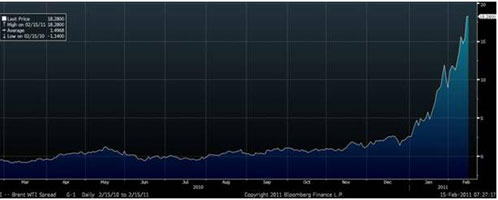
And in this environment we find the Brent and WTI spread at historical highs. Two clear effects: first the inflationary impact on Brent added to the deflationary impact on WTI to create the largest differential between the two ever seen: $14.5/bbl. Also very wide differential relative to other crude, Bonny Light (Nigeria), in particular, and Asian Tapis.

Let’s start by explaining what justifies the weakness of WTI:

Inventories at Cushing (at Oklahoma) are at historically high levels. 50% higher than the average for the past five years (25022). The problem is that the WTI weakness shows the growing isolation of the North American market and infrastructure problems to evacuate excess oil.

WTI crude trades on the basis of inventories at Cushing, in the middle of the American continent, and it is hard to move oil out of the area (called PAD II) or the large refineries on the Gulf.

1) There is enough transport capacity to carry crude from the Gulf to the center of the continent, but not vice versa. The fact that the Enbridge pipeline has had problems has increased the glut of crude in Cushing.

2) There has been an increase in exports of crude oil (oil sands) from Canada to the U.S., which increases the overcapacity in Cushing. Transcanada launched the second phase of its Keystone pipeline, which attracts even more crude to Cushing bottleneck.

3) The increase in U.S. domestic production, including Bakken, is also filling the stores in Cushing. The over-production in the U.S. is partly because the gas companies take advantage of high oil prices to produce more natural gas liquids, whose price is close to oil, in order to fund production of natural gas which today at $4/mmbtu, is not giving the best economics, actually very poor returns. Therefore they compensate for the low profitability of the gas with the price of associated liquids.

Add the fact that three refineries have been closed for maintenance, and we have the perfect storm. Excess production of high oil prices, withdrawal of the American system because of lack of infrastructure, and reduced refinery demand .

Meanwhile, Brent is affected some powerful inflationary forces:

1) The decline of production from Norway and North Sea, that previously functioned as a cushion against price increases, and does not produce that effect anymore.

2) The increase in OPEC oil transit to Asia, and rising domestic demand in exporting countries have reduced the oil for export. Saudi Arabia expects to increase its exports by 1 million barrels per day, but, for now, demand does not justify it.

3) The perception of geopolitical risk and the effect that we mentioned of transport cost increase. The market assumes that the cost of transport must rise. We are already seeing freight day rates recover, particularly in the VLCC segment, as I commented with Oman Oil. Having seen the Baltic Dry Index tumble to record lows due to excess spare capacity of ships, we could start to envision a horizon of recovery. Very gradual, and certainly not to be bullish, because overcapacity still exists (especially in the Capesize and Panamax segments.) And if freight costs rise, the chance to evacuate American crude to Europe is reduced.

As I mentioned two years ago on the differential between gas (Henry Hub) and oil, it is very dangerous to play against a very clear structural effect of isolation of a market, the American, in which the administration has no intention of promoting improvements in the system, and as a result, crude oil and domestic gas (WTI and Henry Hub) at lows is a clear boost from the country’s competitiveness.

Further read:

http://energyandmoney.blogspot.com/2010/01/revolution-of-shale-gas.html

http://energyandmoney.blogspot.com/2011/06/iea-releasing-strategic-reserves.html