Category Archives: Energy

Energy

The end of investment in oil as we know it

crude_oil_oilwatch_feb_1

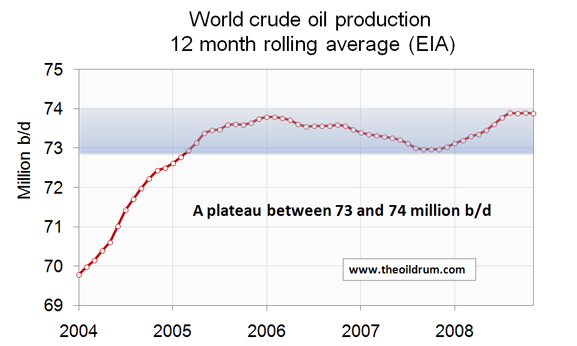
This image from the great www.oildrum.com shows something I believe is very important: despite an increase in capex of 20% per annum in the period, global oil production did not increase significantly.
This unprecedented level of capex in the oil industry happened thanks to a combination of technology and access to credit.  Widespread access to credit is gone, maybe for a very long time, but more importantly, oil companies’ appetite for investment is not going to increase quickly. When oil fell to $10/bbl in the early 90s it scared an entire generation of oil company managers. This is exactly what will happen after this period. 3D seismic, deep offshore exploration, high cost projects, oil sands, … wave bye bye to capex. Remember, Capex in 2001 was $250bn and in 2002 went to $100bn.
Meanwhile the average requirement of oil per capita in the planet is 4.9barrels and 454 cm of gas a year.

In OECD countries with current demand oil consumption is 18.3barrels a year

So if OECD countries slash their demand by 25% it will still be 14.64 barrels a year

However, if oil exporting countries demand goes up by a mere 7% their consumption will be 4.28 barrels a year.

Indigenous population growth in OECD is +0.1%, and growing 1% from immigration (ie going from countries where the average person consumes 2 barrels a year to countries where they will consume at least 4)

Population growth in oil exporting countries is up 5%.

Doing the maths, the demand doom picture is overestimated.

On to Supply:

A) In a tough credit environment, even large and medium sized E&Ps are and will have to drastically cut expenditure in exploration and development. Even worse, service companies are too small and cannot get credit  for large rig projects (look at SBM and PFC).

B) Large caps are cutting expenditure (albeit selectively) already. If they see a weakening of demand all that RDS has to do is reduce the number of trucks in Canada bringing oil sands product from 35 trucks to 5. Boom.

C) Demand needs to fall at least 3%pa to come back in line with the usual demand-supply balance going forward

D) Even if all these things happen the call on OPEC increases, as non-OPEC supply is doing nothing but shrink.

E) 75% of the current projects require at least $40/bbl (technical, not service charge). Companies are not waiting for oil to fall to $20/bbl to revisit these projects which are only being developed because demand exists. If not, these projects can be shut down rapidly (Khursaniyah, Khurais, Genghis Khan, Atlantis, Kashagan, Rosa, Dalia).

Demand NEEDED to fall more than what consensus and sellside expected. I am happy with demand falling  a lot, because the problem is depletion.

Supply is not there, and deffinitely not from non-Opec as consensus estimates (a ramp up of 1mmbpd when year to date it is down). Depletion rates are 4-6%. Even if you consider 0% depletion you need demand to fall a another 5%.

Call on OPEC increases, and self-consumption of producing countries is rising. Price, as such, is adjusting to see where mid term supply, demand and depletion go. That is not an indicator of bearishness.

I bet:

A) 12 month trail reserve replacement will be less than 90%

B) demand will fall accordingly

C) Demand – supply balance will remain the same

More importantly, I am happy that oil falls because the contango curve is steepening again… and bears have yet to explain why, if this is an anomally and fundamentally unjustified, it has continued and widened for seven months at levels never seen before October 08. As the only true safe havens of the equity market, I expect in less than a month investors will come back to revisit high quality, differentiated stocks that discount $30/bbl, trade at 7xPE 2010, 3-4.5x EV/DACF 2010 and FCF yield of 14%.

Tough times for equities

After years of solid performance, equities are a risk, more than an opportunity. A friend of mine said something very pertinent about the underperformance of equities versus corporate bonds: “If you can earn a 3% risk premium on the bonds why bother with equities”.
The market is on 10.4x 2009 P/E…  So stocks have fallen 45-50% and they are only marginally cheaper (in some cases more expensive!) than in 2007. The market 2009 EPS growth shows expectations of -13.3% , and dividend yield at 4.8% (6.7% for Telecoms, 6% for Oils, 4.6% for Industrials, Basic Materials Consumer Services, 3.8% for Technology, 3.4% for Healthcare and Consumer Goods).
See the picture? yields are at risk as well!. Does one really expect the yield of a 13% falling EPS market to stay sustainable at 5% in the current economic and credit environment? … Cash flows remain under pressure and so will dividend policies.
The new defensives are megacap oils (strong balance sheet, high yield and flexibility on capex) while telecoms and healthcare continue to perform well. However, it is only in telecoms and oils where I see “cycle management” of the balance sheet, true capex management and true focus on ROIC.
I believe this trend will continue. So far long Oils short the market has worked. The steep contango curve has helped, but it’s all about balance sheet today. I believe we will continue to enjoy performance versus the market while we see eranings downgrades everywhere, capital increases and dividend cuts.
But isn’t a 30% outperformance overdone? After all, it’s the biggest continued period of outperformance against the market and the underlying commodity since 1991.
Well, the good news is that the market will continue to find it difficult to “buy something else” but the bad news is that, like in 1991, if oil prices stay low we will see dividend cuts and drastic capex cuts.
In this environment, I cannot agree more with the messages of Morgan Stanley on the “new defensives” in the oil and gas sector: BG (hedged 80% of LNG output to 2010) and Tullow (no refinancing needs after the highly succesful capital increase) versus the highest geared stocks (and I disagree again with consensus) with dividend risk, BP or Statoil.  Stick with Exxon (ongoing buyback, $89bn in cash) and short Conoco.  Buffett was right when he bought into megacap oils in October 2008, but I believe he chose the wrong (relative to peers) stock, Conoco, with the most challenging production, earnings breakdown and growth profile of the US majors.
What? Stick with the expensive outperformers versus the cheap underperformers? Beware of this argument, because the cheap are getting more expensive as downgrades, and cuts in capex and dividend, feed through estimates. Remember that Total traded at 4xEV/DACF and after a 25% fall still trades at those estimated multiples… and the risk of going “nuclear” and putting billions in questionnable EPRs and nuclear plants is not to be overlooked.

The Stimulus Package In Graph Format

See the graphic…Funny that if you look at the timeline, the cash spent / economic benefit does not really seem to kick in until 2011/2012…just in time for… the next election.  Everything targeted for 2009 seems to be benefits for the unemployed which just generate deficit and debt. A friend also commented that the balloon format of the graphic is appropriate given the plan is full of hot air.

The way I see it, we may get benefit in 2009 as long as they can use their $1 Trn- $2 Trn package to clean up the financials balance sheets adequately, not making them get more geared.  Even if the absolute value right now (MTM) of the liabilities is $20 Trn, taking it out of the public markets helps only moderately, because the liabilities value in my view is likely to depreciate, not appreciate, and in turn will come back to haunt the economy via taxes.

By the way, $825Bn is just a drop in the ocean compared to the loss of 40% of the securitization market, loss of hundreds of billions in annual interest bearing capacity of SIV’s, CLO’s etc… that are now gone… And the complete destruction of wealth for US consumers from dual housing and stock market declines, now estimated at $9 T.  Meanwhile, the first Baby Boomers are hitting 65.

What Obama will not do (or any other Government) and should: Bulldoze unwanted/unsold housing stock and tighten that market… Everything else will follow; psychology, massive injection of new credit/capital into housing stock, refinanceability of existing CDO’s with a return of bids, on and on.  Housing got the world into this problem. That is where we need to focus. That is where we will likely not.  Everything else is a sympathetic symptom.