Category Archives: Global Economy

Global Economy

Energy Opportunities in Brazil

(This article was originally published in Spanish in Cotizalia.com)

Today I am writing from Rio de Janeiro, and while reviewing some news of the week, I am struck by the following: Jim Cramer recommends buying a bank, Santander, for their exposure to Brazil. Without questioning the merits of the financial institution as a stock, the first thing that comes to mind is: if you want to buy something, do not do it with hybrids. And I agree. It seems obvious to say but if you want to buy Brazil, buy Brazil directly. And there are many reasons to invest in the country: an expected increase of 5% of GDP, energy demand increase of 6% per annum, … And oil, a lot of oil. 14 Billion barrels in proven reserves and in the Santos basin, almost 7 billion barrels of resources, some of the largest discoveries of the decade.

On one side we have Petrobras, with increases of 6% p.a. in production. Petrobras also offers very competitive costs (average cost $ 13/bbl total F&D). However, it suffers from the forthcoming $55bn capital increase and, as Shell or Conoco, also suffers from the discount of large business conglomerates. It is cheap, but its huge investment needs in diversified businesses weigh on their return on capital employed.
Therefore, if you are interested in the almost 7 billion barrel discoveries in Brazil I would encourage you to analyze the two companies that offer absolute exposure in this area: Lupatech and OGX.

The first, Lupatech, as priority local oil services firm for Petrobras, is the great beneficiary of the investment needed to develop the discovered fields. It has an attractive balance sheet, expected growth of 12-15% and higher margins than their European competitors. And remember that Brazil needs to monetize quickly these discoveries, since the government sold in the last ten years oil concessions for a price of $1bn that today are worth approximately $50bn.

The second company, OGX, specialized in exploration, bought at 20 cents per barrel fields that seemed unproductive and nobody wanted and that have proven to contain at least 2.5 billion barrels recoverable, an amount that could be expanded to 7 bn as shown by the 3D seismic exploratory studies, which so far have been successful. OGX has $ 1.5 billion of cash to fund the exploration program of its five fields. And instead of gearing up to develop these reserves, with estimated costs of $ 14/barrel given that they are all shallow water finds, OGX is likely going to sell minority stakes to other investors. From a conservative standpoint, these 2.5 billion barrels could be worth between $10 and $ 12/barrel.
Brazil also offers opportunities in the electricity sector, which expects to increase its installed capacity from 102 GW to 153 in 8 years. 85% of generation is hydro while domestically produced natural gas will play a key role in the future. The sector delivers low-cost production and margin expansion as prices for electricity are higher than the Europeans (by more than 15%), also offering dividend yields above 6 -7%. There are more opportunities for low risk, high yield than the market would normally expect from an emerging country.

The Olympics and oil will be two factors to contribute to a dramatic growth in infrastructure investments. And energy companies are the major beneficiaries of this momentum. It is worth looking at Brazil in detail.
Iraq, the last hope for Big Oil

IRAK (1)

(This article was originally published in Spanish in Cotizalia.com)

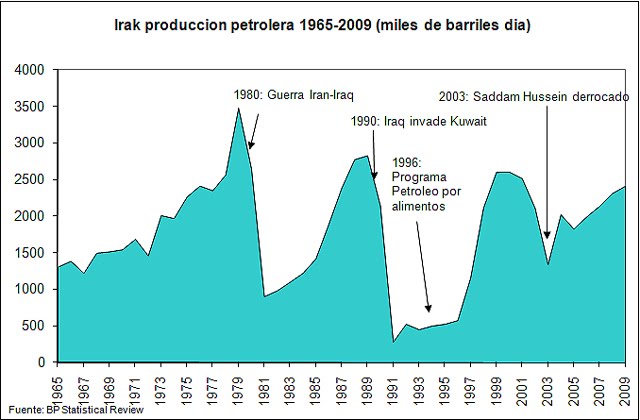
We’ve talked on other occasions of the difficulties that big oil companies find to grow. The reserve replacement ratio is still more than disappointing, below 100% since 2004. But in 2010 the industry could change course. In my opinion, the true hope of the sector is Iraq, the third country in the world in proven reserves, 115 billion barrels of oil, behind Saudi Arabia, with 264 and Iran with 138.

The country has generated much controversy in the press for the war but, since Saddam Hussein was overthrown, Iraq has achieved a production increase that was unthinkable under the previous regime, generating tax revenues for the domestic economy of almost $20 billion more that in the period 1980-2005.

Currently the geopolitical environment has improved substantially. Service firms are established, but the risks are not negligible, with nearby local elections, conflicts with the Kurdish minority and the gradual withdrawal of U.S. troops. For example, it remains unclear if the city of Kirkuk, home to a giant oil field, belongs to the Arabs or the Kurds, which prevents investment there.

The local government has advanced rapidly, licensing more than ten fields in the last year. After a false start in which the license auction was declared void (except the Rumaila field, BP -CNPC) because the conditions imposed by the government were too expensive, between the second half of 2009 and 2010 the government has auctioned licenses to operate up to 60 billion barrels in estimated reserves, with a national strategy to increase production from 2.5 million barrels per day today to a very ambitious target of 12 million. From BP, Shell, Statoil and ENI, to Russia’s Lukoil, China’s CNPC or Exxon, most big oil companies have participated in the process.

From my point of view, the goal of exceeding Saudi Arabia’s production is very ambitious. No one has managed to multiply by 5, as intended, the production of a country in 10 years. I think it’s much more logical to assume that production will rise to 3.5 million barrels per day in 2015, in line with the history of typical production recovery in this region (including Iran).

And the problem now is the costs, estimated at $ 19/barrel (F&D), plus an additional fee of nearly $ 2/barrel. The contracts allow the oil companies to cover costs up to a minimum production level. Until there is a contract typical of the industry,within what is called a PSC(production sharingcontract).

But if minimum production targets are not met, oil companies will suffer from profits lower than the average cost of capital, or even losses. The Zubair field, won by ENI and their partners, for example, will likely generate an internal rate of return of less than 20% below $55/barrel, while requiring investments in excess of $20 billion over 20 years.

If you have enjoyed Avatar (great movie, by the way) and the not-so-subtle allegory about the oil companies, you probably think that this whole process is abominable, but the increase in gross domestic product, infrastructure and wealth for the country that these projects, neglected or poorly managed so far, will generate, will be a giant leap for the country’s ailing economy. The investments to be carried out are astronomical, nearly $ 100,000 million between 2009 and 2029, including infrastructure, water, schools, hospitals , almost the construction of entire cities. Consider that some of these fields require about 500 workers. And the fact that contracts are aggressive and costly conditions for oil is a minor problem, because for them it is probably the last opportunity to improve their low reserve replacement for once.