Category Archives: On the cover

On the cover

Spain: The Mother Of All Bailouts And The Financial Hole

If there are three questions that investors ask me every day those are: why has Spain been so reluctant to ask for a bailout?, why doesn’t Europe act decisively on the Spanish problem? and why does no one really know the true figure of Spain’s banking hole?.

While the IMF has estimated the capital needs of banks at 40 billion euro and Spain has requested an EU credit lifeline of 100bn, I will try to give some ideas that can help answer those questions.Today’s Spanish banking system bailout poses more questions than answers. The financial assistance will be provided by the EFSF/ESM yet these entities are barely capitalized, so the debt of Europe will rise. Also following the proposal, which the Eurozone highlights is a maximum of 100bn, an assessment should be provided by the commission, in liaison with the ECB, EBA abd IMF, as well as the necessary “policy conditionality for the financial sector”. What will those conditions be?. What will this new line of credit –debt- do to Spain’s public debt and borrowing costs?, as investors will add this new line of credit to Spain’s debt pile even if the EU allows the country to account for it separately, and also how will the clean-up of the banks impact on credit to the real economy, which is likely to decrease further?.  

Why did Europe not act more decisively on the Spanish problem?

Basically because non-European bond investors, sovereign wealth funds and central banks, have no significant further ability to add Europe risk to their portfolios, because European countries cannot borrow much more and because the proposed solutions so far are nothing but solving a debt problem with more debt. Another exercise in kicking the ball forward without addressing the debt problem.

The week has given us interesting surprises added to the aforementioned report of the IMF, which highlighted that the core of the Spanish financial system is solid, but draws attention to persistent vulnerabilities in the system. A couple of things: 

  1. The President of the Chinese sovereign wealth fund, China Investment Corporation, Lou Jiwel said that they will not buy more European sovereign debt until the EU takes radical measures to solve its problems. I would highlight his comment “the risk is too high and the returns are too low.” This sentence, similar to that made by Russian officials, helps to provide an answer to a question I get from many readers “is there suddenly no money for Spain?”. Indeed, the availability of foreign investor money is limited after a decade of excess borrowing.
  2. In the UK the rumour is that the British government may not accept an unconditional bailout of Spanish banks with European funds, as it could require a change of the Brussels Treaty . Why? Because the UK spent 31% of its GDP rescuing its banks on its own. Being the second largest net contributor to the EU after Germany (12 billion euro), financing the bailout would almost double the UK contribution, after a 74% increase in 2010. Holland has also warned of the possible need to review, and approve, a new EU Treaty. Watch out for vetoes, which could be likely.
  3. The borrowing capacity of the European Stabilization Fund (EFSF) is increasingly questioned. Bond trading desks have mentioned that their investors no longer consider it in their benchmarks, given the systemic risk, according to Daily Telegraph.

If we add to the above issues the considerable difficulties of the European Central Bank and the International Monetary Fund, as we mentioned in this column in the past two weeks, the only real alternative for Spain seems to be the European Stabilization Mechanism (ESM), but, alas, the fund will not be operational until July, and funds are also limited. The funds that the press mentions over and over, 500 billion euro, will not be available until 2014. The ESM’s capital is less than 16 billion euro, which implies that its maximum leverage capacity is 107billion euro until October 2012.

Even if the ESM leverages its balance sheet its maximum capacity does not cover a third of the potential risks of Greece, Spain and Italy. That is if we ignore the small insignificance that all this means to try to solve a debt problem with more debt and with no meaningful access to non-European investors. In the end it seems it will be the indebted countries of Europe lending themselves money in a kind of circular pattern.

Why has Spain taken so long to ask for a bailout ransom?

That is the million dollar question. Well, at least a 40 to 100 billion question.

First, and this is obvious, to avoid the word “rescue” and the enormous negative political implications involved, and to try to force a combined solution combining private banks bail-ins and a European credit line. Basically to prevent a “Greek bailout” headline in favour of a “sweet and soft bailout” that does not affect sovereignty and only addresses banks liquidity needs.

Spain’s unwillingness to ask for a full bailout looks to prevent the negative consequences for the economy of a full-scale intervention, the famous fear of “the Men in Black” coming to impose massive cuts and tax increases. I personally think that the fear of technocrats is a bit of a memory of the past, from the intervention of Spain in the late 50s. And it might be unjustified as Italy and Spain’s own history shows that in many cases technocrats can be quite positive for the economy.

Too big to fail and too large for bail-out. 

Second, because Spain cannot be “rescued” the Greek way as it is the fourth largest economy in the EU and it would severely impact the entire Europe. In addition, Spain must and can solve its problems alone, as we have mentioned again and again. Spain can cut a large part of the 12 billion it gives in subsidies and its bloated public sector and it has big international quoted banks with a global presence. The IMF said in its report that “in the most unfavorable scenario (-4% GDP 2012), the largest banks would be sufficiently capitalized to withstand a further deterioration of the economy”.  This is why the solution of a 100bn credit line sought by the Spanish Government is much more logical. 

We must not forget that Spain also faces the need to calibrate very carefully the amount of help it needs, because, even if it is not accounted as public debt, the market will immediately add it to the country’s already huge external debt, and therefore its ability to reduce the deficit in the future. Most analysts fear that unless banks undertake the much needed capital increases quickly and efficiently, the burden of the new debt on the public accounts could be a real issue, deficit targets would be difficult to achieve and that borrowing costs will remain high.What we have seen with Spain and the EU is a negotiation to secure a compromise that is best suited to Spain knowing that if Spain falls, the entire EU collapses. A tense game of “poker”. The risk of these negotiations would be that if everyone plays to push the opponent to the edge, the entire table falls apart.

Why does no one really know the true figure of Spain’s banking hole?

The figures published in the press must give headaches to the average citizen. But we must understand that all this is the result of many years of hiding the problem. The “pretend and extend” era that I always write about.

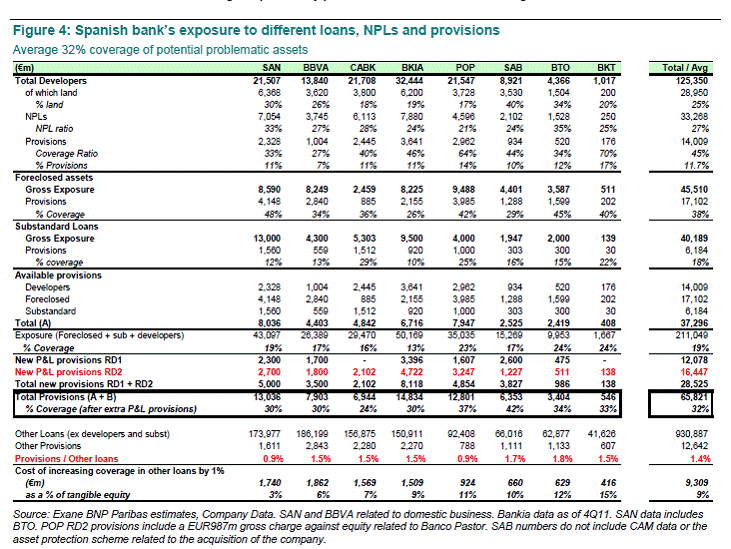
Banks in Spain have a capitalization problem, not a liquidity issue. After the 23.5 billion euro requested by Bankia and the possible need of another 9 billion from Catalunya Caixa and Novagalicia, the estimated figures range between 40 and a 100 billion. The IMF estimates are in the 

bottom of the range, and supposedly enough to meet the timetable to transition to Basel III.
image003

The first thing that surprises analysts is the low figure of provisions made so far .Less than 20% of the toxic assets (which thankfully will be increased to 32% after the recent legislation approved in Spain) but less than 1.4% of “other loans”, ie the “non real estate” that amounts to almost 1 trillion euroThe market has trouble believing the famous sentence repeated over and over in Spain saying that banks have made excessive provisions, particularly given the huge number of businesses closed and the large unemployment level. Minister De Guindos seems to doubt it too, and that is why I believe with the new management at the Central Bank Of Spain we will see a more thorough clean-up process.

The reasons why it is not easy to quantify the magnitude of the banking hole are mainly the following:

  1. My village is worth more than Detroit”. The inability to certify actual transaction values on land and housing loans. When there are no significant transactions since 2008, maybe loans are simply valued at the banks’ self assessment. Same with the empty ghost towns and homes built in areas without meaningful recent sales. The lack of transparency and real transactions makes the valuation process a “because I said so” problem, which is partially what led to the Bankia disaster, a conglomerate of savings banks overpricing their assets and underestimating the risk of their loan portfolio to improve their ratios in the merger.
  2. “You Never Give Me Your Money You Only Give Me Your Funny Papers”. One of the main issues is the sheer complexity of a giant web of loans that are considered “performing” but which are “lifeline” loans to avoid the bankruptcy of zombie companies. We are talking of massive loans to regional companies, government entities, developers and concessionaries which are technically bankrupt but are kept “alive” artificially.
  3. “I Call The Shots, I Say The Prize”. There is a huge amount of properties that are not sold because the owner says that “the price is the price” and never lowers it although there is no demand. But banks extend the owners their credits in order to avoid foreclosures which would increase the already large portfolio of unsold homes in the balance sheet of banks. Many of these loans remain in banks’ balance sheet valued at 80% of the “price”. But what is the real price of those homes when disposable income, wages and savings are falling in Spain?.
  4. “A Little Bit country, A Little Bit Rock n Roll”. The web of interests between banks, indebted firms and regions is a real issue. One of the reasons why the government has been forced to hire independent auditors is that there is a network of interests to keep asset values at high levels,  preventing actual losses from emerging. From desalinization plants that are woth a third of the invested capital, to uneconomical solar and wind projects and a web of cross-shareholding isn industrial stakes that are valued many times higher than market prices.

For example, if a region has requested a loan of 300 million to build a city for a circus –real case-to a savings bank, but the construction company has not been paid, and a bank has been forced to buy the saving bank, it now has both loans. Is there a vested interest among the three-saving bank, construction company and regional community-to defend that the project is still worth those 300 million?.

Today’s move from Spain finally asking for help for a figure -100bn- that addresses the top end of market estimates of the banks’ recapitalization needs is a step in the right direction. 

However, when you realize that of the potential $100 billion to spend, 22% of that has to be provided by Italy, and their lending to Spain is at 3% but Italy has to borrow at 6% the questions continue to arise. 

It is essential that the independent auditors put on the table a realistic figure of banks’ toxic assets, that Spain gets enough funding to support the recapitalization of the banks, but it is absolutely critical that banks finally behave responsibly and clean up the balance sheet so that there is no doubt about the strength of their accounts. Better to err from excess than to make the mistakes of the past. 

If Spain finally gets its act together there will be no need for  “men in black”.

The government in Spain seems to be determined to fix the financial hole created in the times when the country believed things like “we are the best and the world envies us”, “Spain has no subprime”, “we have the best financial system in the world and the best regulation”, “prices cannot fall”. The Irish clean up of its financial system cost them around 40% of GDP. Spain has to make that effort and finally emerge from the nightmare of its massive real estate bubble. Realistically, not with promises and prayers.My interview on Al Jazeera here

http://www.aljazeera.com/programmes/insidestory/2012/06/20126126534386935.html

This article was published in Cotizalia on June 9th 2012

Official Statement from the EU: The Eurogroup has been informed that the Spanish authorities will present a formal request shortly and is willing to respond favourably to such a request.
The financial assistance would be provided by the EFSF/ESM for recapitalisation of financial institutions. The loan will be scaled to provide an effective backstop covering for all possible capital requirements estimated by the diagnostic exercise which the Spanish authorities have commissioned to the external evaluators and the international auditors. The loan amount must cover estimated capital requirements with an additional safety margin, estimated as summing up to EUR 100 billion in total.
Following the formal request, an assessment should be provided by the Commission, in liaison with the ECB, EBA and the IMF, as well as a proposal for the necessary policy conditionality for the financial sector that shall accompany the assistance.
The Eurogroup considers that the Fund for Orderly Bank Restructuring (F.R.O.B.), acting as agent of the Spanish government, could receive the funds and channel them to the financial institutions concerned. The Spanish government will retain the full responsibility of the financial assistance and will sign the MoU.
Beyond the determined implementation of these commitments, the Eurogroup considers that the policy conditionality of the financial assistance should be focused on specific reforms targeting the financial sector, including restructuring plans in line with EU state-aid rules and horizontal structural reforms of the domestic financial sector.
We invite the IMF to support the implementation and monitoring of the financial assistance with regular reporting.

Close To The Edge Or The End Of The Tunnel

(This article was published in Cotizalia on June 2nd, 2012)

Let me start from the end. We are arriving, slowly and with enormous difficulties, at the end of the tunnel. We simply don’t know it because the light at the end of the tunnel is not “back to 2007”. The end of the tunnel does not mean growing at 3% per annum, more debt, the stock market back at highs and holidays in Marbella. I expect a tough decade of adjustments and depressed valuations, because the world is slowing its growth. But it is a very healthy sign to see that Europe is finally exposing the skeletons of the closet, the need for recapitalization of the banking system and adopting the adjustments that the economy has demanded for years.

While the stock market plummets, driven by the weak data coming from the US, China and Europe, I would like to remind of what I always say. This market is a bad investment, but a good bet.

A few comments:

* Despite the fall of the Ibex in Spain, the valuations of most of its companies have not changed significantly relative to their European and global peers in debt adjusted relative multiples. It’s just that most are barely less expensive than they were a few years ago, when Spain traded at “high growth” premiums to peers. Look at the valuations of Russian, Chinese, Brazilian, French and American stocks that collapse every day… And debt is an important factor to curb expectations-hopes-prayers of takeovers. Because predators post-2008, after the value destruction of accumulated losses in corporate transactions, rarely seek to buy more indebted companies.  Remember that over 78% of all corporate transactions in Europe between 2005 and 2011 have been value-destroying, according to Morgan Stanley. The only way in which the Eurostoxx or the Ibex will go up will be when companies show growth cutting off debt.

* In May the bond and stock markets in Europe and emerging markets saw more than 30 billion euro in outflows. We can complain as much as we want about short positions, but what we have here is pure and simple selling. Especially from Long-Only funds.

* 2011 and 2012 so far have been the years with the lowest percentage of share repurchases by companies and executives since 1998 (source: Goldman). It is almost ironic that those who complain about the price of their shares are not buying.

* The greatest mistake of investors in these months has been to remain positioned in risky assets waiting for an elusive ECB, Fed or China stimulus. As a friend always tells me, the only ones who now demand a stimulus plan do so not because of the state of the economy, but to see stock markets rise. And of course, we forget the chart below (courtesy David Einhorn). More stimulus means more debt and fail again.

Spain. Rescue? What Rescue?

This week the successive set of global economic figures, almost all negative, has driven markets to panic mode. But with all due respect to the poor U.S. data, the slowdown in China and the debt crisis, what I find really surprising is to read that 57% of citizens in Spain support a rescue package from the IMF or ECB, because it shows that much of the population supports more stringent austerity measures and the budgets cuts that would be imposed with a rescue package, as we have seen in Portugal. Let’s not forget that any bailout will be done to strengthen the creditworthiness of the country and that means cutting the large expense items -pensions, unemployment support, public sector. In fact, the largest additional effort that will be demanded by the EU, IMF and anyone that’s going to pay for the rescue will be a meaningful reduction in the public sector.

The world is aware that the 5.3% deficit target for 2012 is unachievable, since the estimates of revenues looks too optimistic. More taxes have proven to generate limited or negative revenue growth. The Laffer curve shown in all its glory again. So what will be critical will be to focus on reducing overheads (ministries, councils, subsidies, etc..), liberalize some sectors and cut energy costs.

But what surprises me most is to see how little liquidity is available in the global system to put out financial fres when they become as large as Spain. Last week we talked in this column about the huge debt that the Fed and the ECB hold, and their problems. But the IMF now has just 330 billion dollars of funds available, from a total of $560 billion, almost all of it debt-financed in New Arrangement to Borrow (NAB) , and the veto of both the UK, Canada, United States and China, who refuse to provide more funds, given their own specific domestic debt issues.

A lifeline to Spain of $300bn would consume most IMF funds, and make it impossible to prepare for a solution for Italy, for example. This does not mean that the IMF with the ECB could not provide an appropriate credit line, but a full rescue package seems unaffordable. 

Incidentally, it is striking that in the orgy of debt of the OECD, the IMF has gone from providing support packages of 20 to 30 billion dollars to now talking about figures that are ten times higher to historic ones. 

How to solve a problem called Spanish banks?
All this intense support that the Spanish government is negotiating is to finally make an attempt to clean up the financial system after years of denial saying stubbornly that it was the best and most effectively regulated banking sector in the world, with no sub-prime. A final attempt to limit and clean the real estate exposure, therefore trying to stop the current effect of “contagion and collapse”. Contagion of bad non-performing loans on the rest of the portfolio of credit of banks and collapse of new credit to the real economy.The announcement by Bankia of its capital needs 23.5 billion euros, has revealed two things:

1) When it comes to provisions, the term that the ordinary citizen sees is “revealing losses”. If, as Draghi said on Thursday, banks subject the country to a steady increase of the amount needed for provisions, it creates uncertainty, lack of credibility and suspicion. A slow drip of bad news does not reduce risk, it multiplies the confidence problem . Markets sell the shares and there is a risk of an outflow of deposits. It is better to err by excess of prudence than to wait for markets to forget the  previously published figure of real estate losses and see if it works.

2) The need to recapitalize Spanish banks probably reaches 70-80 billion euro, according to Nomura and Morgan Stanley. As always, Goldman Sachs, optimistic as they are, see only an estimated 17 billion euro of capitalization needs. Anyway you see it, an enormous figure that makes Spain “impossible to bail-out”. And even Goldman warns that banks may be spending up to 6% of Spain’s GDP annually to finish building houses and homes to avoid having to make higher provisions (if properties are finished the provisions required by law are substantially lower).

Therefore, Spain can not afford a Swedish solution, public money to bail out all banks and remove their toxic assets, given the monstrous amount of exposure to real estate of banks, and given the current level of government debt. Issuing public debt to fill the capitalization gap of banks could prove to be extremely damaging to Spain’s already high cost of borrowing.

A possible solution comes from a Bail-In with limited public cost. Forcing a conversion of debt into shares, even though banks dislike this measure due to the massive dilution that would result for their shareholders. The Instituto Juan de Mariana points precisely to that solution , which I also commented on twitter and in this column. Debt To Equity Swaps. An internal recapitalization, forced conversion of debt into equity, which affects only the bank’s shareholders, not the taxpayer, rather than a public bailout, which would be unaffordable and extremely costly. 

A bail-in has the advantage that the bank loses the perverse incentive to return to making lending “mistakes”, “knowing” that it can be rescued with public money. As the bail-in affects its shareholders the most, they will be the first ones to force the bank management to behave appropriately in future lending.The solution is difficult and slow, but once Spain has finally imposed severe recapitalization measures the light at the end of the tunnel will be evident, as seen in other countries.

Confidence and credibility

In a country that has withdrawn billions of deposits from their banks in the first quarter according to the Bank of Spain, Spanish mainstream media (chiefly La Razon, Publico and ABC) still has the audacity to blame the international press, the Anglo-Saxon evil papers, and “speculators” for the decline in its stock market and the rise in bond yields. Blaming the wicked investors who Spain so desperately needs to buy its debt, or the foreign press, by the way, the same press that criticizes openly and aggressively Obama, Bush, JP Morgan, Goldman or Cameron. Yet the headlines “Spain under attack from speculators” and “the attack of anglosaxon press to our banks” is repeated like a mantra in different forms.

The beginning of the solution to Spain’s problem is foreign capital and we must attract it. When I hear atrocities about “scavengers” (on Spain’s public TV) referred to international investors I think that Spain’s media -unwillingly- is at risk of sabotaging the government efforts to seek funding and solutions.

The truth is that I have never seen any business / country prosper and be sustainable on the strategy of telling their clients / investors that they are ignorant and publicly blaming clients for the slowdown in sales. Nor have I ever seen a market that values ​in a positive way a constant change of targets, or missing them, even by a few decimals. Investors can not make acts of faith, because they are not allow by their own customers. If there is no trust, there is no investment. And if the country is not well understood, is it not our fault for not explaining ourselves clearly?

I live in London. Spain is a country valued for its solid corporations and professionals. Hard workers, serious and humble. This media concept of “they do not understand us” or “they attack us” parts of two very dangerous vices that were not typical of Spain. Arrogance and ignorance. The arrogance of thinking that we deserve the attention, forgiveness and eternal capital of investors, no questions asked, and ignorance of what happens globally, which is that almost all OECD countries are in trouble and that the money available is reduced by a deleveraging world.

Spain should not settle on being “one of many bad countries” but we have, precisely because of our current difficulties, to do our homework faster and better . Because we do not judge ourselves. We tend to see ourselves more beautiful, slimmer and with more hair than it is real. We are judged by the world.
Investor confidence can not be recovered in five months. We can not demand that speed. Trust will be recovered with hard figures, not of a quarter, but those of 18-24 months. I’m sure Spain can do it.
Originally published in Cotizalia.
To watch my interview in Al Jazeera about the Spanish banking issues go: (Quicktime or Oplayer required) http://dl.dropbox.com/u/62659029/iv_daniel_lacalle_250512_0.mpg

And my interview on Spain’s bailout

http://www.aljazeera.com/programmes/insidestory/2012/06/20126126534386935.html

Further reading:

Eurobonds? No Thanks. Debt Isn’t Solved With More Debt: http://energyandmoney.blogspot.co.uk/2011/11/eurobonds-no-thanks-debt-isnt-solved.html#

What happened to put Spain on the verge of intervention?: http://energyandmoney.blogspot.co.uk/2012/04/what-happened-to-put-spain-on-verge-of.html
Why Italian and Spanish CDS can rise 40%… and Greece is not to blame:

http://energyandmoney.blogspot.co.uk/2011/11/why-peripheral-cds-can-rise-40-and.html#

The Spanish Banking reform
http://energyandmoney.blogspot.co.uk/2012/05/spanish-banking-reform-and-devils.html
What If Germany Turns Off The EU Funding Tap?

(This article was published in Cotizalia on May 26th, 2012)Another week and as part of our leaders think that the rest of the world is wrong, capital continues to fly away from Europe. €700m a day according to press. The credit and financial credibility of the Eurozone couldn’t be any lower. Yes, my friends, investors will not return if the numbers are not solid, and politicians cannot prohibit selling.

Eighteen European summits in two years. European politicians seem increasingly more detached from the real problems of the economy. How can they meet again without reaching an agreement on anything? They seem to give a message of selfishness to the public, and that they are cheating to investors.

We get constant calls to promote growth, which would be fine if they were not calls to encourage the same subsidized wasteful spending of the past. Funily enough, if the EU had cut part of its €141bn budget, out of which 45% goes to “employment and growth”, by today the continent would have a lot less debt and a lot more growth. In any case, I think that we will gradually see a more logical reform agenda for Europe.

We are outraged to see that Germany finances itself at near zero rates while Southern Europe countries finance themselves at 6% or higher. But instead of thinking that, perhaps, the Central European austerity plans work, the press and politicians say that Germany is going against us, “drowning” us.

We hear that the blame for the debt crisis should be pinned on Germany which broke the deficit limits in the early 2000s, which “obviously” led everyone else to go into a debt frenzy. Here nobody is to blame for anything. It’s like those people that stuff themselves with Big Macs and blame McDonald’s for their obesity. If a bank fails, blame it on the “ill will of the anglosaxon press.” If the stock market falls, blame it on Greece or hedge funds, or both. And the giant real estate bubble, the massive subsidy culture and the savings banks’ recklessness have Helmut Kohl to blame. Please

However, countries that have implemented austerity and budget control, from Estonia to Germany, are those who are better off today. We should not demonize them, but learn together how to attract capital and get out of this debt mess. Austerity -cutting giant political spending- and growth -not subsidies.

Austerity and growth are not mutually exclusive. Reckless spend and growth are.


From a market perspective, the only way to reduce risk premiums and attract investor interest is just moving towards a single tax system, and to contain government expenditure, which has done nothing but grow even in years of “austerity”. Public spending in the EU has not fallen in most countries between 2008 and 2011. In Spain it is still 4% higher than in 2008.

The graph below is devastating. Either we adapt spending to “pre-bubble” levels or the CDS will not stop rising.

Why we should not allow the ECB to become the worst hedge fund in the world

When we say that countries should receive more money from the European Central Bank we forget that it can not infect its balance sheet at the rate of one trillion euros per semester.

Germany, the Netherlands and the countries of central Europe are those who have to carry the financing risk. Not France, which has a serious debt problem. And if they close the tap, it will be bad. But if they open the tap too soon and too much it will be worse. Because they run out of water for the next fire.

There are several things we should know about the European Central Bank:

  1. . The ECB’s current debt is monstrous. At 23 or 24 times its assets, with only 82 billion euros in capital and reserves. Of course, the Fed’s balance sheet is also unacceptably high, 53 times its assets … The big difference is that the capitalization of the Fed does not depend on severely indebted entities such as the European states. But as I always say, we should not copy the ones who do wrong and reclaim our right to do worse. Let’s remember that the U.S. is on the brink of a “fiscal cliff.”
  2. . The ECB weakens with the losses incurred from its purchases of sovereign debt. We are talking about latent losses between 55 and 70 billion euros (source Barcap and Open Europe). Of course, many will say that there are no “losses” because the ECB has not sold the bonds -a “bull market” argument- but anyway we want to see it, systemic risk is increasing and does not dissipate by buying more bonds, as we have seen since November. In fact, losses have increased in 2012.
  3. . The European Central Bank has already contributed to the stabilization of the European market, excessively aggressive and quickly. With more than 1 trillion. And the ECB should keep powder dry in case of future emergencies, because the future ain’t what it used to be, to quote Jim Steinman.
  4. . Saying that “we must use the money of the ECB” is false because it is not disposable money. It is debt, which must be funded through more sovereign debt. The ECB Balance sheet growth goes also against our future tax bills.
  5. . To those parties that demand that Europe should “capitalize “the debt of the ECB: Where will that money come from? Furthermore, it an indirect default that would severely impact the creditworthiness of all solid countries of the Eurozone.
The plan
Once we understand that going back to 2007 can not be the goal, that the bubble and the party is over, we will see things are much clearer and less negative.Eurobonds cannot be implemented when one party in a small country can bring half of Europe to its knees. Creditworthiness would collapse when there is no unity in economic and fiscal policy, and the risks spread, as we mentioned here. Eurobonds, no thanks. I hope we have learned something from the subprime crisis. Packing and hiding toxic assets does not reduce the risk, it increases.No, Germany is not closing the tap, in my opinion. Neither they are going to let anyone drown. Let’s not be dramatic. What Europe has to do here is to stop the party of political spending and subsidies. That’s not drowning. Germany has an exposure to the EU of 500 billion euros and the risk of financial contagion between European countries far exceeds the estimates of many banks.

However, I keep hearing that we need a growth plan, which sounds great if it was not for the fact that it’s a borrowing plan. As of today, and after two years writing about it, I can not believe that Europe is betting on more debt. Remember  that almost no European country has created GDP growth ex-debt in the last 22 years. Have we not learned from all those ridiculous infrastructure plans?. I leave you a figure: the European economy generated less than $1 of GDP for every $ 2.5 of debt (Barcap and IMF data). That is, we continue to build the huge ball of debt in the vague hope that growth will multiply exponentially some day.

This week I have seen some possible proposals that would go to the June summit. The recapitalization plan in Europe would happen of three phases:

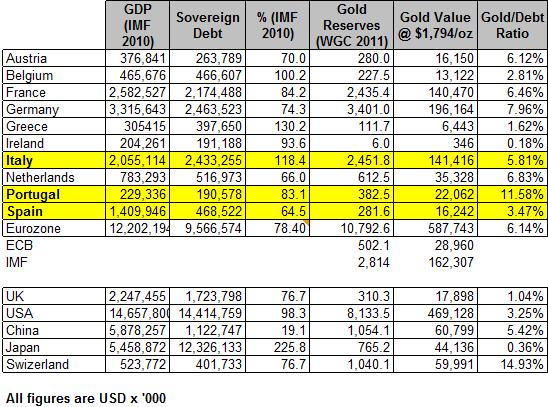
1) A fund to pay debt (Redemption Fund) that incorporates the indebtedness of over 60% of GDP backed by gold reserves of the States. This fund would repay that debt against a commitment to economic reforms, adjustments and more severe cuts guaranteed in the Constitutions of the member states. The problem? The gold to debt ratio of troubled countries is very low. An average of 6.1% for the Eurozone and 3.5% for Spain or 5.8% for Italy.

Gold Res

2) A line of credit to banks to ensure liquidity needs, but not capital needs. We seem to forget that these are mostly all listed companies that can and should access their investor bases to recapitalize themselves.

Additionally, the idea is to try not to create false inflation . The economic miracle of  Central Europe is based, among other things, on multiplying by three the number of low-paying contracts (mini-jobs). An increase in inflation would be lethal because the euro-zone countries have never been able to control it when it overshoots, especially when it’s external inflation (commodities).

And finally, tackle the unjustified strength of the Euro currency versus the US dollar, to devalue and promote competitiveness, reducing the need for internal devaluation we have seen so far. It will take the market to do this last bit, as economic expectations of the euro-zone are adjusted to more realistic figures.The key is shows in the above graph. Either we attract private capital back once we have proven real creditworthiness, or we continue whinging blaming the Germans, the markets or Hedge Funds.

Germany and the ECB are not the problem, but they are not the solution. Only countries can save themselves. If not, there will come a time when Germany and the ECB runs out of money for bailouts.

Hopefully in June, EU leaders will forget about trying to re-create 2007 and think of a more rational future.To watch my interview on Al Jazeera about the Bankia and Spain (Realplayer Quicktime or Oplayer needed): http://dl.dropbox.com/u/62659029/iv_daniel_lacalle_250512_0.mpg

Further reading:

Eurobonds? No Thanks. Debt Isn’t Solved With More Debt: http://energyandmoney.blogspot.co.uk/2011/11/eurobonds-no-thanks-debt-isnt-solved.html#

What happened to put Spain on the verge of intervention?: http://energyandmoney.blogspot.co.uk/2012/04/what-happened-to-put-spain-on-verge-of.html

Why Italian and Spanish CDS can rise 40%… and Greece is not to blame:

The Myth of European Austerity In Five Graphs

This article was written by Manuel Llamas and Domingo Soriano published by Libre Mercado here. All copyright Libertad Digital and Libre Mercado. (Wednesday 23rd June 2012).

“A lie repeated a thousand times becomes the truth”. This well-known sentence, attributed to the master of Nazi propaganda, Joseph Goebbels, could also serve to illustrate the great deception of the alleged public austerity in Europe. Since the outbreak of the debt crisis, it is widely repeated that Germany has sought to impose on the rest of the EU partners an adjustment plan focused on cutting costs and implementing structural reforms that would foster economic growth.

This strategy has been harshly criticized by many economists and by the Southern European countries, the weakest in this crisis, with Greece leading the critics. In fact, analysts, politicians and union leaders blame all the current problems of Europe, including the Greek default, on the imposed austerity measures. After the recent French and Greek elections, the critics of Merkel’s strategy have begun to gain notoriety, to the extent that the European summit to be held on Wednesday will focus more on how to boost growth through government spending (stimulus) than on further cuts in policy to reduce the deficit and debt burden.

However, official data (Eurostat) shows that the much-touted European austerity is today little more than a myth. The Greek default was not due to the demanded cuts but due to the decision to keep a bloated state unchanged. Likewise, the evolution of spending, deficits and public debt in the euro area shows that the austerity only exists on paper. Neither governments have stopped spending well above their means, nor have they undertaken structural reforms to enable their economies to improve their productivity and grow solidly in the near future.

More public spending

The most striking figure, amid all the rhetoric against the cuts, is that public spending in the euro area as a whole has grown by almost 7% between 2008 and 2011, reaching 4.65 billion euro.

In the South of Europe, those most affected by austerity in theory, the evolution is similar: Public spending in France rose by 8.6% since 2008, in Spain, 4%, in Italy, 3%, in Portugal, 7.8%, while in Greece, despite all the announced cuts, spending fell just 8.5% over the 2008 level, although today its public sector continues to spend 2% more than in 2007 (just before the crisis).

In essence, no European country has managed to reduce their public spending to 2004 levels, a few years before the start of the international crisis, which itself could be considered as an exercise in austerity. Not at all. The following chart summarizes the evolution of public spending in these countries, measured in nominal terms at current prices.

auste01

auste02In fact, the situation hardly changed if we look at the evolution of public spending in real terms after inflation.

More deficit and debt

Of course, increasing public spending also meant higher deficit and public debt. As such, in the middle of alleged austerity, the deficit in the euro area as a whole, far from diminishing, has tripled since 2008 , from 2.1% of GDP to 6.2% in 2011, while public debt has grown from 70.1% in 2008 to 87.2% of GDP last year.

As we can see in the graph below, the public sectors in Spain, Greece, Italy and Portugal, the four southern European countries most affected by the debt crisis, are still spending more than they earn. Only a few countries in the North and East of the continent (exemplified here by Germany and Estonia) have maintained their public at deficit under control during these years of crisis.

Chart above shows public deficit.

Obviously, if the deficit is out of control every year, public debt will continue a worrying upward trend. As we can see in the image below, all the countries of southern Europe have public debt figures that are much higher than that held at the beginning of the crisis. Even Spain, which began with a very reasonable level of public debt of less than 30% of GDP, is now touching 70% and could end 2012 above 80%.

deuda-publica-22052012

Greece, meanwhile, is at levels close to 200% and Italy is moving steadily to 130%. With these levels of debt, it is logical to see international investors unwilling to buy more South European government bonds, and the to see the CDS and spreads versus the Bund soar. But governments and political parties continue to blame the “evil speculators” or the unfairness of German taxpayers, strangely reluctant to lend more money when nobody else wants to either.
Chart above shows public debt growth.
Along with the complaints about unreasonable “cuts” allegedly “imposed by the markets” (or the Germans), in recent weeks we have seen a growing public debate that wrongly puts austerity and growth as two opposite concepts. They are not. Austerity is the antonym of waste. In fact, recent history shows that more government spending does not foster growth, and does not help to get out of economic difficulties.

The current crisis began in 2007. From then until late 2011, the four southern European countries we are considering implemented aggressive public “investment” policies that Keynesian economists would qualify as clearly expansionary, with deficits close to or above 10% for several years. If this theory were true, Greece, Portugal and Spain would have already recovered and the growth generated by the “virtuous circle” created by government spending would be paying their debts. But none of this happened.

deficit-publico-22052012

crecimiento-pib-22052012

Meanwhile, Germany and Estonia followed the opposite path and imposed austerity. The result is that both countries had a strong relapse in 2009, with the political cost that it entails . But they are recovering faster and now have much stronger economies. Meanwhile, in Spain, the “Plan E” of investment in infrastructures, an enormous waste of public funds with its vast implication on cost of borrow and deficit, and other public spending measures have failed to stem the crisis. But the message currently repeated over and over is that it takes even more government spending, for much longer, to foster growth. But… For how long?

Chart above shows growth in GDP


Follow Manuel Llamas on @manuel_llamas