Category Archives: On the cover

On the cover

Is the EU growing or getting fat?

The economic sentiment index in the Eurozone is at a five-year high. The index (ESI) rose to 109.6 and has been growing for steadily. With estimates of consumption growth moving between 1.5 and 1.7%, and investment growth of 2.5%, data confirms that manufacturing indices also continue to expand.

To positive macro data, we can add corporate results. In the Eurostoxx 600 we have seen results from 186 companies with a decent sales increase, with a strong double-digit net income improvement. This growth also occurs at the same time as balance sheets have been strengthening.

Is it a direct consequence of the European Central Bank’s policy? Not necessarily. The ECB policy has negatively affected the financial sector earnings and corporate margins remain poor in EU companies’ domestic businesses while deleveraging was much more intense between 2011 and 2013.

There is no denying that Mario Draghi ‘s “stick and carrot” messages have been essential to preventing a new housing bubble fueled by cheap credit, but it is still relevant that almost 30% of the credit granted to the private sector goes to real estate, services and administration. The level of growth is not worrisome, but the increase of investment and credit growth is going to very low productivity sectors.

Investment growth is very poor because low rates and excess liquidity have been essential factors in perpetuating endemic overcapacity (25%) and zombifying sectors of low productivity. But, additionally, almost half of the gross capital formation in the EU’s large economies comes from construction, as Claus Vistesen warns.

Credit growth of 2.4% in March shows that the increase in money supply is still much higher than the growth in leading indicators, and whether this improvement is generated in sectors whose profitability and survival depend on ultra-low rates, can generate an important risk. That is why it is worth analyzing a ratio that analysts tend to be forgotten in Europe,  inventory to sales. It has risen steadily in the past months.

The recent accumulation is not worrying in the Eurozone, but we cannot ignore the risk of extreme credit conditions pushing to perpetuate a model of poor added value. When more than 50% of the total credit granted – public and private – goes to current expenditure and areas of low productivity, the brief “placebo” effect of expansive policies may create a boomerang effect afterward.

According to Moody’s the risk is huge when a very significant part of the companies and governments in the EU could not absorb a 1% interest rate increase.

That is why Draghi’s message on the importance of structural reforms is so relevant, reminding that monetary policy is not a free ride to increase imbalances. Unfortunately, the perpetuation of those imbalances and the perverse incentive to increase the weight of low-productivity sectors is enormous. It is quite evident. Who are the sectors and companies whose investment decisions depend on low rates? Those with poor added value, low margin and weak productivity. With all the effort being made by the ECB to avoid perverse incentives, it is impossible to limit them because the greatest perverse incentive is the so-called expansive policy itself.

When that poor growth and productivity effect given by monetary policy ceases to have its placebo effect, it will be said that “it was not enough” and that it is necessary to repeat.

There are positive elements. Eurozone banks paid € 3.6 billion to the European Central Bank for excess liquidity in 2016 which, at the end of this article, remains at 1.27 trillion euros. That shows that they are not giving loans like crazy, and prefer to be penalized than to repeat the mistakes of 2007.

The reader may say that sectors with good margins and high productivity do not need credit, or at least in large amounts. But think of the reasoning. If it is so, then credit growth as a driver of improvement in the economy is a mistake, because it increases leverage to sectors that cannot face a change of cycle with strength.

In reality, the problem of the Eurozone has never been of liquidity – there was already an excess of it in 2013 – or access to credit, but of excess debt, low value added and overcapacity. The solution should not have come from a monetary policy that encourages indebtedness, no matter how much Draghi warns, but to eliminate that excess of unproductive spending and favor the change of growth pattern to technology and value-added sectors.

By maintaining the imbalances of the decade of excess we are missing the opportunity to prepare for the future.

We are far from a bubble situation, but in Europe, we are perpetuating overcapacity and the weight of rent-seeking and low productivity sectors, those that governments call “strategic”, and increasing debt to sustain current expenditure. And all of this does not make the EU stronger, it makes it fatter.

Daniel Lacalle is a PhD in Economics, fund manager and author of Escape from the Central Bank Trap (BEP), Life In The Financial Markets, and The Energy World Is Flat (Wiley).

Image courtesy @Focuseconomics

Financial Repression, Central Banks and Boom and Bust Cycles

The great debate in mainstream economics these days is centred in the weak level of investment and consumption seen throughout the current recovery. However, it strikes me as ironic that there is almost no debate in the Keynesian world about the diminishing returns of financial repression and the increasing loss of credibility of demand side policies.

There was a time in which the average citizen would see inflation as a fastidious side effect, as an anomaly caused by unclear factors. The veil was lifted in the last eight years. In the past eight years the US, for example, has seen the largest transfer of wealth from savers and the middle class to the government. $1.5 trillion in new taxes, $9 trillion in new debt and $4.7 trillion in central balance sheet expansion for a mere $3 trillion real GDP expansion.

Financial repression was the only tool to solve imbalances of the post-Bretton Woods world. But in the past eight years, financial repression was taken to an extreme never-seen-before.

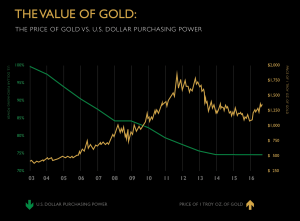
Citizens may not understand economics and the forces that affect their wealth and disposable income, but they sure do perceive the hole in their pockets. Financial repression has obliterated the purchasing power of the currency and at the same time made it more difficult for the middle class to improve their wealth, as it becomes more and more challenging to save and the returns of those savings are slashed with the subsequent 600 cuts in interest rates we have lived in the past decade.

(Source here)

Keynesians will say that financial repression is a necessary tool to improve the economy and solve imbalances created by one or another financial crisis. What they always forget to mention is that those crises have always been caused by the artificial creation of money without any real support. The boom and bust cycles are more frequent precisely due to this constant and uncontrolled use of monetary policy to cover structural problems.

The same mainstream economists will also say that the unintended consequences of financial repression are offset by the so-called “wealth effect”. Yes, the value and purchasing power of money are distorted and devalued, but stock markets compensate that effect and house prices rise. There is a problem. The vast majority of the hard-working middle class do not play the markets, and the constant boom and bust cycles, added to a weakening of purchasing power, makes it increasingly more difficult for citizens to become homeowners. In effect, 80% of US household wealth is not in stocks, financial assets or houses, but in deposits, which are being eroded by the policy of destroying savings to artificially subsidize the indebted and inefficient.

Mortgages may be cheaper, but it does not matter when your credit profile is weak and your salary does not reach to cover the bills. Add to financial repression tax increases and the “wealth effect” is felt less and less by the backbone of the economy, small and medium enterprises (SMEs) and families.

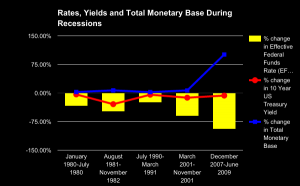
The above chart shows clearly why the middle class and SMEs are left behind in financial crises. The abrupt change in money supply and the lowering of interest rates reaches the weakest parts of the economy last, but when it goes the other way round and money supply collapses, it is the middle class and SMEs who suffer first through the credit crunch and inability to cover costs.

Furthermore, the middle class is not only finding itself as the payer of the bill of each new credit boom cycle, but it also finds it increasingly more difficult to participate in the recoveries, because families and SMEs are suffering the increase in the tax burden to cover the deficits created by wasteful governments and the bailouts of rent-seeking industries -through massive subsidies- and inefficient financial entities.

Not only is it more difficult to participate in the questionable wealth effect created by financial repression, but it is more risky, because the average citizen is a conservative investor looking at the long-term, and is rarely able to actively manage a portfolio to preserve capital and hold on to gains.

This is the reason why mainstream economists scratch their heads when voters react against governments that boast of economic recoveries that the average family simply has not seen. Because when governments forget sound money as a key principle, and the importance of defending savers, the voter will react against the rulers, even if they do not understand that financial repression is an active policy, not a coincidence.

Think about this, today central banks are increasing money supply -printing money- at a rate of $200 billion per month… and we are not even in a recession. With stock market valuations at all-time highs and bond yields at historic lows globally, imagine the side effects when this ends.

Today’s savers need to look for ways to reduce risk and preserve wealth, beating the inflationist agenda, and that is extremely difficult because the small investor’s tolerance for volatility and understanding of valuations is logically limited. That is why more and more small investors, looking to protect their hard-earned wealth, will look at alternatives to deposits that are as far away as possible from the temptation of manipulating money supply of the governments. As the only monetary policy used in the past 50 years generates ever diminishing returns even for the objectives of Keynesians, the urgent need to return to sound money measures and protection of the middle class becomes critical. Because the next bust will not be covered with lower rates and more money supply after 600 cuts and $20 trillion of liquidity.

Daniel Lacalle is a PhD in Economics, fund manager and author of Escape from the Central Bank Trap (BEP), Life In The Financial Markets, and The Energy World Is Flat (Wiley).

Special thanks to Robert Elway. Images courtesy of @RoslandCapital1 

How CEOs can avoid the central bank trap (CEO World)

This article was published in CEO World

We live in strange times. In the past eight years the US has created more money than in the previous fifty years combined, and at the same time interest rates have never been so low. However, total real gross investment in the OECD as a whole only returned to the pre-crisis level by 2014 and remains sluggish at best. In the same period, companies have been increasing cash flow generation and dividends and buy-backs have soared.

Why is this happening?

Welcome to financial repression. Extreme liquidity and zero interest rates policies have come with a nasty addition. Tax burden. Not only price and value of money has been artificially distorted, but the tax burden in the OECD is at all-time highs.

Financial repression is achieving the opposite of what it intends to create. The mainstream economists will tell you that lowering interest rates and massively increasing liquidity will push economic agents to take more risk, consume more and invest long term. But it does not happen as expected. Companies are more prudent in their investment criteria, and families actually save more, increasing their deposits. Economic agents perceive there is something odd in the economy, even if they are not experts, and become more prudent in the face of what is clearly a distorted cost and value of money. The central bank trap, which I discuss in my latest book.

The fact is that financial repression in the past eight years has resulted in one of the largest transfers of wealth from families and businesses into government since the Bretton Woods agreement, $1.5 trillion in new taxes in the US added to $9 trillion of new debt and $4.7 trillion of monetary stimulus. This, in turn, has driven a weak recovery.

A CEO today should be excited.

The opportunities that the central bank trap has generated are enormous.

First, expensive acquisitions made by others lured by the liquidity trap will become the exciting value opportunities for the prudent CEO that has avoided falling into the mirage of cheap debt. In the past two years, takeover targets have sold for a median of 11 times Ebitda, according to Bloomberg, whereas the multiple was only about 7-9 times up until then. Transactions are getting ever-bigger and more expensive, pushing total goodwill to $6.9 trillion. I believe that the sobering factor of tighter monetary policies, added to the reality of challenges in the economy, will generate extremely attractive acquisition opportunities when the bubble bursts. Of course, some CEOs have been very prudent making bolt-on acquisitions while preserving cash and strengthening the balance sheet, and some multiples are justified by realistic growth estimates, but many of the acquisitions that rose in multiples only due to cheap money and low rates will be the write-downs for some, and subsequent opportunities for the prudent manager.

Second, prudent CEOs have been right focusing on total shareholder return via dividends and buybacks in a period of weak growth and increased uncertainty. This has led to a historic high level of cash preservation and a clear mentality of focusing on return on invested capital. For a CEO, correct capital allocation is the main concern, and what better capital allocation than dividends and its own shares if there are no evident growth opportunities elsewhere? This period has seen an unprecedented decline in interest rates, but any CEO knows that perpetuation of overcapacity and large imbalances have also meant that the weighted average cost of capital (WACC) of most industries has not fallen. Instead, WACC has increased globally due to the poor growth and higher risk attached to the equity part of the equation. Therefore, the prudent CEO will not take this rise in WACC as an anomaly, or ignore it, but understand why equity risk premium rises –uncertainty on future estimates, constant downgrades from international agencies of their expectations-.  As such, a prudent CEO will analyze capital allocation opportunities with the view of preserving the value of his or her company, while placing investments in areas where conservative estimates allow a comfortable return on invested capital above its WACC. This strategy will help the CEO navigate an uncertain world where economic cycles have become shorter and more abrupt, as I explain in my book. There is no need to stop investing, rather the opposite, just analyze opportunities that enhance value while keeping a firm eye on shareholder return. We are seeing an improvement in growth and inflation estimates globally in 2017, but we need to pay attention as well to the imbalances that come with those expectations: Perpetuation of overcapacity, higher debt and higher taxes.

Third, CEOs should be excited about the opportunities that digitalization and robots offer. We are moving towards an age where there are lower capital requirements to deliver stronger earnings growth and efficiency and productivity will likely soar. Embracing change and leading the process is a critical element for CEOs to succeed. Another important recommendation to escape the central bank trap is to lead this change looking at higher innovation and investment in research and development. The biggest mistake a CEO can make in this environment is to follow the trap and increase spending disproportionately on subsidized areas or rent-seeking businesses. Low interest rates and high liquidity might lure many to poor productivity sectors, but these are the ones that will suffer the most when the tide turns, and it does. However, high value-added, superior productivity, technology differentiated companies with strong brands will not only gain market share and value, but thrive in complex economic cycles.

Most CEOs have behaved impeccably in this zero-interest-rate, massive liquidity environment. They have ignored the dangerous siren call to take excess risk and more debt and have focused on strengthening the value of their companies while reducing imbalances and creating an environment for a better, more sustainable growth model.ost companies did not follow their incentive to overspend and take more debt. But no government or central bank committee has more or better information about where and how to invest than CEOs and their teams. It is easy to “demand” more investment from companies when the person doing so has no skin in the game. Now, the evidence is clear. The majority of CEOs did the right thing.

Now it is time to look at the future forgetting artificial monetary mirages and demand-side policies. The successful and prudent CEO will adapt and lead change focusing on productivity, technology and added value. And will reap the benefits of absorbing those that believed in growth by government decree and the illusion of the monetary laughing gas mirage.

The future belongs to those CEOs that focus on real fundamental trends and ignore the central bank trap.


Daniel Lacalle is the author of “Escape from the Central Bank Trap” (2017, BEP) ,“Life In The Financial Markets” (Wiley, 2014) and “The Energy World Is Flat” (Wiley, 2014, with Diego Parrilla).

France post-elections. Careful with optimism

The French presidential elections have shown several evidences .

The second round will again put a moderate candidate, Macron , against a far-right one, LePen. This happened years ago between Chirac and LePen’s father … The big difference is that, then, the combination of extreme-left and the far-right did not add more than 40% of votes.

The euphoria of analysts ahead of a second round that concentrates the moderate vote in Macron cannot make us forget that the French society has reacted to the fierce and interventionist statism of Hollande increasing the support to more ultra-interventionist radicalism.

The disaster of the socialist party – pledging unicorns, making stimulus plan after stimulus plan and raising taxes over and over- has been spectacular. Not only has ultra-left-wing and ultra-right-wing populism not stopped, but Socialists have legitimized and fed it by repeating to citizens that the magic solutions of eternal expenditure and constant imbalances were viable. Between the diluted populism of Hamon and that of the totalitarians Melenchon or LePen, many prefered the original.

The decline of the center-right comes after many years of renouncing to its principles of free market and low taxes, surrendering to copy the Socialist party. This has made Fillon, besides the scandals, appear as not credible in its proposals of reform, among other things because he has been in high positions of responsibility and those same reforms were delayed to perpetuate the interventionism that he now criticizes.

Both Hamon and Fillon have requested their voters support for Macron  in the second round, which leads to a high probability of a moderate victory.

What about Melenchon? The far-left candidate lost, but has refused to request the vote for Macron, proving that the extreme left candidate’s calls to defend France from the National Front were just political tactics. Melenchon’s economic policies are very similar to LePen’s.

The inability of traditional parties to respond to the real concerns of the people, including the terrorist threat and immigration, and their historic failure to implement reforms, has taken its toll .

When you make a race to see who is more socialist, it ends up backfiring and benefiting the one that promises unicorns.

The Macron challenge… if he wins

Now the problem of France is to recover the dynamism lost in an economy that Macron himself described as “sclerotic” . There are many doubts about his true reformist agenda, evidenced by his actions when he has been minister. But we have to give him the benefit of the doubt. He faces a radicalized parliament, with traditional parties in disarray.

Reducing corporate tax, cutting labor costs, carrying out a labor reform similar to the Spanish one, and immigrant integration policies are part of Macron’s proposals, but we must wait to see if he wins the second round and if he has the support to implement them.

The challenge is enormous.

Just fifteen years ago, Germany and France had similar deficits and debts. Germany took the road of reforms and France the “ostrich policy”, ignoring its imbalances, attacking its own waterline with confiscatory tax and spending policies to sustain a hypertrophied public sector.

The last time France had a balanced budget was in 1980, and since 1974 it has never generated a surplus, public debt reached 96% of GDP, the economy has been stagnating for two decades, unemployment stands at 10% (with 23.6% youth unemployment ) and in 2017 it still has a current account deficit of 6.5 billion euros while the Eurozone has a surplus. Germany, on the other side, has a budget surplus, growth, much less unemployment (3.9%) and lower debt (71%). The French candidates have blamed the country’s problems on external enemies, from ‘globalization’ to ‘the euro’, however, comparisons with Germany destroy those arguments. It is hilarious to listen to LePen or Melenchon, the Ying and Yang of extremism, blaming France’s problems on “budget cuts” or “austerity .

In a country where public spending exceeds 57% of GDP, where public administration spending has grown by more than 13% since 2008 and 22% of the active population works for the State, local governments and public entities, talking of austerity is a bad joke. In addition, France has spent tens of billions on ‘stimulus plans’ since 2009 . Specifically, 47 billion euro in 2009, 1.24 billion to the automotive industry and two ‘growth plans’ under the Hollande mandate: 37.6 billion euro (‘investments’) and 16.5 billion (‘technology’).

Blaming the French stagnation on “neoliberalism”, “austerity” or “the euro” is like an obese person blaming his overweight on lack of more donuts.

The problem is economic “dirigisme” -interventionism-, which stifles the potential of a rich nation that should not be satisfied with having better economic data than the periphery of Europe. France should be compared to the world’s leading economies. The problem that the next president of France faces is that, repeating the mistakes of the past, the country will not regain the dynamism of a nation that should not be content with secular stagnation and perpetuating imbalances.

Unfortunately, the results of these elections have shown us that a large part of the electorate thinks that “dirigiste” socialism has not worked because the country needs a lot more of it. A large part of the electorate prefers to believe that two plus two add up to twenty-two and that they will be richer if they take more money from those who produce to give it to those who do not.

Last night the European project may have won, and many will be relieved, but this cannot make us forget the most important thing: Legitimising the populist message is not the way to combat radicalism. It fuels populism.

Daniel Lacalle is a PhD in Economics, fund manager and author of Escape from the Central Bank Trap (BEP), Life In The Financial Markets, and The Energy World Is Flat (Wiley).

Image courtesy Google