Category Archives: On the cover

On the cover

Germany’s Trade Surplus Is Not A Problem. It’s the Solution for the EU

You may have read a few times the old mantra that says that  the German trade surplus is an excess of savings that harms the Eurozone.

The fallacy that the German – or any other- trade surplus is a problem starts from the bureaucrats’ view that economic agents are wrong and a group of politicians knows better what and how much a country should import.

A trade surplus is generated when a country exports more than it imports. Great. No country has ever suffered from selling more than it buys, especially when its purchases grow every year. In the case of Germany, it does not export a lot because prices are too low or because there is no internal demand. It exports a lot due to the combination of quality, added value and technology. Most of its products sold abroad are not cheaper or sold in bulk discount. Therefore, Germany’s export boom is not an anomaly caused by interventionism or dumping.

Let’s look at imports. Are imports from Germany too low? Not at all. Germany does not suffer from a deficit in infrastructures or in supply to its consumers and companies. The idea that imports from Germany are low is simply incorrect. Does anyone really think that German companies and economic agents do not purchase more because they want to annoy the world? There is no economic or demand indicator that shows that German consumers or companies are failing to meet any of their consumption needs.

Germany is the third largest global importer and its purchases abroad have increased  by 6.1% per year in the last five years. Germany shows no sign of a deficit in spending or import needs. Rather the opposite.

Germany maintains a high industrial utilization, which has risen from 70.9% in 2009 to 86% today, ie almost all-time high capacity utilization (87.5% average). There is not a single indicator of public expenditure that suggests lack of consumption. The German government expenditure  has grown  almost to historic highs and is expected to continue to increase, maintaining the correct objective to keep public debt under control (over 71% of GDP).

Private investment is already above pre-crisis levels, has been growing since 2009 and remains at exactly the level that companies need according to their growth expectations and the opportunities they see. No more, no less. The presumption that a group of bureaucrats and politicians know better than these companies about where, how much and how to invest is simply hilarious.

The idea that investments should increase because a committee says so, does not take into account that, before the crisis, Germany had embarked on a huge capex cycle. The mistake of criticizing German private investment is to think that the 2004 to 2009 period should be perpetuated eternally. In any case, Germany cannot be accused of lack of private investment, which has steadily increased until recovering pre-crisis levels. Public investment has also increased to 33 billion euro a year.

Those who assume that Germany’s trade surplus, 252.9 billion euros, is an anomaly and a negative for the Euro zone, fail to answer two questions: “What do they know that German companies, governments and consumers do not know about their consumption and investment needs?” And “what for?”

The idea that if Germany decided to spend a lot more it would solve the problems of the European Union is a fallacy. Doubling imports from the Euro zone would have a maximum impact of 0.4% of GDP. Once. The excess capacity in the rest of Europe is close to 20%. If Germany doubled its net investment in Spain, for example, it would  mean less than 650 million euros. Exports from Spain to Germany have already increased at a rate of 8% to 27 billion euro. Exports from the periphery countries to Germany have reached all-time highs. But, above all, it is a fallacy because it ignores that a great part of that unnecessary expense would only cause a short-term bubble that bursts rapidly. Europe would be repeating the same mistakes that led the peripheral countries to create excess capacity and massive imbalances.

The fallacy of “stimulating internal demand” ignores relevant trends such as past spending and excess capacity, efficiency and aging of the population, with the magic idea of ​​solving everything by repeating the mistakes of 2004 to 2007. There is not a single economic indicator in Germany that shows weakness or any need of stimulus.

Does anyone really think that Germany does not invest, import or consume what it needs? What for? To annoy its citizens and its business partners and, at the same time, lose money leaving idle opportunities? It does not make any sense.

There is no single indicator that shows that Germany is saving unnecessarily or that it does not invest, consume and import everything it needs and more. Germany’s trade surplus, its balanced accounts and its net investment position shows that Germany’s policy is not the problem, but the solution to the imbalances of the European Union.

Reducing Germany’s trade surplus via unnecessary imports and useless spending would only take the EU to the same disaster of the 2007 bubble, with its terrible consequences. Demanding Germany to invest and spend on things it does not need would be a monumental mistake and would not solve anything. It would be a short-term mirage, and an inevitable crisis.

The solution to the problems of the Euro zone is not for Germany to copy the imbalances of peripheral countries, but for Europe to learn from the German success model.

Daniel Lacalle. PhD in Economics and author of “Life in the Financial Markets”, “The Energy World Is Flat” (Wiley) and forthcoming “Escape from the Central Bank Trap”.

Image courtesy Google.


Why Inflation Is Not Helping European Stocks

The Euro zone CPI data continues to show the rising trend we commented here (read). In January inflation rose by 1.8% year-on-year, the highest reading since February 2013.

However, while inflation expectations rise, markets remain stale. The stock market is not showing any boost from this reflation trend. Why?

Inflation is up mainly due to energy’s positive contribution (8.1% year-on-year in January, from 2.6% in December) and food prices (1.8% year-on-year). None of those two components are positive for the economy, consumers or companies, as Europe is mainly an importer of energy and commodities.

Core inflation remains stale at 0.9% year-on-year despite a massive stimulus of 80 billion euro a month from the European Central Bank, new credit growing and improved PMIs. Europe’s massive overcapacity continues to burden the economy, and no central bank can disguise that.

There has been some acceleration in non-energy industrial goods prices (to 0.5%) but some softening in the services component (to 1.2% from 1.3%), which shows that the policy of creating inflation by decree is not working.

The Eurostoxx 600 Index is comprised mostly of banks, utilities, telecom companies and construction-industrial conglomerates. None of these benefit from rising CPI due to external factors. Even integrated oil companies in Europe benefit more from refining margins than oil prices. Banks still struggle from 900 billion euro of Non-Performing loans and poor Net Income margins, and although earnings season is shaping to be better than expected, the risk of stagflation as well as political uncertainty in the face of French, Dutch and German elections weighs on a stock market where companies in the previously mentioned sectors are very exposed to political turmoil.

The question is, if after such a massive quantitative easing program in Europe, core inflation remains so weak, the risk of a burst in prices can arrive at the same time as GDP growth remains subdued. With 2% inflation and lower nominal GDP growth, Europe could risk moving to stagflation.

So far, earnings are better than expected and guidance is more robust. Once the uncertainty of elections passes,  we could start to see some relief in European stocks. In the meantime, energy prices are cooling down, which could help reduce the import factors of inflation. But, until then, rising inflation due to commodities has no positive impact on equities.

Daniel Lacalle. PhD in Economics and author of “Life in the Financial Markets”, “The Energy World Is Flat” (Wiley) and forthcoming “Escape from the Central Bank Trap”.

Image courtesy Santander Research

Why America Has Upper Hand In Trade War With China (The Huffington Post)

There has been a lot of tough talk between the US and China recently, particularly from President Donald Trump who has called the latter out for unfairly manipulating its currency to retain an advantage in trade.

Analysts are speculating about the potential repercussions of this tension on trade relations and debt holdings between the two nations, but which one has the upper hand when push comes to shove? Fund manager and author of “Life in the Financial Markets“ and “The Energy World is Flat“ Daniel Lacalle holds a different view.

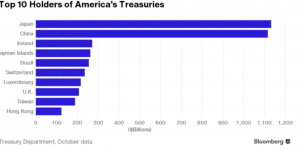
In his blog, fund manager and top 20 economist in the world (according to Derin Cag’s Richtopia), Daniel Lacalle, points out that U.S. total debt is $19.9 trillion, with China holding $1.1 trillion. Japan is actually the largest foreign holder of U.S. bonds since last year as its portfolio has $1.13 trillion of Treasuries while China has trimmed its holdings by $41.3 billion month-over-month in October, bringing its total holdings down to their lowest level since 2010.


Lacalle provides a breakdown of U.S. Treasury holdings, largest of which is with Social Security at $2.801 trillion, followed by the Federal Reserve at $2.463 trillion and mutual funds at $1.379 trillion. $888 billion is held by the Office of Personnel Management Retirement. Next up is the Military Retirement Fund, which has $670 billion in U.S. Treasuries, then Medicare which holds $294 billion. Foreign holders have a total of $6.281 trillion, in which China owns around a sixth.

On the flip side, foreign institutions’ holdings of Chinese debt is down 1.9 billion CNY in January to 421.75 billion CNY, based on data from China Central Depository and Clearing Co. Although foreign investors upped their stakes in Chinese government bonds by 70% last year to 421 billion CNY, the drop in foreign holdings represents its first reduction since October 2015.

In other words, if a trade or currency war does materialize between the US and China, and the latter decides to dump its U.S. debt holdings, it would not be enough to upend the financial standing of Uncle Sam. As Lacalle mentions, the rest of the holders could absorb those Chinese holdings in just three days. This is in sharp contrast to the prevailing view on Wall Street that says China is on the front foot because of it’s Treasury holdings.

Keep in mind, though, that China continues to put the pressure on by working towards replacing the U.S. dollar as the world reserve currency. It has already managed to put the yuan in the IMF SDR a few years back and continues to respond to allegations of currency manipulation. Still, owning U.S. Treasuries helps keep the Chinese economy afloat by keeping the yuan weaker than the dollar so increasing its stake could work in its favor, on top of the political leverage it brings.

With that, it’s probably not in China’s best interest to dump all of its U.S. debt holdings or a considerable chunk of it according to Lacalle since this would cause the dollar’s value to fall sharply and make the yuan rise in the process. Besides, a large collapse in the dollar could put the global economy back in a crisis, something that would also drag Chinese growth down.

Meanwhile, the U.S. is on track towards increasing defense spending and fortifying its military, keeping in line with Trump’s protectionist views. Although the U.S. imports a significant amount of its goods from China, Trump is also pushing for increased domestic production which could lessen its reliance on its trade partners and therefore dampen demand for China’s exports.

As it is, both countries could have a lot to lose when a trade war does happen but it appears that China could be on the back foot if the Trump administration is able to implement all its planned reforms before shots are fired.

Op-ed (CNBC): France exiting the euro would be the largest sovereign default in history with serious contagion effects

A few days ago, David Rachline of the far-right National Front party in France said that “the debt of France is about 2 trillion euros ($2.1 trillion), about 1.7 (trillion euros) are issued under French law, which means that it can be re-denominated.”

The economic program of the National Front specifically calls for the exit of the euro and the creation of a new currency, the French franc, which would be “closely” linked to the euro while allowing the government to undertake “competitive devaluations” making the transition in an “orderly way”.

There is only one problem. It does not work. There is no “orderly exit” from the euro. It is an oxymoron.

This would be the largest credit event in history and would create a massive contagion effect throughout the euro zone. The euro, obviously, would suffer from the break-up risk, so the fallacy of the “closely linked” second currency is simply a joke. Both would collapse in tandem.

The risk is already evident. The French-German yield spread has reached the highest level since 2012 despite the European Central Bank’s (ECB) massive quantitative easing. The ECB has bought more than 255 billion euros of French bonds.

This mirage of an “orderly exit” ignores that the French financial system, which carries assets more than three times the size of France´s GDP (gross domestic product), would be severely damaged from the impact of the credit event.

A financial system that already suffers from weak net income margins and more than 160 billion euros in non-performing loans, would collapse as these bad loans escalate and the losses in the banks’ bond portfolios eat away their core capital. This would inevitably lead to Greek-style capital controls and bank runs as the entities would lose liquidity support from the ECB.

This French exit from the euro would also mean the collapse of France’s pension and social security systems, which are mostly invested in sovereign bonds, the destruction of the savings of millions of citizens, and the bankruptcy of thousands of French small companies.

Let us remember that more than 40 percent of France’s government debt is held by the French savers, pensions and institutions, who would suffer the bulk of the losses from the default. No, there is not an “orderly exit”.

Banks’ outstanding home sovereign and sub-sovereign securities represented 6.4 percent of total assets in the EU, according to Standard & Poor’s. A credit event of this magnitude, and the subsequent contagion risk throughout the euro zone, would lead French and European banks and SMEs (small- to medium-sized businesses) to collapse.

The thought that sinking the currency and defaulting is going to improve the French economy is based on three myths:

That a default will not affect new credit and access to future financing. To think that a default would help France borrow more and cheaper is simply ridiculous.
That citizens would not be affected. Not only would savings and pensions be destroyed, access to credit from SMEs and families disappears, even if they want to invent a thousand public banks printing paper.
That the new economy would be stronger. Covering the large imbalances of the French economy with devaluations and a default harms the productive economy, leaving a weaker and less dynamic economy that leaves a global reserve currency to become a regional one. Import costs soar, and its main trade partners would suffer from the domino effect.
It is terrifying to see that citizens are led to believe in these fake magic solutions. No amount of money printing from the ECB would mitigate the impact of an effective default in France. Someone should tell Marine Le Pen that her plan has already been carried out. By Argentina, and its currency lost 13 zeros in 40 years.

— Daniel Lacalle is the chief investment officer at Tressis Gestión.