@dlacalle_IA
Daniel Lacalle has a PhD in Economics, is Professor of Global Economy and author of “Life In The Financial Markets” and “The Energy World Is Flat”.
Thanks @SpanishLiberty

@dlacalle_IA
Daniel Lacalle has a PhD in Economics, is Professor of Global Economy and author of “Life In The Financial Markets” and “The Energy World Is Flat”.
Thanks @SpanishLiberty

“The United States must greatly strengthen and expand its nuclear capability until such time as the world comes to its senses regarding nukes” Donald J Trump
This tweet from President Elect Trump has caused quite a controversy today. Let´s see the facts and reasons behind it.
Nine countries in the world hold a total of 15,375 nuclear weapons. The United States and Russia account for 93 percent of them.
Russia 7,300
USA 6,970
France 300
China 260
UK 215
Pakistan 130
India 120
Israel 80
North Korea 15
So Donald Trump´s message about more nuclear capabilities might sound strange considering the sheer power of the US military. However, there is a reason. If we put together US and Israel as allies and we look at the nuclear programs of other nations, the deterrence factor that the US stockpile represents is diminishing in a world where terror is spreading and China and Iran are under no circumstance transparent about the purpose of their nuclear programs. The size of the stockpile might be insufficient as a defence and deterrence mechanism. We explained here the dangers of the Obama agreement with Iran (read).
But there is another reason. The separation between nuclear for electricity needs and defence ones is too thin. And in the world there are 437 nuclear reactors operating , with another 66 are under construction, mainly in Asia .
Take for example China’s decision to double its nuclear capacity to 23GW more and plans to build another 50GW as part of their search for leadership in nuclear technology. But Russia is following on the same path.
Apart from the 66 nuclear reactors under construction, the world plans to build another 166 , China, India, Russia, the US, and Middle East countries are among the major promoters.
If we add the nuclear capacity planned for the next ten years, there is a relevant risk to the world stability because US potential enemies could increase the stockpile of nuclear weapons at light speed.
Iran, for example, will keep 6,104 IR-1 centrifuges for 10 years, but the Minister for Foreign Affairs, Javad Zarif, has confirmed that Tehran will use their (IR-8) next-generation centrifuges, which enrich uranium up to 20 times faster than the current IR-1s.
The former Director of the CIA Michael Morell and a whole group of geopolitical analysts have warned of the error that the Obama administration made basing the Iran agreement on the number of centrifuges. “5,000 centrifugues is more than enough to build nuclear weapons, but not for an energy programme”.
According to the International Atomic Energy Agency, a nuclear bomb only needs 25 kilograms of enriched uranium U-235. And although it is more difficult to produce 90% enriched uranium, it is not much more complex than the 4-5% uranium required to generate electricity.
The US, which has been lagging in terms of nuclear technology compared to countries such as France, therefore, needs to step up and take action to lead the technology development, both for energy and defence requirements. And make the deterrence factor stronger.
So Trump´s message is both a warning to other nations and an action plan. Unless other countries quickly change their nuclear development plans and accelerate decommissioning, the US will likely expand its defence system. At the end of the day, as Vegetious stated in the Roman times “If you want peace, you need to be prepared for war”.
Daniel Lacalle is a PhD in Economics, and author of The Life In The Financial Markets and The Energy World Is Flat (Wiley)

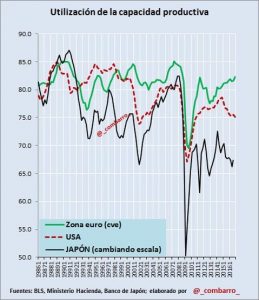
@dlacalle_IA
Graph courtesy @ combarro
When you listen to some politicians tell us we have to “stimulate domestic demand” as a solution to everything it might sound promising. Since there is poor demand – or at least enough demand to justify the expenses that they consider “adequate” – it has to be “stimulated”.
But what does that mean and why does it not work? Behind these technical words lies the good old cronyist spend. When the only goal is to “stimulate demand” real economic return is forgotten and there is no distinction between value-added projects and white elephants.
Look at the following chart of the US after eight years of demand policies (courtesy of Morgan Stanley), and over $ 24 trillion in fiscal and monetary stimulus.
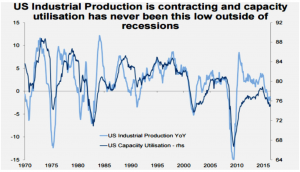
In China, excess capacity is higher than 30% after eight years of massive stimulus , in Europe it reaches 20% and in Brazil the level of industrial utilization is the lowest since 2009. Is it really a demand problem or the result of excess and overstimulation to create artificial demand? It is clearly overcapacity from excess, as shown by Bloomberg .
China launched a monstrous stimulus plan in 2009 that has left more debt, more excess capacity (up 15 points since the launch) and lower productivity. Rouseff, in Brazil, launched a plan to “reindustrialize” Brazil that generated stagflation and enormous imbalances.
And what have we achieved? Poor capital allocation in “strategic” sectors – decided by governments – causes three negative effects:
– Overcapacity costs . A useless bridge is not irrelevant. It has a cost in working capital, in operating costs and leaves the debt behind. All this is covered with higher taxes paid by the productive and efficient sectors. The result: productive sectors are penalized to support cronyism, disincentives to high productivity sectors and subsidization of low productivity sectors. Add that tax increases reduce consumption, and you have the perfect storm.
– Negative economic impact. Not only these plans do not create more employment, but they reduce potential growth. When low-productivity industries receive the covert subsidy of an “industrial plan”, it does not create more employment. Because overcapacity already exists and the workforce in these sectors does not need to increase. Crony sectors do not hire new workers because they already have them, and the only ones who enter the labor force are in low-skilled jobs. Real wages fall or do not rise. The growth potential of the economy collapses because it is perpetuating itself to the inefficient at the expense of the efficient.
– We moved overcapacity from developed countries to emerging markets. What we build to accomodate for “Chinese growth” meets the reality of what the Chinese build themselves to “keep growing.” An increase, according to Deutsche Bank, of $ 18 of debt for each unit of “created” gross GDP.
Does all this mean that no investments are needed? Not at all . Investment is needed when real economic return is evident. The mistake is to think that the “needs” of investment are dictated by governments that benefit from exaggerating the figures.
Daniel Lacalle is a PhD in Economics and author of “Life In The Financial Markets” and “The Energy World Is Flat” (Wiley)
