Tag Archives: Macro

Why the ECB plan is no early Christmas

This article was published in El Confidencial on September 8th 2012

“In central banking, as in diplomacy, style, conservative tailoring and an easy association with the affluent count greatly and results far much less” John Kenneth Galbraith

Euphoria. All is solved. After Thursday’s announcement from the ECB regarding unlimited purchases of short-term sovereign bonds, Draghi and Merkel, the “enemies of Spain and Europe,” according to some press, are now our saviours. Investors seek to protect themselves against inflation through stocks and commodities. By now there is no doubt that we are moving towards an inflationary period driven by financial repression and aggressive monetary policies.

From my point of view, the ECB plan only manipulates the price of short-term bonds artificially. Access to ECB funding is not linked to growth and solvency and is not aimed at rewarding the efficient. It will provide liquidity judging only by price without questioning whether such price is fair or not. It also runs the risk that countries receiving the liquidity will delay reforms knowing that if they push the limits they will receive a bailout. In essence, the ECB could be breaking the principle of responsible lending, a mistake that, in my view, is affecting the entire EU and discouraging long-term investment and capital.

I also believe that this plan simply transfers peripheral risk to countries like France, which do not have sufficient economic strength to endure the added risk. But above all, the ECB plan leaves the medium to long term solution of the economies in pro-state policies that do not promote the creation of new businesses and jobs. In the US I hear talks of SMEs, private job creation and growth, while in Europe it seems we only read about more government debt, to maintain subsidies and how to protect an unsustainable state apparatus, which acts as a crowding-out predator of credit to companies and families.

Questionable premise

The first mistake the ECB plan has, in my opinion, is to think that the bond yields of peripheral countries are “unfairly high”. It happened before with Greece and Portugal. It starts from the premise that bond yields are higher only because of the “fear of a euro breakup” when the reason is pure and simple of solvency. The problem would be much easier to solve if Spanish bonds were discounting an “imaginary” exit from the euro, but what we are seeing discounted is a much more problematic issue. Spain spends twice its revenues.

The negative surprises such as upward revisions in the deficit of Valencia by €3bn –a tiny 82% “mistake”-, the Catalonia bailout, the savings banks’ bailouts, a state deficit that has already reached 4.6% of GDP and that, including regions, may well be significantly ahead of the government target for 2012 … All these issues make the market discount that the gap between expenditure and revenues will expand further because costs do not go down. If the market believed that Spain runs the risk of leaving the euro, bond yields would stand well above 6% due to the inability of the country to finance the primary deficit outside the Eurozone.

The risk of perverse incentives

I see the 10-year bond at 5.6% and I fear that politicians will dust-off the cheque-book for more unneeded infrastructure and construction projects. Savings banks are denying credit of tens of thousands of small and medium enterprises –which generate 80% of added value and 70% of jobs in Spain- yet they seem more than willing to provide lending to high risk construction projects promoted by the regions and financed mostly with debt.

The most dangerous incentive generated by the ECB plan is that countries with greater difficulties will concentrate most of their debt in short-term bonds, which is the tranche that the ECB would buy, because they know that the long-term maturities will have very little institutional demand. The ECB expects that by doing so it will “force” investors to buy long dated debt. I believe the ECB is wrong. Think of the example of a company with poor fundamentals that sees one of its controlling shareholders buy more shares “to support the stock”. Investors do not follow this move except for the very short term. The monetary regulator assumes that credit investors “must buy” European debt and expects that by announcing “unlimited purchases” it will create a steady demand. In my opinion, this is incorrect as the underlying problems of the economies of peripheral countries are not even close to be solved, and will likely be postponed and dragged once bond yields are “perceived” low enough to “spend again”.

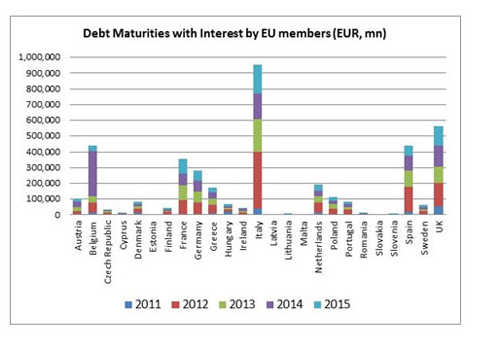
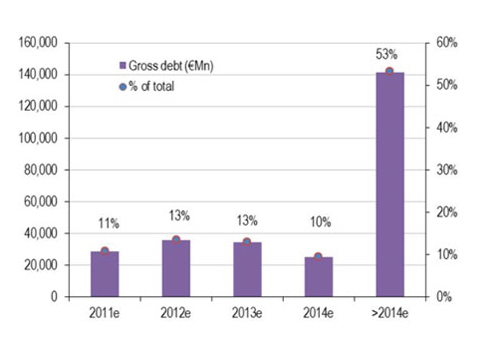
I am concerned about countries which are concentrating too much short-term debt, as the chart shows. The risk is multiplied because they are funding unproductive state spending and long term government investments with short-dated bonds, a dangerous recipe.

We must also note the danger of having “cheap” credit, which could lead many governments to delay cuts and, taking advantage of the complexity of the administration, take another spending party before the Troika comes and citizens see another round of tax increases.
EvoDeudaEfec2011-12

The words that scare me: “unlimited capital”, “strict conditionality” and “sterilization”

The really sad part of the ‘rescue’ plan of the ECB is that not a single cent of that money goes to small and medium businesses, to create jobs. It goes to support a hypertrophied structure of the state, which will continue monopolizing the available credit under the promise that “something” will fall for the real economy … And it does not, because added to this ECB support countries face the urgent need to recapitalize banks, deleveraging. That is, less credit to households and businesses.Instead of supporting banks and government apparatus, and hoping that some crumbs will remain for the real economy, imagine what it would be if families and businesses were the recipients of this “unlimited capital”. Crisis over.Strict conditionality. The carrot and stick. Another problem is that the ECB plan makes countries very dependent on the ECB buying bonds to fund them while the European regulator threatens to withdraw such support if conditions are not met. The countries will be at the mercy of a quarterly ECB revision of its accounts and, therefore, subject to much greater volatility.

The strict conditionality also implies that budget cuts will be very severe. But because those cuts should be reflected in the accounts urgently to continue accessing the ECB line, governments might not focus on long-term structural reforms, focusing instead on elements of immediate impact. Tax increases.

Unlimited capital.

The ECB has not yet bought a single bond and euphoria takes over markets based on a word: “unlimited”.

I’m surprised to hear those words as if they were logical. Unlimited capital. The Eurozone GDP fell by 0.4%, more than 2000 companies file for bankruptcy each quarter, unemployment keeps rising and Europe sees plummeting fiscal revenues. But we read “unlimited” without printing money. Unlimited means generosity with other people’s money. It means debt, and lots of it in a European Central Bank whose balance sheet in 2012 is close to 34% of Eurozone GDP, close to 3 trillion dollars, much more than the Fed (20%) and the Bank of England (21%) in their countries.
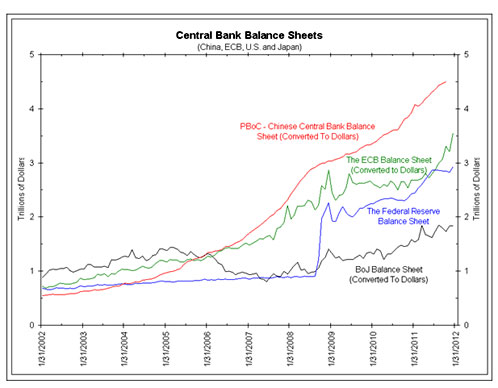
ECB VS FED
 “Sterilization” 

Sterilization means that for every bond it buys the ECB has to sell other assets to prevent inflation from rising out of control and to avoid borrowing massively. Sounds good? But so far Europe has proved unable to contain inflation, just disguise it, and the ECB debt has soared by 20% annually.The issue is that the central bank will be manipulating prices but will not increase liquidity in the system. Why do it then? It only impacts prices short term but the debt and liquidity crisis lingers.Another problem is called France, which would see bond yields soar just as it is growing debt and credit ratings will suffer, as Moody’s has warned. If added to this the ECB also sells French bonds, it will weaken another engine of Europe.From the point of view of institutional demand, foreign capital is likely to continue to avoid Europe as ECB intervention becomes a constant stream of “plugging holes” changing the price of assets and then, investors simply will not be able to invest in European debt on fears that prices are manipulated randomly and according to subjective criteria.

Reforms are not debatable

Every newspaper in Spain demands a bailout as if it was a donation and the end of budget cuts. It is neither. The ECB does not donate, it lends. Spain would not need a bailout if it managed expenses according to revenues, rather than waiting for the return of fiscal revenues of the housing bubble period to finance a hypertrophied state. And the consequences of a bailout are very relevant.

A bailout has a huge impact on the creditworthiness of Spain. And even if rating agencies will promise no downgrade to junk status, the market will do it, as it did with Portugal, Greece and Ireland. Spain has to assess this risk.

Minister De Guindos said Spain is carrying out the reforms that Germany undertook 10 years ago. Let us hope it is correct.

It is easy to reject reforms from Spain’s current perspective of a heavily subsidised nation with an “undeniable right” to debt, and claim that cuts don’t work. To illustrate why reforms are essential I would like to end with a few sentences of an article about Germany’s 2004 reforms, “The three crises that undermine the European colossus ” written by Jose Comas and published in El País in 2004, when many believed Spain was the rich champion of the world:

“Germany is riddled by corruption, recession and deteriorating public services. Its crisis is structural. Convinced of the need to renew a stagnant Germany, Schröder launched in March of last year the ‘Agenda 2010’ reform program. It was a plan to make cuts in social benefits rooted in post-war German culture, and to partly dismantle the achievements of social capitalism: reducing social benefits in retirement, health care, unemployment and making layoffs easier. Schröder opened the bottle and let go the spirits that will lead to political ruin”.

Schröder must be singing “I Hate to Say I Told You So” by The Hives.
Let’s hope Spain will not be trapped by the promises of unlimited capital and donations that don’t exist.
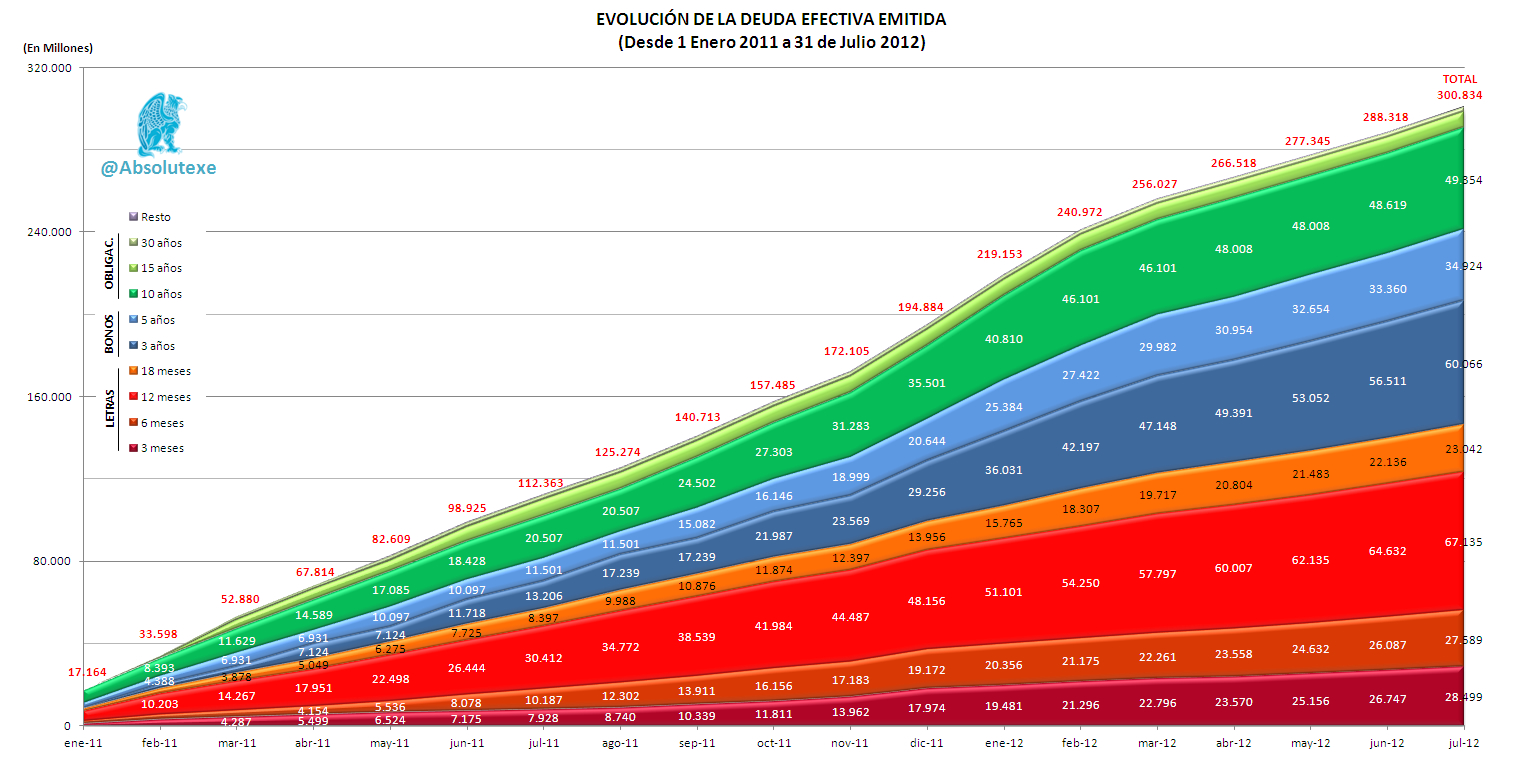
Thanks to @absolutexe for the graph

The myth of “financial terrorism”

This article was published in El Confidencial on August 20

“The phenomenon of economic ignorance is so widespread and its consequences so frightening that the objective to reduce that ignorance becomes a personal goal”, Israel Kirzner.

I spent eight years of my career in the area of ​​Investor Relations and despite suffering the Latin American crisis and others, I never saw the Spanish media insulting investors and spreading conspiracy theories of British attacks on Spain as I am seeing today.

In those days we didn’t approach everything from a sense of entitlement. We had to earn the interest of a market with limited capital. We learned especially from those who criticized us. Today, the global deleveraging process is making capital even more scarce, but our country seems to invoke a right to receive “unlimited capital” unconditionally.

Blaming the waiter for the bad food of the restaurant

Today, the national sport of blaming everyone except ourselves for our problems has reached delirious levels, peaking with articles in the mainstream media accusing the United Kingdom and the markets of “financial terrorism.” It is a handy scapegoat, to use a diffuse entity, the market, as a sort of “evil Dr No” behind our troubles.

This “market” is nothing but our savings, operators which are a secondary consequence of the real causes of a crisis created by ourselves, the states with reckless spending and their central banks. An economic policy based on monetary expansion that generates structural inflation, artificially low interest rates that create bubbles and masses of debt, which ultimately becomes unaffordable, leads to defaults and devaluations that impoverish the entire population.

These media commentators demand every day that the European Union prints, devalues, and raises taxes. However, afterwards the same journalists wonder why inflation rises, and food and raw materials rocket. And their conclusion is obvious: It is the fault of some “evil conspirator” in Westminster or ‘traders’ in London that envy Spain and want to make it fail. Easy. Of course, the hedge funds all together handle a fraction of the funds that the EU manages, but in our ostrich policy of “pretend and extend” the media repeats over and over that hedge funds attack us. Reminds me of my parents’ village, where every time there is a robbery, the people blame the tourists.

Now Spain needs investors like oxygen.

It’s funny that we complain of our unfair bond yields “when the UK is in much worse condition”, the “Perfidious Albion attacking us because of envy”, as the press said of Britain in the Franco times.

When Spain multiplied its debt in four years from €390bn to €734bn and all its regions increased their debt from €60bn to €140bn no one in Spain branded the reckless spending as ‘financial terrorism’, despite squandering money that the country didn’t have. Spending is always justified, and citizens presume good intentions behind it, while now the mainstream media and many politicians attribute dark evil motives and invent conspiracy theories to explain why investors do not trust the country and decide not to buy bonds. Not purchasing, by the way, is not attacking. The country cannot force anyone to “buy.”

In terms of sovereign debt management, Spain should learn from the UK

Let me clarify one thing first. No one is more critical of the UK economic policies than me, I live in London and have been vocal about the very erroneous policy of the previous government of excessive spending and believe the current QE and monetary expansion policy is no solution for recession. But the British ten-year bond is perceived as a solid investment, and there are fundamental reasons for it.

Let me summarize the ongoing debate all over Spain’s economic media. It says: “Spanish bond yields are unreasonably high and the UK’s are unreasonably low despite the fact that the UK is in worse financial shape because the London financial institutions and media attack and exploit our weakness”. Right?, No.

Let’s start with what creates mistrust in the Spanish debt, which needs to be tackled urgently:

-The concerns when accounts do not match. Spreads started to widen aggressively despite ECB interventions with the increase in government spend (the failed 35bn “Plan E” stimulus, the 125bn injected in the savings banks) and the well-known unpaid bills, debts not accounted, while deficit figures had to be revised twice.  If Spain does not give credible and consistent economic data, bond investors, by definition the most conservative and long-term driven, will simply avoid the risk. The UK on the other hand has been detailed and clear not only about swift cuts but stimulus and about budget limitations.

-Institutional credibility and credit responsibility. Everyone knows who to blame for the deficit in the UK, and there is one body and one chancellor who can act on it. There are no debates between parties of “who is less corrupt” than the other, and institutions and their responsibilities are clear and enforced rigorously. Another problem is lack of credit responsibility. In Spain, between savings banks and 17 regional communities with 17 decision centres, each with its vested right to default and be rescued, there is no real political responsibility for the consequences. Regions miss debt targets and then “rebel” against the state. How do they rebel? Not paying their suppliers.

The perception that reforms are cosmetic. Spending cuts in Spain so far have been reductions in expected increases, not real cuts, while the UK has made very deep cuts. Therefore, ahead of uncertainty in the economy, Spain can only count on improving revenues to achieve its targets and that’s a huge risk.

The acceleration of spending. In Spain spending has doubled while revenues stagnated. This acceleration is very relevant. What creates more distrust among investors is the evolution of dynamic solvency ratios (increased costs versus revenue growth), not static (debt / GDP) and also future refinancing needs over the global supply of debt. In the UK, for example, issues tend to be made with very long maturities, and always seeking to avoid saturation of supply. Spain has to refinance, between 2013 and 2015, 259 billion euro, almost the same amount as the UK, 320 billion, but with less than half of GDP and much lower revenues.

The unhelpful messages on default and exit from the euro. If an opposition leader says “if Spain was out of the euro our risk premium would be 300 basis points,” a leader of a majority party says “debt must be declared odious and stop payments” and a minister says “the German banks also benefited from our bubble”, they are unconsciously highlighting in public the risk of default. And investors do read those statements.

Of course, the UK is a country that attracts capital, maintaining investor’s interests as the State’s primary policy, the economy is extremely flexible, and with 8.6% unemployment. The challenges in Spain remain in a regulation that makes investment and job creation extremely bureaucratic, onerous and slow, and an unusually restrictive and cautious approach to foreign investment.

To think that the UK bond yields are low only because the state devalues the currency and monetizes debt is another mistake.

If the panacea to lower bond yields is to print money and have an active central bank easing, Zimbabwe or Argentina would be the countries with the lowest bond yields of the world. Without institutional credibility and credit responsibility, legal certainty and a suitable investment environment, the impact of interventions are temporary and ultimately irrelevant.

The BoE has bought less than half of the debt issued by the UK between 2009 and 2010, the other half was bought by institutions and banks, including, surprise, surprise, a few big Spanish banks.

In Spain the ECB has injected over 400 billion euro to banks, used mainly to buy sovereign debt, more than the Gilt purchases of the Bank of England in 12 months. If the monetization of debt is the reason given by the media to explain low bond yields, Spain has seen a much larger EU-funded program of bond purchases –through its domestic banks- relative to its GDP and its refinancing needs.

Without institutional trust and credit responsibility that prevents default risk on Britain’s debt, the country’s yields would also soar despite BoE purchases.

Bond yields are a reflection of the secondary bond market, ie the investor appetite for the country’s debt. Nobody profits or attacks the country by not buying bonds.

I read that the Spanish government will make a diplomatic offensive to attract investors and I think it’s a wonderful idea.

Three ways to improve:

Stop issuing short-term debt to finance long-term spending, it will take bond yields to stratospheric levels, with or without ECB purchases. It would be positive to see lengthening maturities and a national agreement to attempt the conversion of debt held by domestic entities-nearly 70% of total-to long-term debt.

Attracting capital, as the City of London does. Issue debt to investors who can also have access to assets. One reason for the distrust of investors is because in Southern Europe they are allowed to buy debt but not companies or assets. A national regulation that encourages investment and stops trying to keep out foreign capital would be very productive.

-Enforce compliance and responsibility to those regions and banks with problems. Irrevocable, immediate and demonstrable. If investors see that the money is given out but not controlled, they will not invest.

Strengthen laws to defend creditors and debt repayment. It is not worth changing the Constitution as last year and then a few months later deny of such agreement.

The problem of wasteful spend disguised as ‘real’ economy

I’m getting used to read in the mainstream media that useless investments, duplicate administrations and cronyism are not so bad because they “maintain GDP and employment” and, after all, unnecessary investments in infrastructure “at least are spent in something tangible –real”. Furthermore, these “wasteful activities also generate growth”. This belief is part of a monstrous mistake that began to take shape in the mid 90s when Spain started to see money pouring in from Europe. It had to be spent to get more afterwards. It’s the widespread belief that money is free and that the right side of the balance sheet does not matter or does not exist. “Public money belongs to no one”

This is not true because it assumes that the “money” spent is capital and not debt. If it was capital, I would partially agree. That is, if I’m rich and I spend a significant part of my salary in drinks it is my decision, but it does not have a direct negative impact on my finances. But when it is debt, bad economic decisions cost a lot. That is, if I’m poor and I have two mortgages and I spend a significant part of my salary in drinks I create a double negative effect, the cost of debt and the futility of my expense. The money squandered is not only wasted but it costs, because debt and interest have to be paid by a declining percentage of the profitable and productive part of the economy.

The popular perception in Spain is that if a bridge, a phantom airport or a ghost city that is not needed is built, at least there is something real and valuable. Like China but without its economic power and wealth. The idea that the economic use of those “things” is irrelevant just because some jobs were temporarily created, when in fact there is not only an asset, but an associated liability, and the cost must be covered with the productive returns of another activity or through taxes, or more debt. Therefore, unnecessary infrastructure is not only wasted borrowed money that does not create “real activity”, but it crowds out and eventually erodes the real productive activities, enlarging the debt balloon. The useless bridge-airport-city would only have zero cost to the economy if it were funded with surplus wealth or a donation. And Spain has neither one nor the other.

In summary, Spain must attract capital, learn from its more financially mature peers and forget to support GDP with hot air. No one is attacking Spain, if anything we attack ourselves by scaring investors. The day that the country learns that inflating GDP based on useless spending generates debt that cannot be paid with air; we will start to end our problems.

Blaming the ECB. Better to sink the fleet than to repair the boat

(This article was published in El Confidencial on July 8th)
 
‘Everything is subject to conditionality. There is nothing without conditionality. Conditionality is what gives credibility to these measures’, Mario Draghi, president of the European Central Bank.
 
The new mantra in Spanish media is that the European Central Bank is attacking us. Before, it was the Anglo-Saxon press, then the markets, then,Germany… Now, according to some commentators, it is unquestionably Mario Draghi, president of the ECB, who is to blame for Spain’s misfortunes.
Draghi, obviously, is to blame for the reckless spending, for doubling the national debt, for the most convoluted regulation of the Organisation for Economic Co-operation and Development (OECD), the ghost airports and the phantom cities. Evil.
We have spent a week hearing: “Draghi will connect the printing machine,” and it seemed everyone was shocked when it didn’t happen. The debt threshold is at its limit even at the ECB. Quoting the famous South Park…”Aaaand it’s gone.”
Debt is a drug. And like drug addicts in the infamous crack supermarkets of Harlem, we were looking forward to the ECB to saving us from our debt problem with more debt in order to keep spending. And like drug addicts, even if the ECB lowers rates to indecently low levels, the effects last less and less.
We blame the ECB, which after lending 288bn to Spanish banks and lowering interest rates to 0.75 percent does not “do more.” What more do we want it to do? A donation. Ah, no, my friends, there are no donations.
The ECB does not help. It lends. The ECB doesn’t rescue. It lends. The ECB does not donate. It lends.
When people hear that the ECB should buy Spanish debt they should also know that it’s not a favour, and that there are strict conditions attached to the agreement. But more importantly, people should know by now that the ECB buying bonds does not solve anything, as evidenced by previous purchases, which have not lowered bond yields for more than a very short period of time. 
 
These bond purchases of the past have done nothing but infect the ECB’s balance sheet the same way as the sub-prime debt packages of 2007, without attacking the underlying problem, which is excessive spending.
20120709370709-grafico-1
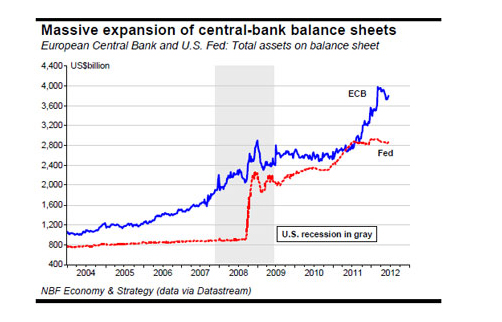
The ECB balance sheet has ballooned to 30 percent of gross domestic product of the Eurozone. The Federal Reserve‘s and the Bank of England’s balance sheet is 20 percent of the GDP of their countries. The Fed and BoE loans are paid back. In Europe, however, no one pays back these loans.
What is a little more debt between rich friends?
The ECB, which has nearly 40 percent of its assets in toxic bank debt, and has lowered interest rates again, has to do “more”. But who contributes to the ECB when all others ask for help? No wonder that Finlandand the Netherlands say: “Me? No, my friends.”
Spain demands “more” from the ECB even when Spain has received the equivalent of two Marshall Plans in aid since 2009. After two injections of liquidity (LTROs) that have crippled the ECB to 3bn of debt, we demand “more”. Expand the balance sheet, they say, which is nothing else than packaging and hiding debt. We demand donations. Well, no.
We live in a manipulated market and the more it is manipulated, the less the placebo effects last, because the real problems are not solved. A manipulated market to benefit the states. Financial repression.
It is curious to hear more and more people demanding financial repression, because that is what they ask for when citizens demand more inflation and mutualisation of debt. And it’s funny because media and citizens demand these measures as if everything was not going to be paid by the taxpayer in the end.
 
Financial repression
 
We claim our undeniable right to be robbed of our savings by lowering interest rates and to sink our financial capacity through inflation.
Commentators tell us insistently that there is no inflation threat. We hear over and over that this is a deflationary spiral, and meanwhile American economist Paul Krugman tells us that “a little bit of financial repression is not that bad.” However, inflation is there and it is a tax, an unfair and accumulated tax created to pay the excessive government debt.
However, the media repeats that there is no risk of inflation. Of course, anyone who pays for groceries, gas, utilities and bills sees prices going up every year while their net income after taxes plummets. Inflation according to “official figures” is 2 percent, yet the real increase in the cost of living is 5 percent per year. I recommend you read this report on the actual inflation in the United States compared to the official.
20120709950709-grafico-2

Every day, I read more suggestions from politicians, economists and other commentators calling for an “audit” of public debts and to consider “illegal” those debts incurred by a state and regional governments that have been democratically elected and supported by the majority.

When one reads “audit,” “revise debts,” or “lenders must bear some of the cost,” one needs to be aware of what it means. It means default. Because then none of us can complain that bond yields are too high. If we call for a restructuring, then bond yields are actually very low, as leaders are telling the market that here is a very high risk that one of them is elected and then defaults.
The consequences of a default are devastating:
 
. The country loses international support. The cost of the remaining debt after default would soar, as has happened in Greece and other similar countries.
. It does not reduce the need to make huge cuts. Spain has a primary deficit of almost 7 percent. Cuts would be even more severe after default, given that the funding of the structural primary deficit would be prohibitive.
. The credit crunch would be enormous. Forget lending to the real economy. The crunch would destroy growth and employment, but as the government would continue spending beyond its means, the crowding-out effect of the state would increase.
. Private companies would suffer immensely. Refinancing needs of non-financial Spanish firms are concentrated in 2014, and many would find it impossible to get financing on the market, which would lead them to cost-cutting and massive restructurings.
20120709510709-grafico-3

One of the most important sentences Draghi said on Thursday was: “What if all countries need help?” The ECB cannot bail out the big Eurozone countries. With what funds? We are talking of infecting the ECB’s balance sheet at 500bn annually if it needs to help Spain, Italy and those who have sought bailouts, when the latest could be Slovenia.

The ECB cannot buy debt without first seeing that countries have carried out drastic reforms that will prevent this debt crisis from happening again in 2014, because Europe faces 800bn of sovereign debt maturities every year over the next three years.

Spain has to solve its structural problems of competitiveness and high spending. To do that there is plenty of support and funding, but there are no donations or quick exits to a structural problem. 
Converting the ECB into the cockroach motel, where what comes in doesn’t come out, would cost much more to all – businesses, citizens and states – instead of doing what should have been done years ago. Align expenses to revenues. What everyone is doing except the state.

Watch the documentary Fraud, Why The Big Recession here:

http://www.youtube.com/watch?v=PTpKGiVwKHY&feature=youtube_gdata_player

Further reading:

http://online.wsj.com/article/SB10001424052702304782404577488283442408896.html


Between junk bond and intervention

(This article was published in Cotizalia on July 1st 2012)

The EU summit concluded with a surprise note. The strategy of Spain and Italy to corner their partners has been a masterstroke and it buys both countries time. Unfortunately, these agreements have had a very modest impact on the Spanish 10-year bonds, still at 6.25 percent, and the spread to the German Bund, which is around 475 basis points.

Why? Because it is still a patch. As someone in Twitter noted ” A decisive solution, using a fund that doesn’t exist to buy debt that won’t be repaid via a mechanism that hasn’t been agreed.” I’ll try to explain it as simply as possible going through the main comments from readers.

Why more uncertainty?

It doesn’t matter which entity we think will provide the funds, be it the European Central Bank, the European Financial Stability Facility or theEuropean Stability Mechanism. They will have to finance themselves in the secondary market, with capital from foreign investors, SWFs, etc. These investors see that the legal structures, mandates and limits of the European mechanisms are discussed, threatened and redesigned almost every month, generating tremendous uncertainty. Therefore, neither the EFSF nor the ESM, when approved, will enter the benchmarks used by funds to decide where to invest.

In short, threatening legal structures that underpin these mechanisms scares investors away, precisely when they are most needed. Would you invest in a fund in which each month the managers threaten to change the prospectus?

We have discussed in previous weeks the enormous difficulties faced by these mechanisms. The ECB’s balance sheet already exceeds 30% of the GDP of the Eurozone, compared with 20 percent of the US Federal Reserve or theBank of England. The European countries that contribute to these mechanisms and the ECB are extremely indebted. In addition, as time passes,there are less “net contributors” because the number of troubled countries grows. Portugal, Greece, Ireland, Spain … and Cyprus, which after four years in the EU, needs a bailout of €10 billion with a GDP of 18 billion.

France already has 89 percent public debt to GDP, Spain surprised negatively on Tuesday with a much higher deficit than expected, German default risk rose 30 percent in a month and meanwhile almost all eurozone economies are in recession or stagnation, while the vast majority of those countries are increasing their debt.

There is no money to continue this “ostrich strategy “of avoiding tackling the debt problems and kicking the can down the road in an EU that feels more isolated from the rest of the world each day.

Why bond spreads keep widening

The spread of the Spanish bond with the Bund is a reflection of the secondary market, ie the investor appetite adjusted by a certain risk. We can complain and make European entities intervene, but if markets don’t see reliable, verifiable and sustainable economic figures and an improvement in the ability to repay debt, investors will not buy bonds. That is why on Friday we saw fund flows of 3 to 1 better to sell.

Imagine a quoted company that is posting weakening results and a major shareholder buys 5 percent in a defensive move. The share price might stabilize for a few days, but then it continues to fall because institutional investors still do not trust the strategy and the profit generation ability of the company. We see the same effect on bond yields after the placebo effect of ECB purchases. Bond yields rise again, due to lack of confidence.

Grand public statements and good intentions are not enough. Until Spain publishes figures showing clear and sustainable improvement of credit qualitywe will not see bond yields fall.

201207019grafico 2

Are markets attacking us?

Investors are not buying Spanish debt. That is not attacking. It is not buying. We should analyze why an investor in bonds, which seeks the lowest risk and the longest duration, prefers to buy bonds at 0 percent yield, the Germans or Swiss, rather than bonds with 6 percent yield, the Spanish. They avoid high yield bonds because they worry more about whether the principal is ever going to be repaid. As Jim Rogers used to say “I am more interested in the return of my money than the return on my money”

With the level of uncertainty about Spain’s public finances, investors feel that 6 percent is not an attractive risk-reward. Spain has destroyed its credibility with changes in deficit figures, broken promises and hidden data for years, and now it has to bring back confidence with facts.

Bond investors do not distinguish between one political party or another, or one government or another. It is a sovereign matter. And if the state doesn’t meet its own targets, investors don’t risk their capital. Would you do it? Would you invest in the debt of a country where targets are not met or are made up? This is what Spain has to solve, now. slashing expenses.

Doesn’t Spain have less debt than Japan?

The spread of Spanish bonds is not high by coincidence or injustice. As a country, Spain always talks of its low debt to GDP, which is a misleading indicator, as GDP, for example, can be artificially inflated by borrowing to build useless things -phantom airports, ghost cities, etc.

What matters to investors is the deterioration of the public accounts, revenues falling and costs rising. Spain’s debt has doubled between 2008 and 2012 but the country has not done enough to stop the escalation of spending while tax revenues coming from the “housing bubble” disappeared. But the expenditures have remained untouched, most of all subsidies and bureaucracy. Spain had three major bubbles: Debt, Housing and State size. Of those three, State size is the one that has not been burst.

Imagine having a credit card for which one pays interest. If expenses double, but income stagnates, first one sees the interest rate rise, and if expenses don’t fall the credit card will be cancelled. And this does not mean that the issuer of the card is “attacking”, it just means that the card holder becomes an unreliable debtor.

Many will say that a country is not a credit card and that “we deserve” to be funded at lower costs. Fine, then, as a country, we should do what households and sensible companies do. Cut expenditures.

Intervention, let’s go

What happens when the credit card is cancelled? That one has to go to a lender of last resort that will solve the liquidity problem, but will demand cuts and high interests. Like those TV ads that say “reduce your monthly payments”, “we consolidate debts into one comfortable monthly payment”… at exorbitant interest rates and with severe penalties.

The problem of using the word “bailout” or “intervention” is that it has a positive connotation, almost humanitarian. I would recommend that when you hear the word, change it in your brain for “mortgage” and when you hear ECB think of “lender”. It shows a completely different meaning.

Some readers tell me they prefer an intervention than keeping our corrupt politicians. I do not know what to say. Changing politicians who have been elected to bring others who are not elected from Brussels? I am not sure, particularly when the latter have a track-record as poor as that of our own leaders.

Blame it on Germany for financing our real estate bubble

As a Finnish member of parliament said to me, “the fact that I have lent to a friend €1,000 and he has wasted the money in parties does not mean that I have to continue lending him or that he doesn’t still owe me my money”. Responsibility must be shared, but donations should not be expected.

But what if we are rated junk bond?

Rating agencies, I’ve said it many times, act always late and poorly. With Spain, investors have assessed its credit risk well below what rating agencies said since March 2011 at least. I always say that a rating agency is an entity that charges Paul McCartney to inform him that the Beatles split up.

First, Spain is not junk bond. But the risk of downgrades cannot be tackled by promising income that never comes, or by giving excuses for poor data, as any rated quoted company can tell. It is tackled by cutting costs and showing better numbers than estimated.

But if we cut spending, we lower GDP

Sure, let’s put more debt into the economy to build useless things until we have the GDP of China and let’s see how we do.

Of course cutting expenditures lowers GDP, but it also slashes the deterioration of our debt problem by a bigger percentage. Spain needs to cut political spending, duplicative administrations and unproductive debt that only generate impoverishment. We are talking of tens of billions per annum.

Print money?

It’s a unanimous cry. Let’s print money. The ECB must buy the debt of our wasted years and monetize it, creating inflation. Let’s do like the United States which “only” has a debt of $50,500 per citizen.

Print money in the EU, when the euro is only used in 25 percent of global transactions would generate high inflation. To begin with, we would have to see if our partners accept to drown the ECB in more debt. But I am surprised that people cry for inflation mentioning an “adequate” level of 5 percent-official, as real inflation would be 8 to 9 percent. I am shocked to hear people calling for their own impoverishment to allow the government to continue spending recklessly. If citizens think that raising VAT is a disgrace-and it is-inflation is the same, but “undercover” and cumulative.

Then there is no solution

Of course there is. Cut spending, duplicative administrations, subsidies and grants, be a serious country, open the doors to free market, and stop thinking that everything is arranged in the Eurozone web of cronyism, patronage and debt.

This week I wrote an article in the Wall Street Journal detailing the four points which, in my opinion, would help Spain to reduce bond yields. None of those points is to “solve a debt problem with more debt,” and the agreement of the EU is exactly that. It gives Spain and Italy time to accelerate and deepen reforms, but is nothing more than a loan.

Of course Spain will be helped and the country will emerge from this mess, but it will not be by going “back in time” like Huey Lewis & The News. It will be through cuts in spending and liberalizing the economy.