All posts by Daniel Lacalle

About Daniel Lacalle

Daniel Lacalle (Madrid, 1967). PhD Economist and Fund Manager. Author of bestsellers "Life In The Financial Markets" and "The Energy World Is Flat" as well as "Escape From the Central Bank Trap". Daniel Lacalle (Madrid, 1967). PhD Economist and Fund Manager. Frequent collaborator with CNBC, Bloomberg, CNN, Hedgeye, Epoch Times, Mises Institute, BBN Times, Wall Street Journal, El Español, A3 Media and 13TV. Holds the CIIA (Certified International Investment Analyst) and masters in Economic Investigation and IESE.

The Myth of European Austerity In Five Graphs

This article was written by Manuel Llamas and Domingo Soriano published by Libre Mercado here. All copyright Libertad Digital and Libre Mercado. (Wednesday 23rd June 2012).

“A lie repeated a thousand times becomes the truth”. This well-known sentence, attributed to the master of Nazi propaganda, Joseph Goebbels, could also serve to illustrate the great deception of the alleged public austerity in Europe. Since the outbreak of the debt crisis, it is widely repeated that Germany has sought to impose on the rest of the EU partners an adjustment plan focused on cutting costs and implementing structural reforms that would foster economic growth.

This strategy has been harshly criticized by many economists and by the Southern European countries, the weakest in this crisis, with Greece leading the critics. In fact, analysts, politicians and union leaders blame all the current problems of Europe, including the Greek default, on the imposed austerity measures. After the recent French and Greek elections, the critics of Merkel’s strategy have begun to gain notoriety, to the extent that the European summit to be held on Wednesday will focus more on how to boost growth through government spending (stimulus) than on further cuts in policy to reduce the deficit and debt burden.

However, official data (Eurostat) shows that the much-touted European austerity is today little more than a myth. The Greek default was not due to the demanded cuts but due to the decision to keep a bloated state unchanged. Likewise, the evolution of spending, deficits and public debt in the euro area shows that the austerity only exists on paper. Neither governments have stopped spending well above their means, nor have they undertaken structural reforms to enable their economies to improve their productivity and grow solidly in the near future.

More public spending

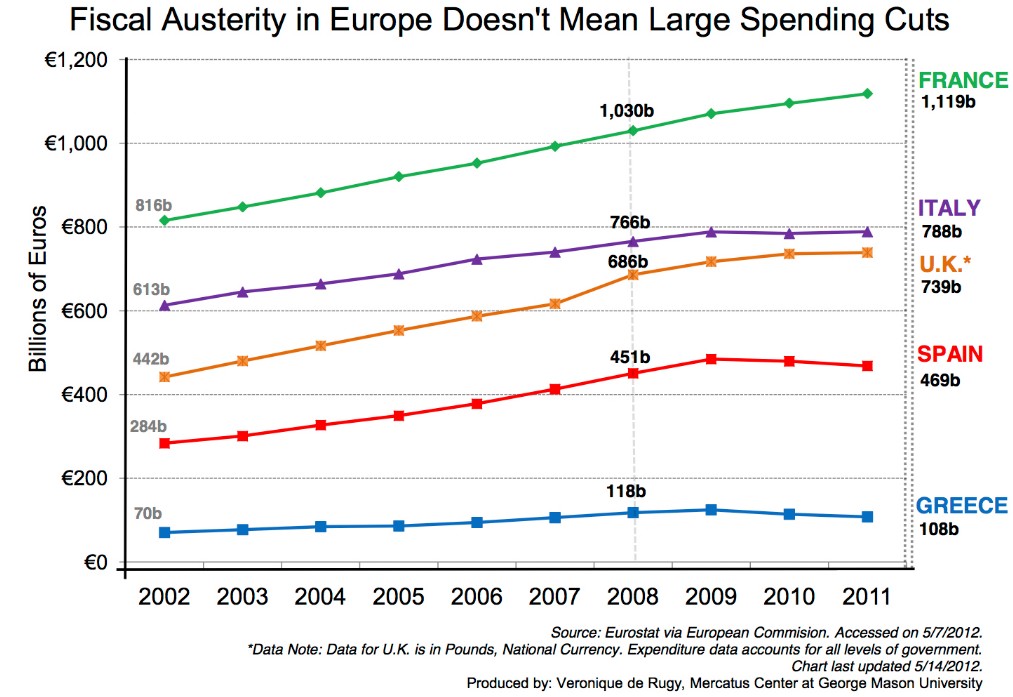
The most striking figure, amid all the rhetoric against the cuts, is that public spending in the euro area as a whole has grown by almost 7% between 2008 and 2011, reaching 4.65 billion euro.

In the South of Europe, those most affected by austerity in theory, the evolution is similar: Public spending in France rose by 8.6% since 2008, in Spain, 4%, in Italy, 3%, in Portugal, 7.8%, while in Greece, despite all the announced cuts, spending fell just 8.5% over the 2008 level, although today its public sector continues to spend 2% more than in 2007 (just before the crisis).

In essence, no European country has managed to reduce their public spending to 2004 levels, a few years before the start of the international crisis, which itself could be considered as an exercise in austerity. Not at all. The following chart summarizes the evolution of public spending in these countries, measured in nominal terms at current prices.

auste01

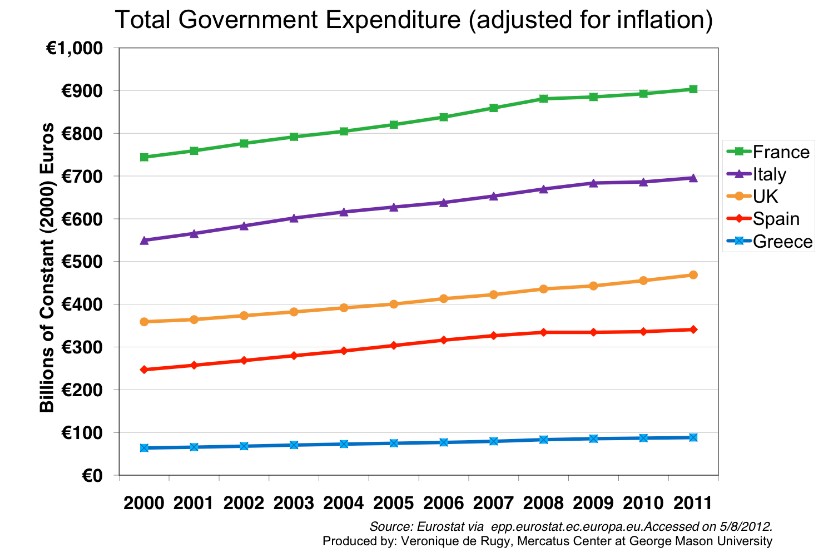
auste02In fact, the situation hardly changed if we look at the evolution of public spending in real terms after inflation.

More deficit and debt

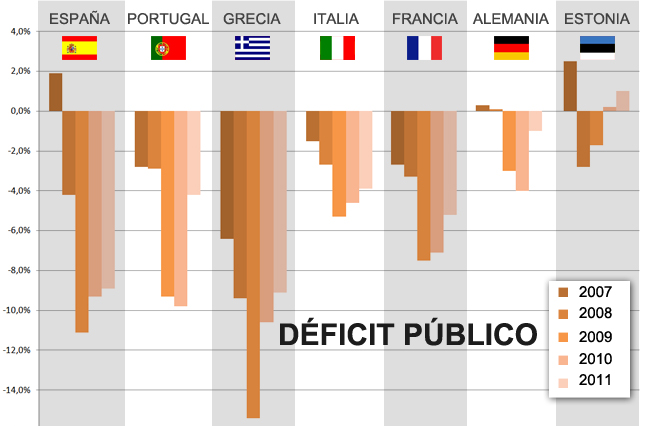
Of course, increasing public spending also meant higher deficit and public debt. As such, in the middle of alleged austerity, the deficit in the euro area as a whole, far from diminishing, has tripled since 2008 , from 2.1% of GDP to 6.2% in 2011, while public debt has grown from 70.1% in 2008 to 87.2% of GDP last year.

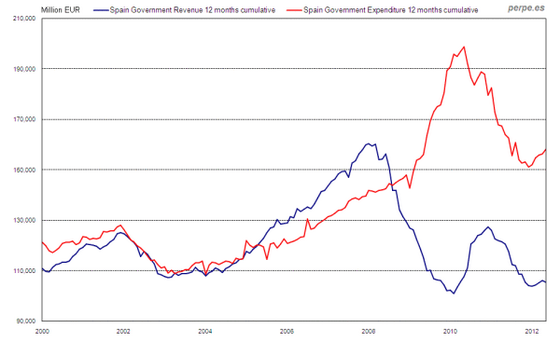
As we can see in the graph below, the public sectors in Spain, Greece, Italy and Portugal, the four southern European countries most affected by the debt crisis, are still spending more than they earn. Only a few countries in the North and East of the continent (exemplified here by Germany and Estonia) have maintained their public at deficit under control during these years of crisis.

Chart above shows public deficit.

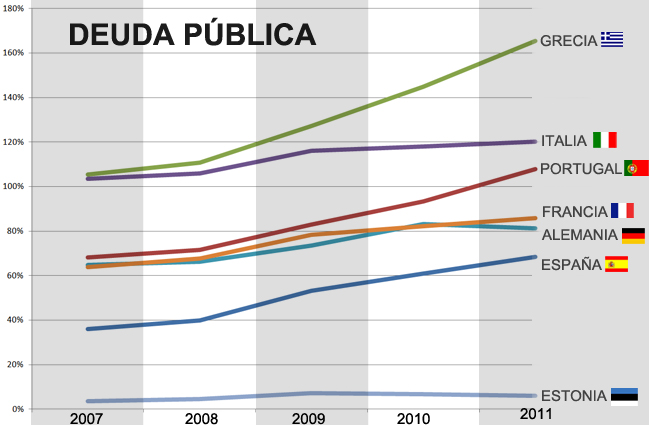
Obviously, if the deficit is out of control every year, public debt will continue a worrying upward trend. As we can see in the image below, all the countries of southern Europe have public debt figures that are much higher than that held at the beginning of the crisis. Even Spain, which began with a very reasonable level of public debt of less than 30% of GDP, is now touching 70% and could end 2012 above 80%.

deuda-publica-22052012

Greece, meanwhile, is at levels close to 200% and Italy is moving steadily to 130%. With these levels of debt, it is logical to see international investors unwilling to buy more South European government bonds, and the to see the CDS and spreads versus the Bund soar. But governments and political parties continue to blame the “evil speculators” or the unfairness of German taxpayers, strangely reluctant to lend more money when nobody else wants to either.
Chart above shows public debt growth.
Along with the complaints about unreasonable “cuts” allegedly “imposed by the markets” (or the Germans), in recent weeks we have seen a growing public debate that wrongly puts austerity and growth as two opposite concepts. They are not. Austerity is the antonym of waste. In fact, recent history shows that more government spending does not foster growth, and does not help to get out of economic difficulties.

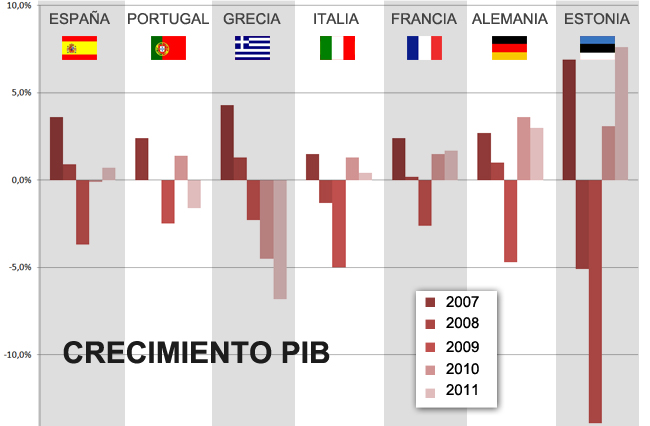
The current crisis began in 2007. From then until late 2011, the four southern European countries we are considering implemented aggressive public “investment” policies that Keynesian economists would qualify as clearly expansionary, with deficits close to or above 10% for several years. If this theory were true, Greece, Portugal and Spain would have already recovered and the growth generated by the “virtuous circle” created by government spending would be paying their debts. But none of this happened.

deficit-publico-22052012

crecimiento-pib-22052012

Meanwhile, Germany and Estonia followed the opposite path and imposed austerity. The result is that both countries had a strong relapse in 2009, with the political cost that it entails . But they are recovering faster and now have much stronger economies. Meanwhile, in Spain, the “Plan E” of investment in infrastructures, an enormous waste of public funds with its vast implication on cost of borrow and deficit, and other public spending measures have failed to stem the crisis. But the message currently repeated over and over is that it takes even more government spending, for much longer, to foster growth. But… For how long?

Chart above shows growth in GDP


Follow Manuel Llamas on @manuel_llamas

Spain: Exit The Euro? A Long and Painful Death

(This article was published in Cotizalia on May 19th 2012)
This week everyone is talking about the possible Greek exit from the euro and the apparently appealing idea of “why not Spain?”. Let’s press the Reset button and start over. We have discussed Greece in detail here (http://energyandmoney.blogspot.co.uk/2012/05/greek-drama.html).

The Greek state, which has more public employees than Spain with four times fewer inhabitants, wasted bailout after bailout and continues delaying reforms, saying that “they’ll come, be patient”. And now, some demand breaking the agreement-yes-after having accepted the money. One thing is to belong to the European club with its obligations and rights, and another is to demand to participate only for the party and not to collect the broken glasses … But it is their sovereign decision to shoot themselves in the foot.To read the arguments in favor of breaking the euro, I recommend the interesting and detailed analysis of Jonathan Tepper here. But I’ll give my opinion focusing on Spain. Leave the euro? No. And I think Spain should not, due to the dangerous implications for the country, its partners and the financial system . Why?

. Because Spain is not rich in oil, gas or natural resources as most countries that have made default and devaluation in the past decades, which allowed them to contain hyperinflation.

. Because even if Spain leaves the euro and enters into a default, it will not be freed to carry out the reforms, adjustments and severe cuts needed due to its structural primary deficit.

. Because Spain can ease its debt problem with reforms and budget control, continuing as a major country in the OECD without breaking the rules.

Leaving the euro, and re-structuring -default, bankruptcy, it’s all the same- to start again is like cheating at cards to try to continue in the casino without paying the debts, and as such you get thrown out. It would lead to a collapse of of 25-40% of GDP quite likely, according to UBS, with 45% unemployment, and hyperinflation.. and then, hopefully, grow.

The examples of devaluation and default in Spain are not encouraging.

Spain devalued the peseta seven times between 1959 and 1993. Inflation and unemployment overshot but what is most important is that by the end of the devaluation frenzy the economy was not stronger, unemployment remained stubbornly high and real inflation -not official- rose well above the expected targets. In the early 90s the so-called “devalue for growth” measures delivered no strong growth and just the obliteration of the middle class for years until the country recovered in 96, mostly due to a massive real estate bubble. Spain devalued in 1992 twice its currency by 6% and 5% and in 1993 by 8%. Unemployment reached 24% (3.5 million), public debt to GDP shot to 68% and public deficit soared to 7% of GDP.

To grow after the shock departure of the euro would require capital. Who would lend or invest in Spain after a blow of such caliber? Just look at the list of countries that have abandoned the reference currencies. Either rich in natural resources or examples of extreme poverty.

In the best case there would be a V effect on growth of GDP. A very doubtful effect that, if anything, would lead to the same starting point. Of the twelve countries that have made ​​mega-devaluations in the last 20 years, none generated a GDP growth remotely similar to the devaluation imposed. Average devaluation of 40% for an average increase in GDP over three years of 10%. Immediate poverty without increasing wealth. As U2 would say, ‘running to stand still’.

An exit of the euro would lead to a devaluation of 35% minimum, default on debt, and the contraction of GDP would be enormous, up to 20% but Spain would continue with a primary deficit problem, which is 3% to 4% currently. The primary deficit is the difference between revenue and expenditure without incorporating the financial burden of public debt.

Spain, as in the bad years pre-euro would have to finance this primary deficit… where? At what cost? In fact, in all cases in the past, the runaway deficit has been the first consequence of the departure of the reference currency . Thus, Spain would have make severe cuts in addition to the drop in investment and disposable income . Leaving the Euro does not free Spain from the much needed cuts and reforms.

At what cost would the Spanish State finance itself outside the euro? The 10 year bond at 6%, which today seems too high, would go to much higher levels. Spain’s financing rate soared to 13% in the devaluation frenzy of the 90s. And CDS in Argentina is 1,196 compared to Spain at 500. And what would happen to corporations? Half of the private debt of the country is held by 28 companies of the Ibex 35 Index. These would bankrupt with the subsequent massive impact on employment.

To think that a Spanish exit of the euro would have no contagion effect in Europe and Latin America, its financial and trading partners, with the subsequent effect on export capacity is also dangerous. Spain would create a domino effect of risk on some European banks, our lenders- as well as defaults on domestic ones, with the consequent spread to Latin America. But once done, Spain would become like Argentina or Ecuador … but without oil and gas, natural resources to keep inflation under control.

Do not forget that Spain is already a net importer of commodities, including agricultural ones. Hyperinflation in such products would lead to extreme poverty, and oe can not be re-orient a nation to autarchy and agriculture in a year.

I remember seeing staff at supermarkets in Argentina changing price tags every half an hour while the government repeated over and over that inflation was just 9%.

Those countries that abandoned reference currencies, made huge devaluations and defaults, kept prices of its domestic oil and gas artificially low to contain hyperinflation. And despite this, inflation shot up to levels of 9% -11%. And in Spain, the “high inflation vs hyperinflation” debate is irrelevant. With 24% unemployment already, 9-10% inflation is hyperinflation.

In Spain, hyperinflation would consume the economy again, as a net importer of raw materials. And the example of other devaluations shows that unemployment is not reduced substantially. Although Argentina doubled its number of civil servants after the de-dollarization, unemployment rose from 14% to to 22% three years later only to fall to an 8% “official” -11% real- rate today, more than 10 years later.

On the other hand, ‘default’ would have a financial domino effect . Given the huge exposure of the banking world to Spain and its private companies, it would create a credit ‘crunch’ at least in Europe if not global. If it happens now with the Greek risk, where we do not know if the impact is 400 billion or a trillion euro, imagine with Spain, which is three times larger than Greece.

But in addition, assuming that the international financial system recovers from the effect of “Spain is out of the euro”, which would take away a good part of the assets of our investors, the country would have very severe financing issues, as it happened in the previous seven devaluations. Because Spain has no natural resources, gold or technology sufficient to make us able to force an autarchy that doesn’t mean “poor for 100 years” . A country back to poor shepherds, farmers and tourism services as in 1960.

Spain is Spain, not Iceland

It seems obvious. The bankruptcy of Iceland, a widely used example, was a national agreement of mutual impoverishment in a country of 320,000 inhabitants. Fewer inhabitants than Bilbao. Spain has 47 million. The implications are devastating. Iceland, when broke, was not as relevant for the global economy as Spain is. In 2007, Iceland had a GDP of 8.5 billion compared with a trillion from Spain. The debt of Iceland, at 800% of the GDP was nothing, tiny, in the global financial world. Nevertheless, its default generated a ‘credit crunch’ that affected many countries. The impact of the debt of Spain, which is 3.5 times the GDP of the country is a major risk of an international financial meltdown.

The cost of leaving the Euro of Greece is estimated between 400 billion euros and 1 trillion euros. Spain would be around 2 to 3.5 trillion euros. With that cost, and an impact on financial markets and banks that could last years of provisions and losses, Spain would not see much of a dime of external financing, which would curtail its return-to-growth options.

A problem created in a decade is not solved in one day.

Spain and Europe suffer the hangover from over a decade of debt. And you don’t not cure a hangover from years of alcoholism in two months. Trying quick solutions has a monstrous side effect.

Spain has to lower its debt within the euro, slimming its wasteful spending (14 billion in subsidies, 100bn in duplicated political spending) to improve its creditworthiness and, therefore, make debt less expensive, while reducing total debt. Attract investors and make State with lower and more sustainable costs. Additionally, it must reorient its production model to high-productivity sectors, making an attractive environment for investors, for the entrepreneur. Not all civil works, infrastructure, useless subsidies and housing.

Devaluations and defaults destroy long-term capital investment because it becomes well known that the country will make more and more devaluations, as we did in the past, and defaults.

Spain needs a process of deleveraging in the private and public sector, which, on the other hand, the country can afford without breaking the rules. Another thing is that until today they have not wanted to do because it was easier to wait until more funds from the EU arrive.

In short, the deleveraging is healthy . Growth will not spectacular, but cleaning unproductive sectors unclogs the fundamental problem, that the country borrows to pay current expenses and interest charges. Spain, if it reduces useless expense and the culture of subsides, can reduce debt with modest growth of a mature economy, but with an affordable and sustainable cost and size, appropriate to the cyclical nature of its production model. Not running to stand still.

To watch my interview on Al Jazeera about the Bankia and Spain (Realplayer Quicktime or Oplayer needed): http://dl.dropbox.com/u/62659029/iv_daniel_lacalle_250512_0.mpg

Further read from Juan Rallo: http://www.iea.org.uk/blog/bringing-back-the-peseta-won%E2%80%99t-solve-spain%E2%80%99s-problems

The Greek Drama

(This article was published in Cotizalia on February 2012 and updated on June 17 for the elections)The exit of Greece from the euro and another default seems almost a certainty. An exit and yet another default.

Putting hundreds of billions into a state that consumes every bailout without tackling the issues of corruption and excess spend, when everyone discounts the inevitable, is a futile exercise and a collective suicide of the European Union. And bailouts have no positive effect on peripheral risk, which is still at levels that were considered “unacceptable” two years ago, despite unlimited liquidity injections.

The Greek state, which has more public workers than Spain with four times fewer inhabitants, has wasted bailout after bailout and continues to delay reforms, and now threatens to melt into a political debacle, with some parties asking to re-negotiate the treaty… After receiving the money.

I recommend you read the chapter on Greece from “Boomerang “by Michael Lewis to understand why the money that has been lent will not be recovered easily. But first and foremost, keeping this painful endless drama has no positive effect for Greece. It only helps, delays the pain actually, to the lending banks, especially German and French, which accumulate €138 billion of Greek debt.

No wonder that France and Germany, who keep €57 and €34 billion of Greek debt respectively, are those who insist on keeping the terminally ill in the euro at all costs, although the country’s GDP collapses at an annual rate of 4-6%, and debt to GDP is at 130%.

Rescuing Greece does not solve anything in a country that overspends 8% of its entire GDP every year, while revenues collapse and new expenditures appear every quarter. A bottomless pit in a system, the euro, within which it can not and will not recover.

And the difference between Greece and other European countries, like Portugal, is that its political parties are not accepting to make the needed reforms. The whole system is becoming almost a swindle of promised reforms in exchange for a bailout that never reaches the population (80% of the bailout money returns to the banks to pay interests) but the people do suffer the budget cuts, which happen everywhere except where they are needed (in the bloated political and public system).Rescuing Greece does not work, we have seen it many times. But would it really be a debacle if Europe allows Greece to restructure and exit the euro, staying in the euro zone as a member similar to Poland, with its own currency?. I always say that if Greece formally bankrupts it clarifies and limits the risk, and we can narrow down and isolate the problem.

Europe can not afford to pay the equivalent to 10% of Spain’s GDP every five months to Greece -to the banks, I must say- to get nowhere.

Given a scenario in which Italy has refinanced only 15% of their maturities for 2012 and Spain only 28%, many of the European Union officials fear that leaving Greece on its own would have a huge impact on the credit default swaps of countries.

The problem in Greece is not the problem of Portugal or Spain or Italy. Those are countries who have dealt in the past with significant challenges and dealt with them. Greece has not balanced a budget for decades.

The cost of rescuing Greece would be another 130 billion euros to start, plus more than 200 billion euros that Europe can consider gone. But Greece’s economy needs to deal with a much larger issue. The political debacle and corruption. So bailouts will not help. That is the Greek drama. And the same politicians, even under different party names, will not solve it. Because the bailout system keeps them alive at the expense of the people.Update for the elections

The Greek elections have scared so many countries that we hear cries to “study” the “possibility” of a concerted action by central banks if Greece leaves the euro. Such is the likely contagion impact.

The Greek election analysis has been done in the markets from a Manichean perspective. New Democracy are the good guys and the bad guys are Syriza. I am more interested in the economic impact of any outcome, and as such, I fear that Greek elections, no matter what happens, will deliver a result that will be bad in any way for European debt.

I say this because, either due to another bailout -and Greece has received the equivalent of 115 Marshall plans in the past years -or by default, Greece shows us the fragility of Europe’s debt web and the risk of covering “debt with more debt.” Greece is not the problem, it is part of it, but it can make a big impact on the global economy due to the exposure to its debt from other countries.

For starters, Greece will need a new additional injection of 15 billion within weeks. Remember in April 2010 when former Spanish president said that the country would gain about 110 million euros a year -yes, a year-with the loan to Greece? Now, neither loan nor gain. Donation.

To put it simply:

. If New Democracy wins , the conservatives or a pro-troika coalition, Greece will probably renegotiate the terms of the bailout, yet require a package of “growth support”-translation: debt- in infrastructure projects financed by the EIB. Financed might be a big word, as these will likely not be repaid. The “cost” of this option is estimated at 50 billion to 60 billion euros in 18 months.

. If Syriza -the left- wins or an anti-bailout coalition reaches government, they will threaten with leaving the euro, and option that could cost Europe between 300 to 400 billion euros, according to an analysis of the Eurogroup, or one trillion, according to Lukas Papadimos. And if they stay, they will force a revision of the austerity programs, an estimated cost of 150 billion if we assume the costs of stopping the adjustments and another partial restructuring of its debt.

. Of course, if Greece goes to a third round of elections, which cost the not inconsiderable amount of 35 million euros each, we should be ready for another hot summer.The reality is that no matter who wins, in Greece the scheme of a hypertrophied political state, spending and cronyism between government and party is the only one who does not suffer. And that any cost of the Greek outcome will be funded by additional debt from a Eurozone with fewer resources which finds itself increasingly isolated from international markets.

(This last update was published in Cotizalia on June 15th 2012)

From UBS:

If they were to leave the Euro, it is likely that a new drachma could lose half of its value when introduced. That’s consistent with other episodes of countries abandoning fixed exchange rate regimes – for example during the Asian crisis of 1997/98. A 50% depreciation of the currency means that Greek GDP in euro would be halved too. As a consequence, the debt to GDP ratio would double. This means that, in order to reduce the ratio by one third, our original target to make the trajectory “sustainable”, the haircut needed is now two-thirds. This simply doubles the loss for foreign investors. In the case of a ½ haircut, it would have to become a 3/4 haircut. In this scenario, the estimated cost for the European taxpayer of a one-third haircut is no longer €60.6Bn, but potentially €121.3Bn. The cost for the European taxpayer in case of a 50% haircut is no longer €91.0Bn, but €136.4Bn.Additionally, Target 2 imbalances would have to be added to the bill, this is currently worth 104Bn. We estimate that the total cost for European taxpayers in case of an exit of Greece would be almost four times more, at €225Bn.

From RBS:

eKathimerini reports that a new opinion poll suggests that the Greek elections will see SYRIZA in a face-off against New Democracy. According to the survey, SYRIZA would garner 28% in elections next month, while ND, which co-signed Greece’s debt deal with socialist PASOK but has long pushed for a renegotiation of the terms of the agreement, would get 24%. PASOK would come in third with 15%, according to the poll, which was carried out last week. Other opinion polls put ND ahead of SYRIZA, which are expected to clash in this election campaign.

Worth looking at HSBC’s solid report published on May 23rd on the implications of a Greek exit:

Devaluations can be really damaging for a short term that is already very difficult for the population:

The Greek exit is manageable, but contagion might not:
And the four possible outcomes of the Greek crisis

Greece could run out of cash this month, despite its widely heralded second bailout.   http://www.cnbc.com/id/47700847

Interesting to see Credit Suisse Macro conference polling results:

Do you think Greece will exit the Euro by year-end 2012?
1.Yes 29%
2.No 71%

Sources: UBS, RBS, Zerohedge, HSBC

The Spanish Banking Reform And The Devil’s Alternative

(This article was published in Cotizalia on May 12th 2012)

There is hope and doubt among investors following the announcement of the Spanish financial reform. And like it or not, investors are the only real solution to help finance the so-called “property management agencies” (bad bank), the term used for the entities that will house the toxic assets of Spanish banks, generated after a decade of real estate bubble.

There is hope because it is the first reform that looks real. But there are doubts, especially because it is not clear which will be the discount to be applied to the valuation of toxic loans, or what will be the formula to finance the gap between loan value and real asset value. The answer, in my opinion, is that if the discount is not strong funding will be complicated.Investors told the government in many meetings that they will only accept an “American” solution, a bailout (TARP) and a complete clean-up of the toxic mess created by real estate. However, the Spanish government does not want to take such a high a political cost, by undertaking a massive bailout that previous administrations failed to undertake. The policy of “pretend and extend” has been incredibly damaging both for the country and for financial institutions. The interventionist regulation of the Bank of Spain and lousy management of the loan portfolio of some entities, not all, made the financial crisis deeper and longer.

The true liberal solution would have been to let the bad banks fail, auction their assets, and let the solid banks emerge stronger. The problem is, and was, to allow publicly managed entities (the savings banks) go under, and the political cost that it would entail.

The other solution would have been to create a giant debt-to-equity swap program that would take care of the toxic loans and re-capitalize the banks. Two problems there as well. One, the size of the problem, more than €170bn, and two, the contagion effect on the holders of that debt, mostly European banks and domestic entities, which would face the dilution with a domino effect of re-capitalization needs.The Spanish government faced the devil’s alternative, remembering Frederick Forsyth’s novel about a situation in which all options entailed huge challenges. Allowing bad banks to fail, or a “USA TARP solution” or a “Swedish solution”, buy the loans at once at real market price. But the cost to the taxpayer would be enormous, between 17 and 30% of GDP, and it could mean bankruptcy for many public institutions, which would have a greater political cost yet. The devil’s alternative.

All the options to solve the mistake of “waiting until it clears” and denying the bubble of the last four years are financially complex and politically difficult. That is why the government in Spain is hoping that the solution will include foreign investors. But these will not allow another half-baked solution, but immediate and total cleaning. And the risk is that this new reform is perceived as courageous, but with unresolved issues, and probably too long -two to five years- to implement.In 2008 we were told that the maximum exposure to troubled real estate loans of the banking system in Spain was €25 billion. Today, four years later, the figure many of us had in mind is now official. Nearly €184 billion in troubled non-performing loans. And someone should be held accountable for the loss of credibility of the enormous amount of incorrect and half-clear information that was provided to markets in the past years to try to “reassure” investors.

At least, the Government puts the problem on the table . The solution is less obvious. But the alternative of the devil tells us to be drastic. It may hurt in the short term, but it cuts the gangrene . Leaving the solution in the hands of the same regulator and the same managers which extended and masked the problem “while markets recover” can cause Spain a major problem. Because credibility is lost in a day and it does not recover in years. And it’s an urgent matter.

In Spain, which prided itself of having no sub-prime crisis – these are things of the evil Americans- no less than €73 billion of the total €184 billion in toxic loans correspond to “land”. This is important because one of the things that separates Spain’s real estate bubble from others in the OECD is that some banks and cajas (savings banks) had the brilliant idea of ​​giving loans to land before urbanization. This has to be completely written-off. Because finished properties can be sold, maybe at 40%, 50% or 60% discount, but credit to land is worth almost nothing. The real estate adjustment cost other countries between 20% and 40% of GDP and massive dilutions in banks. In Spain it will probably be similar. But it’s the beginning of the solution.In 2004, a good friend, a professor at a prestigious business school, told me how surprised he was to see such a “diverse” professional profile in the new Spanish bankers attending his course. Politicians, trade unionists, philosophers, among others.”That’s what free money does, everybody is Rothschild until the music stops” he said. And it stopped. The problem is not that it stopped, but that many of these financial entities, mostly public-owned savings banks, waited for years hoping that the music and the party returned… Spanish real estate only fell 22% from the top while unemployment soared to 24% and the economy tanked because most of the inventory of unsold houses was kept “until prices recovered”, to avoid large mark-to-market losses, through troubled loans.

It is worth noting that the creation of real estate management vehicles (bad banks) and public capital injections will not increase credit immediately to the real economy, because the problem of Spain remains a public and private debt of 350% of GDP, and the deleveraging process is unavoidable. In addition, banks, once they have tried to put out the fire of the real estate hole, face a challenging economic environment. And with expectations of a fall of GDP also in 2013, according to the EU, the bad loans (NPLs) remain a problem. It is impossible to increase credit in an economy where credit expansion was close to 8% pa for a decade, leveraged more than three times its gross domestic product, where the return on assets of many banks is less than its cost of capital.

. If the State is involved in funding the bad banks, but the country accepts bubble-time valuations, the need for constant injections will keep Spain in unsustainable debt ratios. In fact, the government deficit would increase (including state guarantees)  from 87% today to 110% .

. Injections of public money are short term loans and would not affect the taxpayer only if the market valuations are realistic and don’t require additional injections.. Of the €310 billion that we mentioned earlier, €184 are already considered within the category of problematic (delinquent). Of these, €44 bn are already provisioned, ie about 25% of the value of the credits. The remaining amount of real estate loans considered “healthy” and not yet provisioned (€122 bn) are not all fine and secure. As the economy worsens, a part of these will also become non-performing. Let’s face it. Because it can cost between 1% -2% of GDP over three years if the country allows more “hide, pretend and extend”.

. Spain should not try to hide the difficulties of bad banks, those are already sentenced. It should ensure and enhance the situation of the good banks -very good, some of them- and not allow a contagion from a lack of credibility and perception of mismanagement that is not, nor can be generalized . The country cannot allow a capitalization problem -serious, but solvable at market prices- to become a problem of solvency of the system.

Who funds the gap between loan value and true market value of the real estate exposure?

According to the different alternatives considered, the market supports an ECB or EFSF credit line. The problem would come from the demands on tax hikes and additional cuts that such aid would entail. And it’s the same old problem . Debt with more debt that is financed with taxes anyway.

On the other hand, a public funding solution also seems remote because of the need to increase borrowing at a time when spreads to the German Bund are at all-time highs (480bps). And with the system’s credibility into question, forget about Eurobonds to finance real estate bad loans clean-up.

Of course, the most logical is to attract the participation of foreign capital , through partial debt-to-equity swaps, IPOs or placements of convertibles, which will only succeed if the market perceives that valuations of the assets are really discounted and attractive. A 20% -30% discount after a peak-to-current drop of only 22% would not easily create enough investor appetite.

The worst of past mistakes made by banks, regulators and government, is that through our stubbornness of maintaining that nothing was a real problem we have risked the discredit of our financial system, which could spread the problem from the weak banks to the good ones, and from bad managers to solid ones.

It is good to read that some bank rule out any resort to state funds and may make all provisions against operating profits. To separate the bad from the good is much better than the previous policy of infecting healthy assets mixing them with toxic assets, because the risk does not dissipate, it is contagious. Let us separate everything, and show actual market prices. And the solution will be in front of our noses. After four years of evident crisis, this is the opportunity to be realistic.To watch my interview in Al Jazeera about the Spanish banking issues go: (Quicktime or Oplayer required) http://dl.dropbox.com/u/62659029/iv_daniel_lacalle_250512_0.mpg

Further reading:

Eurobonds? No Thanks. Debt Isn’t Solved With More Debt: http://energyandmoney.blogspot.co.uk/2011/11/eurobonds-no-thanks-debt-isnt-solved.html#

What happened to put Spain on the verge of intervention?: http://energyandmoney.blogspot.co.uk/2012/04/what-happened-to-put-spain-on-verge-of.html

Why Italian and Spanish CDS can rise 40%… and Greece is not to blame: