Category Archives: Sin categoría

A Month In News


The outcome of the Spanish elections showed the impossibility of reaching a coalition and it is likely that we will see new elections.

Impact on the economy is already evident:

  • Consumer confidence down 15 bps in two months
  • Job creation slowed down from last year, although unemployment still falling
  • Investments paralyzed already add to 6 billion euro and 167k jobs.
  • Consensus estimates a loss of 2bn euro in economic growth per month of uncertainty, with some analysts (BBVA) assuming  0.4-0.7% GDP impact in 2016.
  • Elections in june mean no government until September.
  • Main risks: all parties want to slow down deficit reduction and aim at higher public spending. Coalitions so far only agreed on raising taxes, increasing bureaucracy and raising spending.

About the Podemos program:

The macroeconomic picture is a joke. Assumes a 6% annual GDP growth to match their delusional spending promises. Growth of 6% pa is impossible looking at potential of Spain´s economy and even more unacceptable with an increase in the tax burden without precedent in exchange for more public spending, not investment. Podemos has invented the multiplier effect of current expenditure. 96 billion euro additional spending, of which only 3bn are for research and development, will generate, according to the Podemos leaders, a ripple effect more than the historical growth of the nominal GDP nominal. Never happened. Podemos has invented a creative accounting, which neither Madoff nor Enron could imagine. 

On OECD and public spending:


OECD calls for more public investment to get out of the stagnation of the economy. What is the problem? That the OECD always calls for more public investment. After $60 billion of accumulated new debt, an increase of 9% in annual public debt since 2007, and a “boom” investment in infrastructure, growth estimates have consistently been revised downward. The very repeated phrase that “there is a lack of public investment in infrastructure” is simply incorrect.

State driven expansionary policies proposed by the new inflationary academia would be wrong when the slowdown is led by falls in the prices of commodities and with evidentt saturation of debt. Why? Because what we are experiencing is a shock of excess supply, which leads to falling prices, not a deficiency of aggregate demand. We are seeing it on consumption, that is growing at a good pace. What we live is an environment of excess capacity after a decade of investor optimism with expectations of growth that were too optimistic.


Draghi and the ECB

Mario Draghi repeats that we must lower taxes and make structural reforms and Governments simply don´t listen.

ECB program is not working

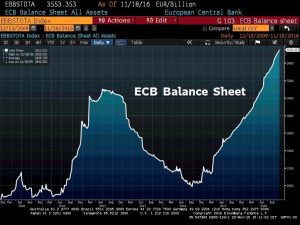
. Excess liquidity has gone from 125bn to 750bn since implemented

. Credit growth is poor (0.6% p month) and focused on poor productivity areas -construction-.

. GDP estimates and inflation expectations have been revised down.

. Message that “it would have been worse” and economy would have lost 1.6% 2015-2017 is questionable given lack of success at predicting.

We are repeating the mistakes of Japan step by step.  We are zombifying the economy

What is zombifying the economy?

Artificially low rates and massive liquidity perpetuate overcapacity, rescue and refinance the most heavily indebted sectors and governments fall to the temptation of increasing deficit spending based on the “everything is going to change next year” argument.

Credit goes t refinance those who should close or restructure, overcapacity remains because rates are low and liquidity is high, and the debt bubble is fuelled further.

Meanwhile taxes go up to finance this party and the bill is charged to the productive sectors. Fiscal pressure increases, making the high-productivity sectors suffer while a covert subsidy is given to the unproductive.

What we need to do is recover the policy of maximizing  disposable income of citizens, strengthen saving, and afterwards consumption. Lower taxes to companies and citizens. Forget demand side policies to recover supply side ones.

In a recent report, Pictet Investment Fund showed what it calls “stimulus saturation”. After more than 27 billion dollars of monetary expansion of the major central banks, and dozens of rate cuts, the world has not reduced its debt problems. It has increased them.

Helicopter Money

Helicopter continues to be the same covert subsidy to the indebted and inefficient, at the expense of the saver and the efficient, perpetuating low productivity, cronyism and high borrowing. And, as such, when it starts, it becomes impossible to reverse. Because it is promoting the misallocation of capital. If it was poor with low rates it is worse throwing money for political spending via white elephants. The experience of history in inflationary monetary policies show that it is likely to lead to stagflation.

Risk to Banks

The impact of negative rates and the latest ECB measures is likely to maintain high Non Performing Loans, and reduce profits by 12-15%.

The current rise in uncertainty and revised growth estimates in Europe is likely to increase NPLs, added to the higher risk in Emerging Markets, where European banks had focused their growth.

The reality is that the artificially low rates sink the profits of banking and, what is worse, the capacity to clean up balance sheets and recapitalize. Banks will have to take more risk at a lower return to finance the real economy.


About political uncertainty in Spain:


BBVA, for example, calculates that, six months this uncertainty continues, the rate of growth of GDP in 2016 will be reduced by 0.5 percentage points, from 2.7% to 2.2%, and 1.3 percentage points in 2017, from 2.7% to 1.4%. A prolonged uncertainty scenario would cut by half the rate of growth of the economy in 2017. The Bill for such uncertainty would be already, in these three months, around 5,000 million euros.

-ICC – Spanish consumer confidence dropped 12 points so far from 2016. The ICC has declined to 95.2 points, a level not reached since December 2014.

Direct financial investment and gross capital formation is also slower. In 2015 it increased 6.4%, according to data from the OECD. It was expected that Spain would be the seventh country in the OECD in investment growth in 2016, with a 5.1% increase of the gross fixed capital formation. However, current estimates already subtracted almost 20% to this growth. Investment projects exceeding 6,000 million euros that would create up to 167,000 jobs direct and indirect have stalled.

Spain appears to have fallen into the trap of 2009. Thinking that everything is solved because the central bank supports and keeps fiscal expansion alive. Some call for more deficit – more debt – and the rating agencies warn of the government stopping or reversing essential structural reforms.

Missing deficit target was a warning sign. The breach comes basically from uncontrolled spending of the autonomous communities and Social Security. Canary Islands, Galicia and Basque country were the only communities that have met the target, with most raising their expenses by c8%. All this shows that it is always a problem of expenditure. Revenues rise nearly 4 percent and spending shoots twice.


On IMF and slowdown:


The International Monetary Fund revised again – fourth time in 15 months – growth expectations. A reduction in the pace of development of 18 of the most important economies for 2016 and 2017. At a global level, a drop of nearly 6% less than the estimate in January.

From this analysis we can draw several conclusions. The eurozone (- 0.2%) and Japan, embarked on enormous monetary stimulus programs, surprise on the downside, especially Japan (2016 – 0.5% and – 0.4% in 2017). The oil countries, especially Russia (- 0.8%) and Nigeria (- 1.8%), return to see their estimates reduced despite devaluations and stabilization of commodities. Brazil not only deepens its recession estimated at – 3.8% but the IMF expects zero growth in 2017.

But if something is surprising is that the IMF increased growth expectations in China by 0.2bps, something that contrasts with the leading indicators for the Asian giant. The IMF has cut its forecast of China’s growth by half since 2010 (“Cooling Dragon” WSJ). It gives me the impression that they are trying to conform to government guidelines that ignore the imbalances in terms of its currency – and the more than likely devaluation – and its high indebtedness – which has nearly doubled since 2006 and already exceeding 230% – and that is never good.

Profits Recession

What is a recession of profits? The constant fall in expectations of earnings despite what one would consider a “benign environment” – low rates, high liquidity-. In Europe, estimates of earnings per share of large companies for the first quarter of 2016 have fallen 12% since the end of January.

It is important to understand a profits recession because it is more serious than a balance-sheet recession, that is solved divesting and reducing unnecessary spending. When we expect unicorns, two of them, increases in tax revenues and the growth of real wages, depend on earnings improving. Additionally, Standard & Poor´s estimated that overall investment will drop by 10% in 2015-2016. The combination suggests downward revisions have only started.


The Energy World Is Flat. Interview at Moneyscience.com

This is an extract. Read the full interview here.

What drove us to write the book was the misunderstandings, myths and historical inaccuracies that I had seen in publications about the energy sector. I saw that both efficiency and technology were making a big change in the energy world and wanted to debunk the myth of peak oil that was very popular. The second factor was that there were many books about maybe oil on its own but very few about energy as in integrated concept including coal, gas, renewables etc. and that’s what we wanted to write about especially because when we wrote it the general consensus was that oil prices were going to be higher for longer and our view was the opposite!

The book is targeted at anyone who is interested in the energy world from a very open perspective, someone that could be an expert but also someone who approaches the energy sector without knowing the basics. People will learn about the history of the energy sector, our view of what the future could be and about the forces that are driving such a change.

“Dramatic change is happening globally to technologies, also changes to efficiency, changes to diversification of supply even in fossil fuels – the fracking revolution has been very important – all these drivers flatten what was perceived as a very volatile market in the energy world in which the risk of running out of energy drove prices higher.”

The title of the book comes as a homage to The World is Flat by Thomas L. Friedman, that as we know was a very popular book a few years ago. Dramatic change is happening globally to technologies, also changes to efficiency, changes to diversification of supply even in fossil fuels – the fracking revolution has been very important – all these drivers flatten what was perceived as a very volatile market in the energy world in which the risk of running out of energy drove prices higher. Like in the technology revolution, the dotcom bubble, the enormous amount of investments that have happened to accommodate the growth in energy demand have created a surplus of capacity that on one hand makes the risk of running out or of disruption of supply minimal and on the other means that it continues the expansion of sources of energy that reduce the dependence on OPEC or on fossil fuels. So demand is growing but not in a way in which it could risk the supply demand balance and at the same time technology is massively eroding the risk premiums and the pricing of different sources of energy, flattening the energy world.

“The concept of peak oil is extremely popular because as most conspiracy theories it is based on half truth and half lie.”

We have seen the first wave of the flattening of the energy world that is mostly a supply shock. Now we will see the next phase which is China growing as a developed country and growing its energy imports by 1-2%. We are being extremely optimistic about the transition of China to a consumer economy. The demand growth estimates will continue to go down. From a price perspective $20 a barrel oil was a price that was not good for consumers or producers. Consumers in Europe have not seen a dramatic improvement in gasoline prices, yet it has a negative impact in terms of growth of economies of producing countries. We will settle at a price that is $33-40, not much higher than that because then all those companies the US that have been suffering will come back with a vengeance. It has happened in the gas market in the past. For oil we’re in for low prices for longer, around the $30-40 level. There may be moments it goes lower or higher, but that low volatility will persist. If you think about gold, supply demand balance is extremely tight there is no oversupply yet prices have collapsed. There is also an effect of the massive amount of ETFs, of futures that were linked to the oil price for financial reasons. As the market becomes more adapted to the view that it won’t stay lower for longer also a lot of those financial instruments disappear and that also impacts the volatility.

“Decarbonisation of the economy is an unquestionable and unstoppable force because the disruptive technologies have not been and will not be erased in their growth because of low gas or oil prices.”

We consciously avoided taking a view on climate change in the book because we are not climate scientists and also
didn’t want to represent a political position. We do take it into account, as we talk about government regulation and the strive to address climate change. Decarbonisation of the economy is an unquestionable and unstoppable force because the disruptive technologies have not been and will not be erased in their growth because of low gas or oil prices. We mention that OPEC is wrong to think solar and wind are going to be reduced in their growth because of low oil prices – no. It’s a completely different position.

The Paris agreement was a huge disappointment for anyone who has climate change as the cornerstone of their concern. I am sceptical about the Paris agreements because if we wanted to really reduce emissions it would be extremely simple. China stops subsiding its coal companies, the European Union stops subsiding the automotive and steel industry and stops giving tax relief to state owned coal companies. That would immediately address the issue of C02 emissions and they’re not doing it. I’m more of a believer that it doesn’t even matter because technology and market forces will take care of it. I think it’s a disgrace that you go to Shanghai and can’t see the sun – that’s unacceptable. That should be addressed through policy but it’s not because they are state owned companies who employ a lot of people. I won’t go into the perverse incentives of keeping an industrial model that is obsolete.
The relentless slow driving force of technology will continue to surprise us all. Seeing it from a positive perspective, policy might help, but the last nail in the coffin of a carbon based economy is technology. Think of 3D printers. What they are going to do to the shipping industry we have not even started to think about.
Policy makers have only one thing on their mind, to sustain GDP for fiscal reasons. The way we calculate GDP is obsolete. Technology is going to take care of it and we will have to start addressing the beneficial cumulative impact of that technology.

The Energy World is Flat: Opportunities from the End of Peak Oil is out now published by Wiley.


Spanish Parliament rejects coalition bid (CNBC)

After two failed investiture votes, it is likely that Spain will be heading for new elections in June. This period of political uncertainty, which started with the municipal elections, starts to show clear signs of economic impact.

There are many studies on the effect on the economy of political uncertainty. The IMF (Aisen and Vega, 2011) and Harvard (Alesina, Sule, Roubini, Swagel, 1996) explain that political instability and constant changes of policies and administrations have a direct impact on economic growth.

The first to suffer in an environment of constant political battle is consumption, investment and hiring decisions of domestic players. That is, it is Spaniards themselves who reduce economic activity seeing every day in the media a battery of impossible magic solutions, and calls to eliminate reforms that have supported growth.

Spanish consumer confidence -ICC – fell by twelve points so far in 2016. The ICC has dropped to 95.2 points, a level not seen since December 2014.

Capital flights reached 70.2 billion euros in 2015, mostly between October and December. Even if we consider the ECB cheaper lending effect, there is a clear negative effect.

Unemployment rose in February by 2,231 people.