Oil Price Outlook. Bounce Could Be Short Lived

The global glut in the oil markets continues. See the interview courtesy of IG.

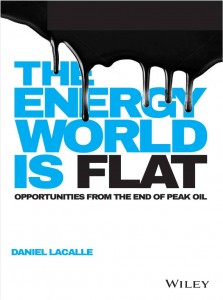
As we explained in our book “The Energy World Is Flat” (Wiley, 2014), the forces that keep flattening the world are working, not only to make the era of high oil prices a distant memory, but also to ensure ample supply for many decades.

Global supply is stronger than ever:

. OPEC output at record 31.5 mbpd. If Iran and Irak add, as I expect, another 1.5mbpd to the market, not only we will see global spare capacity rise (currently at 2.7mbpd), but a surge in “low cost-high quality” barrels, as the oil from those two countries is not only very cheap to extract and develop (as low as $10-20 a barrel), but ranks among the best in terms of API quality.

. Despite large capex cuts and cost savings, US production remains above 9.4mbpd, a fact that not only improves the supply picture, but also reduces the geopolitical premium that we used to attach to the price of a barrel.

. Russia remains strong above 10mbpd.

On the demand side, although global demand estimates have been revised slightly up, the concerns about China, consumer of c11% of total world production, are making international investors nervous.

Efficiency keeps eroding demand growth as well. The IEA estimates that efficiency takes away up to 2mbpd from the estimates of demand growth per annum.

Even with a global demand growth of 1.3%, supply growth will be higher for a third consecutive year.

Technology and substitution continue to make the oil market better supplied, more diversified and less impacted by bottlenecks. Oil demand is c70% for transport. As hybrids, electric cars, natural gas vehicles and synthetic jet fuels develop, the market share of oil in transport has only one way to go. Down.


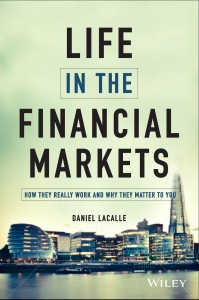
“Life In The Financial Markets” available in Audiobook

My book “Life In The Financial Markets” is now available as audiobook.

Here.

In the book you will find a personal account of:

– How the City and Wall Street work

– An analysis of the debt crisis, the Euro crisis and the wrong measures taken to solve it.

– A critique of quantitative easing policies and devaluation decisions.

– High Frequency Trading, a response to Flash Boys.

– Tobin tax and other incorrect measures.

– Strategy examples from hedge funds.

– Investment recommendations.

– Common mistakes and misleading messages from companies in their corporate communication.

– Analysis of metrics to value companies.

Hope you like it!!!

PRAISE FOR LIFE IN THE FINANCIAL MARKETS

“Refreshing and transcending, all at once. In a world loaded with theoretical market opinions, we finally get a view from a credible market practitioner. Lacalle gets it because he does it, every day.”
Keith R. McCullough, Chief Executive Officer, Hedgeye Risk Management

“Accessible and easy to read, but also thorough and rigorous. This book will be an excellent read for anyone wanting to understand financial markets, monetary policies and investing.”
Lex Van Dam, Trader/Partner, Hamstead Capital

“Lacalle has used his first–hand experiences to give a dose of reality and demystify the markets and the hedge fund industry. He cuts through the jargon and has given insight into how the markets and the real–world economy interlink. Lacalle shows us that the key ingredients that led to the last financial crisis, ie huge debt levels, are still with us now and could set the scene for the next one.”
Steve Sedgwick, Host, Squawk Box CNBC

“Intimate, insightful, inspiring. Daniel Lacalle, a top commentator and fund manager, explains in layman’s terms how financial markets actually work by adding his unique personal perspective. A page–turner.”
Francisco Blanch, Managing Director/Head of Commodity Research, Bank of America–Merrill Lynch


The Largest Financial Trade In History And Its Risk

This is a post by Daniel Morcillo, a special contributor, who reflects on some of the issues we have been discussing here since 2011 (the “sudden stop”, the end of the commodity supercycle, the deflationary nature of QE and the unpredictable impact on the world economy of the normalization  of monetary policy).

While the majority of media is now focused on the Hellenic, Hawks and Trump news, attention is lost upon a matter of greater concern to the world. Something the IMF and BIS analysts have been warning or a couple of years, which stands as the greatest trade seen in financial history. A trade that was originally thought to have been 1/3 of its actual size and which has been fuelled upon by Central Bank policy. I refer to the 9trn$ carry trade which has flowed into Emerging Markets and appears to be unwinding.

This call is not for a meltdown, but rather a global slowdown that could expose similarities with 2001 and deteriorate to 2008 levels in the worst case scenario.

This scenario is mostly based on a probable strong US$ throughout 2015-onward.


  • Central Bank stimulation strategy of easing monetary and fiscal policy (i.e. lower interest rates and more $ liquidity) creates and leads to US outflow of carry trades from $ to EM (1).
  • IMF in 2013-2014 warns of this carry trade and estimate it at 9trn$ (2015).
  • Devaluing currencies (“currency wars”) of the majority of world economies , the Developed Markets need/chase for yield (2), the Emerging Markets need (?) for credit , Central Banks policies (+others…) lead to a deflationary environment.
  • The misallocation of capital in an unwinding carry trade will make emerging markets more illiquid, spark volatility and moreover reflate the $.
  • The very possible scenario of a bull $ in an ending commodity super-cycle (see below) could be very harmful for global growth. Starting at EM and lagging at DM (US then EU).
  • Without knowing how these unintended consequences will exactly play out and when, the existing entrenched involvement of CB policy (e.g. FED hiking) could only attempt to cushion this probable scenario.
  • The peak for the global “expansion” cycle has been undoubtedly positioned by China, who has seen large sums of this $ denominated capital inflow start to roll out (3,4) . I remember pondering back in 2013 at the exuberant irrationality of the Chinese government building empty megacities in the middle of nowhere. Today 1st August 2015, Chinese PMI signals 50.00 (even the PMI number looks manipulated), the PBC along with the Shenzhen and Shangai Composite and their trajectory speak for themselves even though US Hedge Fund consensus still stands bullish. Back to the central scenario, it would be of no surprise to see the RMB unpeg from the $ in CHF/EUR style or GBP/DEM (c.1992) flair.
  • In this overall scenario, the situation of devaluing currencies vs a strong $ will inevitably lead to defaults, as the economic fundamentals of EM are stretched along with their voluminous $ denominated debt burdens.

Significant emerging currency depreciation should cause investors to hesitate. Depreciation is a secondary form of “default”.” William H. Gross, 30th July 2015 (5)

  • For me, the focus now is to see who will be the highest beta debris (once again, based on fundamentals) of this carry trade unwind as well as too see if, when and how it plays out. With a focus on fundamental analysis it is also crucial to analyze capital allocation of this carry trade and its embedded liquidity.

As much as I like to quantify things as much as possible and prove through probability and historical back-testing, this is an unprecedented event in the history of financial markets. This is not only because of the magnitude of the stimulus but also due to the fundamental situation of each economy, market and the varied nature of concerning factors (such as CB policy) concerning each economy individually and as a conglomerate (EM & DM).  Depending on how you look at it; this is both a “This time it’s different” as well as the opposite.

This is more of an initially theoretical evaluation by connecting the dots of our global macro current situation which will be proven to be occurring through upcoming feed on world economic data. Regardless, current economic data does lead me to believe that this scenario which I have summarized above is increasingly likely, if not occurring now.

As an objective student of financial markets, I have to enforce that this is not a “doomsday” style global meltdown warning, but rather something I believe has to be on the eyes of market practitioners as it may fuel large sums of wealth destruction, slowing down global economic growth and lastly, at the same time aligning with the 3 standard-deviation historical average duration of the US economic expansion cycle of 83.64 months (or 7 years), before (statistically) we enter another recessionary cycle, led by the end of the commodity supper-cycle.

Further sources on the matter (cited above):


By Daniel Morcillo


Iran Agreement. Wrong and Dangerous

“All war aims for impunity”, Michael Ignatieff

The agreement between Iran and the world’s great powers is a big political mistake paved with good intentions. It assumes that a government that has the explicit objective of the “total destruction of Israel” and that has not changed a whit its nuclear aspirations, will change. In fact, the agreement was celebrated by the Iranian news agency, since it is not a real change in its program.

“All nuclear power stations will continue their activity, Iran will continue to enrich uranium and the R&D on advanced centrifuges continues.”
Iran will keep 6,104 IR-1 centrifuges for 10 years. I am concerned that the Minister for Foreign Affairs, Javad Zarif, has confirmed that Tehran will begin to use their (IR-8) next-generation centrifuges, which enrich uranium up to 20 times faster than the current IR-1s.
The former Director of the CIA Michael Morell and a whole battery of geopolitical analysts have warned of the error of basing the agreement on the number of centrifuges and “verification”. “5,000 centrifugues is more than enough to build nuclear weapons, but not for an energy programme”.
According to the International Atomic Energy Agency, a nuclear bomb only needs 25 kilograms of enriched uranium U-235. And although it is more difficult to produce uranium 90% enriched, it is not much more complex than the 4-5% uranium required to generate electricity.
Limiting the number of centrifuges is not avoiding any risk. But it’s funny to put the nuclear program as an excuse to “diversify energy sources”. As if Iran could not diversify through natural gas, solar or wind power.
The support of Iran in the battle against the Islamic State has weighed more than the risk to Israel or the stability of the area. But the claim of the Obama Administration that verification alone will work -when only 25kg of enriched uranium can be enough to make a bomb- and leaving the region to solve its own problems are huge miatakes. And it puts Israel in danger.

The risk for stability and peace in the Middle East is huge… in exchange for a promise that “within eight years,” everything will change. It cannot be more naive.
Impact on the oil market… the only positive.
The agreement with Iran means an estimated increased investment in the country of $ 170 billion, primarily in oil and gas. The immediate impact will be to increase production in the short term between 500,000 barrels per day and a million in the medium term, being conservative. This means much more excess supply, as we mentioned many times in this column.

With the end of the embargo, the spare capacity of OPEC also doubles. In addition, investments in new oil infrastructure will help Iran to increase production above 4 million barrels per day and longer term probably to 6.5 million barrels per day.

Iran will have more than 20.8 billion dollars in annual added revenue in the short term, added to the aforementioned investments. Meanwhile, Saudi Arabia has already increased production to the historical record of 10.33 million barrels per day in May. Iraq, although not subject to quotas, also reached record levels.
The strategy of OPEC is still standing. Prove to the world that they are more competitive, flexible and reliable suppliers. Gain market share in an environment of excess of supply that they know is structural. And prove that they can win a price war against the US, Russia and renewables in an environment of low prices.
John Kerry and the negotiators know well that potential new geopolitical conflicts do not impact the “oil weapon” and with the US close to energy independence, they think that it is easy to leave the region to solve its problems without US support. Seems they have forgotten that there are more important things than cheap oil and reducing military presence in the region.
Obama says that the agreement is not based on trust but on verification. This reminds me of the scene in which Hans Blix told Kim Jong Il in the satirical film Team America that “if you don’t let us inspect your palaces we will send you a letter showing how angry we are”, seconds before being thrown into a pool of sharks by the North Korean dictator.
We may have cheap oil for a long time. But the risk to Israel, and by extension, Europe, is very high, and it is irresponsible for the world to appeal to the good will of those who want your destruction.