Tag Archives: International

The Spanish Banking Reform And The Devil’s Alternative

(This article was published in Cotizalia on May 12th 2012)

There is hope and doubt among investors following the announcement of the Spanish financial reform. And like it or not, investors are the only real solution to help finance the so-called “property management agencies” (bad bank), the term used for the entities that will house the toxic assets of Spanish banks, generated after a decade of real estate bubble.

There is hope because it is the first reform that looks real. But there are doubts, especially because it is not clear which will be the discount to be applied to the valuation of toxic loans, or what will be the formula to finance the gap between loan value and real asset value. The answer, in my opinion, is that if the discount is not strong funding will be complicated.Investors told the government in many meetings that they will only accept an “American” solution, a bailout (TARP) and a complete clean-up of the toxic mess created by real estate. However, the Spanish government does not want to take such a high a political cost, by undertaking a massive bailout that previous administrations failed to undertake. The policy of “pretend and extend” has been incredibly damaging both for the country and for financial institutions. The interventionist regulation of the Bank of Spain and lousy management of the loan portfolio of some entities, not all, made the financial crisis deeper and longer.

The true liberal solution would have been to let the bad banks fail, auction their assets, and let the solid banks emerge stronger. The problem is, and was, to allow publicly managed entities (the savings banks) go under, and the political cost that it would entail.

The other solution would have been to create a giant debt-to-equity swap program that would take care of the toxic loans and re-capitalize the banks. Two problems there as well. One, the size of the problem, more than €170bn, and two, the contagion effect on the holders of that debt, mostly European banks and domestic entities, which would face the dilution with a domino effect of re-capitalization needs.The Spanish government faced the devil’s alternative, remembering Frederick Forsyth’s novel about a situation in which all options entailed huge challenges. Allowing bad banks to fail, or a “USA TARP solution” or a “Swedish solution”, buy the loans at once at real market price. But the cost to the taxpayer would be enormous, between 17 and 30% of GDP, and it could mean bankruptcy for many public institutions, which would have a greater political cost yet. The devil’s alternative.

All the options to solve the mistake of “waiting until it clears” and denying the bubble of the last four years are financially complex and politically difficult. That is why the government in Spain is hoping that the solution will include foreign investors. But these will not allow another half-baked solution, but immediate and total cleaning. And the risk is that this new reform is perceived as courageous, but with unresolved issues, and probably too long -two to five years- to implement.In 2008 we were told that the maximum exposure to troubled real estate loans of the banking system in Spain was €25 billion. Today, four years later, the figure many of us had in mind is now official. Nearly €184 billion in troubled non-performing loans. And someone should be held accountable for the loss of credibility of the enormous amount of incorrect and half-clear information that was provided to markets in the past years to try to “reassure” investors.

At least, the Government puts the problem on the table . The solution is less obvious. But the alternative of the devil tells us to be drastic. It may hurt in the short term, but it cuts the gangrene . Leaving the solution in the hands of the same regulator and the same managers which extended and masked the problem “while markets recover” can cause Spain a major problem. Because credibility is lost in a day and it does not recover in years. And it’s an urgent matter.

In Spain, which prided itself of having no sub-prime crisis – these are things of the evil Americans- no less than €73 billion of the total €184 billion in toxic loans correspond to “land”. This is important because one of the things that separates Spain’s real estate bubble from others in the OECD is that some banks and cajas (savings banks) had the brilliant idea of ​​giving loans to land before urbanization. This has to be completely written-off. Because finished properties can be sold, maybe at 40%, 50% or 60% discount, but credit to land is worth almost nothing. The real estate adjustment cost other countries between 20% and 40% of GDP and massive dilutions in banks. In Spain it will probably be similar. But it’s the beginning of the solution.In 2004, a good friend, a professor at a prestigious business school, told me how surprised he was to see such a “diverse” professional profile in the new Spanish bankers attending his course. Politicians, trade unionists, philosophers, among others.”That’s what free money does, everybody is Rothschild until the music stops” he said. And it stopped. The problem is not that it stopped, but that many of these financial entities, mostly public-owned savings banks, waited for years hoping that the music and the party returned… Spanish real estate only fell 22% from the top while unemployment soared to 24% and the economy tanked because most of the inventory of unsold houses was kept “until prices recovered”, to avoid large mark-to-market losses, through troubled loans.

It is worth noting that the creation of real estate management vehicles (bad banks) and public capital injections will not increase credit immediately to the real economy, because the problem of Spain remains a public and private debt of 350% of GDP, and the deleveraging process is unavoidable. In addition, banks, once they have tried to put out the fire of the real estate hole, face a challenging economic environment. And with expectations of a fall of GDP also in 2013, according to the EU, the bad loans (NPLs) remain a problem. It is impossible to increase credit in an economy where credit expansion was close to 8% pa for a decade, leveraged more than three times its gross domestic product, where the return on assets of many banks is less than its cost of capital.

. If the State is involved in funding the bad banks, but the country accepts bubble-time valuations, the need for constant injections will keep Spain in unsustainable debt ratios. In fact, the government deficit would increase (including state guarantees)  from 87% today to 110% .

. Injections of public money are short term loans and would not affect the taxpayer only if the market valuations are realistic and don’t require additional injections.. Of the €310 billion that we mentioned earlier, €184 are already considered within the category of problematic (delinquent). Of these, €44 bn are already provisioned, ie about 25% of the value of the credits. The remaining amount of real estate loans considered “healthy” and not yet provisioned (€122 bn) are not all fine and secure. As the economy worsens, a part of these will also become non-performing. Let’s face it. Because it can cost between 1% -2% of GDP over three years if the country allows more “hide, pretend and extend”.

. Spain should not try to hide the difficulties of bad banks, those are already sentenced. It should ensure and enhance the situation of the good banks -very good, some of them- and not allow a contagion from a lack of credibility and perception of mismanagement that is not, nor can be generalized . The country cannot allow a capitalization problem -serious, but solvable at market prices- to become a problem of solvency of the system.

Who funds the gap between loan value and true market value of the real estate exposure?

According to the different alternatives considered, the market supports an ECB or EFSF credit line. The problem would come from the demands on tax hikes and additional cuts that such aid would entail. And it’s the same old problem . Debt with more debt that is financed with taxes anyway.

On the other hand, a public funding solution also seems remote because of the need to increase borrowing at a time when spreads to the German Bund are at all-time highs (480bps). And with the system’s credibility into question, forget about Eurobonds to finance real estate bad loans clean-up.

Of course, the most logical is to attract the participation of foreign capital , through partial debt-to-equity swaps, IPOs or placements of convertibles, which will only succeed if the market perceives that valuations of the assets are really discounted and attractive. A 20% -30% discount after a peak-to-current drop of only 22% would not easily create enough investor appetite.

The worst of past mistakes made by banks, regulators and government, is that through our stubbornness of maintaining that nothing was a real problem we have risked the discredit of our financial system, which could spread the problem from the weak banks to the good ones, and from bad managers to solid ones.

It is good to read that some bank rule out any resort to state funds and may make all provisions against operating profits. To separate the bad from the good is much better than the previous policy of infecting healthy assets mixing them with toxic assets, because the risk does not dissipate, it is contagious. Let us separate everything, and show actual market prices. And the solution will be in front of our noses. After four years of evident crisis, this is the opportunity to be realistic.To watch my interview in Al Jazeera about the Spanish banking issues go: (Quicktime or Oplayer required) http://dl.dropbox.com/u/62659029/iv_daniel_lacalle_250512_0.mpg

Further reading:

Eurobonds? No Thanks. Debt Isn’t Solved With More Debt: http://energyandmoney.blogspot.co.uk/2011/11/eurobonds-no-thanks-debt-isnt-solved.html#

What happened to put Spain on the verge of intervention?: http://energyandmoney.blogspot.co.uk/2012/04/what-happened-to-put-spain-on-verge-of.html

Why Italian and Spanish CDS can rise 40%… and Greece is not to blame:
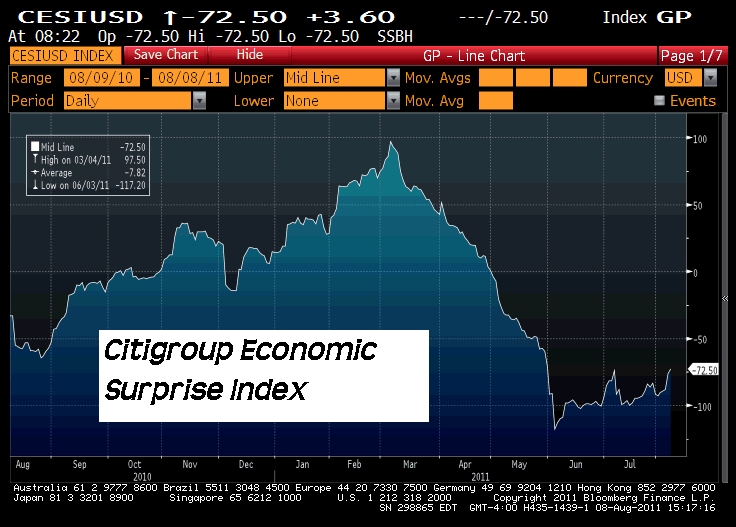
The Recession Trade: Back By Popular Demand

econ_surprise1
(published in Cotizalia on November 12th)This past week I had meetings with investors and funds in Geneva and Zurich and the mood remains sombre.
Europe is increasingly giving worse news, the Super Committee is getting nowhere and investors see the market collapse only to recover a fraction of what it lost.The United States and Europe are in recession. The current uncertainty lies only in the magnitude of such recession. In this environment a group of friends from hedge funds and investment houses have chosen the stocks and assets that, from their point of view, can win in a recession. It is an exercise we did for the first time with a group of 35 professionals in 2001 and repeated in 2008 with very positive and interesting results. Of course, the following list is just an illustrative sample of what a group of experts think.The initial premise of the survey assumes a stagnant economy and rising inflation on the side of commodities because of the monetarist policies of the governments of the OECD. In this environment, we look for companies that have chosen a precise and inflexible approach to increase margins, competitive position and high cash flow, lower costs and greater return on capital. Well, here are the favorites:

The favorites (by number of votes):

Philip Morris . The business is a cash machine, with a captive market and growing in emerging countries and a dividend paid entirely from free cash, with a Return on Equity (ROE) of 242%.

McDonald’s . The fast food giant sales increased by 5-7% in all its markets, opening a restaurant every two days in China with an aim to reach a day in 2012. A business that sells in hard times more units of higher-margin product (cheapest burgers), with a return on equity (ROE) of 40%.

Campbell: Campbell Soups generate strong growth with good quality products and very low price. A Return on equity (ROE) of 76% and almost no debt.

Walmart: A favorite of the last recession, impressive handling of costs and low prices. Generates a return on assets that increased in harsh environments and a return on equity of 22% with $10.6 billion in cash.

McKesson. Solid healthcare favourite, fully oriented to improving profit margins. A 23% Return on Assets and $3.200 billion of cash.

Exxon, accumulating $9 billion in cash, with a return on capital employed of 25% at $70/bbl (compared with 12% of its competitors) and totally inflexible when protecting investors against attacks from governments, which has been especially evident during the Obama administration. Wrongly seen as a value trap by some, this is by far the safest bet in energy for a recession. in Europe, Shell is the favourite due to its outstanding cash-on-cash-returns and discipline in capex, added to low exposure to “value destructing” diversification businesses.

KBR, Halliburton’s former subsidiary generated a lot of criticism from the press for its contracts in Iraq and its military support division. All this is behind us and today it’s a machine of positive returns (19% in a negative environment) and winning contracts despite the economic difficulties of many countries. No debt.

Seadrill: 11% dividend yield and winning contracts at day-rates that come 15-17% above competitors. A safe bet on the tightening deepwater drilling market.

G4S. The British company offers security services, with a return on equity of 20% and good dividend, the business has gotten only better in recent years.

The Spanish:

With the highest number of votes, the only stock in the Top 25 is Inditex . It has better return on capital than Walmart, attractive growth and €3 billion in cash, a business model that has nothing to envy even from Exxon.

Finally, most opt for ETFs in gold, coal and platinum.

The Shorts of this anti-recession portfolio are dominated by the CAC Index (France) for its excessive debt, high weight of problematic banks, strong state intervention in their businesses and risk of infection of the Euro debt crisis. This is followed by environmental services companies (Veolia, etc..) still seeing deterioration in returns, lost margins and increasing debt, plus the European telecommunications companies (Telecom Italia, Deutsche Telecom, France Telecom) that see their returns fall to levels dangerously close to cost of capital, and the equipment sector in renewable energy (solar and wind turbines, Vestas, Gamesa, Solarworld…), which are seeing disappearing subsidies worldwide while the over-capacity eats away returns, working capital requirements increase and growth collapses.

From my point of view, this exercise in choosing the companies that win in a recessionary environment also helps to understand how important it is to have global leaders that focus their strategy to generate better returns on capital employed, not creating overcapacity and that forget the dream of “improving cost of capital” by increasing debt.

Surprisingly the main difference between the stocks ​​mentioned and their European competitors lies both in cash as in returns and margins. And that is fundamentally a strategic and cultural difference regarding the importance of margins and returns, as traditionally Europeans favour “growth for growth sake.”

Hopefully the macroeconomic scenario is different and that everyone who voted is wrong, but I also hope that our companies learn to deal with a recessionary environment, and not only look elsewhere or expect to be rescued.

Note: Daniel Lacalle can invest in the companies mentioned in the blog, the opinions reflected here are personal and not professional recommendations. The above list comes from a survey, and is not a personal recommendation to buy or sell.

Attack Iran? Is It A Good Idea?

Naval_Update_03-14-12

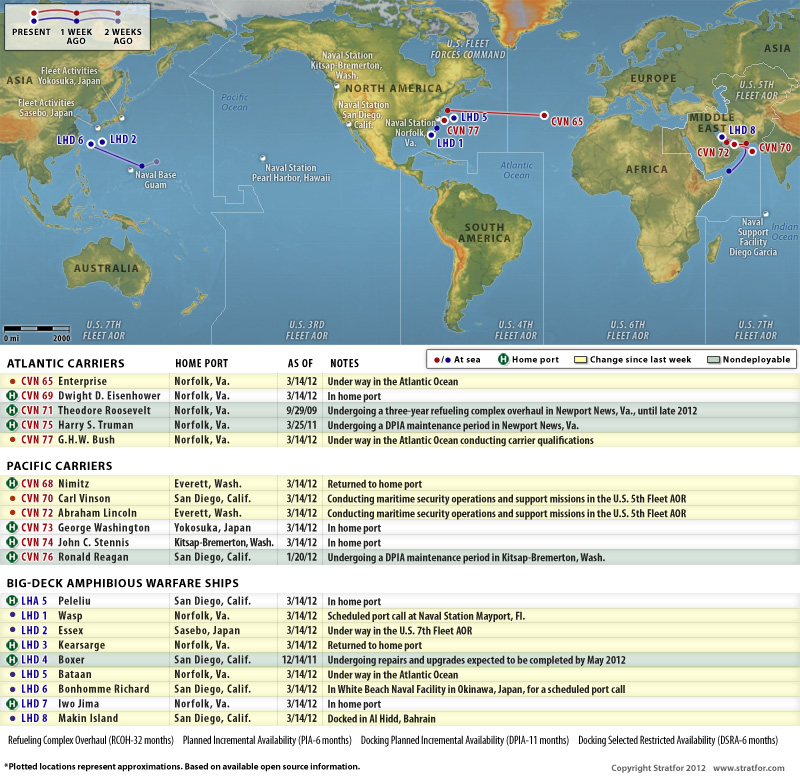
The picture above shows the recent move of warfare ships in the region (via zerohedge).

According to Israel’s NRG and CNBC, Netanyahu has achieved a majority (8 over 6) supporting an Iran attack. NRG also notes that at this point Israel has decided to not wait until the US elections in November before proceeding with an attack.

I believe Israel is trying to push the US administration and Europe to be more forceful and strong in its sanctions against Iran, but as my friend David Simantob mentioned in my Facebook account:  “I think what we are dealing with is a lot of noise from Israel to push Obama and others to act to isolate Iran. Remember nobody did anything until Israel started threatening to attack. Now we have a EU embargo, Swift (the international financial transaction system) kicking Iran out and soon we may even have an embargo on Iranian imports of refined petroleum. I don’t think Israel wants to attack Iran and I don’t think any attack by Israel will sufficiently delay a nuclear weapons program in that country. What Israel wants and what will work is strict sanctions combined with efforts for regime change in Iran. Iran ruled by sane people like a western democratic movement would not be a threat even if it did have nuclear weapons”.
I would like to highlight a few issues:
a) Iran cannot shut down the strait of Ormuz easily. It would be like shooting itself in the foot as the country would be undersupplied and unable to export, but it would also mean a declaration of war against Oman, as Ormuz is in its waters too, which is equivalent to an attack on Saudi Arabia and the Arab League.
b) The strait of Ormuz only moves 11% of world oil output now, so the impact on crude suppl would be very limited before the alternative route (the horn of Africa) is used by tankers.
c) Iran total oil exports average 2.15mbpd, of which virtually nothing goes to the US, 10% go to Italy, c18% to the rest of Europe, while most Iran’s exports go to Asia (China, Japan, India and South Korea in particular). Spain imports c196kbpd from Iran. France (58kbpd) and Germany (15kbpd) can play hardball with Iran and not bear any real cost. So the EU embargo is not a real issue. The IEA estimates 2011 Iranian crude imports into Europe at 792k bopd (Italy 185k, Spain 196k, Belgium 36k, France 58k, Greece 103k, Germany 15k, Holland 15k).
d) So far in 2012, Saudi Arabia ouput increase has more than compensated the drop of Iran supplies. To the point that OPECsupply is at record highs, while OECD inventories, as we have explained here ( http://energyandmoney.blogspot.co.uk/2012/03/us-talks-of-releasing-strategic.html#) remain at very high levels, so it seems the world has been quietly preparing for a disruption of Iran supplies at least, whether there is conflict or not.

e) Israel is not defenseless, as it has more than two hundred atom bombs that can destroy Iran’s facilities. The issue is that Israel does not want to be bullied and pushed to attack by Iran’s threats and promises to “wipe Israel from the face of the Earth”, and then “blamed” for the deaths of innocent civilians. Iran has carefully placed its nuclear facilities as close to population centres precisely to prevent such a situation. But Israel cannot live easily with the idea of a nuclear-powered country that promotes forums to debunk “the myth of the Holocaust”, and that vows to destroy the jewish country.

Interestingly enough, all the problem would disappear with a moderate Iran and if Ahmadinejad stopped promising the destruction of the jews as a core part of his political agenda.

The problem of an attack on Iran is that it would be extremely costly, around $100m per day, a logistical nightmare, as Azerbaijan will not allow other countries to use its territory to launch an attack on Iran (according to Defence Minister Safar Abiyev) and probably highly ineffective as it would probably cause a popularity surge for Ahmadinejad, which is what we have seen so many times in the past. Former Bush administration National Security Advisor Stephen J. Hadley has already warned against an attack on the Islamic Republic yesterday. “If something needs to be done, it is not military action,” said Hadley. “There’s a wide spectrum between sheer diplomacy and military action.”
On the other side of the analysis, some think an attack on Iran is the “least bad option”, as this article highlights  http://www.foreignaffairs.com/articles/136917/matthew-kroenig/time-to-attack-iran . My concerns remain both on the risk of a surge in support for the Iran regime among muslim countries and also on the threat to the civilian population of Israel, and Iran.
If the issue is to halt the Iran nuclear programme, I believe the way is to impose really strict sanctions as well as promoting a true regime change at the same time, using the threat of an attack to its nuclear facilities as a threat, sort fo a multiple diplomatic attack, but I must say that the proposals I have read so far (here) don’t seem too convincing.
In this article (http://www.haaretz.com/print-edition/opinion/sanctions-alone-won-t-stop-iran-s-nuclear-work-1.265981) the journalist warns against the resignation to an inevitable nuclear Iran:

.The Chinese are still opposed to sanctions and the Iranians are enriching their uranium to a higher level. Obama’s response is that he has had it and the time has come for sanctions and immediately – which means within a few weeks, perhaps by the end of March. In March, however, Gabon will assume the presidency of the Security Council, and it is not certain that Iran is at the top of its agenda. And there are still the problems with the Chinese.
And if we assume that ultimately there will be sanctions, so what? The involvement with sanctions, who’s for and who’s against, when, why and to what extent, deflects from the primary problem – the absence of an American strategy for tough negotiations with Iran. Even more serious, however, is that there are worrying signs that the Obama administration is beginning to resign itself not only to the fact that Iran will continue to enrich uranium, but also to recognition that the Islamic republic could ultimately build a nuclear bomb.

Credit Suisse had an interesting feedback from Dr Mohammed ElBaradei, the recent ex-head of the International Atomic Energy Agency (IAEA – ie the nuclear weapon inspectors) and Noble Peace Prize awardee. His view is that:
  • There is extremely low probability of an Israeli attack on Iran.
  • Iran is still a distance from actually making a nuclear weapon even if they have the technology, as, at the very least, they do not have enough nuclear material and obtaining it will alert the inspectors.
  • He feels the US and Iran ‘probably’ will negotiate directly in Obama’s, potential, second term. The deal would need to allow the Iranian leadership to claim retention of the technology to its population but privately stop the reality of a weapon.
  • Iran has the ability to be extremely disruptive if/when the sanctions bite in Iran, Saudi border, Afghanistan, Palestine, Syria and the UAE – none of the western powers want this.
  • China and Russia do not believe that a military or sanction approach will work and publicly and privately will rebuke them.

Let’s hope there is no attack or any relevant conflict and that Iran allows inspectors to its nuclear facilities while we see a transition to a less aggressive government in the beautiful Persian country.

US Talks of releasing Strategic Reserves of Crude as Saudi Arabia Production Rockets… And Iran Plummets

saudi
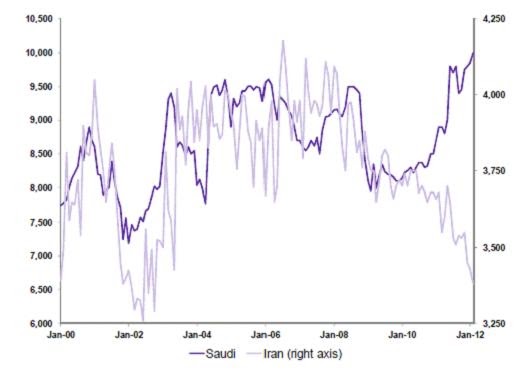
Saudi crude oil production has surged to 10.0million bpd, the highest level in 30 years, this as Iranian production has plummeted. Thanks to Goldman Sachs Research. This surge shows that the comments about Saudi Arabia not being able to increase production were meritless and also shows that they add production when demand is there.

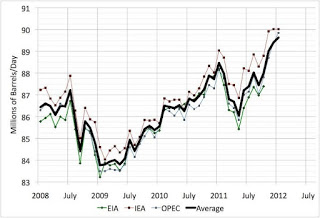
Yet OPEC production is at record highs:

photo opec

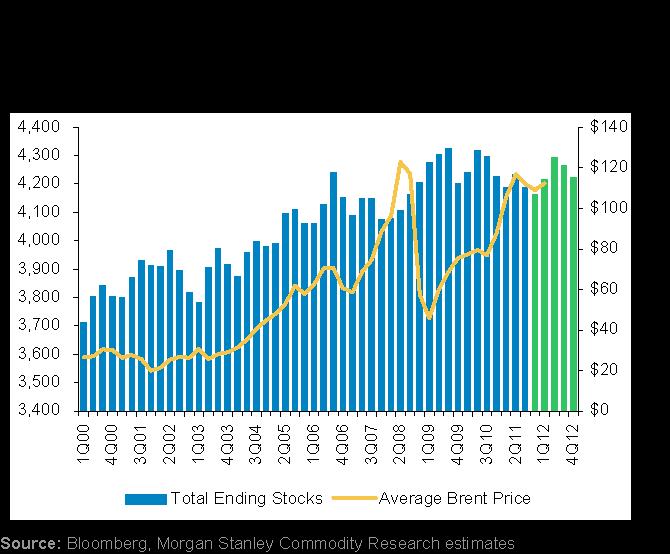
..And Morgan Stanley warns of rapidly rising inventories…

inventoriesFrom Oriel: Despite the latest Obama rhetoric against Iran, he can hardly afford a pre-election attack, unless he taps the SPR (but even that is unlikely to be enough): An ABC News-Washington Post poll found that 65 percent of respondents said they disapprove of the way has handled rising gasoline prices – just 26 percent approve of his work on the issue, his lowest rating in the poll. Most Americans say higher prices are already taking a toll on family finances, and nearly half say they think that prices will continue to rise, and stay high.A new CBS News-New York Times poll released Monday evening shows Obama’s approval rating falling to 41 percent, a drop that “may be partially attributable to rising gas prices.” Hardly a surprise then that White House released a new report on Monday seeking to highlight the progress his administration has made on energy ….. and then I see in a report that ‘US President Barack Obama and British Prime Minister David Cameron discussed the possibility of releasing emergency oil reserves during a meeting on Wednesday, two sources familiar with the talks have told Reuters. Obama raised the issue during a broad bilateral meeting at the White House, according to a UK official with knowledge of the discussion, in the first sign that Obama is starting to test global support for an effort to knock back near-record fuel prices.

This could look in time as one of the dumbest decisions, in my opinion, since the day when the UK sold all its gold reserves between 1999 and 2002 at around $280/ounce… unless Obama sees a material economic recession ahead and then the new QE of the economy is artificially lowering the price of oil.

The U.S. strategic petroleum reserve is at almost historic highs again with c696 millions barrels, of which 262 millions barrels are sweet and 434 millions barrels are sour. The International Energy Agency reported in April 2011 that SPR in OECD Europe and OECD Pacific totaled 186 millions barrels and 391 millions barrels, respectively.

This would be the 4th time in the past 50 years that IEA has released strategic reserves. The last three times, the improvement in oil prices that they looked for resulted in three subsequent super-spikes. This, I fear, will be the outcome again soon. So the call on OPEC, even if demand continues to slow down, will increase to 30.1mbpd, making prices go higher.

We are in a US election year and the political dividend from appearing to push oil prices lower is very attractive (Bill Clinton knows it well, he did it too). President Obama wants to appear tough on oil and keep gasoline prices low in July. But a few weeks later we will be back where we started. Lower prices only accelerate demand anyway”.

Here we go… another QE in disguise.