Tag Archives: Macro

Austerity and Growth. Why It Works

(This article was published in El Confidencial and  Cotizalia on April 4/2012)

The great debate in modern macroeconomic analysis focuses on whether the processes of public spending cuts that are being carried out are consistent with fostering growth or whether spending cuts threaten economic development.

Many anti-austerity economists like Krugman, who calls for more spending but also massive wage cuts, or Stiglitz warn of austerity as a driver of deepening crisis.

I’d like to give a summary of the talk I gave a few months ago in Austin and Dallas called “Austerity Works” and why it is in Spain and Southern Europe where budget control is most needed.

The first thing worth to note is that Europe is not undertaking true austerity measures, but very modest cost savings. In fact, in most cases the cuts have only slowed down the speed of spending growth. As we explained here to reduce the “deficit” from 8.9% to 5 % is not austerity, it’s just fiscal prudence. It is not the same to aim for debt reduction than to reduce its increase.

The first argument often used by those who attack the austerity programs is to compare this process with what happened in the 30’s, that is, a worsening of the crisis. But these arguments tend to forget the differences between both periods.

* In the thirties there was a combination of austerity with protectionism , a lethal combination that our rulers should avoid. In a globalized world it is very difficult that we can see the wild U.S. protectionism of the 30s. Unfortunately, this is where Europe can err seriously, since political intervention and protectionism is growing, but not alarmingly.

* In the thirties interest rates were extremely high and the financial capacity of the systems was very limited. That is not the case today. The role of central banks and the globalization of the financial systems has changed this risk dramatically.

* In the thirties quantitative easing was not used as a tool to mitigate the risk of deflation and stagnation. But there is a huge problem to solve. The QE (quantitative easing) that the U.S. Fed makes floods the system with money directly, skipping the banks as an intermediary. In Europe, the monetary policies have been directed solely at banks, which hold on to the funds, buying sovereign debt, without extending credit to the real economy.

The current problem is that the increased liquidity provided by the ECB fails to reach businesses and families. As the chief executive of a large Spanish company said to me “credit crunch here is affecting the small and efficient businesses, not the inefficient overgeared large companies.”

The reasons why I believe that more spending is equivalent to a shot in the foot is as follows:

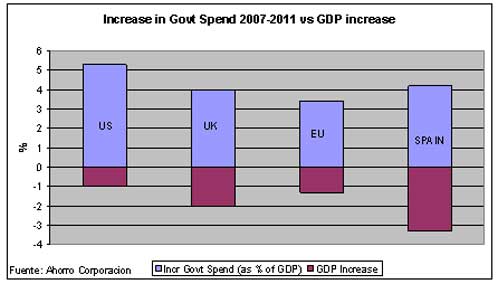
* Spending more did not work, repeating it is suicidal . Spain increased public spending by 67.2 billion euros between 2007 and 2011, 6.4% of GDP, to generate a GDP decline of 3.3% and a fall of industrial output of 12.7%, with an increase in unemployment to 24%. That increased spending also meant a cost of additional debt equivalent to 0.3% of GDP. Spain SA not only did not stop the crisis spending, but rather deepened it. The figures in Spain are devastating, but the U.S., UK and the Eurozone demonstrate the same principle, that increased spending has not produced a real positive impact on GDP.

I always speak about the debt saturation model. When an additional unit of debt does not generate additional GDP, but negative . We have saturated the dubious benefit of spending. A clear example of this aspect is the infamous Plan E of the Spanish government, 13 billion euros, only generated debt, job losses and lower GDP.
govt spend

As we have seen in the past years, “lack of austerity” is expensive, but indiscriminate spending is even worse. I always say that if Krugman was able to read the details of expenditure items in many European general budgets he would join the Austrian school in a minute. We are not just talking about tens of billions dumped in phantom cities, unused airports, useless infrastructure and outright subsidies and grants. The problem is that all these expenses are not supported by an equivalent income (no ROIC, Return on Invested Capital) thus leaving behind them not just a non-existent value, but an unpayable debt that must be covered with higher taxes destroying other activities and productive sectors.

Useless infrastructures and subsidies are not only wasteful, but the debt they leave behind is also crowding out and taxing the profitable and productive sectors. The subsidy and uneconomical public spend culture also becomes a private “investment deterrent” . No one dares to put a penny in an economy in which taxes generated by productive sectors will be used to cover liabilities of unproductive wasted capital.

Why does austerity work:

* It frees financial resources from unproductive to productive activities. Today, almost 70% of financial resources available are used to purchase public debt and finance government expenditure. It is the crowding out effect of a State that accounts for more than 50% of Europe’s economy. If the State stops monopolizing the majority of credit availability, and also stops spending on unproductive activities, private investment activity and high productivity activities return. It is no coincidence that the states that have cut public spending are the ones that create more jobs.

* It accelerates the transformation to a more productive economy. It is no coincidence that productivity falls with increasing public spending. Most public spending stimulus plans are directed to subsidies and to rescue declining industries (mining, automobile) and very low productivity activities (construction, civil engineering), and it monopolizes scarce financial resources which precludes private investment in high productivity areas. If countries rescue the inefficient by taking from the efficient one’s pocket, investors fly away from the country and moves to more attractive places.

* It helps create real jobs, not subsidized labour. When the State spends on pointless companies and investments with no return, it does not create employment, it subsidizes it by borrowing. And that cost comes from taxpayers until the State runs out of other people’s money and the pyramid collapses. Europe has seen the destruction of more than 80,000 small and medium enterprises annually while governments subsidize spending that also destroys public jobs in the medium term, when money runs out.

* The increase in interest expenses from more government debt hinders recovery and generates tax increases that discourage consumption and investment as well as repel capital. If Europe stopped issuing new debt to pay interests on old debt it would start to solve its problems.

It is relatively easy, austerity would help: Not only stop paying unnecessary subsidies and reduce billions of euros of cost of additional debt, but austerity attracts capital and reduces the loss of tax revenue by bringing new investors. And instead of removing 0.3% of GDP increasing debt, GDP would be up reducing the financial burden.

The well-intentioned recipes of Krugman and Stiglitz start from incorrect assumptions:

. That most European governments would spend taxpayers’ money more efficiently and wisely than private investors.

. Even worse, they assume that those European governments would base their investment criteria in a capitalist, return-driven, open-market, Anglo-Saxon way.

. And much, much worse, they assume that the investment decisions of most European governments are compatible with private investment, when often they aren’t.

Most of these “growth plans” have proven to crowd-out private investment, prevent competition, unfairly defend unproductive and declining sectors, and aim at safeguarding inefficient low productivity oligopolies. As such, in many cases European government spending has proven to be in most cases more damaging than helpful for economic recovery, and it widens the funding hole.

We need to escape the spiral of spending, of favors owed, protectionism and subsidies, we need to stop rescuing the unproductive and, through lower taxes and lower spending, foster investment private capital, innovation and growth.

Further read:

My article in The Wall Street Journal:
http://online.wsj.com/article/SB10001424052702304782404577488283442408896.html?mod=WSJEUROPE_hpp_sections_opinion

also here:

http://energyandmoney.blogspot.co.uk/2012/06/recipe-for-spanish-comeback.html#frameId=uWidget20a9e6e60130f5c6a6f0&height=131

The Myth Of European Austerity

What If Germany Turns Off The Funding Tap?

The European House Of Cards

http://energyandmoney.blogspot.co.uk/2012/06/euro-house-of-cards-and-greek-temporary.html

Real Austerity Does Work

http://pompeunomics.com/2012/07/09/real-austerity-does-work/

You can’t get Blood from a Stone

In the hope that someone in the EU reads it:I: Inflation is a tax. Create inflation when salaries are stale and spending will collapse

II: Printing money is stealing funds from savings and from efficient companies to give it to inefficient and indebted governments.

III: Trying to increase tax revenues to bubble-period figures is impossible. Those revenues disappear when the bubble bursts. You have to bring spending to pre-bubble levels.

IV: Increasing spending and debt means passing the bill or the consequences of a default to our children.

V: Offsetting private investments with government spending assumes that politicians are better managers and investors than private entrepreneurs.

VI: More taxes, less growth, less revenues. Same spending, more deficit. More debt, bigger hole.VII: Increasing debt today is to assume that we deserve to spend today the expected productivity and efficiencies of the future.

VIII: If our policy is that countries don’t have to worry about debt because governments don’t need to pay it we shouldn’t be surprised with increased cost of borrowing.

IX: Increasing public spending today assumes that the same governments that made spending mistakes in the past will now change their way and do it well.

X: If a country’s debt is “low” and its cost “manageable” yet demand for its bonds is collapsing and costs soaring, the debt is neither low nor manageable.


The Euro House of Cards and the Greek Temporary Relief

After a week of maximum tension in Europe driven by the Greek elections, Spanish and Italian bond yields, and Cyprus, another one that needs a bailout, things seem to be stabilizing. As suspected, New Democracy -the conservatives- have won in Greece but they will need to form a coalition in the next 3 days. Germany have already suggested this may allow some loosening of program terms but Eurozone bond yields remain at historical highs and the challenges remain. Yet Greece solves nothing. At the close of this post (Monday 18th) Spain 10 year soared to 7.00%, a spread to the Bund of 553bps.The solution to the debt crisis in Europe is evident. No more reckless spending, reduce debt and avoid forcing monetary expansion measures. After consuming billions of dollars in expansionary policies without success, Europe should stop and think that the damage is greater than the benefit. All these mechanisms have proven ineffective . We have seen five consecutive years of stimulus plans in Europe, a total of $2.63 trillion, with no evidence of success. Providing liquidity and financial relief must be temporary measures, not structural. To demand half a trillion in new stimulus each year is madness.

The solution is fiscal prudence, halting the spiral of political spending, cleaning banks’ balance sheets-preferably paid by shareholders and bondholders-, attracting capital and eliminating unproductive subsidies.

The European House of Cards

The European crisis continues and this page ” The European Super Highway of Debt “ shows visually the size of the house of cards. More debt is not going to help.

In the European credit market we have seen this week a few interesting things:

  • Despite the austerity measures, Spanish public debt has grown 5.39% in the first quarter to 774.5 billion euros, 72.1% of GDP. Reforms must continue, but much faster.
  • The Spanish risk premium to the Bund stands at 553 basis points . Why? Because debt and financing costs would soar if the country was to use the loan of 100 billion to recapitalize the troubled banks, making it more difficult to repay that debt. The key issue to tackle is that international investors are selling government bonds, leading to the Spanish banks having to buy more public debt. Almost 67% of the country’s debt is now in national hands.
  • The credit default swaps (CDS) in France and Germany are up almost 12% in a month, showing that the crisis is still spreading. All CDS, including Germany’s, have risen on the risk of another stimulus plan/shot of debt. This is what happens when one breaks the principle of responsibility of creditors. Structurally rescuing banks and countries endangers the whole system.
  • The International Monetary Fund on Friday urged Europe to help Ireland refinance its crippling bank bailout and consider taking equity in state-owned banks to help Dublin return to bond markets and avoid a second bailout next year.
  • We are told again and again that the ECB and Germany do not support peripherals . However, the numbers say otherwise. The Bundesbank has lent to the periphery of Europe 699 billion euro since January within the Target scheme II, equivalent to almost 25% of the GDP of Germany. Spanish banks have asked the ECB for a further 7.4 billion euros, making a total of 288 billion so far.
  • While Europe, the ECB, EFSF or ESM, provides support, the countries contributing funds to these institutions are almost all highly indebted and are funded in many cases at much higher rates. Il Corriere della Sera echoed the irony that Italy will contribute 19 billion euro to the 100bn loan to Spain, lending it at a 3.3% rate when Italy has to borrow in the markets at 6%.

Look at the chart below. Over 85% of the money that is contributed to the European stability fund is provided by heavily indebted countries and their contribution is not capital. It is debt.

The Greek Relief

In all this week heading into the Greek elections we have read comments that central banks “maybe” “may” “study” the “possibility” of a concerted action to support the economy. Failed before? Try and try again.

Greece shows us the fragility of Europe’s policy of “debt with more debt.” Greece is not the problem, it is part of it, but it can cause a big financial turmoil given the web of cross-country loans.For starters, Greece will need a new additional injection of 15 billion within weeks. Remember in April 2010 when former Spanish president said that the country would gain about 110 million euros a year -yes, a year-with the loan to Greece? Now, neither loan nor gain. A donation.

To put it simply:

New Democracy winning, with a coalition of pro-Europe parties, solves nothing. It is ironic to see the markets rejoice at the fact that the same party that lied about the countries’ finances is now winning. Greece will probably renegotiate the terms of the bailout, yet require a package of “growth”- ie debt- for infrastructure projects financed by the EIB. Funded is probably too big a word, because it is highly unlikely that the loan will be repaid. The “cost” of this option is estimated at 50 to 60 billion Euro in a period of 18 months. JP Morgan estimates only €15bn of €410bn total “aid” to Greece went into economy – rest to creditors, yet the financial hole of lending to Greece has only grown.

The reality is that no matter who ends in government, in Greece what has won is the scheme of a hypertrophied state, political spending and cronyism between government and financial institutions. And that additional debt will be funded by a Euro-zone with fewer resources and increasingly isolated from international markets.

The giant financial web, the house of cards of the Euro-zone, is the reason why every time there is an announcement of intervention the placebo effect lasts a few hours an bond yields explode higher. The  house of cards of debt is the root of the problem and only tackling it would be the beginning of the solution

At the close of this article, there is speculation again with the possibility of a massive shot of liquidity (LTRO) from the European Central Bank, but this has a considerable risk. Banks use most of that liquidity to buy sovereign debt, creating a vicious circle. On the one hand, liquidity does not reach the real economy, lending to households and businesses continues to fall, and on the other hand, it doubles the risk. The bank balance sheet risk and the public debt risk together. This is because banks have ​​it more difficult to attract funding as their sovereign bond portfolio gets larger and riskier, impairing financial entities’ balance sheets.

The stubbornness of the European Union to solve a debt problem with more debt only increases the fragility of this house of cards. Fortunately, now there is no turning back because the creditworthiness and the credibility damage is already done. Now, the entire European Union must address the shortcomings of its foundation and find a real fiscal union and implement credible fiscal prudence. Only then, and not before, will Europe see international capital returning and see sustainable economic growth.

You can watch my interview in Al Jazeera on the Spanish crisis here
http://www.aljazeera.com/programmes/insidestory/2012/06/20126126534386935.html

Anthology of Shocking Market Quotes

In this crazy market there are moments to cherish. The recent collapse has generated memorable quotes from conversations with brokers and analysts. Here are my top 10:
  1.  “No one owns this stock” (Me: “it is 100% owned every day”) Him: “you know what I mean” (Me: “No I don’t”)
  2.  “The company has to take a $4bn write-off, which would be very positive for returns”
  3.  “Why would you think that a State Owned Company will not increase tariffs by 20%?”
  4. “If you forget the sovereign and macro concerns, it is very cheap” (tied with “”We leave that to the strategists” and “On an absolute basis, the stock is cheap”  )
  5.  “Stock overhang should not matter because it gives opportunity to buy cheaper”
  6.  “Seven percent yield is very attractive” (Me: “But sovereign is at 6.5%”) Him: “Why would sovereign matter?”
  7.  “Earnings downgrades are not relevant, although consensus will have to go down 20%”
  8.  “Semi-State Owned Enterprises have less risk because they will be allowed to earn medium profits”
  9.  “I don’t use P/E for valuation, I don’t believe their accounting methods or find them relevant”
  10.  “I don’t look at EV, I’m recommending an equity, not debt”
Of course, these are added to the classics “everything is discounted” and “my estimates are very conservative” etc… 
And, as always, never forget the Top Three Sentences to Identify a Great Short when you read a broker report:
  •  Fundamentals Haven’t Changed
  •  It’s A Good Company
  •  Dividend Yield Is Supportive
From meetings with companies, here are my Top 10:
  1.  “It’s not a profit warning, it’s a revision of estimates” (tied with “”this is an opportunity for longer term investors”)
  2.  “Management ownership of stock is low because if we owned a lot of stock it could compromise our long term perspective”
  3.  “This acquisition has not destroyed value. Depends what you define as value creation”
  4.  “Paying the dividend in shares proves our commitment to maintaining shareholder remuneration in difficult times”.
  5.  “A convertible bond is not dilutive because shares will go up more in the long term”
  6.  “Of course we have kept our targets, we are just rebasing them”
  7.  “Our plan has not changed, it has just been postponed”
  8.  “Leverage doesn’t impact fundamentals”
  9.  “In the long term we will be proven right”
  10. “You cannot judge the valuation of the company on earnings and balance sheet”
  11. Deservedly… My all time favorite: “We are committed to having the highest dividend yield of our sector

And from Buyside, the mother of all… “The market is wrong”, “It’s only a correction”, “catalysts abound” or “why is X stock down/up?” … culminating in “My friend has told me that this is going up“.

Daniel Lacalle, June 12, 2012