Tag Archives: Macro

The Myth of European Austerity In Five Graphs

This article was written by Manuel Llamas and Domingo Soriano published by Libre Mercado here. All copyright Libertad Digital and Libre Mercado. (Wednesday 23rd June 2012).

“A lie repeated a thousand times becomes the truth”. This well-known sentence, attributed to the master of Nazi propaganda, Joseph Goebbels, could also serve to illustrate the great deception of the alleged public austerity in Europe. Since the outbreak of the debt crisis, it is widely repeated that Germany has sought to impose on the rest of the EU partners an adjustment plan focused on cutting costs and implementing structural reforms that would foster economic growth.

This strategy has been harshly criticized by many economists and by the Southern European countries, the weakest in this crisis, with Greece leading the critics. In fact, analysts, politicians and union leaders blame all the current problems of Europe, including the Greek default, on the imposed austerity measures. After the recent French and Greek elections, the critics of Merkel’s strategy have begun to gain notoriety, to the extent that the European summit to be held on Wednesday will focus more on how to boost growth through government spending (stimulus) than on further cuts in policy to reduce the deficit and debt burden.

However, official data (Eurostat) shows that the much-touted European austerity is today little more than a myth. The Greek default was not due to the demanded cuts but due to the decision to keep a bloated state unchanged. Likewise, the evolution of spending, deficits and public debt in the euro area shows that the austerity only exists on paper. Neither governments have stopped spending well above their means, nor have they undertaken structural reforms to enable their economies to improve their productivity and grow solidly in the near future.

More public spending

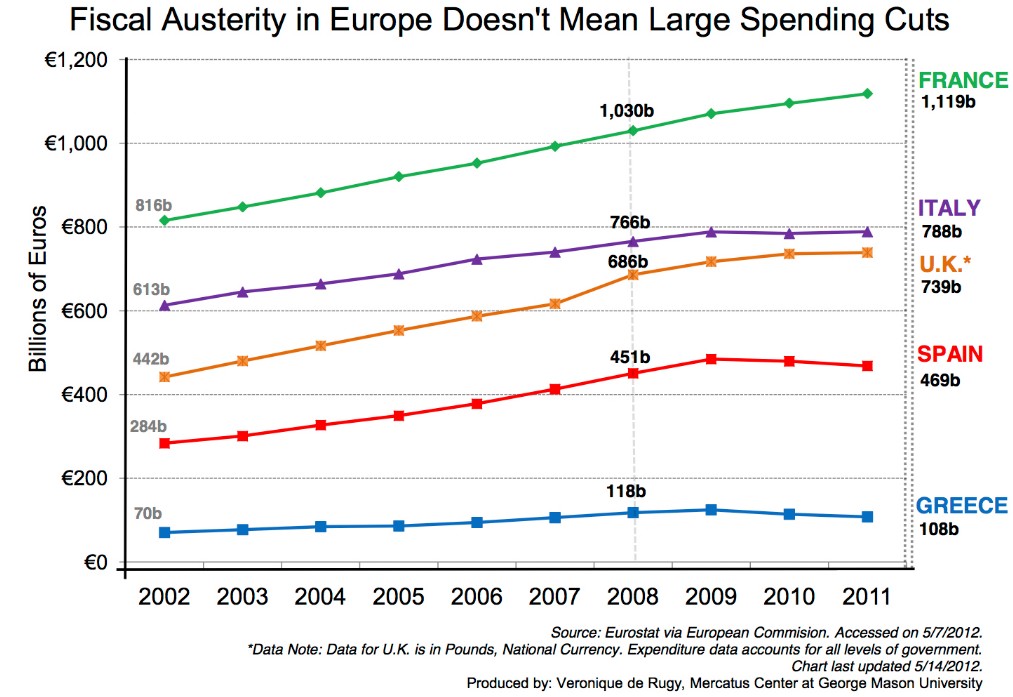
The most striking figure, amid all the rhetoric against the cuts, is that public spending in the euro area as a whole has grown by almost 7% between 2008 and 2011, reaching 4.65 billion euro.

In the South of Europe, those most affected by austerity in theory, the evolution is similar: Public spending in France rose by 8.6% since 2008, in Spain, 4%, in Italy, 3%, in Portugal, 7.8%, while in Greece, despite all the announced cuts, spending fell just 8.5% over the 2008 level, although today its public sector continues to spend 2% more than in 2007 (just before the crisis).

In essence, no European country has managed to reduce their public spending to 2004 levels, a few years before the start of the international crisis, which itself could be considered as an exercise in austerity. Not at all. The following chart summarizes the evolution of public spending in these countries, measured in nominal terms at current prices.

auste01

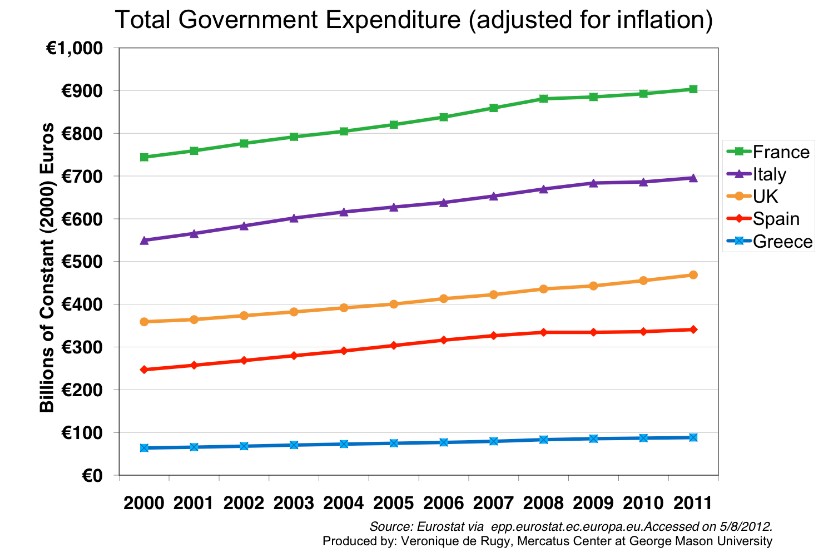
auste02In fact, the situation hardly changed if we look at the evolution of public spending in real terms after inflation.

More deficit and debt

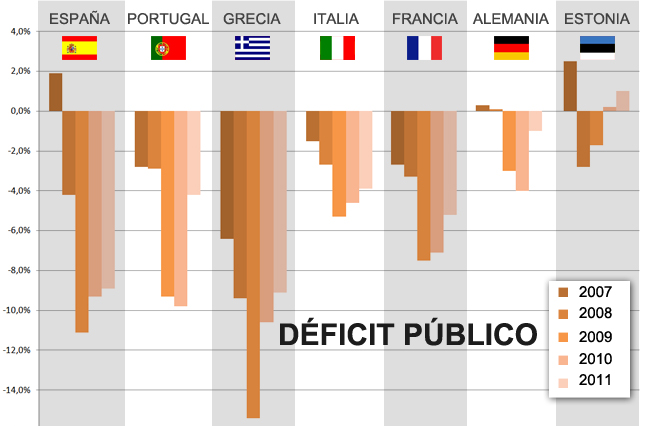
Of course, increasing public spending also meant higher deficit and public debt. As such, in the middle of alleged austerity, the deficit in the euro area as a whole, far from diminishing, has tripled since 2008 , from 2.1% of GDP to 6.2% in 2011, while public debt has grown from 70.1% in 2008 to 87.2% of GDP last year.

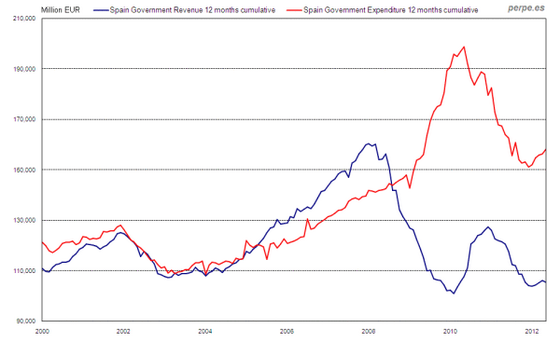
As we can see in the graph below, the public sectors in Spain, Greece, Italy and Portugal, the four southern European countries most affected by the debt crisis, are still spending more than they earn. Only a few countries in the North and East of the continent (exemplified here by Germany and Estonia) have maintained their public at deficit under control during these years of crisis.

Chart above shows public deficit.

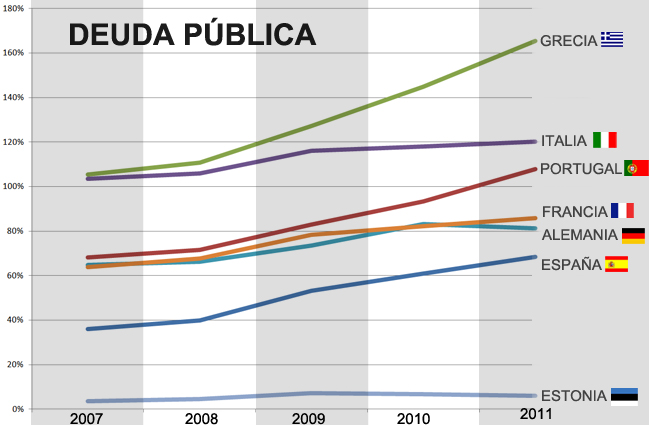
Obviously, if the deficit is out of control every year, public debt will continue a worrying upward trend. As we can see in the image below, all the countries of southern Europe have public debt figures that are much higher than that held at the beginning of the crisis. Even Spain, which began with a very reasonable level of public debt of less than 30% of GDP, is now touching 70% and could end 2012 above 80%.

deuda-publica-22052012

Greece, meanwhile, is at levels close to 200% and Italy is moving steadily to 130%. With these levels of debt, it is logical to see international investors unwilling to buy more South European government bonds, and the to see the CDS and spreads versus the Bund soar. But governments and political parties continue to blame the “evil speculators” or the unfairness of German taxpayers, strangely reluctant to lend more money when nobody else wants to either.
Chart above shows public debt growth.
Along with the complaints about unreasonable “cuts” allegedly “imposed by the markets” (or the Germans), in recent weeks we have seen a growing public debate that wrongly puts austerity and growth as two opposite concepts. They are not. Austerity is the antonym of waste. In fact, recent history shows that more government spending does not foster growth, and does not help to get out of economic difficulties.

The current crisis began in 2007. From then until late 2011, the four southern European countries we are considering implemented aggressive public “investment” policies that Keynesian economists would qualify as clearly expansionary, with deficits close to or above 10% for several years. If this theory were true, Greece, Portugal and Spain would have already recovered and the growth generated by the “virtuous circle” created by government spending would be paying their debts. But none of this happened.

deficit-publico-22052012

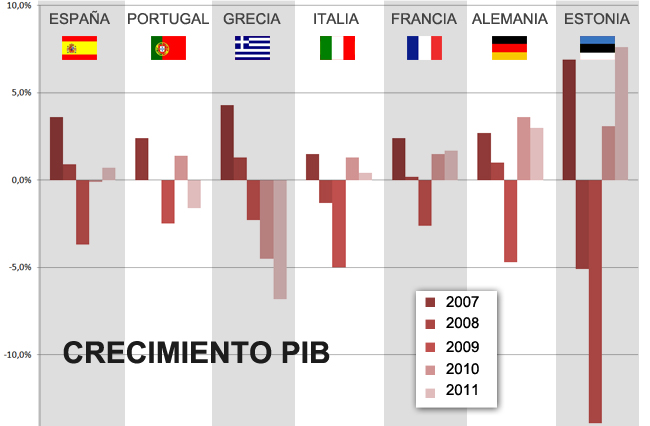
crecimiento-pib-22052012

Meanwhile, Germany and Estonia followed the opposite path and imposed austerity. The result is that both countries had a strong relapse in 2009, with the political cost that it entails . But they are recovering faster and now have much stronger economies. Meanwhile, in Spain, the “Plan E” of investment in infrastructures, an enormous waste of public funds with its vast implication on cost of borrow and deficit, and other public spending measures have failed to stem the crisis. But the message currently repeated over and over is that it takes even more government spending, for much longer, to foster growth. But… For how long?

Chart above shows growth in GDP


Follow Manuel Llamas on @manuel_llamas

The Recession Trade: Back By Popular Demand

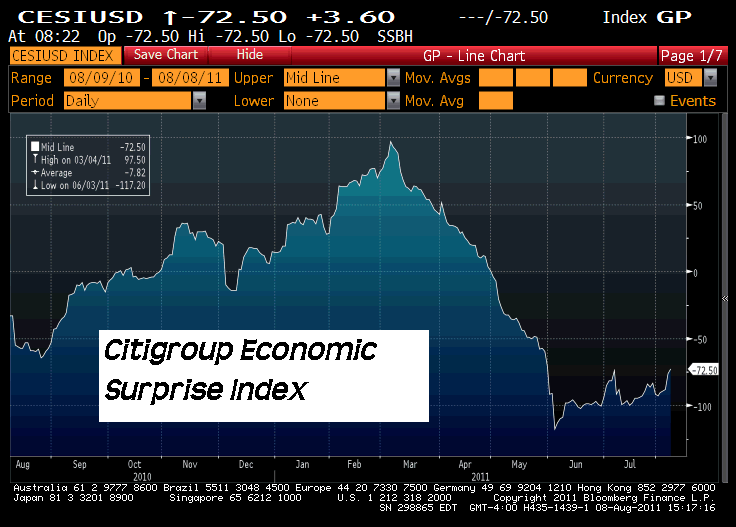
econ_surprise1
(published in Cotizalia on November 12th)This past week I had meetings with investors and funds in Geneva and Zurich and the mood remains sombre.
Europe is increasingly giving worse news, the Super Committee is getting nowhere and investors see the market collapse only to recover a fraction of what it lost.The United States and Europe are in recession. The current uncertainty lies only in the magnitude of such recession. In this environment a group of friends from hedge funds and investment houses have chosen the stocks and assets that, from their point of view, can win in a recession. It is an exercise we did for the first time with a group of 35 professionals in 2001 and repeated in 2008 with very positive and interesting results. Of course, the following list is just an illustrative sample of what a group of experts think.The initial premise of the survey assumes a stagnant economy and rising inflation on the side of commodities because of the monetarist policies of the governments of the OECD. In this environment, we look for companies that have chosen a precise and inflexible approach to increase margins, competitive position and high cash flow, lower costs and greater return on capital. Well, here are the favorites:

The favorites (by number of votes):

Philip Morris . The business is a cash machine, with a captive market and growing in emerging countries and a dividend paid entirely from free cash, with a Return on Equity (ROE) of 242%.

McDonald’s . The fast food giant sales increased by 5-7% in all its markets, opening a restaurant every two days in China with an aim to reach a day in 2012. A business that sells in hard times more units of higher-margin product (cheapest burgers), with a return on equity (ROE) of 40%.

Campbell: Campbell Soups generate strong growth with good quality products and very low price. A Return on equity (ROE) of 76% and almost no debt.

Walmart: A favorite of the last recession, impressive handling of costs and low prices. Generates a return on assets that increased in harsh environments and a return on equity of 22% with $10.6 billion in cash.

McKesson. Solid healthcare favourite, fully oriented to improving profit margins. A 23% Return on Assets and $3.200 billion of cash.

Exxon, accumulating $9 billion in cash, with a return on capital employed of 25% at $70/bbl (compared with 12% of its competitors) and totally inflexible when protecting investors against attacks from governments, which has been especially evident during the Obama administration. Wrongly seen as a value trap by some, this is by far the safest bet in energy for a recession. in Europe, Shell is the favourite due to its outstanding cash-on-cash-returns and discipline in capex, added to low exposure to “value destructing” diversification businesses.

KBR, Halliburton’s former subsidiary generated a lot of criticism from the press for its contracts in Iraq and its military support division. All this is behind us and today it’s a machine of positive returns (19% in a negative environment) and winning contracts despite the economic difficulties of many countries. No debt.

Seadrill: 11% dividend yield and winning contracts at day-rates that come 15-17% above competitors. A safe bet on the tightening deepwater drilling market.

G4S. The British company offers security services, with a return on equity of 20% and good dividend, the business has gotten only better in recent years.

The Spanish:

With the highest number of votes, the only stock in the Top 25 is Inditex . It has better return on capital than Walmart, attractive growth and €3 billion in cash, a business model that has nothing to envy even from Exxon.

Finally, most opt for ETFs in gold, coal and platinum.

The Shorts of this anti-recession portfolio are dominated by the CAC Index (France) for its excessive debt, high weight of problematic banks, strong state intervention in their businesses and risk of infection of the Euro debt crisis. This is followed by environmental services companies (Veolia, etc..) still seeing deterioration in returns, lost margins and increasing debt, plus the European telecommunications companies (Telecom Italia, Deutsche Telecom, France Telecom) that see their returns fall to levels dangerously close to cost of capital, and the equipment sector in renewable energy (solar and wind turbines, Vestas, Gamesa, Solarworld…), which are seeing disappearing subsidies worldwide while the over-capacity eats away returns, working capital requirements increase and growth collapses.

From my point of view, this exercise in choosing the companies that win in a recessionary environment also helps to understand how important it is to have global leaders that focus their strategy to generate better returns on capital employed, not creating overcapacity and that forget the dream of “improving cost of capital” by increasing debt.

Surprisingly the main difference between the stocks ​​mentioned and their European competitors lies both in cash as in returns and margins. And that is fundamentally a strategic and cultural difference regarding the importance of margins and returns, as traditionally Europeans favour “growth for growth sake.”

Hopefully the macroeconomic scenario is different and that everyone who voted is wrong, but I also hope that our companies learn to deal with a recessionary environment, and not only look elsewhere or expect to be rescued.

Note: Daniel Lacalle can invest in the companies mentioned in the blog, the opinions reflected here are personal and not professional recommendations. The above list comes from a survey, and is not a personal recommendation to buy or sell.

Why Italian and Spanish CDS can rise 40%… and Greece is not to blame

(Published in Cotizalia on 5th Nov 2011)The peripheral European sovereign risk premium and the role of CDS (credit default swaps) have focused the debate this week with my Twitter followers. Despite the enormous stimulus measures and bailout packages, the CDS of the peripheral countries remains at historic highs. It falls one day and rises quickly the next. That is because, despite all the stimulus plans,  the risk increases.

On the issue of credit default swaps there are many myths that often hide the desire of governments to mask reality. We’re used to hear that every time the premium rises they say that it is because of Greece, the Fed, or any other excuse.

The CDS market is about $ 24.1 billion gross. Insignificant compared with the impact of the ECB and public institutions. The European Union itself in 2010 analyzed the potential impact of CDS positions on the cost of debt and concluded that there was no effect. Nevertheless, the EU has banned CDS without collateral, a cosmetic measure as not even 0.3% of the CDS market transactions are negotiated without coverage.

The main positions in CDS are in Italy ($ 22.8 billion), Germany ($ 13.1), Spain ($ 13.1), Brazil ($10.6) and Greece ($ 8.7), but for those who support the the theory of an “attack from Anglo-Saxon institutions” against Europe, the figures don’t even compare remotely with the U.S. CDS positions, or, more tellingly, General Electric, Bank of America, JPMorgan and Goldman Sachs that, combined, surpass the CDS exposure to Italy and Spain together. The biggest exposure to corporate CDS is … Berkshire Hathaway with $ 4.8 billion, far more than Deutsche Telekom, Telefonica, and France Telecom, all below $ 4.0 billion.

. Those buying CDS do not expect that countries or companies go bankrupt because in that case the “credit event” would make these CDS worthless. What they expect is to cushion the impact of default risk. In fact, when one buys a CDS, one seeks to mitigate the probability of bankruptcy when it is between 20 and 65% (Spain is now at 29%, Italy 35%). From 65% chance of default, the CDS does not protect.

. While Euro governments persist in the mirage metric of debt to GDP, false because what matters is free cash flow generation, bond investors looks at the percentage of income to interest expense, the acceleration of debt and deterioration of the accounts, calculating the difference between the actual cost of it, artificially manipulated by the ECB buying, and the real one if it was traded in the open market, given the fundamentals of the economy and the type of interest that institutions would demand.

By that calculation, unless things change, the Spanish CDS, for example, could rise 40% in the next twelve months (519 basis points if the deficit reaches 12.5% ​​and the financial costs exceed 35% of income). Since it is very likely that the next government sees a real deficit of 8% instead of 6% due to lower income than expected (uncollectible bills of autonomous regions) and see higher non-computed costs, the probability is not small. in Italy, the deterioration of the accounts has made the 10 year government bold yield 6.595%, its highest since 1997. And the deterioration of the accounts is visible while refinancing needs take 20% of all Euro supply. Italian CDS rising by 35-40% is also likely as spending cuts are proving less and less evident.

. 96% of the sovereign CDS market is absorbed by the financial institutions (many semi-state owned) that accumulate billions of European sovereign debt (€275bn) and know they have to “pitch-in” and buy more when countries need to refinance € 5.9 billion from 2011-2015.

. Many of the new CDS are “quant CDS”, a simple long-short strategy in which the investor buys protection against sovereign risk using CDS, buying in dollars and selling in euros, which “insulates” the sovereign risk and covers the two parts with no “speculative” impact to the country risk premium.To understand the rise of risk premium spreads we must analyze the lack of institutional demand, as the demand-supply analysis explains perfectly why the CDS up despite aid packages to Greece, bailouts and injections of debt.

The first major problem for peripheral debt is institutional investors do not demand it because the price and interest does not match the risk .

If we look at official figures, Spanish debt seems well placed between residents and non-residents (62% -38%). The Treasury boasts that 38% of sovereign debt is placed “between non-resident investors”, however this figure conceals the fact that the vast majority are European central banks, which support each other in the orgy of public debt, EU institutions and underwriters. In Italy it’s the same. Institutional demand is all but nonexistent. Very active buyers are the European central banks, government agencies and the Social Security, which can go to the primary market and is filling its reserve fund, up to 80%, with sovereign bonds . In other words, almost 45% of the debt is bought by the issuing country and the rest by the EU entities.

On Thursday’s Spanish auction there was not a single final customer order, I have been told by several banks. The same since July 2011. And in 2012, Spain has €150 billion more to refinance. Italy has €361 billion maturities in 2012. Therefore it is essential to attract capital and to stop placing the debt in a false cocoon market buddied between the ECB, public entities, social security and underwriters. Countries have to show that this investment is attractive for foreign capital. And that can only be achieved regaining confidence in public accounting, commitment to re-pay, providing transparency and allowing the investor to receive an interest on that debt that is right, not manipulated.

The fundamental reason for the rise of the CDS is not the absolute debt level, religiously repeated by politicians, but the acceleration of expenses and the deterioration of cash flow.

The other reason why CDS are not down is the huge refinancing needs. Between 2011 and 2015, European governments must refinance € 5.9 billion and European companies another €1.1 billion, all while GDP and stagnates and spending does not drop substantially. Italy, especially the Czech Republic and Spain are the biggest risks.

It seems normal that bond investors will continue to demand a premium over the German bund of at least 150 basis points rising to 400 if the deterioration of the income statement of Europe SA continues. The sovereign debt risk premium of peripheral countries is at risk of rising in a scenario in which the supply of debt in the market far exceeds the possibilities of investors to buy it. Spain can not expect to reduce their risk premium when their refinancing needs account for 8% of European supply in 2012, because it is simply impossible to bear weight by investors. The same with Italy, which accounts for a staggering 20% of European refinancing requirements in 2012.

Europe: Week Of Panic, Decade Of Decadence, Years Of Abstinence

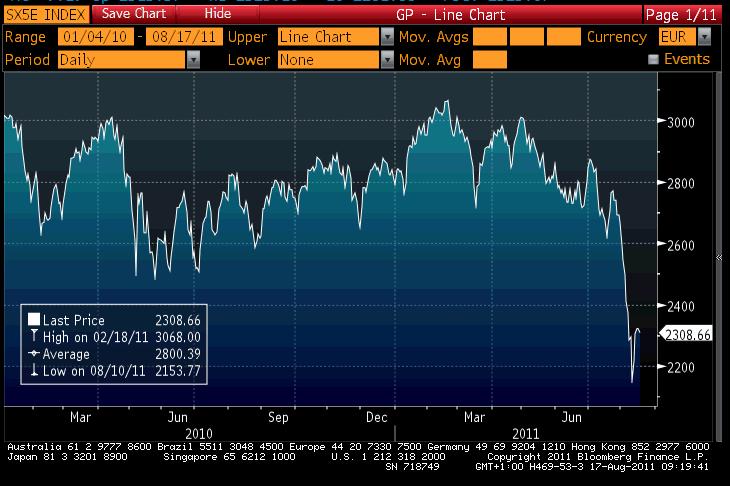
Eurostoxx

(Published in Spain in Cotizalia on 14th August 2011)

Beware of those that see the fall in the stock market this August as an unjustified anomaly and the rise in the past days as “a return to normal”.

We have heard all sorts of explanations for the decline in stocks except one that is coincidentally the most important and most painful:

Between the 1st and the 11th of August, according to Merrill Lynch and Goldman Sachs, we saw a systematic sale of $25 billion in stocks. Of that total, $16.5 billion were not evil hedge funds, or robotic machines or high frequency traders, but pension funds and institutions: the ‘Long Onlys’, the long-term guys. Goodbye.

Now our beloved regulators decide to ban short selling. Congratulations. Let’s put the blame for the bad restaurant food on the customer . We do not learn. We are repeating 2008 step by step. That year Europe also banned short-selling, and after a rise of 7%, it led to a collapse of 30%. Because that is when sales really start. Hedge Funds provide liquidity and short-selling is for many market participants the only way of adjusting risk on their long positions. So long positions are not added when investors cannot mitigate the risks with shorts. Simple.

If the fundamentals of the economy are not sound governments can do what they want, but intervention cannot prevent the stock market from falling. Since they can’t ban investors from selling their stocks, they look for “other measures” to generate calm, measures that create greater panic later.

The interventionist measures, from mass-buying Italian or Spanish bonds, to QE1-2, to the release of IEA crude inventories or banning short-selling, cause the same effect as shooting heroin to a drug addict. A temporary high followed by a bigger fall.

Governments are obsessed with controlling the movement of the market, either through intervention on bonds, stock markets, laws or taxes. And governments desperately want to see asset appreciation. Why? Because a huge part of private debt comes at risk if the listed securities fall by 30-40% and this would generate a new problem in the balance of “non performing loans” of financial institutions. The same institutions that governments desperately need to refinance their debt snowball.

But the effect of these injections of more debt in the economy are diminishing because the real problem, the system’s debt and low growth, increases and no government is interested in implementing measures to encourage enterprise creation and growth, because they are too long-term, while short term spending programs are more effective when one has the forthcoming elections as the only horizon. 

In a sick economy, solutions like these that are just giving alcohol to the drunk do not help, but also the immediate rush effect is dissipated faster and faster because cirrhosis is getting worse.

The future is not what it used to be, as the great composer Jim Steinman said. That’s the problem. What we have been saying in this column for two years. The forecasts of GDP in the U.S., and the Eurozone in particular, are inflated.

France published a zero GDP growth in the second quarter, Germany +0.1% (vs +0.5% expected), Greece a contraction of no less than 6.9%, Netherlands flat, Spain is on the path to ‘zero growth’, Italy as well, and the list goes on. Several banks have had to revise their estimates of GDP growth for the Euro-zone in the second half of 2011 to +0.1% (from +0.4% previously).

It is a slow but inexorable drain that leads to a conclusion that is very difficult to explain politically after an increase in debt and public spending “to reactivate the economy” of 6-7% annually, 14% annually in the U.S.. Zero growth and stagflation.

It is surprising that for 2012 we still expect GDP growth in the Euro area of +1.1% to +1.6%. And this is impossible in an environment in which the rising debt is choking the economy and in which governments have to impose much more aggressive cost cutting measures and austerity plans.

How do we repay the debt without growth?

As the Italian opposition leader, Bersani, told Berlusconi when the latter blamed speculators for the stock market nosedive: “It is not speculation. Investors are asking something completely legitimate: how will we repay our debt if this country is unable to grow? “

The problem of constant negative revisions of growth estimates would not be such if countries had not wasted so much money injecting useless stimulus funds into the economy to create more debt and no improvement in GDP. This is the Debt Saturation Model.

When the economy is sick, it is wise to invest selectively and appropriately in areas of high productivity to generate a positive GDP effect, but this effect decreases rapidly as countries abuse of the formula. And boy has it been abused. According to Roubini, 78% of money spent on the so-called stimulus packages implemented in Europe has not produced any improvement in GDP. More importantly, the vast majority of that money has been wasted in low productivity areas, ghost airports, unused infrastructures, subsidising the automotive, construction and cinema industries, let alone to rescue bankrupt countries. Like a heavily geared company that invests its meagre cash flows in low ROIC businesses, the debt hole grows.

Countries in Europe have created an enormous debt burden with no GDP boost to help pay for it, so the solvency of the system suffers because it does not generate revenue for the state or growth.

And here’s why the stock market nosedives. If GDP is stagnant, debt cannot be repaid, leverage goes up, and austerity measures will be more severe, which in turn delays the recovery even further. And stocks values ​​fall because the equity risk premium rises.

Intervention doesn’t work. Didn’t work. And will not work. But for those still tempted to do it again, this time, unlike in 2007, the weapons of States to “intervene” markets are fewer and weaker. Then, interest rates were 5% (now close to zero), the economy was still growing (not anymore) and the debt was much lower (Spain, France, Italy were in surplus).
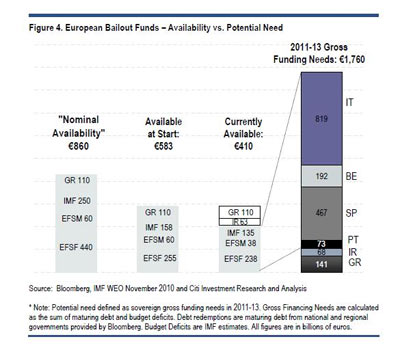
2011081253grafico1

European governments have ignored the effect of government debt on the real economy

While the European Union was struggling to extinguish the fire of Greek bankruptcy and the debt crisis of the peripheral countries, the multiplying effect of risk was in motion . In fact, by troubleshooting debt with more debt (heroin to the addict) and convincing themselves that their debt to GDP was not as high as the U.S. one, governments have accelerated the evaporation of liquidity available for the real economy in the banking system . That is, while the cake of GDP was reduced and the burden of debt grew, Europe went from a solvency problem to a possible liquidity problem. By focusing on State debt and feeding the credit monster, governments have virtually wiped-out small businesses and mid sized enterprises.

If we also note that European banks have in most cases more than 100% of their core capital in sovereign debt, then the risk in the balance sheet of banks is that, unless countries take urgent measures to reduce absolute total debt, banks will have to take more provisions for sovereign risk and liquidity available to the system and the real economy will be even lower.

This multiplying effect of sovereign risk is passed to companies, their financing costs and therefore, stock market valuation, because the average cost of capital (WACC) rises.

Does anyone remember that between November 2008 and March 2009 some very solid single A rated and large companies had to refinance their debt at 320-360 basis points above mid-swaps due to the lack of liquidity in the system caused by the huge ball of sovereign debt?
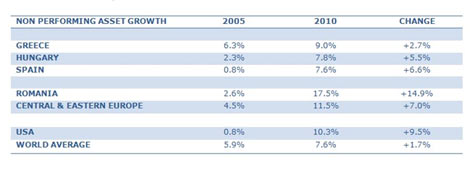
2011081219cuadro2If 100% of Societe Generale’s “core capital” is sovereign debt and for any reason there was a new State problem of liquidity, it would have an immediate impact on the real economy (“shrink lending”) and the financing of French companies. In Italy, UniCredit has 121%, in Intesa 121% in Spain between 76% and 120% … and that’s assuming that all urgent refinancing needs are covered. European states have in excess of €250 billion short to medium term maturities.

So the cake of GDP is shrinking, the snowball of debt is rising and the financial system is draining its liquidity. Add lack of confidence and the cocktail is explosive. European banks have deposited €120bn in the ECB this month,  the interbank market is drying up and that could be a sign that banks don’t trust each other.


(Data: Boombust.org)

We must curtail the spiral of debt

In addition, the European Central Bank checkbook is not as wide and in any case, such checks are going to be paid by the real economy in cuts and taxes. In July, the Spanish banks increased the use of credit lines of the ECB by 10% to € 52 billion, the Italian banking increased by 95% to € 80 billion, France followed suit in € 2.3 billion. The cake is reduced and the ability to stop fires is diminishing.

We can blame whoever we want for the stock market reactions, but to the recent comments blaming speculators I would say:

– Who is more of a speculator than a government which provides estimates of GDP and deficit that are not going to be achieved?

– Who is more of a speculator than a government that wastes the future revenues of an entire generation on short-term-no-growth spending?. As an example, every new child in Spain, Portugal or Greece is born with €30,000 (average) of debt.

– Who can demand long term investment commitment when all policy decisions taken are for the short term?

– How will governments solve the snowball of debt in Europe when many political parties, unions and social agents claim that more spending is needed, and therefore more debt?

A year ago I commented a few points that I think are worth remembering today, because they are relevant again:

“The market is wary of the macroeconomic environment, following continuous downward revisions of growth forecasts and increases of the deficit of the Euro-zone countries, yet without a clear environment that promotes economic growth. On the other hand, the market does not trust the estimates of earnings and balance sheet structure of companies, however big or strong they are. ”

In Europe, in the second quarter, over 48% of companies have published in-line or lower results than expected, but more important is that the majority (80%) has revised down or avoided to comment on future prospects. 35% have cut dividends. And the worst, 86% of companies that have reported have not improved their debt using free cash. Only through divestments. So if the problem of sovereign debt spreads on banks, companies can suffer another black winter of liquidity as in 2008.

The current market is “a bad investment and a good bet” . Investors have very little visibility for long-term investment decisions . And that increases the volatility and equity risk premium.

Further read:

Euro Crisis, CDS, The Market Doesn’t Attack. It Defends Itself.

http://energyandmoney.blogspot.com/2011/08/euro-crisis-credit-default-swaps-market.html