Tag Archives: Macro

Can Spain afford to be "green"?

(This article was published in Spain’s Cotizalia on February 11th 2010)

What timing. After months preparing for a trip to Madrid, I arrived on Thursday 4th, amid the market and debt debacle. A day after the market crash and four days before the presentation of the Spanish Secretary of State for Economic Affairs here in London. The macroeconomic forecasts “from -0.3% GDP growth in 2010 to +3% in 2012 by doubling the exports” worry me. What country will Spain double its exports to in two years with the Euro at all time highs and competitiveness at historical lows?

I have the luck or misfortune of following the economy of 58 countries. What country in the world is forecasting to increase its imports from Europe between 2010 and 2011? No idea. And above all, how can Spain take away market share from other exporting countries in an environment of aggressive competition?

Amid all this, people wonder why the markets fell and different articles comment on the role of “short speculators”. Too bad no one called us “long speculators” or “saviors of enterprises requiring capital increases” in 2009.

Going back to the Spanish Government presentation… Imagine the CEO of any publicly traded company which had breached the consensus estimates for three years in a row submitted such bullish growth plan and think how much his companies shares would drop. Obvious.

Fortunately, my meetings on Friday left me much calmer. The companies are doing their homework and, as always, it will be the private sector which will rescue the economy. I hear no one expects a quick economic recovery and corporates, which are close to the customer and the export industry are preparing themselves for several years of less than modest growth. I hear excellent plans to cut costs by 30-40%, diversification efforts and, above all, restraint in capex and debt control.

And in this day an issue did pop up constantly. In Spain there is little more that can be done in infrastructure and renewable spending for a few years. The drastic cut of the civil works and infrastructure spending is imminent. Spain has invested in infrastructure like an emerging country, but with the demand of a mature market, and now it has an enormous excess capacity while it needs to digest, and pay, the national debt increased through a stimulus plan that brought debt to GDP to 11% devoted to infrastructure and civil work with no returns, ie spending that generates debt but does not generate GDP.

In this environment, power prices are at historic lows due to overcapacity and lack of demand, and yet the fact that renewables account for 40% of the electricity generated in some days make the premiums for these technologies (especially solar) to generate a tariff deficit of between €1bn and €1.2bn, a bill that is transferred to future generations.

This deficit is generated by the monstrous deception that is to have a government that raises electricity tariffs by a maximum 3-4% annually in one of the countries that pays less for electricity in Europe, while the real energy costs, including renewable premiums, is much higher. And this then becomes debt, owed to the power companies, that must be placed in the market to be securitised… And we have spent many months waiting for the tariff deficit securitization while the figure of debt rises month after month, which is unacceptable and introduces even more uncertainty in the power stocks. This is the national problem of Spain: to fix it all with debt, and now the bubble of debt is almost unbearable. The government has to refinance €60bn, saving banks and autonomous regions €150bn, etc … Let’s see just what kind of spreads will be required to place this paper.

Spain’s GDP is approximately €1.06 trillion, premiums for renewables account for 6 billion euros, 0.6% of GDP, and the accumulated tariff deficit is 11 billion, or about 1% of GDP. Additionally, the tariff deficit expected for the next two years is an additional €4 billion. Spain, at the same time, wants to install about 5,000 additional megawatts of wind generation and other 2,300 megawatts of solar by 2012.

Well, friends, do numbers. Either the government passes the real tariff to the consumer, which is unlikely given there is a 20% unemployment, or the bubble and its financing becomes unsustainable and with it the green economy model. Green energy costs. Let’s face it. Now it’s time to face whether the green energy model is sustainable in a weak economic and high debt environment.
Three recommendations for utilities

(This article, like most in this blog, was published in Cotizalia in Spanish)

The utility sector faces this year the need to renew their strategic plans and give the market an attractive message for shareholders. It is not easy, as most companies have clear that the next five years will not see the electricity demand growth the industry enjoyed between 1990 and 2008. So the biggest risk facing the sector is to give overly optimistic messages or growth targets that are difficult to digest by the market, which would negatively impact their shares. And remember what a dreadful market performance we have seen in the past two years among large integrated utilities like Enel, Gaz de France-Suez and E. On even when they have published acceptable results.

Transmission companies are fully regulated, so they have it relatively easy, because their investment plans are guaranteed by the government with a minimum return. The complex part is to justify the multiples at which they trade (the highest since 2000) without giving the market an assessment of their minimum growth in regulated assets (RAB). Added to the equation the fact that the regulators have a nasty habit of delaying the simplest decisions for months, and the risk increases. It is therefore absolutely necessary to clarify the regulatory environment, and confirm the growth expectations. If not, we return to the regulatory risk discount that affected National Grid and the Spanish companies for years.

Large integrated groups have a harder task ahead. They face an environment without significant growth in demand, with some excess capacity in generation, and the industry no longer has the strong balance sheets that facilitated large corporate mergers. With a sector in Europe committed to divest more than €15 billion, it is difficult to see asset price inflation to levels of 2004-2006, as it’s a buyer’s market. Therefore, the challenge is to clarify how to create shareholder value when the macroeconomic environment is complex.

From my point of view, the Spanish companies can boast of having managed the 2009 crisis better than their European competitors. And they should exploit three key areas:

– The first is to clearly show their competitive advantage in costs. For example, compared with European companies, the Spanish, on average, have reduced their costs in 2009 by 7%. This ability to manage complex environments is essential to create value.

– The second is to focus on Return on Capital Employed and managing the investment process. Being bigger is not better or more profitable. Spanish companies have shown to be capable of generating superior returns to its peers (9.8% compared with those of Europe, 8%) while reducing unnecessary investments in over €8 billion despite the fall in demand for electricity and gas in Spain, which has been above the European average.

– The third is to commit to a policy of Total Shareholder Return. Once the process of reducing corporate debt has been completed, and so far it has been done remarkably well, with more than €13 billion average reduction in debt in the sector, the message should focus on profitability for shareholders. The key is to reduce exposure to low-return assets, crystallising value in the most attractive ones, as they did floating the renewables divisions, and could do again with the distribution or nuclear generation, while ensuring a minimum absolute dividend and the improvement in book equity.

This is a year in which companies will have to compare themselves with others, and show that they do better than average. Focusing on returns generated at the bottom of the cycle, ensuring shareholder remuneration and managing the balance sheet will be what differentiates the winners from the losers in the market. The empire-building strategies of European multinationals have driven the sector to a six-year relative minimum PE to the market. Now it’s time to differentiate strategies.

Over 1.2 Billion Chinese can’t be wrong

20091125112611china1
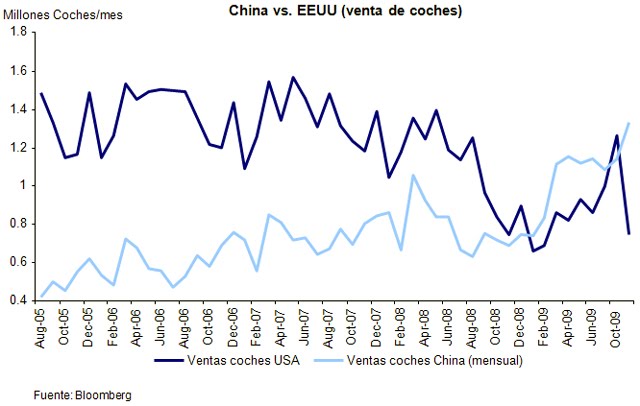
(Published in Cotizalia in Spanish on Nov 26th 2009). Chart shows monthly car sales in USA vs China.

“Data from China is not credible.” This phrase and similar ones have led many funds, especially traditional ones, to miss part of the rally in stocks and commodities, to give just one example. It seems to me that in 2009 many suffered from a bit of excess of caution and a lot of looking at the growth data in the wrong places (USA, Europe). And it’s already more than a year since the launch of China’s economic stimulus program and the data continue to surprise on the rise.

In 2010, China’s GDP will grow c9%. But more importantly, it is likely to do so with very moderate inflation, around 2.5%, thanks to the fact that OECD countries will continue to be in a difficult economic environment and therefore, prices of products imported by China will probably not increase dramatically, as has happened with oil, coal and gas between 2008 and 2009.

Remember that China imports 3.6 million barrels per day of oil, and growing. Well, that consumption is only 2 barrels a year per capita, c4% of global demand. Meanwhile the U.S. remains about 24 barrels a year per capita, 24% of the total, but falling. This scenario, moderate rise in prices of imported commodities as high domestic growth is financed, is ideal for China to deliver long term economic growth and credit expansion without causing major inflationary moves, and that will likely generate the next local stock market rally. Do you remember Europe in 1950? The same.

Investments in fixed assets in the country will continue growing by c30% in 2010. Over 300 projects implemented on a large scale in 2009 lead me to think that we will see an increase in infrastructure investment over several years. This investment will force Chinese authorities to keep the current loose monetary policy at least for the medium term. Thus, according to several analysts, the figure of bank loans will double in three years. And this expansion of credit obviously generates a massive increase in consumption and spending power of families. The increase in disposable income is what is leading car sales to exceed U.S. figures, and we will see the same for other assets.

The important thing to remember is that the figures for 2009 are the result of a recovery from a downward cycle, and do not include the results of credit expansion and domestic demand, so China will be able to harness the greatest growth in its history without depending so much on exports and with relatively moderate inflation.
And what keeps me comfortably optimistic about Chinese stocks and those companies exposed to the growth of the country is this period of expansion, which coincides with the decline of the OECD, which makes it impossible for Western Central Banks to raise rates in a relevant way, and which will likely make investors increase exposure to risk assets. Alternatively we might lose the other 50% rally worrying about data from mature economies in decline.

Bye bye Yen?

Just a thought, only marginally out of the energy sector, but given the surprise change of government in Japan, and what appears to be a growing sense in the market that this government is more focused, finally, on fiscal restraint (or least this threat of massive debt overhang to deal with) and less concerned about maintaining the weak-policy on JPY and even stating their ability to intermediate has declined, it looks like the JPY is keeping its bid. The market—big vocal guys like Jim O’Neil at GS for example—have been pounding the table that the JPY would decline back to 120 eventually on failing demographics and a larger global recovery, and it’s on its way, but slower. Maybe it’s because the US has usurped Japan as the ultimate source of funding and itself is now in a fiscal death spiral; maybe it’s these demographics and the start of deleveraging a bit, I’m not sure, it’s complicated. But whatever the root cause(s), the implication of a stronger than expected JPY (particularly against the $) absolutely HAS to be a weaker domestic industrial and manufacturing economy in Japan. Until China de-pegs, Japan’s opportunities for exports (at least market share risk) seem to be declining; in fact, what we are seeing are Japanese companies setting up shop in China (or elsewhere) instead, similar to the US. Therefore, the Japanese ‘equity market’ might be able to do ok, particularly if this increased JPY leads to a bit of insulation on domestic consumption, but the Japanese economy could be fairly troubled. Utilities would be in the cross hairs of declining consumption.

The key to figure out is: is this a currency issue primarily, or is it something else structural? We know that Japanese energy companies are short Yen in revenues and long Yen in expenses, eg, their costs fall when the JPY is strong, but now perhaps the JPY relative strength is enough to have structurally interrupted volumes and we know what slack does to prices on top of that!…