Category Archives: On the cover

On the cover

The Thatcher Recipe

(Article published in Spanish in Actualidad Economica magazine, June 2014 supplement: “El Espectador Incorrecto – Una mirada liberal al mundo”)

While Continental Europe is still struggling to recover from the deepest economic crisis since World War II, UK business confidence is reaching historic highs. With an expected GDP growth of 2.7% for 2014 and unemployment trending down towards 7% well earlier than planned by the Bank of England itself, the UK’s economic health is striking. The streets of London are buoyant, with retail sales booming. And importantly such confidence in the future is not limited to London but can also be felt across the country, as confirmed by a recent national survey (Grant Thornton’s UK Business Confidence Monitor – Q1 2014). The roots of such economic success go back to the Margaret Thatcher years.


It seems normal to anyone living in Britain today to shop in supermarkets at any time of day or night, to get cash at the bank’s counter or the post office on Saturdays, to switch electricity supplier in a few clicks after being alerted by the incumbent supplier itself that there is a cheaper offer with some competitors, to travel to anywhere in Europe for a fraction of a typical flight ticket, even to start a new business in a day. What a contrast with the UK of the 1970s and early 1980s, which Bank of England was qualifying as “the sick man of Europe”! Britain was paralysed by constant strikes, streets were empty after 6pm with most shops closed by then, Europe was making fun of lazy and lousy Britain. The country’s decline seemed unstoppable and both politicians and the British people seemed resigned to it.


Free markets, flexibility in employment laws, tight control of government spending, tax cuts for business and individuals, even for top earners… Such pillars of Ms Thatcher’s economic programme are hardly contested today by either Conservative or Labour leaders, who over the years have, one after the other, admitted being “Thatcherites”. Margaret Thatcher reportedly considered that her biggest victory was to have brought the Labour Party to end-up backing her economic policies. Ms Thatcher’s reforms now appear so obvious and natural that it seems that nobody can contest them anymore.


Nevertheless, the intense debate re-ignited at the time of her funeral last year shows that her legacy remains hugely controversial. As if British people were shameful of what they have become: successful and wealthier, but greedy and selfish?


While the Iron Lady obviously did not do everything right and too often seemed hermetic to people’s complaints, one has to admit that she has transformed her country to an extent that no other European nation has lived over the past 40 years.


Ms Thatcher’s eleven years in power were particularly ground-breaking in three major economic aspects:


First of all, government spending was cut dramatically and budget deficits were kept under control for the first time since the War, even turning to a surplus in the late 1980s. Ms Thatcher considered a national humiliation that her country had to request a loan from the IMF in 1976. She decided that the fight against public spending should be the country’s top priority. The only areas intentionally preserved from cuts were police, defence and the National Health Service. After reaching 44.6% of GDP just as Ms Thatcher came to power in 1979, public spending was cut back to 39.2% by the end of her three terms in 1990. This despite having to face two recessions in the meantime. Even more significantly, the control of budget deficits became the new norm so that State spending continued to drop in the 1990s, even under Tony Blair’s New Labour governments, in a clear contrast with most major industrialised economies. At the end of the 1990s, Britain had reduced public spending almost to the level of the US, well below any other large European country. Interestingly, Ms Thatcher managed to reverse the trend of Budget deficits while at the same time drastically cutting taxes. She was convinced that the country was being paralysed by the heavy weight of taxation, which was not only preventing corporates from investing but also was creating an assisted mentality and was killing any entrepreneurial spirit. Taxes had reached levels of up to 83% of income. She capped the marginal tax rate at 60% to start with, then 40%, and cut the common tax rate from 33% to 30%, while raising VAT. And she would refute accusations of favouring the rich, convinced as she was that you need to incentivise those who are ready to take risks, invest and create jobs. The reduction in Budget deficits was financed not only by spending cuts but also by a £50bn privatisation programme. Emblematic companies like Jaguar, British Telecom, BP, British Gas, British Airways, British Aerospace were either sold or privatised. But here again the National Health Service was kept under State ownership and control.


Another key aspect of Ms Thatcher’s era is how the stringent reforms underpinned individual wealth, against all odds. Since 1980, GDP per capita has increased more in the UK than in the US, Japan, Germany or France. While the UK’s GDP per capita had been lagging all major industrialised nations in the three previous decades, the situation started to reverse during Ms Thatcher’s terms and Britain took the lead in the 1990s and 2000s. Such statistics are the best answers to those who blame her for having increased the gap between the rich and the poor, as the whole population in fact got significantly wealthier. A good illustration of this is how the most modest segments of the British population gained access to the property market. Through her famous “Right to Buy” scheme, Margaret Thatcher led the State to sell 1.5 million council homes at large discounts so that the poorest could acquire the properties they were living in.  The scheme was clever as it helped restore public finances, generating £18bn over the period. And it made Ms Thatcher hugely popular among popular classes!


But if there was one achievement to keep in mind from Margaret Thatcher’s eleven years in power, it is how she has converted Britain to free markets. Her economic principle was to limit the State’s functions to the protection of individuals while the markets would take care of the rest, under the control of strong independent regulators. She profoundly believed in people’s sense of responsibility and therefore in private enterprise. She abolished currency exchange controls and cut State subsidies to industries. She deregulated finance, but also most utilities services, including telecoms, power and gas supply. While largely criticised in its initial stage, notably due to an initial boost in unemployment numbers, the process quickly proved to be a significant incentive to innovation and competition. In her view, economic freedom would lead to growth and job creation, which is pretty much what happened. UK regulators have not been questioned since then and are well respected today for their role to limit free market excesses. They are not only independent from the central government but also careful of interests of both private operators and final users. The British society gradually gave up its assisted mindset to adapt itself to the notion of sound emulation through competition. This has been the source of major progress and growth in the UK economy and still today represents one of the country’s key strengths relative to its peers internationally.


So Margaret Thatcher inherited from a stagnant economy, a huge, costly and inefficient public sector, a population discouraged by confiscatory tax levels and structural unemployment. Not so dissimilar to Europe today is it…?  Now we know the recipe to success. But we are running late so let’s not wait, Margaret Thatcher’s era was 25 years ago!


Jean-Hugues de Lamaze

Economist and Fund Manager in London


Important Disclaimer: All of Daniel Lacalle’s views expressed in his books and this blog are strictly personal and should not be taken as buy or sell recommendations

Chinese Imports discrepancy impacts commodities

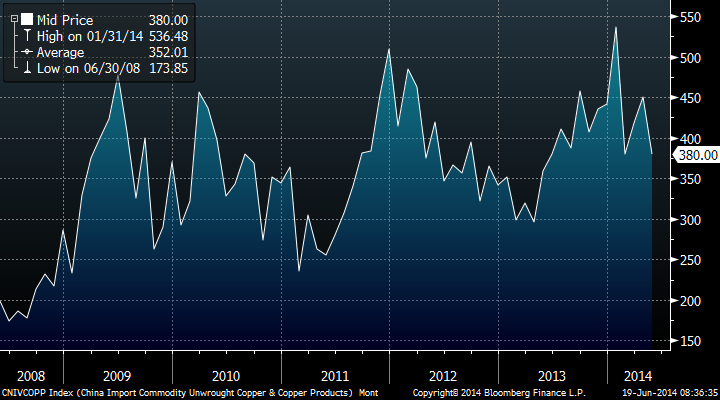
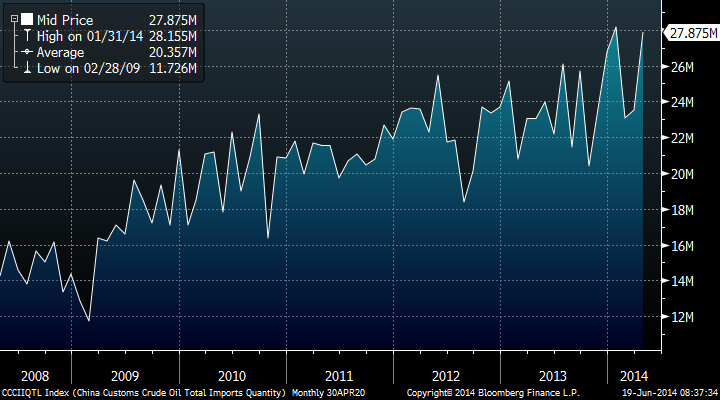
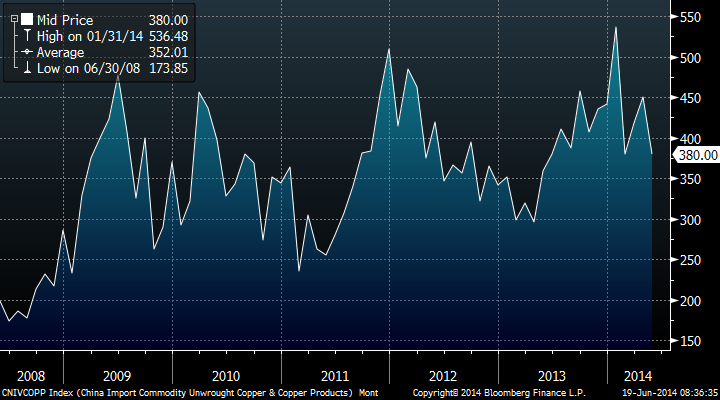
The discrepancy between Chinese imports continues to drive commodities. As seen below, Chinese copper and coal imports remain weak and trending down while oil imports are rising (see graphs below). Copper is down 1.8% MTD and 9.2% YTD, maybe as a vengeance against Chile for obliterating Spain mercilessly in the World Cup.

chinese copper imports

Oil continues to strengthen with Brent  at $114.074/bbl and WTI at $106.51/bbl despite yesterday’s bearish DOE data. Crude drew 0.58 m Bbls vs. expectations for a 0.58 m Bbl draw. Cushing crude inventories built 0.25 m Bbls on the week and now stand at 21.4 m Bbls.  Gasoline built 0.79 m Bbls vs. expectations for a 0.39 m Bbl draw and distillates built 0.44 m Bbls vs. expectations for a 0.04 m Bbl draw. All products drew 0.35 m Bbls. Refinery utilization was down 0.8% vs. expectations for a 0.7% increase. Refinery utilization stands at 87.1% vs. a 5-year average of 88.2%.

Iraq update: The head of Iraq’s state-run South Oil Company Dhiya Jaffar said on Wednesday that Exxon has carried out a “major evacuation” of their staff and BP had evacuated 20% of its staff. He said ENI, Schlumberger, Weatherford, and Baker Hughes had no plans to evacuate staff from Iraq following the lightning advance of Sunni militants through the country. (Reuters) Comments that the refinery in Baiji had fallen to attackers from the Islamic State in Iraq and Syria have been denied by the Malaki government.

Chinese oil imports have strengthened, driving the products market tighter and Tapis to $118.16/bbl, a premium over Brent.

chinese oil imports

Coal continues to weaken to $79.80/mt driven by weak Chinese imports (see graph below).

chinese coal imports

US gas remains well supported at $4.56/mmbtu. Consensus estimates a 112-Bcf inventory build this week vs. a build of 107-Bcf last week and a build of 91-Bcf last year at this time. Gas demand likely has decreased by 1.8-Bcf/d w/w, mainly driven by a 1.6-Bcf/d drop in power sector consumption.

UK gas continues to weaken, at 40 p/th, down 3.97% this month despite the Ukraine crisis, as Gazprom has reassured European markets will continue to be well supplied, Statoil has promised to increase exports if needed and inventories remain in the upper level of the 5 year average. Recent weak gas production from Norway (down 9% year on year) shows that Europe has not needed to increase its imports and demand remains weak.

Spanish power prices rise 89bps driven by low hydro production and extremely hot weather. Spanish power prices are the best performers this year of all continental power prices, with France down 5.86% YTD, Germany down 5.6% YTD, Nordpool down 9.6%, UK down 16.9% and Spain only down 1.2%


Important Disclaimer: All of Daniel Lacalle’s views expressed in his books and this blog are strictly personal and should not be taken as buy or sell recommendations

World Trade Slows Down

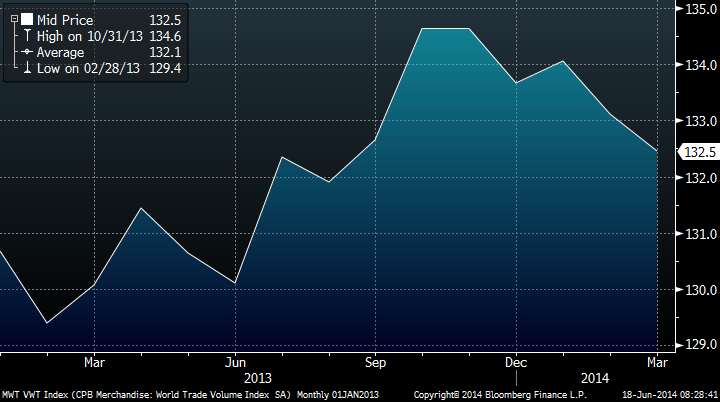
comercio mundial


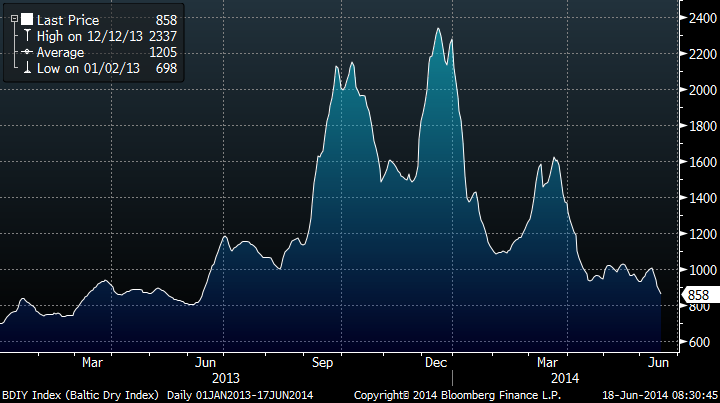
Worth noting today the evident slowdown in global trade, massively revised down (30%) from January estimates. Japan posted a 2.7% decline in exports in May, UK was also down 5% in April and Eurozone exports stalled… but at the same time the Baltic Dry Index is down 2.58%v this month (-52.3% this year) driven by ongoing weakness in Chinese overall imports. Overcapacity paints part of the picture, but the other most relevant part is weak trade data, well below the +16% increase expected in January (see graphs below). Merrill Lynch is betting on a BDI rebound helped by seasonality, re-stocking and a rise in seaborne iron ore volumes of +16% in 2014 and +10% in 2015. I fail to be that positive, as the indications from industrial production globally are negative regarding marginal additional growth expectations, as revisions are down 12% from January estimates globally and the backwardation on coal and iron ore has steepened.

If GDP forecasts are correct, the World Trade Organization expects a broad-based but modest upturn in the volume of world trade in 2014 (+4.7%), and further consolidation of this growth in 2015 (+5.3%).

The average ratio of trade growth compared to GDP since the mid-1980s is around 2 to 1 – with trade growing at twice the pace of GDP, according to the WTO. However, in the last two years the ratio was closer to 1 to 1.

To deliver on the expected +4.7% trade growth in 2014, this ratio would have to move to 2.5 to 1 from June to December assuming that global GDP growth expectations are correct (+3.3%)

BDI May

Freight rates for panamax dry bulk vessels are now below opex, and long-term forward rates have fallen below break-even. The main reason for this weakness is in the coal market.

Chinese coal import is the most important trade for panamaxes and chinese imports of thermal coal are expected to be lower in 2014 than in 2013.

Capesize rates have come down 43% YTD and forward rates for Q4 fell 4% this Friday.

Adding to this a 100 milion tonnes of Australian capacity growth, the outlook for both coal prices and the Baltic Dry is not positive. Freight companies are growing the fleet by 4% this year so oversupply is even higher.

Brent at $113.58/bbl, and WTI at $106.87/bbl. The Norwegian Petroleum Directorate has issued its production numbers for May (this aggregates all Norwegian production each month). Oil is down 13% yoy and gas is down 9% yoy.

Worries about disruption to Iraq supply continue to support prices. The IEA in its medium term oil market report published yesterday cut its Iraqi supply forecast by close to 0.5m b/d & now expects it to reach only 4.5m bpd in 2019, commenting that the growth is “increasingly at risk” (this compares to the government’s target of 8.5-9m bpd by 2020).

Coal continues to weaken to $79.45/mt helped by lower Chinese imports and higher Australian exports. Chinese iron ore import prices are down 33.5% YTD.

CO2  at €5.80/mt still driven by backloading. Impact on power prices is inexistent. CO2 is up 13.4% this month and power prices are flat all over Europe.

UK gas is down 1.34% at 40.45p/th with all the gains of the Ukraine crisis erased from the price yet again. Both Europe and Ukraine have ample inventories and alternative supplies to offset disruptions. UK gas is down 40.7% YTD. UK power prices are down 12% YTD due to the weak gas price and poor demand.


Important Disclaimer: All of Daniel Lacalle’s views expressed in his books and this blog are strictly personal and should not be taken as buy or sell recommendations

Iraq and Ukraine move the commodities market

Geopolitical black swans are impacting commodities this morning, with Iraq conflict worsening and Russia threat of cutting supplies to Ukraine.

Brent is at $113.02/bbl and WTI at $107.32/bbl driven by concerns about Iraq. Markets are reacting well as the physical market is not affected so far but concerns are justified.

Iraq produces 3.5mbpd, or 4% of global production and is seen as a key source of future supply growth. Production is mostly in the fields in the South, so far unaffected by the latest attacks, concentrated in the North, according to JP Morgan.

So far the physical market has not seen a relevant disruption, but markets will remain nervous as long as Malaki continues to lose the grip of the key cities, and the terrorists get close to Baghdad.  Expect oil to move closer to $115/bbl Brent as the market analyses the risk of losing exportable production.

The Islamic State in Iraq and the Levant (ISIL) have seized the city of Tal Afar in Northwestern Iraq yesterday but have not continued to advance to Baghdad, so far only concentrating on northern Iraq. The rebels have control of Mosul, the second largest city in Iraq, along with Tikrit and the small towns of Dhiluiya and Yathrib, north of Baghdad. Iraq’s military spokesman Qassim Ata yesterday said that the Iraq army had killed more than 279 members of the rebel group. President Obama has indicated that he is reviewing military options to help Iraq in fighting the rebel groups.

Kurdistan PM is mentioning in the BBC the possibility of splitting Iraq into three separate regions.

The Kurdistan Regional Government has taken over security of the giant Kirkuk field (260k b/d of production) in the North Remaining oil production in the northern oil fields is another 435k b/d. Iraq has the 5th largest proven oil reserves & is the 2nd largest crude producer in OPEC, behind Saudi Arabia, at 3.5 mbpd. OECD oil inventories were 2,624mb at end April, 77mb lower than the 5-yr average & 53mb lower than last year.

My thoughts:

– The US is unable to get involved in a war. The fact that the US will likely be oil independent (including Canada) in 2016 gives little incentive to take action.

– There is very little real western support for Malaki and the country is currently too corrupt so there is risk of a bad public image and lack of popular support problem.

– Oil companies in the South have very strong armies and security is very tight. I see low risk of oil supply disruptions and the ports are working adequately.

– The three large oil companies must have anticipated these issues as they shipped most of their needed equipment last year. They also doubled security.

– Low probability of the ISIS reaching Baghdad but strong probability of a country that ends up broken in three (Kurdistan, a Sunni North capital Tikrit and a Shiia South capital Baghdad).

Helping reduce the geopolitical risk on oil is the FT reporting that US liquids production hit 11.27 mbpd in April, and is today above its previous peak in 1970 of 11.3 mbpd. With a higher percentage of NGLs, still crude production was 8.3 mbpd in April (now 8.5m), lower than the record high of 10 mbpd in November 1970.

UK gas rises +7.1% at 45p/therm and European gas seems to rise in sympathy as Gazprom threatens to cut supply to Ukraine after the deadline to pay the outstanding bill of $2bn passed with no agreement on  a timetable of payment or price. The Ukraine government is mentioning that the price has to be revised to international levels and that they cannot pay this figure or the revised price of $8.5/mmbtu. The EU is looking for an option that includes a revision of the price for a long term contract and gradual payments. Gazprom will cut off supplies unless Ukraine pays for the gas up front.

Gazprom however, will not disrupt supplies to Europe. 33% of Europe’s gas comes from Gazprom and 50% of it is transported through Ukraine. Ukraine has enough gas in storage (13bcm) to hold on to summer demand as its annual consumption is 33bcm according to UBS. Europe also has a record amount of gas in storage after a very warm winter.

Europe’s largest gas supplier after Gazprom is Statoil who mentions it can “easily” offset any short-term disruption of Russian supply.

 Coal remains weak at $80.40/mt holding on to its support level despite news that freight rates for panamax dry bulk vessels are now below opex, and long-term forward rates have fallen below break-even. Chinese coal import is the most important trade for panamaxes and chinese imports of thermal coal are expected to be lower in 2014 than in 2013. Capesize rates have come down 43% YTD and forward rates for Q4 fell 4% this Friday.Adding to this a 100 milion tonnes of Australian capacity growth, the outlook for both coal prices and the Baltic Dry is not positive. Freight companies are growing the fleet by 4% this year so oversupply is even higher.

The Baltic Dry index is down 3% this month (-60% YTD) driven by oversupply of reights and weakening Chinese imports.

 CO2 rises 53bps at €5.74/mt helped by backloading efforts to reduce the impact on CO2 prices of lower industrial demand and poor thermal output.

US gas rises 65bps at $4.67/mmbtu helped by the past six weeks injection data. It would require a very aggressive change in injection data in the next months to justify prices below $4/mmbtu… I believe we are going to see $5/mmbtu sooner rather than later. Weekly natural gas storage injection of 107 Bcf way below the consensus median injection estimate of 112 Bcf and the bears’ view of 161bcf. Total working storage is now at 1,606 Bcf, 727 Bcf below last year’s level and 877 Bcf below the 5-year average of 2,483 Bcf.

Power prices in Europe are reacting mildly… Germany at €34.70/mwh (-5.35% YTD), Nordpool at €30.78/mwh (-4% YTD). Spanish power prices are down 1.2% YTD and French -5.5% YTD.


Important Disclaimer: All of Daniel Lacalle’s views expressed in his books and this blog are strictly personal and should not be taken as buy or sell recommendations