Category Archives: On the cover

On the cover

UK Gas Prices Rocketing… Implications

UK Gas

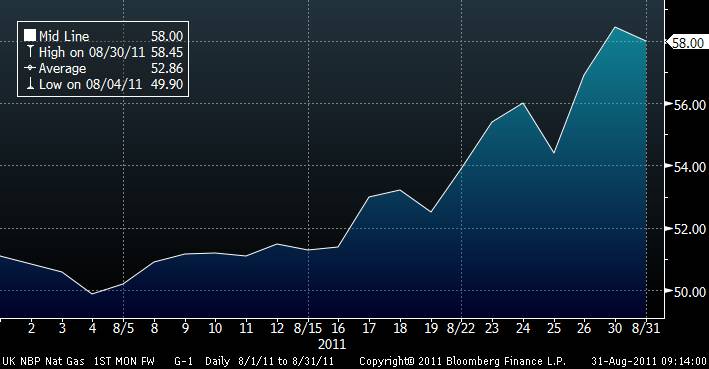
UK natural gas prices are very strong this month, with 1-month forward up 16.3%. The system continues to remain tight due to volatility in Norwegian flows with the ongoing maintenance season as well as weak inflows from LNG terminals. Moreover, maintenance at Qatar LNG and theNorth Sea also help the prices.

Qatargas are taking their 3 largest LNG trains down for 2 weeks each between September and mid November. Will disrupt UK LNG supplies, which are nearly all uncontracted from Qatar, at the same time as Statoil was putting the Troll field (31BCM per annum) into maintenance through September (3 to 10 days).
The key implication for the market has been a massive rally in the stocks most exposed to electricity prices in the UK, as power is driven by gas at the margin. As such, Drax and International Power have seen a re-rating as clean dark spreads have shot to 18 month highs.High UK Gas prices are also very positive for North Sea producers, from Centrica to smaller E&Ps including Premier or Tullow. But most importantly, high UK gas prices mean a very strong environment for LNG companies, that can sell cargoes anywhere in the world at the highest price. BG Group, Shell are expected to contiinue to generate record profits on LNG trading and achieving LNG prices that range from $9/MMBTU in UK to $12/MMBTU in Asia.

The final clear implication is that rocketing gas prices in Europe obliterate the possibilities of Euro consumers to achieve a positive negotiaion of their oil-linked contracts with Gazprom and Statoil. As spot gas prices shoot above the long term gas contracted price (difference now is barely $0.5/MMBTU) it is unlikely to see a benevolent attitude from producers to reduce the price of the long-term contract barely a couple of months ahead of winter.

Europe: Week Of Panic, Decade Of Decadence, Years Of Abstinence

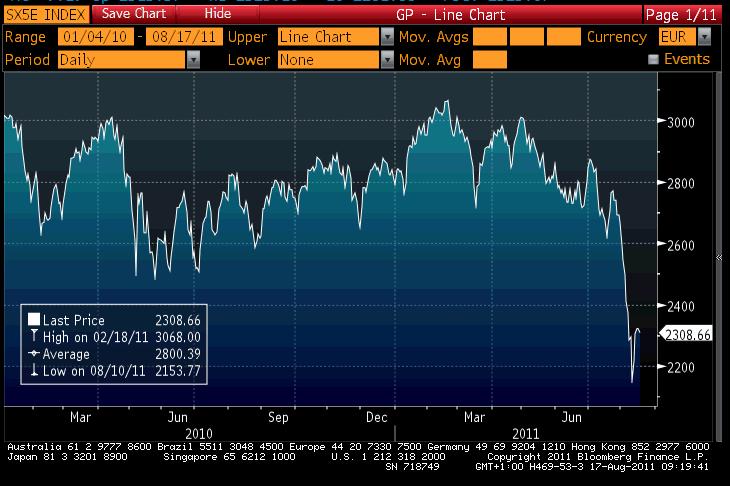
Eurostoxx

(Published in Spain in Cotizalia on 14th August 2011)

Beware of those that see the fall in the stock market this August as an unjustified anomaly and the rise in the past days as “a return to normal”.

We have heard all sorts of explanations for the decline in stocks except one that is coincidentally the most important and most painful:

Between the 1st and the 11th of August, according to Merrill Lynch and Goldman Sachs, we saw a systematic sale of $25 billion in stocks. Of that total, $16.5 billion were not evil hedge funds, or robotic machines or high frequency traders, but pension funds and institutions: the ‘Long Onlys’, the long-term guys. Goodbye.

Now our beloved regulators decide to ban short selling. Congratulations. Let’s put the blame for the bad restaurant food on the customer . We do not learn. We are repeating 2008 step by step. That year Europe also banned short-selling, and after a rise of 7%, it led to a collapse of 30%. Because that is when sales really start. Hedge Funds provide liquidity and short-selling is for many market participants the only way of adjusting risk on their long positions. So long positions are not added when investors cannot mitigate the risks with shorts. Simple.

If the fundamentals of the economy are not sound governments can do what they want, but intervention cannot prevent the stock market from falling. Since they can’t ban investors from selling their stocks, they look for “other measures” to generate calm, measures that create greater panic later.

The interventionist measures, from mass-buying Italian or Spanish bonds, to QE1-2, to the release of IEA crude inventories or banning short-selling, cause the same effect as shooting heroin to a drug addict. A temporary high followed by a bigger fall.

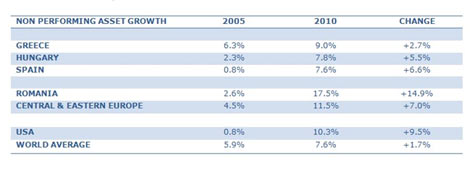
Governments are obsessed with controlling the movement of the market, either through intervention on bonds, stock markets, laws or taxes. And governments desperately want to see asset appreciation. Why? Because a huge part of private debt comes at risk if the listed securities fall by 30-40% and this would generate a new problem in the balance of “non performing loans” of financial institutions. The same institutions that governments desperately need to refinance their debt snowball.

But the effect of these injections of more debt in the economy are diminishing because the real problem, the system’s debt and low growth, increases and no government is interested in implementing measures to encourage enterprise creation and growth, because they are too long-term, while short term spending programs are more effective when one has the forthcoming elections as the only horizon. 

In a sick economy, solutions like these that are just giving alcohol to the drunk do not help, but also the immediate rush effect is dissipated faster and faster because cirrhosis is getting worse.

The future is not what it used to be, as the great composer Jim Steinman said. That’s the problem. What we have been saying in this column for two years. The forecasts of GDP in the U.S., and the Eurozone in particular, are inflated.

France published a zero GDP growth in the second quarter, Germany +0.1% (vs +0.5% expected), Greece a contraction of no less than 6.9%, Netherlands flat, Spain is on the path to ‘zero growth’, Italy as well, and the list goes on. Several banks have had to revise their estimates of GDP growth for the Euro-zone in the second half of 2011 to +0.1% (from +0.4% previously).

It is a slow but inexorable drain that leads to a conclusion that is very difficult to explain politically after an increase in debt and public spending “to reactivate the economy” of 6-7% annually, 14% annually in the U.S.. Zero growth and stagflation.

It is surprising that for 2012 we still expect GDP growth in the Euro area of +1.1% to +1.6%. And this is impossible in an environment in which the rising debt is choking the economy and in which governments have to impose much more aggressive cost cutting measures and austerity plans.

How do we repay the debt without growth?

As the Italian opposition leader, Bersani, told Berlusconi when the latter blamed speculators for the stock market nosedive: “It is not speculation. Investors are asking something completely legitimate: how will we repay our debt if this country is unable to grow? “

The problem of constant negative revisions of growth estimates would not be such if countries had not wasted so much money injecting useless stimulus funds into the economy to create more debt and no improvement in GDP. This is the Debt Saturation Model.

When the economy is sick, it is wise to invest selectively and appropriately in areas of high productivity to generate a positive GDP effect, but this effect decreases rapidly as countries abuse of the formula. And boy has it been abused. According to Roubini, 78% of money spent on the so-called stimulus packages implemented in Europe has not produced any improvement in GDP. More importantly, the vast majority of that money has been wasted in low productivity areas, ghost airports, unused infrastructures, subsidising the automotive, construction and cinema industries, let alone to rescue bankrupt countries. Like a heavily geared company that invests its meagre cash flows in low ROIC businesses, the debt hole grows.

Countries in Europe have created an enormous debt burden with no GDP boost to help pay for it, so the solvency of the system suffers because it does not generate revenue for the state or growth.

And here’s why the stock market nosedives. If GDP is stagnant, debt cannot be repaid, leverage goes up, and austerity measures will be more severe, which in turn delays the recovery even further. And stocks values ​​fall because the equity risk premium rises.

Intervention doesn’t work. Didn’t work. And will not work. But for those still tempted to do it again, this time, unlike in 2007, the weapons of States to “intervene” markets are fewer and weaker. Then, interest rates were 5% (now close to zero), the economy was still growing (not anymore) and the debt was much lower (Spain, France, Italy were in surplus).

2011081253grafico1

European governments have ignored the effect of government debt on the real economy

While the European Union was struggling to extinguish the fire of Greek bankruptcy and the debt crisis of the peripheral countries, the multiplying effect of risk was in motion . In fact, by troubleshooting debt with more debt (heroin to the addict) and convincing themselves that their debt to GDP was not as high as the U.S. one, governments have accelerated the evaporation of liquidity available for the real economy in the banking system . That is, while the cake of GDP was reduced and the burden of debt grew, Europe went from a solvency problem to a possible liquidity problem. By focusing on State debt and feeding the credit monster, governments have virtually wiped-out small businesses and mid sized enterprises.

If we also note that European banks have in most cases more than 100% of their core capital in sovereign debt, then the risk in the balance sheet of banks is that, unless countries take urgent measures to reduce absolute total debt, banks will have to take more provisions for sovereign risk and liquidity available to the system and the real economy will be even lower.

This multiplying effect of sovereign risk is passed to companies, their financing costs and therefore, stock market valuation, because the average cost of capital (WACC) rises.

Does anyone remember that between November 2008 and March 2009 some very solid single A rated and large companies had to refinance their debt at 320-360 basis points above mid-swaps due to the lack of liquidity in the system caused by the huge ball of sovereign debt?

2011081219cuadro2If 100% of Societe Generale’s “core capital” is sovereign debt and for any reason there was a new State problem of liquidity, it would have an immediate impact on the real economy (“shrink lending”) and the financing of French companies. In Italy, UniCredit has 121%, in Intesa 121% in Spain between 76% and 120% … and that’s assuming that all urgent refinancing needs are covered. European states have in excess of €250 billion short to medium term maturities.
So the cake of GDP is shrinking, the snowball of debt is rising and the financial system is draining its liquidity. Add lack of confidence and the cocktail is explosive. European banks have deposited €120bn in the ECB this month,  the interbank market is drying up and that could be a sign that banks don’t trust each other.


(Data: Boombust.org)

We must curtail the spiral of debt

In addition, the European Central Bank checkbook is not as wide and in any case, such checks are going to be paid by the real economy in cuts and taxes. In July, the Spanish banks increased the use of credit lines of the ECB by 10% to € 52 billion, the Italian banking increased by 95% to € 80 billion, France followed suit in € 2.3 billion. The cake is reduced and the ability to stop fires is diminishing.

We can blame whoever we want for the stock market reactions, but to the recent comments blaming speculators I would say:

– Who is more of a speculator than a government which provides estimates of GDP and deficit that are not going to be achieved?

– Who is more of a speculator than a government that wastes the future revenues of an entire generation on short-term-no-growth spending?. As an example, every new child in Spain, Portugal or Greece is born with €30,000 (average) of debt.

– Who can demand long term investment commitment when all policy decisions taken are for the short term?

– How will governments solve the snowball of debt in Europe when many political parties, unions and social agents claim that more spending is needed, and therefore more debt?

A year ago I commented a few points that I think are worth remembering today, because they are relevant again:

“The market is wary of the macroeconomic environment, following continuous downward revisions of growth forecasts and increases of the deficit of the Euro-zone countries, yet without a clear environment that promotes economic growth. On the other hand, the market does not trust the estimates of earnings and balance sheet structure of companies, however big or strong they are. ”

In Europe, in the second quarter, over 48% of companies have published in-line or lower results than expected, but more important is that the majority (80%) has revised down or avoided to comment on future prospects. 35% have cut dividends. And the worst, 86% of companies that have reported have not improved their debt using free cash. Only through divestments. So if the problem of sovereign debt spreads on banks, companies can suffer another black winter of liquidity as in 2008.

The current market is “a bad investment and a good bet” . Investors have very little visibility for long-term investment decisions . And that increases the volatility and equity risk premium.

Further read:

Euro Crisis, CDS, The Market Doesn’t Attack. It Defends Itself.

http://energyandmoney.blogspot.com/2011/08/euro-crisis-credit-default-swaps-market.html

Some August Thoughts On Oil, Brent-WTI and NatGas

brent
A few thoughts on Oil and Gas prices

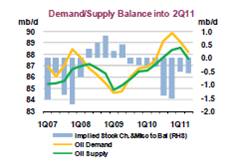
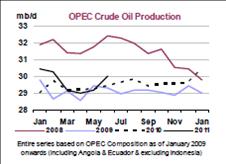
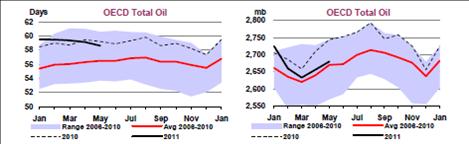
A) Oil demand is still above supply by c400kbpd but this could be short-lived if an OECD slowdown brings GDP estimates down by 2%. Given OPEC spare capacity is still at 5mmbpd and inventories in the IEA countries are in the upper range of the 2006-2010 average level, there is no small risk of entering an environment of oversupply if OPEC countries continue cheating on quotas (producing 27.5mmbpd versus 24.5mmbpd quota).

iea inventories
iea demand
B) New OPEC President, Iranian Rostam Qasemi is beyond hawkish towards the West. He was the commander of Iran’s Revolutionary Guard and one of Ahmadinejad’s most active advisors.
C) Venezuela surpassing Saudi Arabia in proven oil reserves has been ignored by the media, but has very significant implications on the balance of power between “hawks” (Iran, Venezuela, and Angola to a certain extent) and “doves” (Saudi Arabia, EUA, Kuwait). This, added to an Iranian president, means more power to the hawks not only in the decision making, but also in the quota split (as quotas are based on proven reserves, and Venezuela has surpassed Saudi Arabia).
D) Kuwait, traditionally supportive of benign oil pricing, is already giving messages of “supporting the current price”. This means that either their budget balance requires a higher price than we think ($75/bbl) or that they start to acknowledge that the downside could be more significant and that prices could overshoot on the downside as they did in 2008.
opec supply
D) Reduction in net length across the petroleum complex has been aggressive and not surprising in view of recent macro developments. The change in the crude position reflected a sharp reduction in Managed Money net length (~23k contracts) BUT overall positioning remains towards the upper end of the historical ranges.
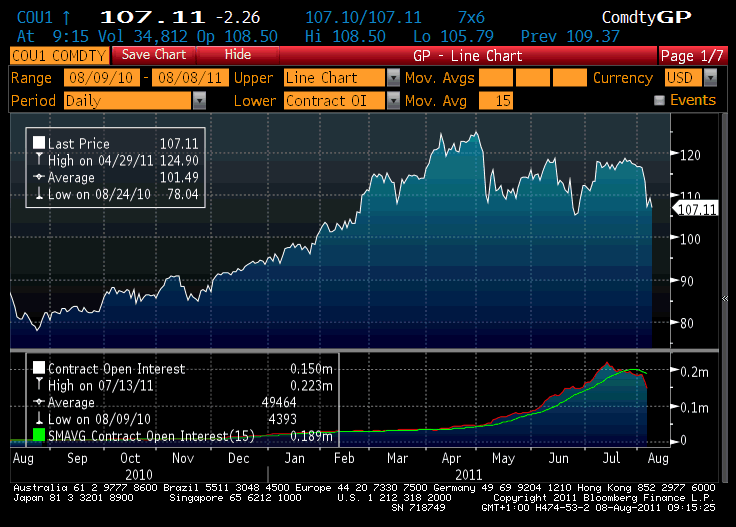
I think oil (Brent) settles below $100/bbl in September (putting at risk the budget balance of Iran, Venezuela, Russia and Angola, who all need $90-95/bbl to balance), and this might trigger a supply response, but only then.
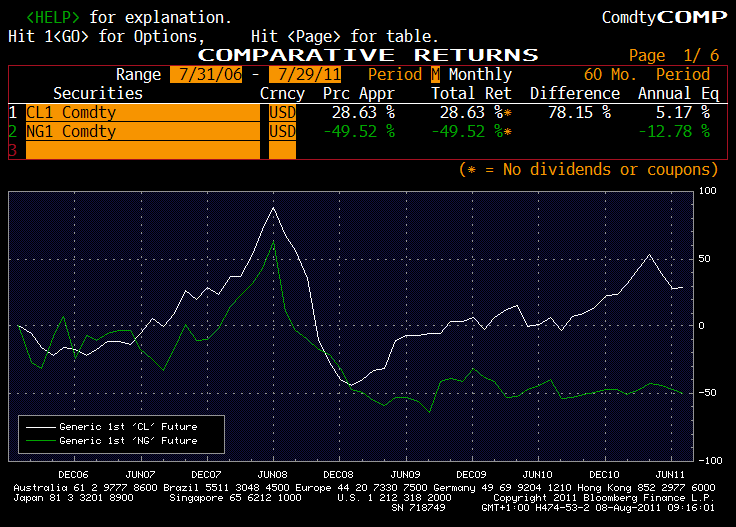
Meanwhile, weakness in WTI will continue (the gap between Brent and WTI is at $21/bbl), and the lower WTI goes, we can see a risk to the hedging availability of liquid-rich companies in the US.
wti gas
Careful, because too many US gas companies are saying that “even at $80/bbl we can hedge all our liquids production” but the hedging cost is soaring and the last time they gave that message banks started to be cautious about counterparty risk, particularly with natural gas below $4/mmcfd on the other side of the cash-flow spectrum.
Further read:
Venezuela surpasses Saudi Arabia in oil reserves
WTI-Brent Spread… More fundamental Than Most Think
Iran Grows Output Despite Embargo
The Increased Isolation of Iran
China Slows Down as Saudi Arabia Accelerates
Peak Oil? Demand Weak Supply Concerns Overdone

Euro Crisis & Credit Default Swaps. The Market Doesn’t Attack. It Defends Itself.

Italian CDS

Graph above shows Italian 5 yr CDS.

Deja Vu? As in 2008, governments in Southern Europe are blaming everyone except themselves. “The sovereign risk premium goes up because of the attack of speculators.” 

I look forward to the day when I hear “risk premium rises because institutions can no longer absorb more debt than they already have”.

One quick glance at Europe’s financial institutions and the numbers are staggering. SocGen’s entire core capital is comprised of Euro sovereign bonds, for Unicredit, 121%, Intesa 121%. In Spain, BBVA, 193%, SAN 76%. And all this is before another $200bn of Euro debt refinancing requirements.

As in 2008, the blame now is placed among hedge funds . And wait, soon we will see European governments or the ECB making interventionist decisions. Ban Credit Default Swaps. Or ignore rating agencies. Kill the dog to get rid of the flees. Blame the customer for the restaurant food. Does anyone remember what happened in 2008 when Europe banned short positions? The market plummeted another 30%. Because that is when selling REALLY starts. So far it’s only protection seeking. Trust me.

The risk premium does not rise because of any attack. It rises because the holders of government bonds, who see the risk of economic stagnation and increasing debt, can not sell their holdings and seek protection (hence the CDS widening).

96% of the market for sovereign CDS (credit default swaps or the cost of insurance against a default) is absorbed by the European largest institutions, most of them country “flagships” or semi-state-owned entities, who are flooded with  €250 billion of European sovereign bonds in their books. These entities, from DB to SocGen, the Spaniards or the Italians, seek protection and can not sell because of low liquidity, there are no buyers, and in any case they will receive the call to participate in the the next auction of debt. With a problem. The purchasing power is reduced by saturation, but also due to the increasingly stringent requirements of core reserves… While at the same time refinancing needs of indebted states are increasing. According to JP Morgan, Italy will have liquidity problems in September, and Spain in March 2012.2_20110519085443Hedge funds don’t attack. We would be happy to invest against the rise of the risk premium if it were not justified . But that is not the case. The trend is clear and normal. It is re-evaluating sovereign risk. A sovereign debt that for decades we have been told had no risk. As the swindle of “house prices never go down.”The sovereign debt crisis has many similarities with the housing bubble. An “over-priced” asset (in this case sovereign debt, regarded as an unwarranted risk-free asset), a brutal increase in inventory (all countries issuing, using pension funds, domestic banks and social security to buy more debt) and a bubble burst, when borrowing capacity is maximized. At the same time, the pool of capital allowed to invest in sovereign debt evaporates as the CDS rises and the cost of borrow rockets, because most fixed income investors cannot take the risk and volatility implied by the high yield sovereigns.

The end in this case, as in the sub-prime crisis (read “The Big Short”) is the same. A devaluation of the underlying asset (sovereign debt) and an appreciation of its risk factor according to real actual demand and true likelihood of repayment. 

The phases are typical: “shock, anger, denial, acceptance”. First, shock (“but our financial system is the strongest in the world”), then anger (“Spain/Portugal/Italy is not Greece”), then denial (“the premium rises due to external causes/US debt-ceiling deal/speculation”), and finally acceptance . And that’s where the solution begins. Countries will be less “easy” about leveraging up as debt will be more expensive, the states will learn not to squander and the growth-through-debt policy, ie, fund the privileges acquired by a decadent society with the income of future generations, will be over. And it will come.
It’s funny that we care so much about the cost of debt of Spain or Italy and whether the 10 year bond stands at 6.3% or 6.2%. We are only concerned because the governments want to return to the Debt-for-all-party and pay less . If the state model was to build and maintain a surplus, these moves would not worry so much.We forget also that the free-debt oasis is a recent invention. Less than twenty years ago South European states financed themselves at twice those rates, but then they had growing economies, were not indebted to 120% of GDP, and unemployment rates were assumable, not structural.
The following graph shows the % of peripheral public debt in the portfolios of domestic (resident) and foreign (non-resident) banks.

2011080258lacalle-1

2011080261lacalle2

Countries and institutions thought the CDS market, $60 trillion, was more than enough to ensure credit risk. Why? Because they only thought there was risk in corporate bonds and, therefore, the sovereign debt market would not need large default insurance contracts. That was OK until countries started to issue debt like crazy, creating a huge bubble of bonds that are almost impossible to insure, while at the same time GDP growth stalled and unemployment rose. And who takes the risk to insure this debt while state banks and credit institutions are struggling to remove themselves of their debt hole?

For those who blame the wicked capitalists, do not forget that over 50% of the Spanish financial system is public, the saving banks, and in Italy, Portugal and Greece the percentage is also in the region of 50%.But let us review the elements that make the snowball grow, despite the “messages” to calm the market, because actions, I must say, few. In Spain, Italy and the peripheral economies they have not implemented many of the measures announced with great fanfare.1) The precedent of “stress tests” in which banks have taken significant haircuts in the valuation of their assets, has proven to be self-indulgent and inadequate, but also has shown to the eyes of the public the very low core capital of the institutions, particularly the semi-state-owned ones.

2) The rating downgrades, which no one in any government expected, are a reality. The agencies have taken two years to reflect on their “ratings” what the market already knew. The economic fragility of the indebted countries. And its is not the “evil doings of Anglo-Saxon agencies attacking the poor European countries with imperialist tactics” as some politicians say. It is rather the opposite. Rating agencies have been monstrously generous in the past.

3) The successive bailouts of Greece and Ireland have left the financial system without “gunpowder” to address similar risks in other countries, but also these bailouts have weakened the balance sheets of the entities that hold the bonds.

4) The optimistic estimates of growth and deficit reduction . Each month we see new revised estimates of GDP in 2012. And they are too optimistic. The IMF indicates that Spain, Portugal, Italy and Greece will not meet the government forecasts of deficit for 2014. Spain will be at -3.9%, versus a target of -2.14%, as growth will probably be very low. If GDP is not growing, unemployment rises, funding costs rocket and debt goes up.But what is more important, without measures to incentivize  job creation and support entrepeneurs, government revenues will be eaten by interest charges and costs that do not generate any return (GDP). Some call these costs “social” but they are just borrowing from our children’s future income.

While governments gave themselves pats on the back on the success of the last auction of sovereign debt, no one wrote the headline “the latest debt auctions have only been covered by domestic institutions.” Foreign entities were flying away from peripheral sovereign debt (see graph above, sorry it’s in Spanish). And while Southern European leaders took advantage of their last months in office before an election debacle to sink the economy of their regions by increasing the debt by 43% amid economic pre-stagnation, the states were dangerously close to a level of risk country that is not acceptable for any investor. Today, the premium  that Spanish ten year bonds have to offer for investors to buy them instead of German bonds is up to 6.2%. Italian one is 5.8%. If Spain or Italy reach the 7% level, many institutions simply will not be able to buy them for being too risky. The pie of available capital for investment is not only smaller and with more countries stalking it, but some countries will simply be unable to access a part of it.

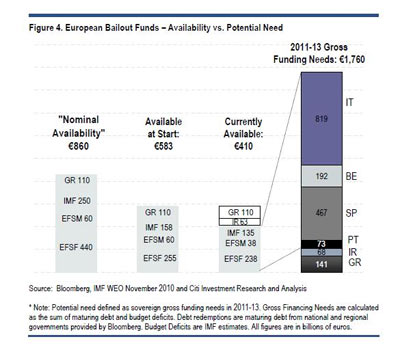
citiefsfThe warning signs have been there since 2008 . Many of us have said this in writing. Meanwhile, the system has continued to sink into debt at a more expensive interest rate each time, while no one cared that almost 60% of peripheral countries’ state revenues are used to pay interest expenses. This year, the cash deficit reached by Spain will be 14.5 billion euros. The balance of income over expenditure is negative before paying interests.

And now governments demand cheaper and more credit when they are borrowing money to cover interests only. No capital. The result is that after the cuts already announced, peripheral countries will need a spending reduction of 30% to cover the cash deficit and interest. “Blame it on the wicked investors” who have the fastidious desire to recover their investment and request an interest that is appropriate to the risk. Outrageous.

The market, that evil entity that causes so much hatred among interventionists, reacts because it has been lied to. And reacts by selling equities and seeking protection on bonds.

Do the interventionist European States want to get rid of the alleged “dictatorship of the markets” that they claim is the problem? Perfect. Do not allow leaders to borrow again like crazy. No more deficit and they will not have to worry whether the blame is of hedge funds , Merkel, Fitch or the new U2 tour.

PS: Pier Luigi Bersani, Italy’s opposition leader said to Berlusconi on Wednesday: “it’s not speculation, it’s about investors and our creditors that don’t trust us any longer”. “Investors are asking a legitimate question… how can these guys pay their debt if they don’t grow”

Further read:

European crisis, falling demand more debt

http://energyandmoney.blogspot.com/2011/07/european-crisis-falling-demand-and.html