Category Archives: Sin categoría

Exxon was right. Where will oil companies invest in 2015?

(This article was published in Spanish in Cotizalia on 14th April 2011)

In 2008, Rex Tillerson, CEO of ExxonMobil, was facing a General Shareholders Meeting with a request, almost a demand, by a California pension fund, a group of nuns and the Rothschild family. The requirement: to dedicate a substantial portion of its investment program to renewable energy. It was the culmination of a process of harassment of U.S. oil majors that started with the then young administration of President Obama. The request was unsuccessful. The general meeting of shareholders rejected it by a majority. Not even to make a “wink” to an administration hostile to the sector.

The explanation was simple. It is a different business. It is valid for other companies, where the competitive advantage requires in sustained institutional support and where returns are well below those demanded by the Exxon group. With or without subsidies. Because, as Tillerson himself “if we really wanted to see subsidies for renewables eliminated, the only thing we should do is spend millions on those technologies, because then the government would immediately withdraw the premiums, or rather, retire them for us only.”

Today, Exxon is the most profitable oil company in the world, with a return on capital employed of 22%, has distributed $112 billion to shareholders over the past five years, has the highest return per barrel in the industry ($20 per barrel produced 2006 -2010), a reserve replacement ratio 210%, with virtually no debt and no divestiture requirements from ruinous adventures like other competitors. And the interesting thing is that these rates of return are not be generated because they are a very large company (just check the poor returns of comparable European companies), but because of the focus of its strategy on two principles that I would call:

a) Focus on the core business and activities where they have real competitive advantage to return those benefits to their shareholders. It’s a company that invests $35 billion a year of capital that belongs to its shareholders, not an NGO.

b) An organization focused on generating superior returns, not intangible objectives. Return on capital employed (ROCE) as an absolute objective. Intangible benefits and costs are imaginary inventions to justify losses.

Chevron and ConocoPhillips also turned away from experiments and generated significantly higher returns than those oil companies that diversified into other technologies, despite the weak dollar. Meanwhile, competitors who took to strategic adventures outside their industry are in the process of selling at a bargain price their “star” projects.

Many European oil companies boast in their advertising of their investments in alternative energy. But behind the image lies a very different reality. In fact, after years of multibillion-dollar losses, the reality is that most have returned to their core business.

We made a detailed analysis of the plans of oil companies for the next five years. The results (only Oil Majors, ie Big Oil) are:

. Over 85% of the annual investment in the sector, ie, well above the $200 billion annually, will be dedicated to Exploration and Production. Nearly half destined for natural gas and half oil. Of this amount, almost 30% will be dedicated to exploration of new reserves in “frontier areas” or areas where they expect to find the next mega-field, the new Kashagan, Tupi (Brazil), Uganda or Jubilee (Ghana). Greenland, the Russian Arctic, Mozambique and Namibia in addition to the large investments (over $10 billion in 2011) in the U.S. in shale oil, where it is estimated that we could see a revolution similar to the gas shale (shale gas).

. Less than 14% will be dedicated to refining, marketing and chemicals. The returns are relatively poor and do not justify further investments. The OECD industry is facing overcapacity with nearly 7 million barrels per day of excess capacity in refining and 65% of average utilization in chemicals.

. Less than 1% of investments will be devoted to “alternative energies.” And when the oil majors talk about alternative energy, over 67% of that money is for “biofuels” which is a derivative of refining, not wind turbines or solar panels. ExxonMobil invests in technology and development more than $200 million per year, mostly to improve transport efficiency and liquefied gas.

. The only companies that will explicitly invest in wind turbines and solar panels are BP ($10bn in ten years, less than 2% of their annual investment), and the market does not reward them for this low-return capex, Petrochina (a gigawatt in wind, less than 1% of their investment) and Total (a little solar and CO2 capture and storage). Shell divested most of its activities in solar and wind energy smartly at peak valuations (2009).

Why don’t these companies invest more in alternative energy?.

. First, because the returns are very low and more risky (politically) than its main activity, and as the average cost of capital of Big Oil is close to 9% upstream, the sector should require higher returns than those generated by regulated sectors. Alternative energies generate returns of 11-12% with a debt of c80% at project level, which is impossible to for oil companies, who know you can not gear by more than 25% an energy project, being a cyclical business. So the integrated utilities, which have a lower cost of capital and relatively low but stable returns, are more willing to include alternative energy in their investment plans. At the end of the day, renewable energies are utility-type of businesses, as we have seen now that the “supernormal growth” prospects have moderated to more logical 5-6% pa.

. Second, because the electric-utility model requires concentration in countries with great political influence and government control and concentration is exactly what the oil sector tries to avoid, following the disasters seen from 1975 to 1999. Thus, since the end of the era of nationalization and break-ups forced by anti-trusts, the oil companies want to avoid accumulating more than 20% of their assets in one country. Governments are very greedy when it comes to demanding long term investments from private companies but also very quick to cut private profits.

. Third, avoid subsidies because they are removed at the first opportunity. The oil industry endures some of the most onerous taxes (up to 80% in some countries) in the industrial sector, multi-million dollar investments with very long maturity periods in cyclical sectors, risks in unstable countries, PSCs (Production Sharing Contracts), and the sword of Damocles of “surprise” taxes, as we saw in France last week. $400 million into the pockets of government. that is the reason to avoid regulated activities, and the oil sector has divested more than $30 billion in these activities since 2008.

I read many articles saying that oil subsidies are enormous, but such analysis is flawed, by bringing together private companies and state owned ones. For the IEA and others to count as subsidies what Saudi Arabia gives to its company, Aramco, or what Rosneft and Gazprom get from Russia or China provides to PetroChina and Sinopec, etc. is a joke. When comparing subsidies to industries, these should not be included, that’s cheating. And most of what the articles call “subsidies” are deductions for double taxation. It is quite funny to expect that oil companies pay 60% tax in the North Sea, for example, and then pay for them also in the U.S or elsewhere.

For years the chief executives of American oil companies were criticized because they did everything wrong and were obsolete while counterparts in Europe and the United Kingdom were betting “on the future”, from investments in Business To Business and the Internet (in 2001 some oil companies spent more on this part of their strategic plans than in E&P), transmission networks, nuclear energy, healthcare (I swear), or hydrogen fuel (with multibillion-dollar losses). No more experiments. As an example, Shell, after the arrival of Peter Voser, immediately imposed a “back to basics” focus on exploration and production, generating cash flow and high returns on any part of the cycle. They reached in three years the goal of becoming the second most profitable company in the sector.

Now, with the sector at record levels of cash generation, investment plans in the oil sector are simple. No more adventures. Exxon was right.

Further read:

http://energyandmoney.blogspot.com/2009/11/china-exxon-and-war-for-resources.html

http://energyandmoney.blogspot.com/2010/07/five-risks-of-big-oil.html

Given all that has happened… Oil prices have not gone up a lot

(This article was published in Spanish in Cotizalia on April 5th 2011)

The most interesting debate in the energy sector in recent weeks does not focus on how much the barrel has appreciated, but the opposite: How little it has risen in such a geopolitical storm.

A good friend, with over thirty years experience in oil, from National Oilwell Patterson and working for the DOE (Department of Energy, USA) told me recently that “the positive surprise is that oil is not trading at prices close to $200 per barrel”.

The main reason behind this is that the market is well balanced and the risk of shortages is very low. Crude inventories at Cushing (Oklahoma) are at record highs. In China, we have seen demand growth slowdown for two months, something very similar to what happens in Europe.

European and American refineries are operating at frankly poor capacity levels, close to 82%, and inventories of refined products remain at levels above the average of the last five years.

With everything that has happened in the oil market, it is curious that the price is only at $122/bbl (Brent), $ 108/bbl WTI at the close of this article. Also, we should not forget the collapse of the dollar as and additional mitigating factor. My friend alerts that “raw materials rise due to the emphasis on printing money and stimulus plans, which destroy the value of currencies.”

Let us review what has happened, with disparate effects. Let’s start with the supply side:

. The war in Libya has cut nearly 1.3 million barrels a day. And while the market welcomed the “news” that the rebels are going to sell 100 thousand barrels a day, it is hard to see a recovery of the Libyan barrels for several months. For my readers who still think it is a humanitarian action in Lybia, I recommend reading, “Resource Wars and the Shape of Global Conflict” by Michael Klare .

. Iraq, which has launched nineteen major oil projects to restore production to pre-war levels from 2.1 million barrels per day to 3.5 million, is still struggling, and will probably end the year about 300,000 barrels per day below objectives, according to friends at ExxonMobil and BP. In March, exports fell 2%. Part of the problem is that oil companies are taking up more time to get the country rid of land mines (and have funded the removal of 5%) than getting rigs installed. According to the minister of environment in Iraq, Hussein Kamal Latif, without the help of the sector Iraq would take 100 years to clear the mines scattered by the army of Saddam Hussein throughout the country. On the positive side, Kurdistan now exports about 80,000 barrels a day … hoping to exceed 200,000 in December.

. Nigeria. Yemen and Syria are all over the news. But with Nigeria, which is 2.1 million barrels a day to the market, nobody seems to want to talk. And in Nigeria the conflict is relevant, with the elections delayed several days due to fights between supporters of Prime Minister Goodluck Jonathan and the opposition. The parliamentary elections have had to be delayed, and presidential elections to April 16. Moreover, Nigeria is the largest oil producer in Africa and its political stability is crucial to the balance of supply and demand. Do not forget that in 2010 Nigeria accounted for almost 60% of the increase in OPEC production, and is the second largest oil exporter to the U.S. and Europe. Around 70% of Nigerian crude is exported to Europe and the U.S.. Therefore, Nigeria is much more important for oil market stability than many countries in the Middle East.

. Russia maintains its output at 10.2 million barrels a day, although still below the peak of 1987 (11.5mbpd).

. What role is left for Saudi Arabia? The kingdom continues to be the “World Bank” of oil, and just announced a 30% increase in investments in exploration. But from Riyadh they will not decide to increase production “just because the West wants it” after enduring years of anti-Saudi rhetoric from western governments.

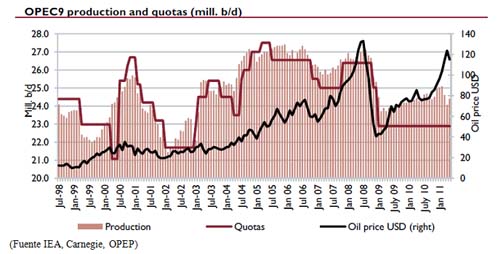
These effects have made ​​the spare capacity of OPEC as perceived by the market drop to less than 5 million barrels/day. But OPEC has cut its crude exports by 363,000 barrels per day in March . That’s not because they are evil, but because demand is well covered.

On the demand side:

. Although demand will rise 1.2 million barrels per day in 2011, an increase of $10/bbl has an estimated negative effect on global GDP of slightly less than 0.3%.

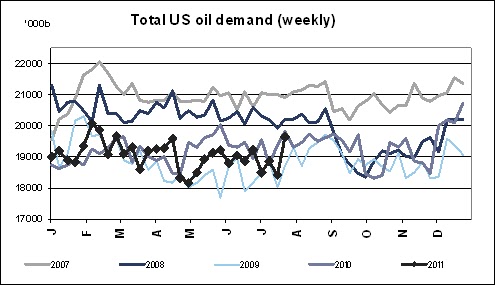
. U.S. demand has stagnated since January, increasing marginally compared with 2010.

. China has reduced its imports to 19.95 million tonnes, 9% below the January figure.

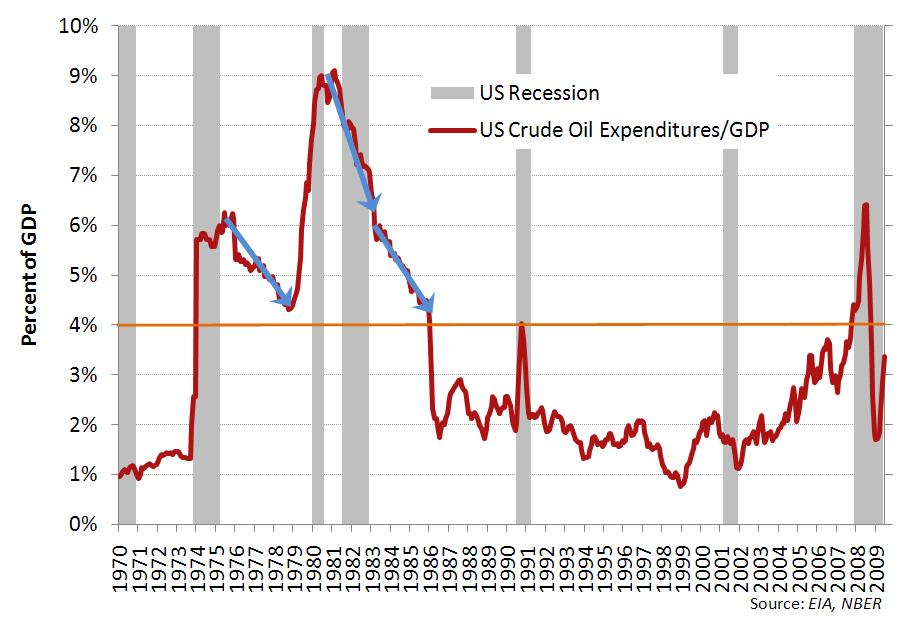
. The effect of demand destruction, as always, happens with a delay of about six months. And then, as JP Morgan said in an analysis released Tuesday, the price of oil can go from having an “Arab spring to a Western winter”. Same as in 2008.

A reader of mine was surprised to read here that since 1974 U.S. oil demand has only increased by 14%.

The real peak oil is in demand, which stalled in the OECD in 2007 and still has not recovered as much as the IEA says it will, and they have always been wrong. And China imports huge quantities until the Chinese government says “stop.”

Oil is trading with no discernible geopolitical risk premium and may not reflect it unless things get much worse. So what’s really interesting is that in this environment it is “only” 20% below the peak price of 2008, when then there was no reduction in spare capacity as we see today, or widespread conflict in the Middle East.

However, if geopolitical conflicts continue to soar and we continue printing money-debt with interest rates kept artificially low, where the OECD is totally to blame, be prepared to pay another 20% more to fill the tank of your car.

Unsustainable energy policy, higher debt, higher unemployment

(This article was published in Spain’s Cotizalia on 31st March 2011)

Beware. The European Union, Germany and the UK have implemented some of the most harmful energy measures both for their economies and, ironically, for the objectives they strive to achieve.Let us review the measures and their consequences:

. 20-20-20 Roadmap : The goal that forces to impose a 20% of renewable energy in the electricity mix hides behind its seemingly ambitious and unanimous goals the danger of percentages. As absolute targets are not specified, the cost of the measure is higher for smaller countries. 20% of renewables in a generation park like the German, 120GW (giga watts) is not the same in cost (subsidies, tariffs, investment in new transmission networks) than for a country like Portugal, Spain or Greece. Even more if we compare it relative to GDP.

Achieving that goal will cost Germany (if they implement it) that is an economy 2.8 times larger than the Spanish, the same as for Spain in subsidies and extra-cost of networks, but only 0.3% of GDP, while in Spain it’s almost 1%. This restricts the competitiveness of small countries compared to its EU partners, but even worse compared to the rest of the world. It removes the ability to recover the economy and therefore create jobs. In energy, costs are everything.

Studies of the Universidad Juan Carlos I (“Study of the Effects on Employment of Public Aid to Renewable Energy sources”), and six other universities at European level have quantified the loss of jobs by the introduction of the so-called green economy (badly called green, because it does nothing but increase the consumption of coal, which had been deemed obsolete) in 1.8 jobs lost for each created.

. Decommissioning or closure of nuclear plants : If 7GW of closed nuclear plants in Germany do not return to work, this means increasing by 8 million additional tons of coal imports to Germany. If they stop all new nuclear projects globally, coal consumption will increase by 80,000 tonnes between 2010 and 2020. And nuclear generation is “base-load” (ie, works almost without a break), so can not be replaced by renewables in its entirety. And this leads us to gas. The importance of natural gas as back-up in the energy mix will make energy dependence (a term I find ridiculous) increase. An Ostrich type of anti-nuclear policy, because in the middle of the EU we have France with 58 nuclear reactors, but some seem to think that if there is a radiation accident it will stop short at the border.

. Minimum price for CO2. The UK does things as badly as anyone, and has shown it this week. Intervening in the market and imposing a minimum price of CO2 while raising taxes on gas production in the North Sea has managed to increase consumption of gas by 15% at a higher price. In addition, the UK has increased dependence on foreign energy by forcing the closure of several projects, over $10 billion, in exploration and production in the North Sea. And a loss of 120 jobs in the first day. Success!.

The European Union plans as if the world was limited to our 27 countries. The EU is 13% of world coal consumption and 16% of natural gas. But supports 100% of the cost of CO2 and 70% of the cost of premiums for renewables worldwide. Thus the effect of their actions is amplified by the loss of global competitiveness in a group of highly indebted countries.

. Remove petrol and diesel transport by 2050. Again, without calculating the cost or impact on the economy. We are “only” talking about a cost close to twenty-six billion euros only in costs of network infrastructures. But most importantly, these do not reduce energy dependence or improve costs. Electrifying the park could reduce oil consumption (paradox, to be more competitive again), but will increase coal and natural gas prices, and adding to the renewable premiums, taxes lost from petrol and diesel, over 56% final price, will be transferred to the consumer of electric cars in the power bill.

We must not forget the impact of these measures and their cost of implementation, the impact on budget deficits and on the battered state of European countries’ debt. To add a cost to the system involving another 1-1.5% of GDP on debt with “supposed” benefits in 2050 has an enormous impact on employment and working conditions. At the end of the day in most companies the four major costs include energy, taxes, debt costs and wages. If the first three parts rise disproportionately, the third invariably suffers.

Besides, these measures have a minimal effect at European level, let alone globally. Only the planned investments in coal plants in China offsets all efforts of the EU to meet the Kyoto targets. Thus, the weight of coal as global primary energy source increased by 1.3% in 2010 to 52.3%.

And do not forget that apart from xenophobic arguments about good and bad countries, which are embarrassing, the cost of the “ostrich policy” of energy self-sufficiency that they want to impose far exceeds (all costs included) the equivalent of $700/barrel (source: CERA, Utilities Weekly). And who do we expect to sell the haemorrhage of debt we will issue to achieve the above objectives? … the oil-producing countries, China and the U.S… Amazing.

It is rather sad that the “success” of Europe in its emissions reduction target is due mainly to the displacement of its energy intensive industries to the Far East, with the consequent loss of European jobs, and the effect of reducing industrial demand runaway that the debt orgy has generated. A success. And to close the circle, it has increased the energy dependence from Russia, Qatar (gas) or Australia and South Africa (coal).

What about pollution? We forget that the rare earths required to manufacture solar panels and batteries pollute hundreds of thousands of tons of water per year. But it pollutes in China (97% market share), so no problem.

These measures give off a smell of stale paternalism, or as Professor Dieter Helm would say, “the addiction of politicians to” roadmaps “that set the future direction of energy with Soviet precision”. And with the same disastrous results as the ridiculous five-year plans.

Until governments stop trying to plan and intervene in the energy market like the rest of the world did not exist, they will be doomed to failure. And we have spent many years with dreadful results. The green economy, which seems phenomenal, as long as it doesn’t have to be paid by my grandchildren, will only succeed if it is competitive. Governments should only create a reasonable and stable regulatory framework for technology and let the market offer solutions. Competing.

War in Libya and the possible Algerian black swan

(This article was published in Cotizalia on 24/3/2011)

The UN resolution 1973, supported by the Arab League and accepted by Russia and China, has a clear immediate goal: Overthrow the Qaddafi government. What is not clear is what the ultimate goal is and what will be the position of the West after supporting a rebellion without defined leaders, common goals or government project. As we discussed in this column, the reality of Libya and its many tribes is more complex than we would like to admit. As a friend of mine says, “careful what you wish for,” because we are still regretting the support to the “freedom fighters”, the Taliban, in Afghanistan.I commented several weeks ago to our readers that the information that came from friends in companies based in the area, Schlumberger, Halliburton, Petrofac, Saipem and Technip were not encouraging for those who expected a quick fix. And my fear that this conflict will lead to a long, bloody and difficult transition with multiple factions similar to the Iraq and Afghanistan examples is increasing. I hope I’m wrong.

Indirectly, the two powers that derive benefit from all this are Russia and China . Russia has gone from being viewed, unfairly in my view, as a country in which western investment was a big risk to be a huge opportunity, and Gazprom is now the best source of security of supply of gas, with annual volumes of 136BCM that are cheap and safe for the European Union. The agreement between Total and one of my favourite companies, Novatek, which is likely to include Statoil, is a clear example. China has very little presence in Libya, a few Petrochina exploratory wells, but benefits in two sides . On the one hand, less international competition in Sudan, Uganda, Nigeria and West Africa, where they continue accumulating reserves, and on the other, potential access to new licenses, as they did in Iraq.

In Libya, the fact that rebel forces are multiple and with no clear leaders means that the balance of power in a future without Qaddafi depends largely on the support of Western countries, becoming with Iraq as a second vertex of control and strategic deterrence both to contain Iran and to protect Saudi Arabia and Israel. Libya is not only important for its production 1,660,000 barrels of daily exports, but as a test scenario of the fragile process of a possible change to democracy .

The exposure to Libya of major energy companies is relatively small, except in the case of ENI, OMV, where Libya is 20% and 24% of their net assets, and Repsol, with 7%. From other oil companies the most exposed are Marathon (12% of its production), Gazprom (less than 6%), and to a much lesser extent, Conoco Phillips (USA), Total (France), Hess, Statoil (Norway) and Occidental (USA).

But I have the feeling that the ultimate goal of an operation of this size, without forgetting to support the civilian population, which is obvious, is to have an operations center that allows to monitor Algeria and other neighbors that can potentially be a greatest destabilizing factor.

Libya has gone from being acclaimed in 2006 by our countries to the Chair of the Human Rights Commission of United Nations (the only vote against was the USA) to a regime to remove. But the danger of intervening, with a weekly cost, according to the Daily Telegraph , of $500 million for the allies, is that the war goes on forever and then it becomes more difficult to support other countries. And this brings us to Algeria, a country of enormous strategic importance , with 4,500 million cubic meters of proven gas reserves, the tenth country in the world, and 12 billion barrels of proven oil reserves.

Algeria is essential for Spain. It’s almost 30% of the natural gas consumed in the country according to official sources. But it is a relationship that benefits both countries, and Portugal. The joint venture of Repsol-Gas Natural, has the Algerian national company, Sonatrach, as one of its main suppliers. And, despite the legal dispute that the two companies hold (€ 1.5 billion in arbitration) and the loss by Repsol-Gas Natural of the Gassi Touil contract in 2007, there is no doubt that Spain is very important for Algeria, and that both parties are bound to understand each other. Additionally, a consortium involving Endesa (12%) and Iberdrola (20%) with France’s GDF Suez and Sonatrach, among others, has invested in the Medgaz pipeline that links Algeria to Spain. Spain’s energy investments in Algeria are around $5 billion. The Algerian company also holds shares in the Portuguese EDP (and hence its subsidiary in Spain, Hidrocantabrico) and provides another 2BCM of annual gas supply to Portugal. Algeria, therefore, is not at all irrelevant to the Iberian Peninsula.

In Libya, the opposition is tribal, and the religious-ideological content is limited, but in Algeria strategists perceive that the risk of a revolt against the regime of Abdelaziz Bouteflika can not only affect the supply of gas to Spain, with the devastating effect that this could have on the battered economy of the EU and its credit risk, but there are also fears that moderate opposition can again be dominated by radicals. In Algeria, in addition, the impact on Western investments extend to many more countries than those mentioned in Libya. Therefore, it is hard to think of the action on Libya as an isolated event.

Further read:

Lybia in Flames:
http://energyandmoney.blogspot.com/2011/02/lybia-in-flames-and-clash-of.html

Egypt and MENA risk:
http://energyandmoney.blogspot.com/2011/01/here-is-summary-of-my-views-on-egypt.html