Category Archives: Sin categoría

China and the Brazilian Oil Land-grab… A Bubble?

(This article was published in Spanish in Cotizalia on October 7th 2010)

The Repsol sale of 40% of its assets in Brazil to China’s Sinopec has generated some controversy in the media all week. And in several cases we have seen the term “bubble” used for the transaction.

China has a very clear objective, which is to secure its energy future and build up reserves in new frontiers, from Uganda and Nigeria to Iraq and Latin America. The war for natural resources. In 2009 and 2010 YTD, China has acquired over US$115bn in international oil and gas assets. And while some companies and the analyst community are surprised by the prices paid, we still see the shopping spree accelerating.

Sinopec has paid $7.1 billion for 40% of Repsol Brazil. This implies a “headline” price of about $ 15/barrel for the reserves, and the market compared this to the price of $5/barrel estimated for the value of the Brazilian assets in January and with the $8.50 per barrel paid by Petrobras to the Brazilian State for their new wells last month. “Bubble?” Let’s figure by figure.

For starters, the media has ignored the fact that Sinopec retains a 40% interest in the cash injected in to the IPO. So the net transfer to Repsol is 60% of USD7.1bn in return for 40% of contingent reserves of 1.2bn. So $4.3bn for 480mb or USD9/bbloe (or USD7.1/bbloe including the net risked exploration resources).An excellent figure for Repsol in any case .

Additionally, we should not confuse the value of assets within an integrated industrial group (the $ 5/barrel above) with its selling price if they are disaggregated. All oil majors are trading at a huge discount on their sum-of-the parts of its assets. For example, BP has sold $7 billion of assets to Apache at an average of $7.8/barrel. This does not mean that these assets should be valued within the BP group at these multiples. It is the historic conglomerate discount of 30-40% of all the mega-cap integrated oils.

Also we should not confuse the value that the Brazilian state uses to transfer assets to their flagship company, Petrobras, the $ 8.5/barrel, with a private transaction.

The Sinopec deal is justified from the perspective of other similar transactions made by Chinese enterprises and state-owned companies with a long term vision. Sinochem, China, paid Statoil $15/barrel for their Pelegrino assets in deep water Brazil in May, Sinopec itself paid $16/barrel for Addax, high risk assets in Nigeria, and KNOC, Korea, has paid $12.5/boe for Dana Petroleum, with much higher gas content, which is obviously less valuable than oil.

On the other hand, Chinese companies start with a much lower cost of capital assumption than their American or European competitors. The Asian giants do not have to worry about their debt, and, of course, have no need to pay enormous dividends like the integrated oils, that neither has served them to generate share price appreciation or to better compete in the M&A arena. China has plenty of capital and lacks natural resources to ensure its long-term supply.

Is this a bubble? No. It is simply a different use of capital and a longer term horizon. And it is not, moreover, for three reasons:

a) Oil assets are very scarce. To have a bubble we would have to see a risk that these assets were multiplied or fall dramatically in value, but, as stated in this column, we must take into account the scarcity value and the undeniable truth of the gradual decline rates of the oil reserves. Proof of this is the race that has been generated to participate in the 11 licenses for Iraq, where the companies (including China) will invest up to $200 billion in the next ten years accepting returns not exceeding 12%, and with an enormous political risk.

b) Unless we believe the demand for oil from emerging nations will collapse, the cost of access to natural resources is irrelevant compared to the risk of losing supplies or lose competitiveness. Oil reserves, therefore, should be seen as a cog in the huge Chinese machine. Oil is an “input”, and the relative price of these reserves does not make the total cost of “China Inc.” less competitive when the variables are planned in detail.

c) State-owned enterprises plan their projects with oil price assumptions that are higher than those used by the integrated oil sector, which is still planning at $40-50/barrel. Therefore, these companies are more than happy to have access to returns of 12-16% at $ 80/barrel.

As a friend of mine reminds me, China has a problem of too much cash, their US dollar stockpile is a perishable asset, and they can see value in oil assets above what assets are worth to others not only because they use a higher oil price, but because in any planning they use a sizeable revaluation of the Rmb.

In summary, while the European Union continue to waste time with pointless debates, instead of securing oil and gas reserves and diversify our access to natural resources, the rest are winning the war for natural resources. We’ll see if this is a bubble. I doubt it.

Iraq, A New Frontier And A Few Question Marks

IRAKWe’ve talked on other occasions of the difficulties that big oil companies find to grow. The reserve replacement ratio is still disappointing.

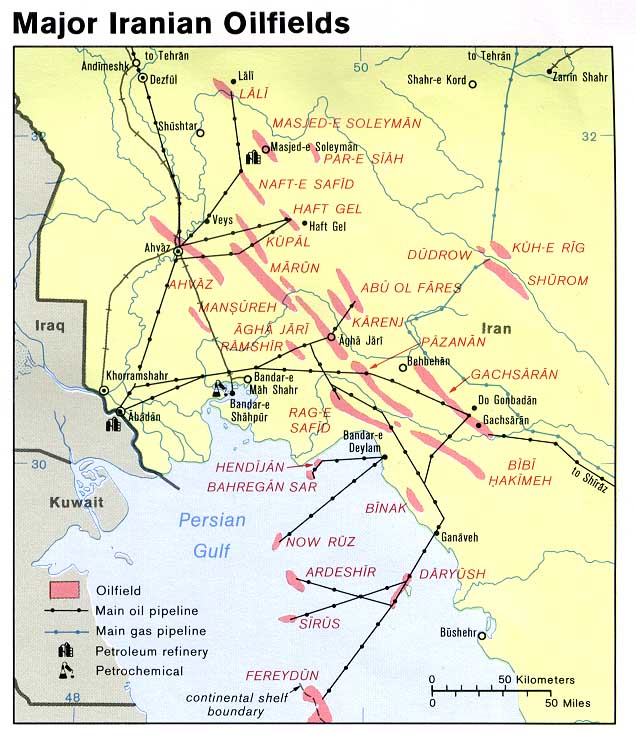
In my opinion, the true hope of the sector is Iraq, one of the largest proven oil reserves in the world, 145 billion barrels of oil, behind Saudi Arabia, with 264 and above Iran’s 138 billion barrels of oil.

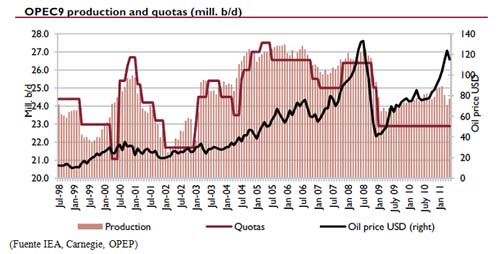
Iraq is presently outside the normal OPEC system, which is based on reserves, and given it currently produces around 2.5mbd they have stated they will not discuss a quota until output reaches 4mbd (in line with Iran). So the increase in estimated reserves can be viewed cynically as a way of preparing itself ahead of an OPEC quota.

Currently the geopolitical environment has improved substantially. Service firms are established, but the risks are not negligible, with nearby local elections, conflicts with the Kurdish minority and the gradual withdrawal of U.S. troops. For example, it remains unclear if the city of Kirkuk, home to a giant oil field, belongs to the Arabs or the Kurds, which prevents investment there.

The local government has advanced rapidly, licensing 11 fields in the last year. After a false start in which the license auction was declared void (except the Rumaila field, BP-CNPC) because the conditions imposed by the government were too onerous, between the second half of 2009 and 2010 the government has auctioned licenses to operate up to 60 billion barrels in estimated reserves, with a national strategy to increase production from 2.5 million barrels per day today to a very ambitious target of 12 million. From BP, Shell, Statoil and ENI, to Russia’s Lukoil, China’s CNPC or Exxon, most big oil companies have participated in the process.

Iraq’s 11 deals with foreign companies should in theory help increase capacity to 12mbd by 2017. From my point of view, the goal of exceeding Saudi Arabia’s production is very ambitious. No one has managed to multiply by 5, as intended, the production of a country in 10 years. And Iraqi production hasn’t exceeded 3 million barrels/day since 1979. I think it’s much more logical to assume that production will rise to 3.5 million barrels per day in 2015, in line with the history of typical production recovery in this region (including Iran).

Of the reserve revision seen this week, the bulk of the increase comes from the West Qurna field, now thought to hold 43bn bbl compared to 21.5bn previously. Exxon signed the PSC for West Qurna development Phase 1, Lukoil for Phase 2. The next largest source of uplift is Zubair (up from 4.1bn to 7.8bn bbl), where ENI is leading the development consortium. On the flipside, Rumalia (BP-CNPC) was revised downwards slightly from 17.8 to 17.0bn bbl, and Majnoon (Shell) from 12.6bn to 12.0bn bbl.

And the problem now is the costs, estimated at $19/barrel (F&D), plus an additional fee of nearly $2/barrel. The contracts allow the oil companies to cover costs up to a minimum production level. Until there is a contract typical of the industry,within what is called a PSC(production sharing contract). And IRRs can vary significantly, but in most cases only surpass 16% if ramp-up is in a straight line.

But if minimum production targets are not met, oil companies will suffer from profits lower than the average cost of capital, or even losses. The Zubair field, won by ENI and their partners, for example, will likely generate an internal rate of return of less than 20% below $55/barrel, while requiring investments in excess of $20 billion over 20 years. In total, the capex will exceed $100bn, and a lot needs to happen in terms of services (still small relative local presence), infrastructure and administration (there is no real government to manage the process and give the approvals).

We see most of the rates of return for the companies involved in the Big Six Iraqi oil fields fall within the 10%-18% IRR range, with higher returns for the pre-existing PSCs and government-owned entities. The key Kurdistan operators get very high IRRs under the Kurdish PSC, which has much more favorable terms than the Iraqi TSC. However, the Kurdistan situation is less than clear, and Iraq still considers all these contracts illegal. It is very difficult to believe that the contracts will be validated after elections.

For Iraq, the increase in gross domestic product, infrastructure and wealth for the country that these projects, neglected or poorly managed so far, will generate, will be a giant leap for the country’s ailing economy. The investments to be carried out are astronomical, nearly $100 billion between 2009 and 2029, including infrastructure, water, schools, hospitals , almost the construction of entire cities. Consider that some of these fields require about 500 workers. And the fact that contracts are aggressive and costly conditions for oil is a minor problem, because for them it is probably the last opportunity to improve their low reserve replacement for once.

Update: Iraq reached 2.75 mbpd production in July 2011, the highest since 2003.

US Natural Gas … The picture gets bleak(er)

US GAS

As I mentioned a few weeks ago… It could get worse, and it did. The bulls of the market have been calling for the need of a drastic cut in production in US gas and it hasn’t happened. No wonder the Hedge Funds net long positions on US gas have been reduced by 50%.

The environment is still strong for producers to keep increasing volumes, credit is abundant, hedges are in place and companies still think that growth and production is more important than supply management and economics. As an example, Chesapeake has entered into a 5 year VPP with Barclays on the Barnett 280 mmcfed of production relating to 390 BCF of 1P for $1.15 bn. This is after costs, so I imagine the price of the hedge is $4.50 (considering 20% royalty and $0.80 operating costs). Over the past three years Chesapeake has averaged $4.70 per mcf on their VPPs. This is generating utility-type returns in a very cyclical industry where everyone claims to be the low cost producer. So as long as there is credit, gas will flow regardless of diminishing returns.

Not only have we broken through 2003 lows (these are nominal prices), we are doing so in an environment where gas drilling and services day-rates remain robust, activity flush and inventories at cyclically long highs.

What has happened? Oil at $81/bbl, for starters. Wet gas changes the economics of drilling, so loads of ‘uneconomic’ gas fields are made economic by selling the liquids. Tough for dry gas-dominated producers, like in the Barnett shale.

Additionally, efficiencies in extraction, principally in horizontal drilling are forcing the cost curve lower despite the stronger environment for services. So day-rates are up, but cost per mcf produced is down.

Credit is also an important factor. Almost any producer of size can tap higher amounts of debt financing to keep drilling.

However, gas can self-correct rapidly. Once the situation becomes A few months of drastically curtailed production; or a few months of ultra-low prices like $2.50 would quickly re-equilibrate supply and demand, and force us back to long-term averages on the cost curve…but that cost curve itself is not static.

Meanwhile, the curve contango steepens. Cal 2012 is 16% above 2011. The bull case here is that by 2012 we could see conventional decline (6% pa) meet unconventional plateau, added to a view o demand improving, albeit slightly. The risk to believe this case is that the forward curve is slightly polluted by the hedges being taken in the financial markets.

The Increased Isolation of Iran versus Saudi Arabia and Israel

(Article published in Spanish in Cotizalia on Sept 30th, 2010)

It is the largest arms contract signed in U.S. history. $60 billion in weapons to Saudi Arabia. More importantly, that huge contract probably includes a long-term agreement to ensure oil supplies to the U.S. from the Saudi Kingdom. After so many empty words about energy independence from the Middle East, it seems that gone are the days of anti-OPEC messages from the current administration. But it is also of paramount importance to secure the protection of Israel from the threats of the Iran regime. After all, the Saudi Kingdom has as much to fear from Iran as Israel has.

The United States faces a future that needs Israel and Saudi Arabia as much as it did twenty years ago, if not more. Israel as the representative of Western values and democracy in the region, and Saudi Arabia as the best balancing factor as a West-friendly regime versus Iran and other radical Arab nations. And this is needed because the US will only be able to focus on recovering economic growth on the foundation that is provided by cheap energy, the only possible way, and through three pillars: the abundant reserves of conventional natural gas and shale gas (more than 250 years of supply, as Peter Voser, CEO of Royal Dutch Shell, says), oil from the Saudi + U.S. + Canada triangle and to a lesser extent, clean energy (nuclear and wind).

Of course, this agreement is intended to send a message to Iran, that is continuing with its nuclear program, despite the virus threats to its IT systems, and its anti-Israel but also anti-Saudi messages. It is not just a prevention message, it is a way to strengthen the Saudi government as leader of the moderate wing of the Arab countries. The Iranian regime is not supporting the King Abdullah, and continues to try to grab influence in the Shia community versus the Suni majority, while Saudi Arabia is undertaking the most ambitious program of modernization and opening up in its history, more than a billion dollars of investment in infrastructure and services, and, after sporadic protests in August, a very specific focus on education and securing employment for the population younger than 25 years, more than half of its 18 million inhabitants. A stronger Saudi Arabia and a lower influence of Iran on the Shia muslims means also a safer Israel and a better balance in the region.

We are aware that arming the Saudi Kingdom with $60 billion to send a message to a country, Iran, whose military budget is less than the $10 billion a year, must start from the view that conflict is most likely than what we believe or obey other strategic objectives. That goal may be the security of oil supplies ahead of an eventual geopolitical problem that significantly reduces exports from the Persian country.

Since March we have seen all Western oil companies cancel, reluctantly, supplies to Iran. The embargo is effective and is already evident in the prices of oil and the increase of Saudi crude exports to the United States that has analysts all over the world scratching their heads.

Why grow imports when U.S. demand is not really rising and inventories are at a five year high? At the end of the day, imports are going up because someone is buying these boats, and not, as some analysts seem to assume, because suddenly, lo and behold, boats appeared out of the blue one afternoon to download. Are the US building a cushion, an additional strategic reserve? Maybe.

Add to that the increase in the number of vessels storing oil on sea, which has risen 10% in two months, and it is plausible to estimate that if they are not preparing an environment of conflict, at least they may be seeking to ensure supplies of oil in a more complex geopolitical environment, taking advantage that oil trades with virtually no political risk premium.

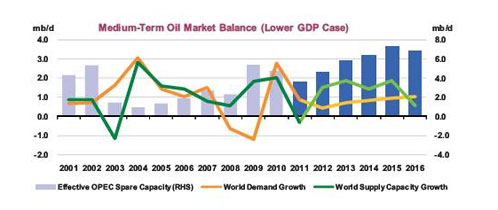
It is true that OPEC now has 6.3 million barrels per day of spare capacity and that between Russia and Iraq they are expected to increase global supply by 2.5 million barrels per day in 2013, but I fear that not even Hussain al-Shahristani , Iraq’s oil minister, assumes the country’s goals as easily achievable in the medium term, particularly if the investments of international business concession of the fields start to slow down following the recent local incidents at the premises of the Al-Ahdab East field (CNPC, China).

But if Iran has to be considered out of the equation in a tense geopolitical environment, spare capacity is gone, and the additional barrels will only be able to come from the only country that can immediately increase capacity from 9 to 11 million barrels a day … You guessed it, Saudi Arabia.