Category Archives: Sin categoría

Crude Contango… How To Benefit

contango

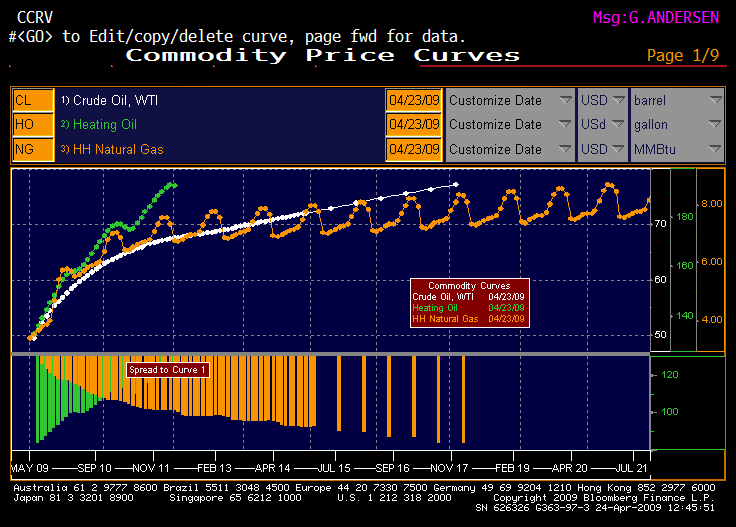
The crude contango is making big profits for oil majors as they make money from storage and selling forward, but oil remains posed to stay in the current range ($55-60) short-term. Conoco and ENI beat consensus by 15%… If these two beat witht heir exposure to domestic gas, imagine the rest. We’re nearing a peak in refinery maintenance, and from here until the middle of the year, more capacity is expected to come online and generally crude demand follows that.

On supply news, an oil pipeline linking Russia’s far east to China’s northeast is set to start operation by the end of 2010, Zhou Jiping, deputy general manager of the China National Petroleum Corp. confirmed at a conference Thursday. The pipeline would run from Skovorodino, Russia to China’s northeastern city of Daqing. Construction will start at the end of this month, according to earlier reports. The pipeline will transport 15 million tonnes of crude oil annually from Russia to China from 2011 to 2030. I believe no way this kind of pipeline is built in 12 months. Meanwhile, China says they will inject funds into oil companies for acquisitions (watch out E&Ps).

OPEC sailings are seen to drop by 232 kb/d (-1.0% w/w) to 22.17 mb/d (-7.8% y/y)for the four weeks ending the 9th May. OPEC oil in transit (excluding floating storage) is expected to fall by 5.58 mmbbls (-1.5%). North American long haul arrivals are forecast to continue their decline, falling by 512 kbpd (-8.7%) to  5.36 mb/d for the four weeks ending the 23rd May. European arrivals are expected to up by 357 kb/d (13.8% w/w) to 2.95 mb/d.
Pemex is rumoured will exercise its 30-day contract cancellation rights on some incumbent rigs in order to purge some high day rates and then re-contract at lower market rates.
Now, on UK gas, despite the strong messages on support for E&P spending in the North Sea, decline rates have steepened to c7% according to Venture.

 In terms of price dynamics, all UK gas contracts softened as the reduction in Norwegian volumes was replaced mostly by increases from Morecambe, and LNG through Teessport. The fight to tighten supply is ongoing, but de-stocking and spot LNG are offsetting Statoil and other suppliers’ dropping 8mm3 off supply intraday.

 On US Natural Gas, Conoco results yesterday showed the extent of weak demand in the US (despite the beat on estimates) and the main problem is that the company is very slow in cutting capex. Although inventory data was mildly above consensus estimates the risk comes from a warmer summer in the midst of a weak demand and economic environment. I doubt we will see $2.5/MMBTU gas as some predict, but $3.5 levels are likely to be tested.

Finally, CO2 remains tight in the range.  EUA seems reluctant to test another time the 14€ level and yesterday movement shows how much it would be difficult to go over this resistance. Of course Carbon fell towards the end of the session amid weakening German power prices but the recent correlation with equity market in the wake of better economic condition looks to early and exaggerated in accordance to the real slowdown of European industrial production. So to go through 14.50€ and test 16.00€ will definitely need to have better economic indicators but not only improved equity market.

Keep rockin’ and stay long energy… The contango works for you
Oil prices and the future of E&Ps

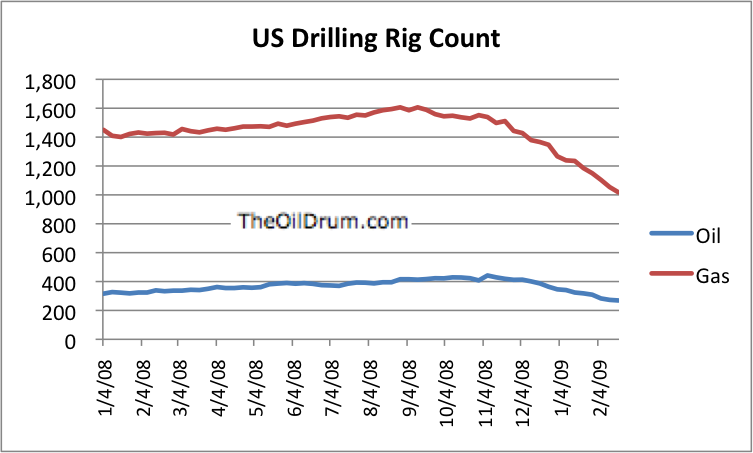
oil_gas_rig_countIn a previous post I mentioned the end of oil investment as we know it. We are seeing it happen in front of us. Oil companies are not willing tocommit vast amounts of capital (BP consumes its entire market cap in capex in three years) unless there is a secure valid return.  Return on Capital Employed is falling to  almost utility level, and this is a cause of concern.

However, the big supermajors are comfortable given their low gearing (20-23% net debt to  equity), but with oil entrenched at c$50/bbl , which for most assets is below break-even price, the independent E&Ps are set to fall one by one like pieces of a domino. The credit crunch is taking care of the really small ones, as they are finding it impossible to refinance their development and drilling programs. Oilexco and Bowleven have already succumbed. Others will follow.
For the lucky ones,  the ones that have been smart enough to increase capital and refinance in the past years, enjoy strong assets and attractive development opportunities (Tullow, Dana) the end will likely come through M&A. The supermajors and utilities need access to reserves to either replace their declining assets (BP, RDS, Total) or get the desired access to equity gas (EDF, GSZ, E.On, RWE). We have already seen Centrica buy 23% of Venture at 725p. This means paying less than $6/boe for 2P reserves, a highly attractive valuation compared to developing their declining North Sea assets. The stock trades at 805p. Still below the average historical transaction price of $12-15/boe.
The problem here, is that, as I have mentioned in the past, some of these independents will be taken over and still be the worst performers of the sector (remember when ENI acquired Burren).  Investors will likely stick to the attractive exploration companies with strong balance sheet and the added positive factor of M&A … Tullow, Dana, Venture and Premier are set to deliver strong returns to shareholders as downside is limited at $50/bbl NAV valuations and upside on exploration could deliver between 15 to 35% returns in the short term… and forget about the “boom or bust bets” in really troubled small independent producers. They could be taken over, yes, but at $1 like Oilexco.

Yes, energy equities still make sense

nonopec12oil20090220

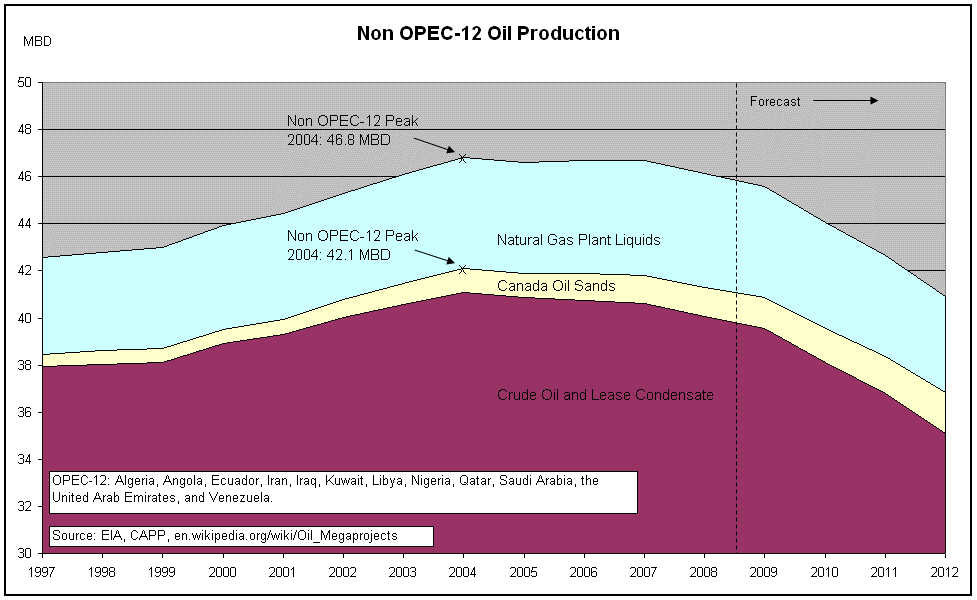
Our friends at UBS and the Oil Drum have reminded us again… Beware, oil bears because the decline in supply will come to haunt you. According to UBS most of the new projects expected to come on stream until 2015 require $60/bbl to break even.  Meanwhile the market continues to  believe Opec capacity additions will grow. However, supply is still not enough to cover the demand (IEA data) if we assume 85mbpd (2mm below current levels) in the next three years. Simply because the market perception of 4mm boe of spare capacity is massively optimistic.

So being bearish, what does the market bet on?: Opec capacity additions beyond historical achievements. I call it the Perceived Oil NGO, willing to lose money and develop below cost no matter what.

Remember what bears expected in January:

A) After a disappointing 2008, non-OPEC supply should bounce back “rapidly” in 2H09 (this is essential to strip any geopolitical risk out of the oil price)

B) New start-ups add 1.4MBD to gross production by mid-09, 1.9 MBD by end ‘09

C) Demand is in structural decline and will never recover to 87 mmbpd (and efficiency and the electric car will take care of any bounce).

Starting from the end, demand destruction due to expensive, subsidised marginal technologies would be totally acceptable at $140/bbl, not at $40/bbl (below the marginal cost of several areas), not to mention the impact of credit crunch on marginal technologies, the lack of proven substitution of electric cars (minimum horse power, need more than 60  minutes to charge half the battery) and the huge need of gas and oil as electricity generating sources if electric vehicles are successful.

As for supply, remember the “dead certain projects adding 1.925kboepd of production” in 2008? Either not on stream or flows c60% way below expected.

This is no peak oil view. Peak oil is about reserve depletion to extinction. This is about massive increased technical challenge and cost to achieve secondary and tertiary recovery in a world with 39 available rigs to 2009 and only 140 new rigs built until 2020 (for information purpose, Saudi Arabia would need them all to keep its current flows).

Has anyone stopped to think how much of incremental supply relies on Kashagan starting up in 2012 and flowing peak in 2013? 15%. 

We are betting on Opec capacity including Iraq to increase 1.3mbpd every year in the next two years. Where are the rigs and the equipment on those projects?  The two giant projects we expected are “delayed sine die”… and the service providers, Schlumberger and Technip, have no comment on timeline.

If you could take the rig counts in Saudi Arabia from 45 to 50 up to 2,000 over a decade they could basically sustain their current production at best. What you would have to do is take every rig in the world to Saudi Arabia. They are going to have one hell of a time going to 160 rigs by the end of 2009, which is their announced plan.  Where are those rigs? 

Saudi Crude Production in 2007 was 8.47m bl/d. Incremental crude volumes for 2008 came from:

 1) Khursaniyah, Fadhili, Abu Hadriyah (AFK) which is due to start up in 3Q with peak production of 500k bl/d. 2008 contribution of 155k bl/d (500k bl/d in 4Q plus half quarter in 3Q).

 2) Shaybah II with 250k bl/d in 4Q, peak production of 250k bbl/d, contributing 30k bl/d in 08 (half quarter in 4Q).

 Adding these volumes together would imply crude volumes of 8.24m bl/d.

 However, Khursaniyah is delayed and at the start of the year it was expected Q1. The delay equates to 280kb/d shortfall vs. expectations, or 3.3% of Saudi production.

In addition there is the decline of the base. CERA put Middle Eastern decline at ~5%, which would be about 400kb/d versus some commentators which have assumed less.

So the explicit slippage is 280kb/d or 3.3%, the impact of decline and delay is 680kb/d or 8%.

The International Oil Daily mentioned in January industry sources stating that Saudi Aramco looks set to miss deadlines on most of its projects. Khursaniyah may not reach full output of 500 kbd until December 2009, two years after schedule, as the contractor has struggled to source corrosion-resistant materials for the natural gas separation unit. Khurais (1.2mbd by end 2009) is expected to be six months late, although indications of 0.8mbd by end 2009 would be in line with my view anyway (there is room to slip more). Shaybah and Nuayyim (250kbd and 100kbd respectively) are both expected to slip from end 2008 to 1Q 2009. Khurais remains a key sensitivity, for both Saudi and the global market.

Meanwhile the signs of demand bottoming down started to appear last week (draws in crude versus an expected build of 3.5mm barrels).

Yes, it is still time to buy energy stocks… As long as they are strong in balance sheet, good cycle managers with strong dividend streams.  As for renewables… the future is solid, but the near-term is heavily dependent on credit. Too tough a bet short-term.

The market, the market

me_1126

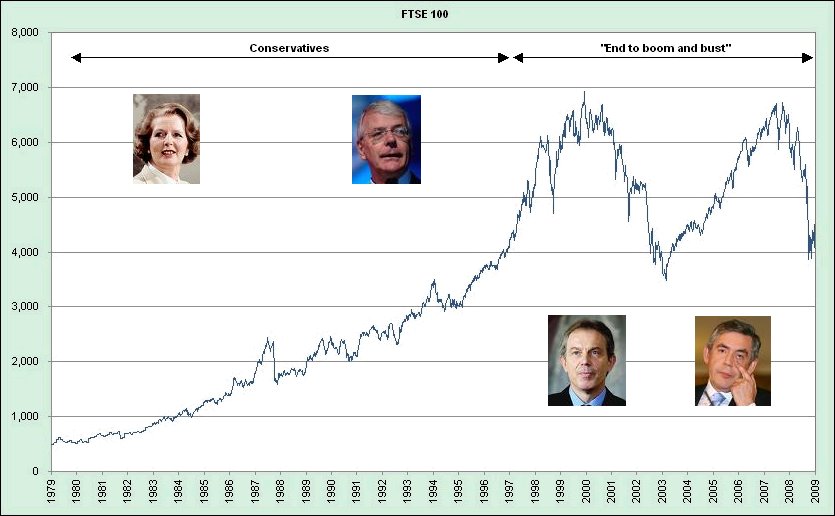
A pretty humorous chart I received last week, with obvious political connotations, but some truth embedded in it.
The basic thing that this chart shows me is that leverage and asset bubbles create huge volatility and will continue to  do so. For the market to stabilize we need debt at all levels to go back to 1981-82 levels, returns to sustainable moderate growth, open market policies, lower taxes for families and industries and liberalization. What European (not only UK) governments are doing is precisely the opposite and why even after a 14% fall in the market year-to-date I see downside… It’s not about “valuation” (most valuation tools, like EV/EBITDA  or Sum Of The Parts are bull market asset inflation tools) , it’s about sustainable returns over a WACC that is doing nothing but increase (cost of debt down, yes, cost of equity and risk premium up) and balance sheets that keep eroding after a period of furious M&A, growth and capex.
Worth a watch: