Market Front Row : Will They, Won’t They

This week we are starting to publish “Front Row”.

Front Row represents the personal view of Rodrigo Rodriguez, European Head of developed cash trading for Credit Suisse.

While controversial and sometimes politically incorrect , he presents an unbiased market view and while he uses both internal and external research at no point this should be consider Credit Suisse’s view.

It is a pleasure to get the market view from excellent professionals and market . It is intended to be a periodic (weekly, bi-weekly) view of markets from friends that might help get a better perspective. Here we go… Round one
front row 1

Front Row

In this note we have argued about a bad number being good for the market or just being bad…and I have always argued that a bad number is just that. Bad. And similarly, for a good one.

However when discussing this yesterday with the team the view was slightly different: “if the number is good it should be really good for the market and if it is bad you should not read too much into it and use it to buy the market” Chandan said..

Why? The Ben is there and the reason for QE3 was the unemployment and growth mandate the Fed has, if this round of QE does not work then he will do QE4 and he will not stop till he turns it around.

As Garthwaite told me yesterday, investors should start getting very used to exceptional low yields as they are here to stay “for 10-20 years” – clearly little Rod’s economic books will look a lot different from mine!

Will they won’t they? 
Last week I did talk about Catalonia and the Spanish bail out, I said that this government was not ready yet and today I am going to try to give some more colour on it.

So yesterday Luis de Guindos , Spanish Minister of the Economy and Competitiveness, at a conference at LSE mentioned that Spain did not beed a bail out …but did he really say that?…Luckily for me my friend Juan (Did not you miss him) was there (unfortunately a 5pm talk is too early for some hard-working Spaniards I know….) and to my question :”Has DeGuindos lost it ? “ Juan replied: “ Actually this interpretation by the press is misleading what De Guindos actually said was “ Spain does not need a bail out …we are talking about a financial assistance programme or a credit line”

In summary this government is as scared as the previous one, Zapatero would not mention the word “crisis” but downturn, slowdown etc the Conservative party will not talk about bail out but Financial assistance….no comment..

So everyone knows my view that Spain should have already asked for such help, but digging a little bit deeper my conversation with Juan got into an interesting area.

Basically Juan’s argument is that politicians (mainly from the core) need to clarify their position on the burden sharing of the recapitalization of the financial legacy positions.

Germany, Finland and Holland are now saying something completely different to what they said in July .

Clearly the Irish and Spanish thought that they had signed for a recapitalization of the banks that will be pooled by all the EU countries once the European Bank Supervisory would be created . However the core countries are saying that is not exactly what they signed or what they thought they had signed…therefore it is normal that Spain is quite sceptical about signing a new MOU.

Following his argument , which I must recognize is quite a valid one he added:

“Rod, Why should Spain ask for a bail out in a week that BBVA has issued €2B (trading 40bps tighter today) , Popular is near to raise €2.5B on a capital increase, Telefonica is raising today and the Treasury raised €4b?”

My answer was immediate: “ come on!!!! this money has been raised because the market discounts a bail out is practically imminent” Juan’s point was that is not related to the Spanish bail out but to the increased confidence on strength of the Euro .

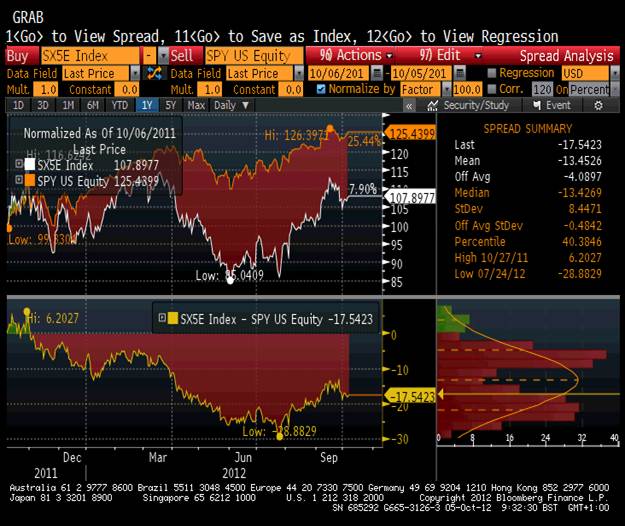
I do not doubt he might be right but the performance of the recent performance of European Equities vs. US ones clearly does not show me such confidence.

One question is still unanswered, “ Why has Spain not used the existing, authorised loan to recapitalize Bankia?” That was the question my friend wanted to ask yesterday to Mr De Guindos, unfortunately some idiot with a “Spain for Sale “ placard managed to get all the attention….

Something has to give in. Are you sure the flows have not come?
I understand the S&P is near the highs and people are getting nervous

I have even mentioning that my big worry was which hands were holding this market, I had the impression that hedge funds were loaded on risk, banks back books were running as much risk as the whole year and long only money had already rotated their portfolio towards cyclicals, i.e. unless there was new money coming we were creating the perfect formula for disaster. However there have been a couple of articles this week that make me revaluate these assumptions.

On one hand and I am sure you guys have seen this (Hedge Funds in Denial Betting on Stock Losses During 12% Rally 2012-10-05 00:03:35.274 GMT By Whitney Kisling and Nikolaj Gammeltoft):

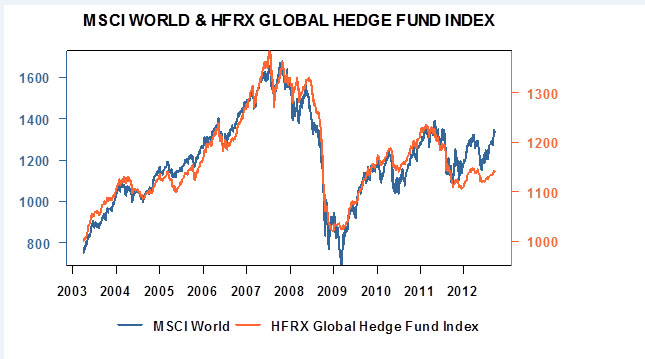
“For the first time this year, hedge funds are turning away from a rally in the global stock market. The ratio of bullish to bearish bets among professional speculators fell last week and is below historical averages, according to a survey by International Strategy & Investment Group. The reduction came as the MSCI All-Country World Index extended its yearly advance to 12 percent and contrasts with January, when managers bought shares as they rose, data compiled by ISI and Bloomberg show. The unexposure from hedge funds, as well as fund managers is just spectacular. The ISI gauge of hedge-fund bullishness measuring the proportion of bets that shares will rise slipped to 46.5 last week from 48.1 in late August. The level is below the measure’s 10-year average of 50.2, the ISI data show “

If that is true then we all know where the pain trade is by looking at the chart below…..
front row 2
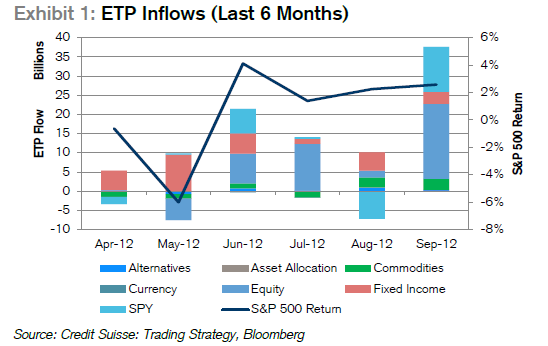
On the other hand we might not have felt that so much new money was put to work through our desks in Europe (cash, PT , D1) but clearly the following justifies why the S&P is so solid and that my perception was wrong: Please click here to view the report: Largest Inflows Since 2008:
  • The S&P 500 was up 2.5% in September, but more impressive was the fact that ETP net inflows in September climbed to $37.6bn – the largest inflows since December of 2008. All asset classes attracted new assets, but equities accounted for over $31bn (including $11.7bn in SPY).
  • There was over $31bn in equity ETP inflows in September.
  • Let the good times roll: The accommodative monetary policy helped fuel a healthy risk appetite with inflows across most regions (U.S., Emerging Markets, and Europe in particular).
  • Real estate, Mid cap, Materials activity rises: Overall, volumes were up compared to the last two months, but still below average compared to the year as a whole. Some exceptions which had higher trading activity were Real Estate, Mid Caps and Materials. On the other hand, the level of Financials trading was underwhelming.
  • U.S. inflows across all caps: Large inflows went all across the cap spectrum with SPY ($11.7bn, Large Cap), IWM ($2.8bn, Small Cap), and IJH ($1.7bn, Mid Cap) all popular.
  • Emerging Markets: Broad based EM exposure was high in demand for the 4th straight month, led by stalwarts VWO and EEM. From a single country perspective, EWZ was especially of interest with $1bn of net creations.
front row 3

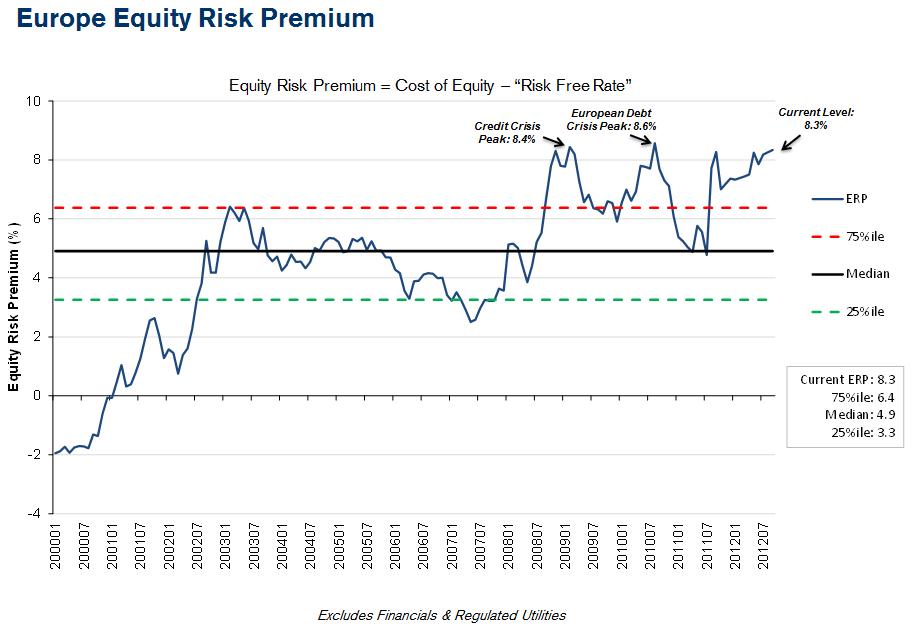
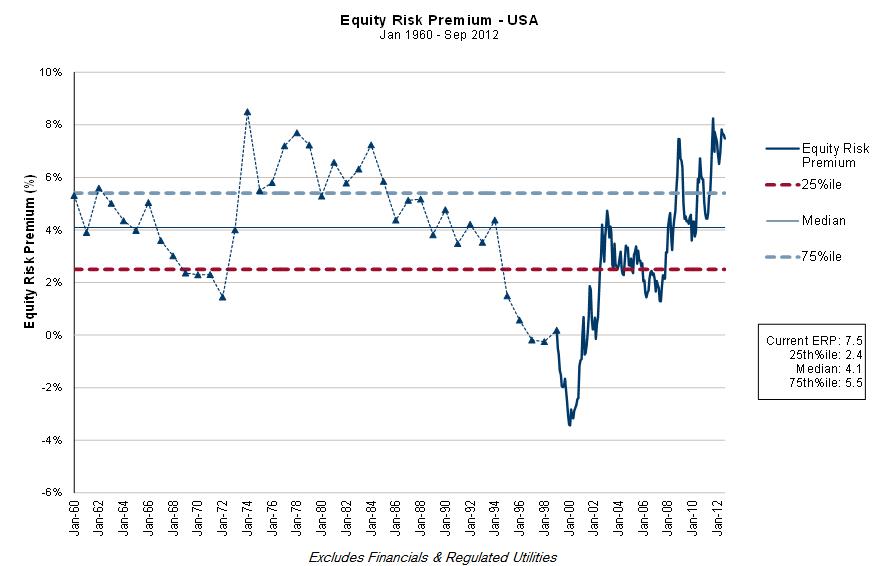
Once again on my Multi Asset Risk meeting, the following was mentioned: “Great market for High yield origination” “Rates near historic lows” “ Funding is extremely quiet and unsecure funding is no problem” “largest quarter ever on global high yield, inflows continue while spreads keep tightening” ….. So there was only one more thing to check then , is the S&P expensive compare to other asset classes? I asked my friend Leonardo Grimaldi for some colour on Equity risk premium and these are his thoughts

“We at HOLT have just done an analysis of the US equity risk premium and estimated it at 7.5%. The last time it was this high was in the early 1970s, a period characterised by stagflation, high unemployment, and an oil shock. The equity risk premium is calculated as the difference between the real cost of equity and the real cost of debt. The real cost of debt now stands at a 40-year low, as a result of very loose monetary policy post Lehman and strong corporate balance sheets. We calculate the cost of equity by solving for the yield on equities given aggregate market capitalisation and forecasted consensus earnings. The question arises: can the equity risk premium stay this high? For it to go back down to long term median levels (c. 4%), either the cost of debt has to increase and/or the cost of equity has to decline. It follows that bond prices would decline and/or equities would continue to rally (assuming forecasted earnings, which are not terribly demanding at the moment, do not change materially). Given the clear stance by Fed to keep rates very low for the next two years, it is hard to see the cost of debt rising considerably, which leads us towards equities. At a factor level in this asset class, Value is starting to come back and correlations are declining, making the environment more conducive to stock picking as opposed to an allocation decision. However, given that the economy is in Contraction, the best stocks to choose at the moment are companies have been able to show high, stable returns over the cycles or those in the defensive sectors.”
front row 4

front row 5

In summary if you believe that Ben-Draghi has reintroduced the risk free rate you need to own the upside somehow or you cannot continue in Fixed income , as at some point rational money will be forced into equities (Vole is cheap if you are not brave enough to be naked, one thing I would like to point is that Mean reversion has started to work amazingly well this month…).
Hara-kiri: Turning Europe Into Japan

This article was published in El Confidencial on October 12th 2012

“EU wins the Nobel Prize for pillaging its People with debt and bailouts.” Keith McCullough

“Doing a rescue right bank is more costly, not less, which is why political leaders prefer to zombify rather than clean up their banking systems”. Yves Smith

This week I had a meeting with readers of El Confidencial and commented that the global sovereign debt bubble is already bursting, a bubble that is closely linked to reckless public spending financed with a bloated banking sector that is now rescued with public money and the creation of bad banks.

States fail to grasp the problem of shrinking assets and deleveraging. The available capital to invest in sovereign debt has been shrinking every year by 3.5% globally since 2007, while government issuances and government-guaranteed bank bailouts have increased by 8% pa. In Spain we are six years behind most countries in the clean-up process, so the impact is likely to be larger and in a shorter period of time.

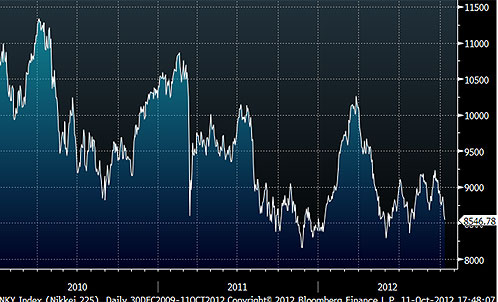
When the regional governments and the EU member states came to London to try to pitch their bond issuances they always told us that their banks were world-class models of management and risk control, and that all the regions individually had less debt than Japan. Now we run the risk of seeing the two lost decades of Japan by copying their policy. We want to be a “Japan without Toyota”. And Japan has its own serious problems.

Japan 1

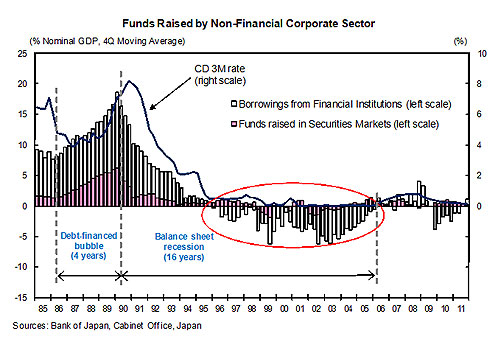
The bad bank and the financial system bailout, like Japan 

Japan carried out bailout after bailout from 1995 to 2005 and in 2008 under the same premise that we have now in Europe, a premise that has already failed in Ireland. “Everything goes up in the long term”. The long term will solve everything, valuations are “attractive” and creating a bad bank will improve credit to the real economy. Well, no.

Doubts about the bad bank in Spain are not coming from uncertainty, but from the certainty that it hasn’t worked in the past. Investors do not want to accept the valuations of loans and reject investing in the bad bank. The press calls them “vulture funds”. A failed bank that cannot sell its assets or clean its loans meets a government without money and both demand that international investors buy toxic assets at an agreed price between the first two so that it doesn’t look bad in front of creditors and voters… Yet the one the press calls “vulture” is the investor.

From the lost decade … to the two lost decades

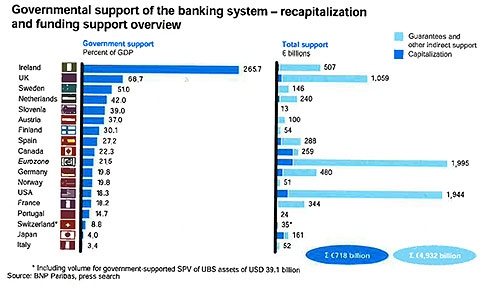
Sorry for the poor quality of the chart below, but it shows the following. The OECD has spent more than 4.9 trillion euros to rescue banks from the crisis. That’s 4 times the GDP of Spain. Except in very specific cases, like the United States and little else, virtually nothing of that “aid” has been recovered. Why do they do it?.

Because it is feared that the fall of banks is more harmful than keeping them zombie and wait until the crisis ends and valuations rise. But it doesn’t work. Toxic is toxic now and in ten years. And governments never think of “working capital” and “interest accrual” as a problem while the “long term” arrives.

Japan 2

Five years ago a French banker told me that “no one dares to analyse let alone reject a loan to the government”. It is extremely difficult to clean the system from a way of doing politics, of building useless infrastructure, housing bubbles and interventionism in what is euphemistically called “growth policies”.

The problem of bad banks is that past experiences do not help, and even if we repeat again and again that the crisis was of US origin, the problem is Europe. Let me show you a few figures to illustrate the enormous problem of the European banking system:

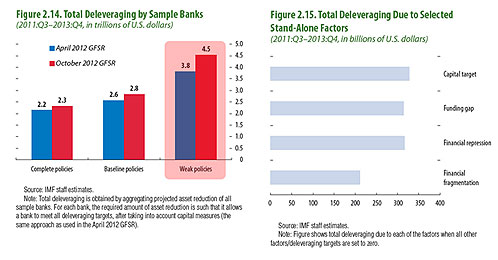
Half of the world’s largest banks are in the European Union. 56% of European banks have political or public control. In 2010, U.S. banks had a balance sheet of 8.6 trillion (80% of GDP). In the European Union, banks’ balance sheets exceeded 43 billion euros (350% of GDP). According to the IMF, European banks have to divest up to 4.5 trillion euros. Will credit flow? No.

Japan 3

At this point it is doubtful that the discount at which the Spanish bad bank will buy toxic loans is adequate. In fact, what many perceive is that the problem of the loan portfolio is not of “non-performance” but absolute insolvency, especially in land. Another risk is that the bad bank may have only 10% of capitalization making it a giant leveraged bet on the rebirth of the housing bubble. When the government says that the bad bank will not cost taxpayers a cent it is just saying that they expect -pray- that asset prices will rise. Meanwhile citizens have less disposable income due to confiscatory tax policies. It is difficult to see a recovery in housing with wage and disposable income deflation, just like in Japan in the 90s.

Last week the Irish Minister Joan Burton commented that the Irish bad bank, NAMA, will probably lose 15 billion euros of the 32 billion paid for the “toxic loans” acquired by the taxpayer at a “bargain” 58%” discount.

The solution, in my view, is the “bail-in” of banks. Liquidate the problematic entities with bondholders and shareholders taking losses. Europe cannot have a banking system that is five times larger than the American. A bail-in would separate the good from the bad banks and address the problem of public debt paid with taxes and spent on bailouts.

Sinking the economy the Samurai way

All I read over and over is that Europe needs “social contract and growth policies”, which means more welfare state, more government planned infrastructure and not worrying about deficits… Like Japan. But Europe is not Japan. And even if it were, it does not work. Europe cannot emulate the race of debt and public spending made by Japan because it would be committing hara-kiri .

Japan is the dream of a European interventionist government or a minister of Civil Works: Expenditures on useless infrastructure, endless civil works and a pyramidal welfare state increasingly at risk of insolvency due to its declining population.

Japan spends 60% more than its revenues, has a deficit of nearly 10% of GDP, net debt – deducting some government assets – of 135% of GDP. In 2013 Japan has to issue debt equal to 60% of its GDP (source The Atlantic).

Half of the Japanese budget is wasted on debt interest expense and pensions. Does this sound familiar?. With an aging population in which the pyramidal structure of the welfare state and public spending were unchanged, Japan is living on borrowed time and its citizens contribute their savings to maintain a public debt that is not secured by assets. Does this sound even more familiar?

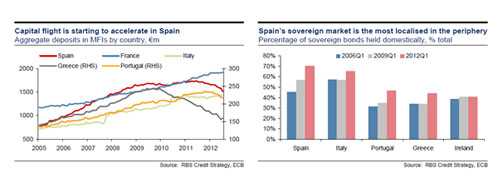
In addition, 95% of Japanese debt is held by local investors. In Spain, Portugal and Italy it is close to 65-70%. This seems to be the goal of the EU leaders for peripheral countries. Local buyout of public debt. But the Japanese save and their companies are world leaders in exports. Japan repatriates currencies. Europe, especially Spain, consumes currencies.

And yet, the “Japanese” solution to the recession is what some seem to repeat over and over again, eternal social guarantees and public spending, even if this has only led to a crisis of the “two lost decades” and an unaffordable debt.

Japan 4

The fans of the “policies of growth” want Japan without Toyota… And it does not work. 

Japan has modern industries and technology, moderate unemployment and a powerful industry. It also has a large savings ratio. Despite this and being a world superpower, Japan is heading towards the largest debt crisis after another decade of reckless spending. Because it depends on the savings of an ageing population whose disposable income continues to decrease. The crisis could be the next financial tsunami, because the pyramid scheme of debt financed by domestic savings is being consumed.

Those in Europe that demand the European Central Bank to behave like the Bank of Japan, fuelling the public debt bubble, and that want the state to undertake “guaranteed welfare and growth policies” are betting on being Japan without its private savings or industries. It’s suicidal.

The solution is not to borrow against our grandchildren building more useless airports and trains in a Ponzi scheme to subsidize the short-term placebo effect of ephemeral subsidized employment. Zombi banks must be liquidated, without cost to anyone but shareholders and creditors. We need real market economy.

The solution hurts because there are no miracles. De-leveraging will take a long time, and in the meantime we must revitalize the European economy by attracting private investment. But that does not provide votes or photo opportunities inaugurating useless bridges. We want Japan, but without Toyota. Someone will pay.

Spain is not Enron, but the risks exist

This article was published in El Confidencial on October 6th 2012

“Spain is not Uganda, it is Enron” Christopher Mahoney

“Spain will not grow for the next five to ten years” Sean Egan

sovereign downgrades

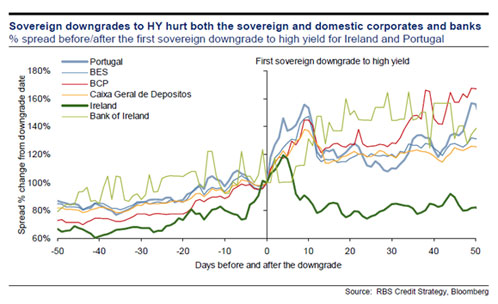
One of the most dangerous problems in Spain today is to reject the international analysis about the country’s difficulties as malicious. The market is very concerned about Spain today, but if the steps to resolve the debt crisis are not taken, Spain could quickly go from a cause of concern to being ignored.

We cannot say it was a successful week for the “Spain brand”. The country was mentioned as an example of hypertrophied government size in the Romney-Obama debate, the EU is wary of the deficit targets for 2012 and 2013, and the country gets compared with Enron. I do not like it, it hurts my pride, but we must pay attention.

The continuous fluctuations and messages about the request or a bailout are not accidental. The reality is that it is impossible to rescue Spain. It would cost a trillion euros, according to estimates by Moody’s and Egan Jones, and governments have to find ways to avoid the impact on the Eurozone.

regions add 18
The meeting of the presidents of Spain’s regional governments was an example of “trainwreck” for many investors. There was talk of compromise, but more importantly, of “sharing the deficit”-more debt, unconditional support -more debt- and “growth policy”-more debt. There were no talks of political spending cuts, just trying to increase the deficit. When talking of deficit read “losses” and read more taxes.
This is what we must avoid. Chris Mahoney thinks the country has more than a debt problem, but, just like Enron, Spain has a huge dependence on credit, and without credit its GDP mirage fades. Mahoney says that Spain depends on “a positive image” to continue to access more debt. Spain, according to Mahoney, needs to create the illusion of future growth to attract more debt to keep the illusion of wealth and to continue creating a debt snowball.
I disagree. The scheme of eternal debt is widespread across the OECD, except that in Spain we took the party by storm and the hangover will be tougher.
Spain is not Enron. It can stop the snowball of debt in a week cutting wasteful spend. In the debate between Romney and Obama Spain had the dubious honour of being signalled as an example of bloated government spending, but unlike other countries, its massive expenditures could be cut immediately given the enormous size of subsidies, 1.4% of GDP.
Enron could not cut debt because its assets simply did not exist. In Spain the private debt of the country, which is huge, is supported by assets, which could be better or worse but sellable, and as such, debt can be reduced with divestments and capital.
The risk is not being Enron, but to be perceived as a kind of Rumasa –the industrial Ponzi-scheme created by Mr Ruiz Mateos in the 70s- a huge web of opaque cross-holdings between state, banks, and companies to hide debt and pump up asset values between close friends and cronyism. This is only solved with more foreign investment, opening the market.
capital flight
Why do they doubt that Spain will grow again?

When Sean Egan warns that Spain will not grow for five or ten years, what he analyses is the inability to generate industrial demand and investment with such a monstrous debt and a huge tax burden. If we maintain a confiscatory tax policy, legal uncertainty and the bloated weight of the government, he could be right. Considering that Spain is an ultra-cyclical economy, it could also recover quickly if the burden of taxes and government is reduced. Let’s face it, exports are improving and foreign investment rebounded slightly, although it’s nothing to get excited. Most of the deleveraging is not completed, because the reduction of public and private debt has not yet really begun aggressively.

Investors and analysts warn that the problem in Spain is the increasing burden of financial commitments without demands.

Egan Jones downgraded Spain last week. They cite as most important elements of its downgrade the pace of industrial demand destruction, and the debt overload of the regional and bank bailouts. Let’s remember that when the year started the capital needs of banks were supposed to be a maximum of €40 billion and now the official figure has risen to €60 billion, while many analysts assume capital needs of €200 billion.

Bailout after bailout

The problem is that in the vicious cycle savings banks-state-regions-spending-debt there is never a bankruptcy, no credit responsibility and, therefore, a perverse incentive for mismanagement.

I see that the bond market, taking advantage of the Draghi effect, is trying to accumulate five-year Spanish credit default swaps, although the volume is still small. Investors perceive the following problems that could cost up to 60 billion more than expected in 2013, bringing the deficit close to 6%, well above targets:

* Giving full and unconditional support to the regions. The regions have already consumed almost all of the Liquidity Fund available to them, with extremely mild conditions. The government says that the state could intervene the regions if they don’t comply with the targets. Let us see what government dares to intervene Valencia or Catalonia.

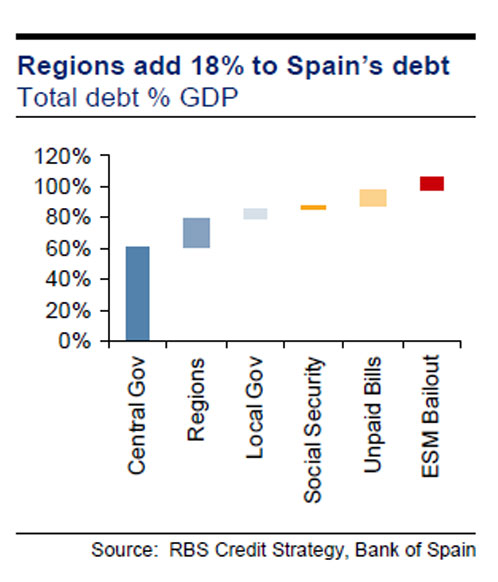
The regions have an outstanding debt €191 billion, 18% of Spain’s GDP. All guaranteed by the state. Having the state as guarantor creates perverse incentives. Regions are bailed out but no one dares to intervene them, and even if this happens, the taxpayer pays the bill any way. The autonomous communities complain that their individual deficit is very low. Remember: deficit = loss = more taxes. They account together for 33% of the total Spanish deficit.

* Unconditional support to bankrupt savings banks. The Spanish banking system balance sheet is 340% of the country’s GDP and, moreover, is extremely exposed to sovereign debt. With non-performing loans of 9%, and the drop in deposits it is likely that we will see another round of “bailouts” in 2013.

* The “bad bank” will buy real estate assets not with enough discount, at”economic value”, that is, betting that the long term everything will go up. This will require an injection of public capital to support the bank’s finances. And the longer it takes to sell, more public capital injections will be needed. All this is done to “get credit flowing” to the real economy. However, banks cannot recapitalize themselves as requested by the EU and at the same time provide credit to a “real economy” that sees increasing taxes and decreasing margins. That’s like blowing and slurping.

European CDS against Spain. Crazy
The European Union is greatly concerned. They doubt Spain will comply with the deficit targets in 2012 and 2013. The IMF believes that Spain will not reach a 3% deficit until 2017. The EU is so concerned that after criticizing Credit Default Swaps for years, and given the magnitude of the potential problem, between 700 billion and one trillion euros, the EU itself and the ECB are considering issuing European credit default swaps for the Spanish rescue, according to Bloomberg .

This is a recipe for disaster, because it shows that the EU itself is wary of the ability to repay debt of Spain and seeks to attract foreign investors to finance the bailout, insuring against a default of Spain. What happens? That CDS overshoot, which spill over to the sovereign debt but also to the debt of European Stability Mechanism (ESM).

A debt problem is not solved by more debt. If Spain stops the bailouts and establishes unquestionable credit responsibility, negative surprises are likely to be decreased greatly. A further delay in the deleveraging process from the expenditure side will mean a longer path to recovery and revenue growth. But it seems it does not matter. Someone will pay the debt. Some day.

My comments to CNBC here: “We have a lot of earnings downgrades to come and an environment where companies need to reduce their debt significantly”

http://www.elconfidencial.com/encuentros-digitales/daniel-lacalle-26

Top 10 Ronald Reagan quotes

  1. A hippie is someone who looks like Tarzan, walks like Jane, and smells like Cheetah
  2. I’ve noticed that everybody that is for abortion has already been born
  3. Here’s my strategy on the Cold War: We win, they lose
  4. Socialism only works in two places: Heaven where they don’t need it and hell where they already have it.
  5. The nine most dangerous words in the English language are: “I’m from the government and I’m here to help.”
  6. The government’s view of the economy could be summed up in a few short phrases: If it moves, tax it. If it keeps moving, regulate it. And if it stops moving, subsidize it.
  7. How do you tell a communist? Well, it’s someone who reads Marx and Lenin. And how do you tell an anti-Communist? It’s someone who understands Marx and Lenin.
  8. It has been said that politics is the second oldest profession. I have learned that it bears a striking resemblance to the first.
  9. I have left orders to be awakened at any time in case of national emergency, even if I’m in a cabinet meeting.
  10. Recession is when your neighbour loses his job. Depression is when you lose yours. And recovery is when Jimmy Carter loses his.