Integrated Oils. Break-Up or Fade Away?

2011072056lacalle-1

21st July 2011
“It’s better to burn out than fade away” Neil Young.

Integrated oil companies don’t create value for shareholders. This is the unanimous cry of investors.

The reason is simple. There is no evidence that the integrated model works.
And, as always, it’s the US companies who are tackling this issue. First Murphy, Marathon and now Conoco have announced the complete separation of their Upstream and Downstream businesses. Finally.

The conglomerate discount at which the sector trades has now reached record levels (between 20 and 40%) and quarter after quarter investors see that the supposed benefits or synergies of agglomerating refining, exploration and production, gas and electricity and various renewable adventures are seen nowhere in the returns and certainly not in the share price.Of course, we continue to see slides where companies applaud themselves for being “large”. Large conglomerates of many capital intensive businesses with poor profitability. Because today we do not see the benefits or improved competitive position with respect to independents either in growth or relationships with producing countries. Big Is Not Beautiful .

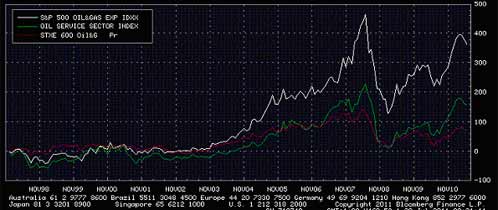
“Long term, Lacalle, these are long-term investments.” I hear. Well, long term investors have not been rewarded at all. The European integrated oils (red line on the chart above) since 1998 have performed quite poorly while oil rose from $14 to $114/bbl. Meanwhile, independent explorers rose c300% (12% annually) in the U.S. (white line) and 500% (20% annually) in the UK. Furthermore, the oil services companies (green line) rose 155% (7% annually). For reference, I remind of my posts on oilfield services and independent explorers.

With oil prices increasing almost tenfold, the integrated European sector average performance since the end of the mega-mergers, 1998, has been a paltry 3.8% annually. Considering they have paid a dividend yield in that period of between 3% and 6% and assuming that such dividends were reinvested, the real stock market performance has been almost equal to inflation. Destruction of value of spectacular size.

But it’s even more impressive to see how terribly the integrated Europeans have performed (+3.8% annually in dollars) compared to the Americans (+7.6% pa) since the days of mega-mergers.The reason, sad to say, is that the Europeans have generated an average 12-16% ROCE due to the “diversification” into many low-return businesses, while Americans were generating a 18-23% ROCE. In Europe, poor refining investments (remember “the golden age of refining” bet?) and adventures out of the sector  from renewables to power and healthcare, telecoms and nuclear, have “eaten” the profits of exploration and production. Investing in refining in Europe is a donation, not a business.

It’s a shame, but many of the European oil majors are semi-state political vehicles where the alignment of interests between shareholders and managers is very low. As an example, using data from annual reports, we find that European managers have virtually no shares in their companies (less than 0.01% of capital), compared to 6% on average in the U.S., apart from the giants Chevron Exxon or Conoco (between 1% and 1.2% of capital). People tend to work harder if their own money is at stake, and if a CEO has more desire to become a minister than to see shares go up, his actions will lead to his principal goal.
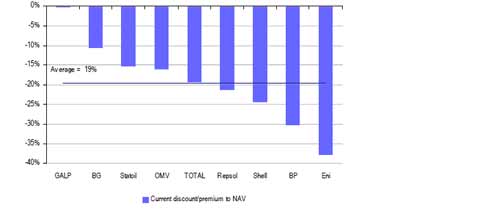
2011072061lacalle-2No wonder, then, that ROCE driven companies outperform. Exxon just trades at a 4% discount compared to the sum of the parts of its businesses, while Chevron trades at a premium of 4%. On average, the listed American integrateds, according to UBS, trade at a discount of 5-8% while ENI (Italy, semi-state) trades at a 38% discount, OMV (Austria, semi-state) at 16%, Total (France, private but with strong public ties) at 22%, or BP (private but a “flagship company”) at 30%. Repsol, which emerged from the “Argentina trip to hell”, used part of the philosophy of Marathon (either by choice or necessity or shareholder pressure) has cut its discount from 40% to 20%. But it still has much to do to be remotely similar to Murphy or Marathon and it is important to remember that maintaining control positions in listed subsidiaries does not help because the conglomerate discount remains.(source: UBS)

We recently explained why the integrated sector does not work in the stock market , but what would happen  if they broke into parts?. Let us focus on the possibilities of a break-up to create value:

1) Not all have to. As we have seen, American integrated trade at a small discount or a premium to their sum-of-the-parts, thanks to the ongoing evaluation of their business portfolio, and having no mercy when it comes to divest in areas of low profitability .

2) Not all can do it . In order to do a successful break-up companies need to start with a powerful exploration business, with high growth that would trade at a strong premium and a very strong refining and marketing business with strong cash flow and good EV/complexity and margins so that investors value them.  Marathon and Murphy are companies that have exploration and production businesses that can trade at higher multiples, but also very successful in refining so it is easy to separate them.

In the European case it is more difficult because usually companies “limp” in one division or another. They are also companies with more “surprise invested capital” (a lot of hidden diversification with low returns) and thus this could lead to a separation at very low multiples. For example, despite having a world-class exploration and production business, Total’s refining + marketing + renewables, which has generated losses in France since 2001 as the CFO acknowledges, could not be separated. If Total, for example, could not close the refinery in Dunkirk, losing millions a month, could  Repsol sell its inefficient refineries given the same pressure from local governments?

BP, for example, also has a powerful exploratory heart, but very low growth (Thunderhorse, etc) and average exploration success, and is still trying to sort out its disastrous Russian adventure (TNK, 20% of its reserves), sell their underperforming European refining and reduce exposure to its renewable business at a time where renewables are falling in valuation every day. If it separated its activities in three, as some propose, these would very likely trade at sub-peer multiples as well.

There are also many pressures and core-shareholder policies that prevent companies from selling non-strategic assets. From ENI with its subsidiary Snam ReteGas and Galp, to Repsol and Gas Natural, which at some point traded at €40/share when it was a possible candidate to be sold, yet now trades at €14/share after a massive acquisition and a capital increase.

Furthermore, disposing of those assets would probably show to investors that the alleged “high growth” E&P division is probably not going to trade at the multiples of an independent explorer given the fact that, at the core, in most integrated oil companies, the exploration success ratio is well below that of independent companies, the reserve replacement is lower and they are not takeover candidates or sellers of assets, just aggregation vehicles.

Separation has only proven to create value for all stakeholders (shareholders, industry, country) when the parts are true growth and value, as the model of BG and Centrica showed, which delivered two strong national companies without massive conglomerate issues, lean operations, higher ROCE and clear market valuations. This made them also bigger and better companies.

3) Not all should. One should ask – sell and separated to do what? Sometimes you have to be careful what you wish for. When some of these companies are separated, the excess cash is often used to make acquisitions, and given the examples of the past, it is sometimes better to stay with the devil you know.

Example: If  ENI dispose of Snam it would lose €2.5 billion in operating profit.As an industrial and semi-state owned company, it would seek to acquire something that would replace that figure. And would probably be more expensive than the asset sold. Unless those gains are reinvested in buying back shares, pay dividends or make one acquisition of very obvious high value, the benefit may be non-existent. So the only way to create value is to forget trying to reinvent the wheel and focus their efforts on growth in exploration, an area where their returns and competitive advantage are obvious.

The illusion of value in Euromajors’ E&P businesses is another contention issue. If we look at European majors’ E&P business from the perspective of an independent upstream company, here is what we find: No real organic reserve replacement (most of it is acquired), sub-standard growth (1-2% pa at best), very exposed to OPEC, gas and non-conventional resources, exploration success below-E&P standards in past five years at less than 35% (versus E&Ps at 56%), low ROCE (15-17%), bureaucratic and slow management decisions. But most important, a major’s E&P business, even if restored to industry standards, is not for sale as they are asset aggregators, so it would never be valued on a NAV basis like other E&Ps. See the example of Statoil, which is now a pure play E&P, has no conglomerate problems and still trades at 16% discount to sector.
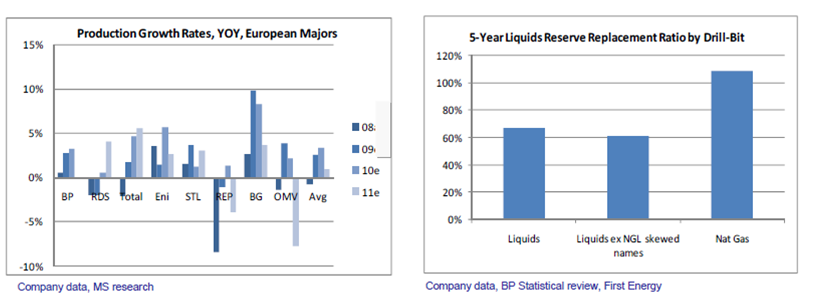
Majors production reserves

The only upside from integration is size and scale. By staying combined and being huge $100bn+ companies, the majors force the market to value them on P/E, and dividend yield rather than being subjected to the scrutiny of production growth, ROCE, reserve replacement etc  and EV/complexity adjusted barrel, margin, cash-flow etc  that smaller pure play peers are subjected to in upstream and refining.

The weakness in the theory of break-up value as a strategy is that by splitting up they subject themselves to a comparison of their individual businesses vs peers, and the comparison is bound to be poor on growth, on exploration upside, cash flow and ROCE. So it seems that majors are happy to complain about their share price, but prefer to continue to mask poor strategic and operating performance vs independents by staying “too big to ignore”.Ultimately, as we said a year ago, be wary of promises of value based on estimates of sum-of-the-parts. Because it ends as a text-book case of “value trap.” And let’s welcome focused strategies. At the end of the day an oil is not an NGO, it’s a “capital allocator” which should review its portfolio of businesses each year and cut off mercilessly the areas of low profitability … As Shell has begun to do since Peter Voser beame CEO. And forget the “long-term value” mirage. As Exxon says, there is no long-term strategy that cannot be monitored from quarter to quarter. Size does not matter unless it creates value

http://online.wsj.com/article/SB10001424052702304537904577277440911481180.html
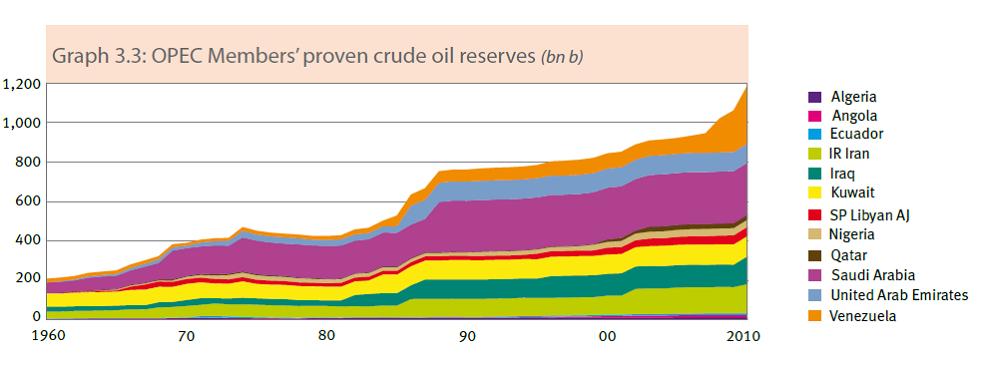
It’s Official: Venezuela beats Saudi Arabia In Proven Oil Reserves

OPEC20th July 2011
Venezuela’s proven oil reserves have soared over the year to a level that surpasses Saudi Arabia.

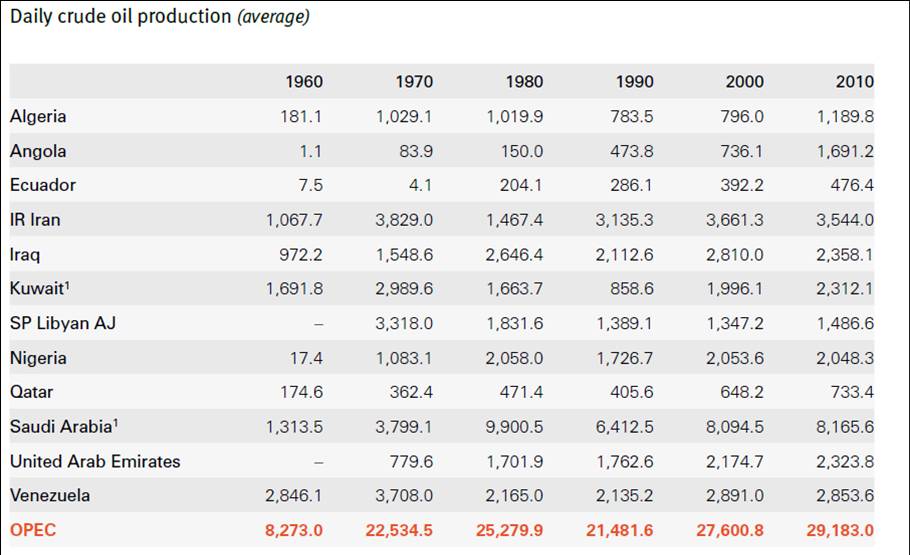
Venezuela’s proven reserves amounted to 296.5 billion barrels, ie a 40.4% increase over the previous year. Furthermore, it exceeds the reserves published by Saudi Arabia, which reached 264.5 billion barrels . These details were published in the Annual Statistical Bulletin prepared by OPEC for 2010-2011.

The problem with Venezuela is the quality of its oil and the industry itself. Venezuela’s oil is heavy and ultra heavy. Low quality and high cost. Additionally, the national oil company, PDVSA is a very inefficient, bureaucratic and slow company, and only if it eliminates these obstacles and returns to the be the efficient company it was twenty years ago will the country have a competitive and world-class oil industry.

This massive increase in oil reserves, 40%, which comes with a giant increase of 24% from Iran, does not come as a surprise to the companies present in the area. It’s not magic. It is because the OPEC Secretariat has introduced its own change in methodology to include extra-heavy oil in figures for Venezuela and Iran (some 800kbpd of production for Venezuela and up to 950kbpd for Iran).

These reserves were always there, but given that they were mostly heavy oil, very expensive to produce, it required a high oil price to declare those reserves as commercial. Once OPEC has established an oil price deck closer to the current level, these reserves are considered proven and commercial. In my calculation these oil fields requires an average minimum  $85-90/barrel price to generate 15% IRR.

This reserve upgrade doesn’t change the current dynamic of supply and demand in the oil market, but unquestionably could change the balance of power at OPEC. And not to a nicer side.
In the meantime, after a long controversy about the actual level of Venezuelan oil production, the International Energy Agency (IEA) revised up the country’s oil production by an average of 393 kbpd for the past four years, placing it at 2.5 mbpd. Nonetheless, the IEA estimates remain around 350k b/d below the official data. Part of the difference could be due to the inclusion of condensates production in the official data, which accounts for slightly more than 100k b/d, and other exports to non-OECD countries, such as Cuba (unaccounted subsidised barrels), that could be hard to verify.

opec production

The Venezuelan oil basket price for 2012 if we use $104/bbl increases Venezuelan oil exports by approximately $9.0bn, according to Barclays which takes the country’s current account balance estimate to $23.bn (7.6% of GDP). This week’s increase of reserves, and the subsequent larger piece of OPEC quota that Venezuela can collect, will significantly strengthen the country’s financial position.
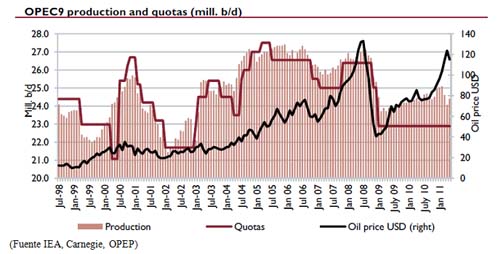
In the next OPEC meeting the two hawkish countries, Venezuela and Iran will have a substantial higher power than Saudi Arabia, Kuwait and Emirates have today. This is because quotas are set according to proven reserves, and Venezuela and Iran are supporters of a tighter quota policy and defenders of a stricter policy towards the West, pushing for higher oil prices, as the two countries need $80/bbl at least to balance their budgets.

2011060855Sin título-1 copiaVenezuela and Iran will likely look to achieve two goals in the next OPEC meeting: be able to produce more oil than Saudi Arabia while at the same time keep quotas unchanged at 24.7mbpd (real production now at c28mbpd). Basically take a larger part of a cake that will not grow. It is unclear if Saudi Arabia will agree to this. The Kingdom has already increased production by 800kbpd this year to a record 9.6mbpd. The Kingdom seems to be looking to attend the next OPEC meeting from a firmer standpoint regarding their production (they don’t want to be again the only ones to comply with quotas) and also seems to be looking to establish itself as the key balancing factor to an oil market that the IEA sees tighter into year-end. Meanwhile Iran has increased output despite the embargo, as we mentioned here. There is clearly a battle of opposing forces going on.

The problem, from the economy point of view, is that Venezuela, along with Iran represent the most aggressive stance towards the Western countries and try to force a higher price for crude. If they gain control of the OPEC decisions it will likely lead to further instability and volatility in the market.As I mentioned, Saudi Arabia increased its production in June over January by up to 800kbpd because they foresaw this reserve upgrade, and subsequent quota re-shuffling.

Things will only get more interesting as we approach the next OPEC meeting. We will see.

Further read:http://energyandmoney.blogspot.com/2011/06/iran-grows-output-despite-35-fall-in.html

http://energyandmoney.blogspot.com/2011/06/china-slows-down-as-saudi-arabia.html

http://energyandmoney.blogspot.com/2011/06/iea-releasing-strategic-reserves.html

http://energyandmoney.blogspot.com/2010/10/increased-isolation-of-iran-versus.html

The Shale Oil Revolution In North America and Argentina. Who Wins?

2011071315cuadro-3

14th July 2011

The oil market is nervous. As we have highlighted over this blog, Chinese demand remains the main concern. China’s oil imports fell to an eight-month low in June, 5.7% lower than the month before and down by 11.5% year on year.

The figures add to concerns that the Chinese government will slow growth with a sharp tightening of monetary policy, in response to consumer price inflation running at 6.4 per cent last month despite five interest rate rises since October.

Meanwhile, Saudi Arabia has increased production to a record 9.6mbpd, an increase of 800kbpd from January, and Iraq reached record output of 2.75mbpd, almost back to pre-war levels.

As of June, IEA inventories remain above the 2006-2010 average.

However, I still receive doomsday messages about supply. And I say, don’t worry, supply is adequate.

Now the Shale Oil revolution is upon us.Remember what shale gas did to natural gas prices? Down 54% from the peak. Imagine what shale oil can do.Peak-Oil defenders, gas lobbies and environmental groups all said shale gas was not economical below $8/mmcfe, they said that it was a “bluff” and that the decline rates would make the “fad” disappear as soon as natural gas reached $6/mmcfe. It reached $2.5/mmcfe (now at $4.5) and the rig count is at all-time highs (890), companies continue to make good returns (18% IRR) despite pressure pumping and service costs rising, the environmental concerns are being addressed swiftly and adequately and decline rates have proven to be significantly less aggressive.

The NY Times battle against shale gas, driven by half-truths and questionable analysis, is lost. No one denies the massive resource base, even in Europe and China, and the opportunity to supply cheap, abundant energy.

Well, shale oil could generate a similar transformation impact for the oil market.

Last Thursday we met in London with twenty North American oil companies and a representative of the Energy Information Administration (EIA). We only talked about one issue: the revolution of Shale Oil, which could be a transformational force in the oil market.

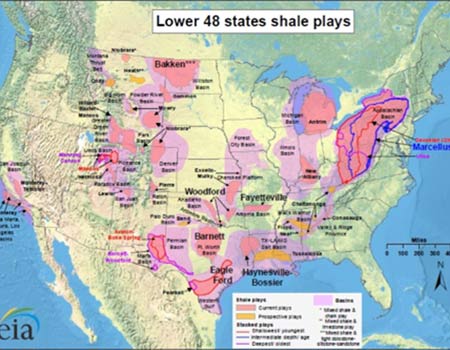
The United States has over 24 billion barrels of recoverable oil in shale and Argentina over 200 million barrels of recoverable shale oil. Abundant oil supply delivered thanks to hydraulic fracking, a tried, tested and proven extraction technology. Companies like Anadarko, Oasis and Marathon are already developing shale oil fast. Repsol could benefit from this revolution in Argentina. First things first and let’s start with the U.S.

The oil sector is rubbing its hands at the prospect of a revolution which already generates 18-20% IRRs using a base price of $ 60/bbl.

Shale oil production in the United States has grown dramatically, from a modest 275,000 barrels/ day to an estimated 400,000 barrels/day in 2011 and up to 510,000 barrels/day in 2012. To give you an idea, this is the equivalent of Khursaniyah, one of the star oil fields of Saudi Arabia.

In a report published this week, the EIA estimates a level of productivity in the fields of North Dakota, Montana and Canada, together with Eagle Ford (Texas) that can make oil production reach very relevant levels in ten years, to the point where the US would halve its oil imports and its dependency on OPEC.

The figures are worth highlighting:

. With the improved hydraulic fracking techniques using recycled water and increased productivity, tight and shale oil is economically viable at $60/bbl. If we assume $100/bbl, each well repays its total investment cost in eight months. Three times faster than a conventional oil well.

. The oil industry alone will invest $25 billion in 2011 to drill 5,000 new wells. In 2012, the investment will reach $ 45 billion, giving employment to hundreds of thousands.

. Environmental concerns have already been addressed with the use of recycled water, isolation of aquifers and of drilling installations.

In Canada, there are several new plays popping onto investors’ radar screens, including the Mississippian Alberta Bakken/Exshaw shales in southern Alberta, Cretaceous Second White Specks in the Deep Basin, Jurassic Nordegg shales in the Peace River area of Alberta, and Devonian Muskwa/Duvernay shales in northwest Alberta/Deep Basin. On the more cautious side, Chesapeake quotes oil prices of between $30/bbl and $50/bbl being required to achieve 10% rates of return on different shale oil plays.

Who benefits from this revolution?

Anadarko , one of the best explorers in the world with the best track record of profitability in conventional and unconventional oil and gas, Oasis, small but very exposed to Shale Oil in Bakken, Marathon and Noble, two giants of exploration but more diversified, and the gas giants Chesapeake and EOG are all involved in very large acreage and moving fast in shale oil.

In Argentina, Repsol is prepared to follow the US-led revolution after announcing shale oil reserves of 150 million barrels recoverable. Of course, those reserves were already there and were known by the Repsol team at the time of the acquisition of YPF more than a decade ago, but what has changed is the development of hydraulic fracking techniques, horizontal drilling and the incredible expansion of the industry’s exploration and production of unconventional oil and gas, which has made ​​productivity soar and the average cost per well fall despite the fact that pressure pumping costs have risen by c30%.

Of course, in Argentina the problem is the price at which they can sell the oil and gas under schemes acceptable to the government, but if the country wants to revive the economy, attract capital and recover the disastrous situation of domestic production, it has no other option but to apply international prices. But let’s wait, as history reminds us that logic does not always prevail.

YPF, Argentina’s Repsol’s subsidiary, will drill 17 exploratory wells in 2011 with an investment of less than $ 200 million. Assuming a 12% royalty and 35% tax, the Argentine shale oil can generate returns of 35% (IRR) per well at $90/bbl assuming a 70% oil and 30% gas content, the latter sold at the “bargain-price” regulated by Argentina for domestic consumption (about $ 2.60/mmbtu compared with $4.50/mmbtu in the U.S. and up to $11 in Chile). Of course, if prices are adapted to the international average, returns would be much higher.

For now, the projections of production in Argentina are negligible and the political and regulatory environment is still uncertain. Repsol has sold 45% of YPF to institutional investors and the Argentine Petersen group, hoping that the participation of local investors can help improve the situation for their business in Argentina. Hopefully that will work.

For Repsol-YPF it will not be any problem to access enough water for extraction on a massive scale, as there is more than enough in the area of ​​Neuquen. The risk, of course, is the annoying habit of the Argentine government to seize profits when things work, so the presence of local investors can mitigate this interventionist “temptation”. We’ll see. But the other major unknown is how much will they have to invest to bring these reserves into production. A rough initial estimate of a development plan with 200 wells per year would mean an average of $2.8 billion annually (if the wells are multi-stage horizontal). And if Repsol invests aggressively in shale oil they might forget about questionable experiments in wind energy and marine algae, something that investors will appreciate.

Update:

Repsol announced on November 8th 2011 its “largest ever oil find”, with an estimated 927mb of recoverable resources (741mb of oil, the rest gas) in a 428 km2 exploration area in the Vaca Muerta shale formation on its Loma La Lata licences. In addition, it has started exploration on a further 502 km2 where it sees “similar potential” to the first area.
YPF has started exploring an additional 502km2 area, where its first well produced 400b/d of oil. Repsol believes that this new area has “similar potential” to the first area.

This oil would be sold at $60/bbl at the fixed price set by the government.

On February 8th 2012 Repsol’s subsidiary YPF announced 22.807bn boe of prospective resource, 1.525bn boe of contingent resource (1.213bn net to YPF) and 116Mboe of 3P reserves. The contingent resource lies in the 2 areas previously highlighted by YPF called Area 1 and Area 2. YPF highlight that Area 1 and 2 require 60 new drilling rigs and a $28bn investment (capex and opex) to develop. More would be needed for gas. The key remains whether there will be an adequate pricing/fiscal system to allow the investments. The update from YPF comes after government plans, as highlighted by Argentina’s Planning Minister Julio De Vido last Saturday, to force oil and gas companies to operate at full capacity even at a loss and follow new operating guidelines.

How can shale oil affect the price of oil? An aggressive increase in shale oil production, easily transportable and inexpensive, can impact the price of crude in a similar way to what ​​shale gas did to the price of Henry Hub natural gas. We have already seen the impact of “unconventional” oil in the price of WTI, which is trading at a $20 discount to Brent.

Shale oil could reduce dependence on changes in OPEC quotas and become the “cushion” to buffer the volatility of oil as the North Sea oil was a decade ago.

Shale oil is more than a promise. The pessimists will say, as they said with the shale gas in 2006 or Brazil’s pre-salt in 2005, that it’s all a lie, uneconomical, overstated and that the world is running out of oil. They are entitled to their opinion. Meanwhile Saudi Arabia has reached a record level of production of 9.6 million barrels/day, Iraq has surpassed 2.7 million barrels/day and Russia has surpassed 10.2 million barrels/day. And shale oil is upon us.

Further read:

http://www.eia.gov/oog/info/twip/twip.asp

http://energyandmoney.blogspot.com/2010/11/shale-oil-600-years-of-supply.html

http://energyandmoney.blogspot.com/2011/06/shale-gas-in-europe-poland-and-energy.html

http://energyandmoney.blogspot.com/2010/01/revolution-of-shale-gas.html

http://energyandmoney.blogspot.com/2010/10/has-cheap-gas-killed-renewable-star.html

http://www.cotizalia.com/lleno-energia/2011/petroleo-abundante-barato-revolucion-shale-20110714-5806.html

European Crisis, Falling Demand and Increasing Interventionism

EUROZONE/CONTAGION CJuly 8th, 2011

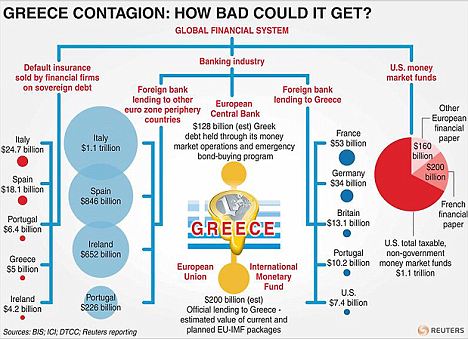
Today the 2 year greek bond reached 30% gross yield for the first time ever. Italy’s 10 year is now at 5.3%. Portugal 5 year CDS above 1000. The Euro debt crisis is in full swing. And apart from piles of leverage and out-of-control spending, the reckless subsidization and manipulation of power and gas markets has been partially to blame.

We are in July and the figures for energy demand are troubling, since they are a true reflection of the evolution of the economy and GDP.

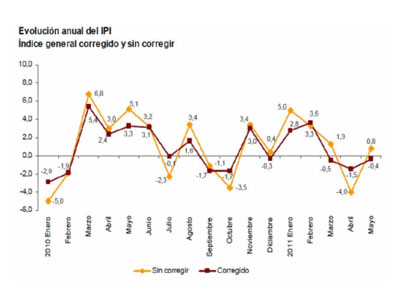
The numbers are frightening, mainly because except Germany and some Nordic countries the rest of Europe languishes in spite of the optimistic expectations of “recovery” announced with great fanfare in 2008. It is even more worrying to note that the effect of stimulus plans, which accounted for more than 3.5% of EU GDP between 2007 and 2009, not only have been dissipated, but industrial activity has fallen to levels similar to those of 2008. So all the EU is left with is the debt generated by those stimulus plans, but no significant effect on GDP.

According to Societe Generale, the demand for natural gas in the countries surveyed (France, Portugal, Spain, UK and Italy) in May fell 11.8% over 2010.The cumulative year 2011 shows a drop of 9.7% year on year. The demand for natural gas in Spain in the first half, including June, has fallen 1.9% compared to 2010.

As for electricity demand, the countries surveyed in Europe (France, UK, Italy, Belgium, Greece, Portugal, Denmark, Poland and Spain) show a decrease of -2.5% annual cumulative. Electricity demand in Spain in the first half remained relatively stable compared to 2010, but not growing.

2011070621IPI-2-DEFIn this environment, the EU launched its Energy Efficiency Directive, which, if approved, would force the electricity and gas sector to achieve savings in annual consumption equivalent to 1.5% of sales. This would result in an improvement in energy efficiency 20% by 2020. Another interventionist measure from our friends in Brussels.

The proposed directive contains very detailed and wide-ranging proposals but according to Eurelectric it’s easy to already identify some preliminary areas of concern and ambiguity:

. Administrative burden: The proposal adds further uncertainties in permitting and authorisation procedures, potentially deterring investments and resulting in additional costs to meet the EU’s energy-climate targets. One example is the ambition to pre-define a technology mix for electricity generation.

. Inconsistency with the third liberalisation package: Europe ha forgotten about liberalisation. Now it’s all about obligation and central planning, and the consumer will pay for it all (the cost could exceed €1 trillion including infrastructure). Many provisions (obligation on smart metering/billing or on energy storage) contradict the EU legislation currently under implementation.

. Subsidiarity in delivering energy savings: Market mechanisms are ignored in favour of Soviet-style planning, but also the conditions required to deliver energy savings vary between and even within member states, creating an obligation but also a difference in cost.

Screen-shot-2011-01-06-at-6.38.31-AM-e1294324806568

So on one side, systems are more inefficient, overcapacity remains, political intervention is forcing a pre-defined energy mix regardless of cost and feasibility, and at the same time demand is falling and industrial production remains weak.

And what is the problem? That if the GDP does not recover aggressively, the borrowing cost of economies grows, and given the voracity and debt demand of governments, industries get limited access to credit, just as we approach 2013, a year in which industrial groups have a higher concentration of debt maturities (2013-2014). And with more than €50 billion a year in subsidies in the European power systems, that the EU wants to triple, the cost of energy for industries and consumers will rise even with falling GDP, making countries less competitive.

If demand remains weak, overcapacity in the electricity and gas systems will not fall, just as Europe announces several incentives for investing in new capacity, from nuclear (in the UK, 10GW), wind (7GW pa) and solar (10GW pa), but also coal (Germany, lignite, 5GW planned). Investments that can be very valid in a process of displacement of other technologies, but the policy so far is to subsidize not only the “emerging” technologies but the “dying” ones too.

What is striking about the European Union that is so fond of  forced planning, intervention and patronizing the world on what to do is how it benefits on the industrial level from exporting to “polluting” countries like China or India and how it ignores the “externalization of pollution” that de-industrialization creates (as those same European industries move to other countries with less stringent environmental requirements). The pollution created by the thousands of tons of rare earths required for our high-tech and green lifestyle results in millions of tons of water polluted in China from the extraction process. The EU doesn’t care, but still patronises about CO2 and environmental policies.

Now the EU, in the middle of social revolts, austerity plans, budget cuts and a debt crisis, wants to increase its budget by 12%, three times the rate of inflation, after a 30% increase before. This also looks to increase the €126bn budget up to c€150bn in 2015.
The problem of the energy systems of the EU has not been liberalization, but intervention.

Interventionism means higher costs and mass subsidies, even to coal, for example (€1.5 billion in Spain only including direct subsidies and capacity payments), reaching the ironic situation of having countries where all the technologies are subsidized.

The liberalization of the electricity and gas markets between 1999 and 2004 brought the longest period of investments, improved infrastructure, service quality and better cost since the time of supply shortages of the seventies. It was then, as the EU ballooned in 2004, when governments decided to intervene, changing the laws in mid-game, subsidizing some technologies over others, restricting the free movement of capital, creating fictitious markets (like CO2) and generating capricious signals of demand and price through subsidies. And without risk, because either through tariffs or through taxes, planning errors have always been paid the consumer.

It is this devilish myriad of costs added to the final bills, and added to taxes, which in the EU are the highest in the OECD, what makes the final prices rise despite demand falls. The EU loaded the system with an infinity of small items, which always begin with the presumption of being “small”, but are slowly adding to the total bill. Capacity payments, restriction costs, ancillary services, subsidies…

The solution? Well, very simple. Market, market. If a coal-fired or gas plant must be reduced or disappear, so be it. If the price of electricity or the gas system that the EU has voted is expensive, the consumer should know clearly the cost of what is being promoted.

I am sure that if customers in Europe, suffering the austerity measures and cuts, knew that the cost of implementation of the so-called “low carbon economy” is conservatively €900bn, they would not be so happy.  

If we keep inefficient technologies based on subsidies and anti-economic measures forgetting the market, not only we will keep unnecessary overcapacity in the system, but the consumer will not see the advantages of the lower parts of the cycle.

Further read:

http://energyandmoney.blogspot.com/2011/06/state-of-fear-german-nuclear-shutdown.html

http://energyandmoney.blogspot.com/2011/06/co2-collapses-20-in-two-days.html#frameId=uWidget20a9e6e60130f5c6a6f0&height=130

http://energyandmoney.blogspot.com/2009/06/calling-bottom-on-power-prices-in.html