This will make you think twice about your long gold

This is an email sent by Cave Montazeri of Barclays Capital doing the rounds all over the market. Great piece and deserves to be read:”You could take all the gold that’s ever been mined, and it would fill a cube 67 feet in each direction. For what that’s worth at current gold prices, you could buy all — not some — all of the farmland in the United States. Plus, you could buy 10 Exxon Mobils, plus have $1 trillion of walking-around money. Or you could have a big cube of metal. Which would you take? Which is going to produce more value?” – Warren Buffett

Being a geek from the Golden State, I figured I ought to check those numbers:

Gold is traditionally weighed in Troy Ounces (31.1035 grammes). With the density of gold at 19.32 g/cm3, a troy ounce of gold would have a volume of 1.61 cm3. A metric tonne (equals 1,000kg = 32,150.72 troy ounces) of gold would therefore have a volume of 51,762 cm3 (i.e. 1.61 x 32,150.72), which would be equivalent to a cube of side 37.27cm (Approx. 1′ 3”).

According to the world Gold Council (www.gold.org), at the end of 2009, the total volume of gold ever mined was approximately 165,000 tonnes. That is equivalent to 8,540,730,000 cm3; or about 300,000 cubic feet, which matches that Warren Buffett said (“You could take all the gold that’s ever been mined, and it would fill a cube 67 feet in each direction”). At current price of gold ($1,361) that is a total value of $7.2trn

Exxon Mobil’s market cap is $340bn so 10 Exxon Mobils would cost you $3.4trn (for ease of computation this is assuming to takeover premium). Alternatively, for $3.4trn you could also take 100% ownership of ALL the following companies: Exxon Mobil, Apple, Microsoft, Berkshire Hathaway, Walmart, Google, Procter & Gamble, IBM, J&J, GE, AT&T, Chevron, JP Morgan, Oracle, Coca-Cola, Pfizer, Wells Fargo, Cisco Systems, and Intel

Finally on his last point, according to the USDA, there is 922m acre of farmland in the US, of which 406m can be used for crops (the rest includes woodlands, pastureland, ponds, wastelands, etc…) at an average price of $3,500 per acre; for a total purchase price of $3.2trn (for ALL the farmland)

So the math adds up: $3.4trn worth of S&P 100 companies (10 XOMs for example) + $3.2trn for all the US farmlands + some pocket change left to spend on ipads and parties. Good job Warren Buffett. I’ll buy some farmland REITs.

http://www.ritholtz.com/blog/2010/08/i-love-gold/

Has Cheap Gas Killed The Renewable Star?

cheap gas(This article was published in Spanish in Cotizalia on Oct 14th 2010)

I find it very interesting to see how in a globalized world, few have stopped to discuss the devastating impact that cheap gas has on the growth of wind and solar facilities, particularly in the U.S., and in turn the chilling effect posed by renewables on gas demand. However, companies on both sides, gas producers and renewable developers, are betting (praying, I would say) on electricity prices rising one day to generate acceptable returns again, even though the two sectors create a deflationary effect on prices. And without acceptable power and gas prices, investments are ruined. This is a war to see who loses more money, sooner and faster. In the European Union we are used to accept energy decisions that are not economically justifiable, as the decommissioning of nuclear power stations or coal subsidies, but in the U.S. this is not so easy.

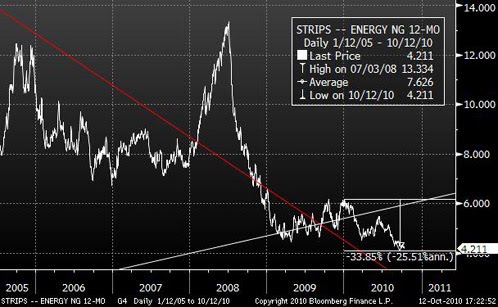
The plummeting of natural gas prices in the U.S. continues. Not only it has broken the support of 2003 (Henry Hub), but production continues to grow by 1.5% per year and storage is at historic highs, 3.750 bcf. Thus, the price falls inexorably, from the 2006-2007 average of $8/mmbtu to $4 today.

The revolution of shale gas and a much more efficient and economical extraction process, hydraulic fracking, has led to reach 250 years of proven reserves and see the unit cost of production fall by 33%. Thus all producers, from Shell to Petrohawk, continue to increase production despite falling prices. Now that revolution is coming to Europe, as we mentioned here (May).

Of course, there are differences in the different gas prices in the world. NBP, the English natural gas, for example, is trading at nearly $7/MMBTU equivalent as the Norwegians are closing the tap at the Langeled pipeline at a rate of nearly 30 million cubic meters per day to avoid overcapacity. Being an island also helps.

But the general trend in all markets is clear: Very low likelihood of increased natural gas prices as the market continues to have a surplus capacity of 13-15BCM (billion cubic meters) annually, which is estimated to continue until 2014. And the producers of liquefied gas from Qatar to Yemen, will not cut production at these prices because most investments were made (FID, final investment decision) with an estimated gas price of $1.5/MMBTU.

However, the effect of cheap gas is essential to understand the drop in wind power installations.

The issue is as follows:

a) The price of electricity is set in a marginal system, like the U.S.one, by the price of gas (mainly) or coal.

b) The price of gas depends mainly on electricity demand to go up or down.

c) New technologies, wind and solar, when they exceed a critical mass, generate deflation in electricity prices because they add new baseload capacity at a low price (ex-subsidies).

d) However, to see further growth in renewable installations with adequate returns, wind and solar power plants need to see a higher price of electricity, which they themselves contribute to cap. Currently wind farms cannot sign long term PPAs, power price agreements, due to very low prices. This is the deflationary impact of renewables. And if electricity prices do not rise to reasonable levels, they will still require subsidies to survive, creating a vicious circle. Does the right hand eat the left?

e) So if they are eroding demand for natural gas and coal to generate electricity, they cannot expect prices to rise unless the taxpayer pays for a minimum return.

In short, renewables are needed and gas as well, but as from a certain critical mass and percentage of the energy matrix onwards, both engulf the same hand that feeds their returns.

Given this scenario, deflation, the only way to improve returns is to remove capacity (“coal? it is virtually defunct) or create more demand for electricity that, due to increased efficiency, is not easy.

Or promoting the electric vehicle, but when oil demand falls, oh surprise, the price of gasoline falls as well and remains much more competitive than the electricity including subsidies and aids. Unless we use the xenophobic argument that we do not like the country that sells us the commodity. That’s another story

To close the circle, the fact that the price of this invented and surreal “commodity” created by bureaucrats in the EU called CO2 is at rock-bottom prices (at €15.6/mt, oh surprise, also due to falling demand for gas and coal) does not help, and as it doesn’t add significantly to the costs of thermal power, it breaks the deck. Numbers don’t add up.

Trying to force the displacement of baseload commodities and technologies forces a downward revision of price, thereby wiping out the marginal technologies. That’s why they are commodities, because marginal cost adapts to demand.

Returning to the U.S., as the price of electricity is well below the price required to make a wind or solar power plant financially viable, the U.S. administration gives no more subsidies. Why? Not for political reasons, as many say, but for reasons of price, cost and demand. States are unwilling to accept price unreasonable rate cases when gas is abundant and very cheap.

Large power companies are beginning to seriously worry about the low returns on their investments, given their high gearing levels. And they witness the negative effect of over-capacity in the profitability of their businesses. Who would have thought that the enemy to beat, fossil fuels, was in turn essential to maintain a minimum return for their investments. Meanwhile, gas producers, with very low debt, accept the market price, as they always have, and produce more in a traditional suicide strategy to stifle the opposite sector. Now they would all have to find a way to agree to ensure that overcapacity does not continue to increase.

The day, a few years ago, when the energy sector decide to bet on “ever-growing demand” and forgot that “control and management of supply” is paramount, was also the day when we started to see the growing “running to stand still” strategies that have caused so much damage to the sector. Because governments do not care whether companies shoot each in the foot as long as the energy bill goes down. But this downward spiral will not end until we see corporate bankrupcies. And we might see them sooner rather than later.
China and the Brazilian Oil Land-grab… A Bubble?

(This article was published in Spanish in Cotizalia on October 7th 2010)

The Repsol sale of 40% of its assets in Brazil to China’s Sinopec has generated some controversy in the media all week. And in several cases we have seen the term “bubble” used for the transaction.

China has a very clear objective, which is to secure its energy future and build up reserves in new frontiers, from Uganda and Nigeria to Iraq and Latin America. The war for natural resources. In 2009 and 2010 YTD, China has acquired over US$115bn in international oil and gas assets. And while some companies and the analyst community are surprised by the prices paid, we still see the shopping spree accelerating.

Sinopec has paid $7.1 billion for 40% of Repsol Brazil. This implies a “headline” price of about $ 15/barrel for the reserves, and the market compared this to the price of $5/barrel estimated for the value of the Brazilian assets in January and with the $8.50 per barrel paid by Petrobras to the Brazilian State for their new wells last month. “Bubble?” Let’s figure by figure.

For starters, the media has ignored the fact that Sinopec retains a 40% interest in the cash injected in to the IPO. So the net transfer to Repsol is 60% of USD7.1bn in return for 40% of contingent reserves of 1.2bn. So $4.3bn for 480mb or USD9/bbloe (or USD7.1/bbloe including the net risked exploration resources).An excellent figure for Repsol in any case .

Additionally, we should not confuse the value of assets within an integrated industrial group (the $ 5/barrel above) with its selling price if they are disaggregated. All oil majors are trading at a huge discount on their sum-of-the parts of its assets. For example, BP has sold $7 billion of assets to Apache at an average of $7.8/barrel. This does not mean that these assets should be valued within the BP group at these multiples. It is the historic conglomerate discount of 30-40% of all the mega-cap integrated oils.

Also we should not confuse the value that the Brazilian state uses to transfer assets to their flagship company, Petrobras, the $ 8.5/barrel, with a private transaction.

The Sinopec deal is justified from the perspective of other similar transactions made by Chinese enterprises and state-owned companies with a long term vision. Sinochem, China, paid Statoil $15/barrel for their Pelegrino assets in deep water Brazil in May, Sinopec itself paid $16/barrel for Addax, high risk assets in Nigeria, and KNOC, Korea, has paid $12.5/boe for Dana Petroleum, with much higher gas content, which is obviously less valuable than oil.

On the other hand, Chinese companies start with a much lower cost of capital assumption than their American or European competitors. The Asian giants do not have to worry about their debt, and, of course, have no need to pay enormous dividends like the integrated oils, that neither has served them to generate share price appreciation or to better compete in the M&A arena. China has plenty of capital and lacks natural resources to ensure its long-term supply.

Is this a bubble? No. It is simply a different use of capital and a longer term horizon. And it is not, moreover, for three reasons:

a) Oil assets are very scarce. To have a bubble we would have to see a risk that these assets were multiplied or fall dramatically in value, but, as stated in this column, we must take into account the scarcity value and the undeniable truth of the gradual decline rates of the oil reserves. Proof of this is the race that has been generated to participate in the 11 licenses for Iraq, where the companies (including China) will invest up to $200 billion in the next ten years accepting returns not exceeding 12%, and with an enormous political risk.

b) Unless we believe the demand for oil from emerging nations will collapse, the cost of access to natural resources is irrelevant compared to the risk of losing supplies or lose competitiveness. Oil reserves, therefore, should be seen as a cog in the huge Chinese machine. Oil is an “input”, and the relative price of these reserves does not make the total cost of “China Inc.” less competitive when the variables are planned in detail.

c) State-owned enterprises plan their projects with oil price assumptions that are higher than those used by the integrated oil sector, which is still planning at $40-50/barrel. Therefore, these companies are more than happy to have access to returns of 12-16% at $ 80/barrel.

As a friend of mine reminds me, China has a problem of too much cash, their US dollar stockpile is a perishable asset, and they can see value in oil assets above what assets are worth to others not only because they use a higher oil price, but because in any planning they use a sizeable revaluation of the Rmb.

In summary, while the European Union continue to waste time with pointless debates, instead of securing oil and gas reserves and diversify our access to natural resources, the rest are winning the war for natural resources. We’ll see if this is a bubble. I doubt it.

Iraq, A New Frontier And A Few Question Marks

IRAKWe’ve talked on other occasions of the difficulties that big oil companies find to grow. The reserve replacement ratio is still disappointing.

In my opinion, the true hope of the sector is Iraq, one of the largest proven oil reserves in the world, 145 billion barrels of oil, behind Saudi Arabia, with 264 and above Iran’s 138 billion barrels of oil.

Iraq is presently outside the normal OPEC system, which is based on reserves, and given it currently produces around 2.5mbd they have stated they will not discuss a quota until output reaches 4mbd (in line with Iran). So the increase in estimated reserves can be viewed cynically as a way of preparing itself ahead of an OPEC quota.

Currently the geopolitical environment has improved substantially. Service firms are established, but the risks are not negligible, with nearby local elections, conflicts with the Kurdish minority and the gradual withdrawal of U.S. troops. For example, it remains unclear if the city of Kirkuk, home to a giant oil field, belongs to the Arabs or the Kurds, which prevents investment there.

The local government has advanced rapidly, licensing 11 fields in the last year. After a false start in which the license auction was declared void (except the Rumaila field, BP-CNPC) because the conditions imposed by the government were too onerous, between the second half of 2009 and 2010 the government has auctioned licenses to operate up to 60 billion barrels in estimated reserves, with a national strategy to increase production from 2.5 million barrels per day today to a very ambitious target of 12 million. From BP, Shell, Statoil and ENI, to Russia’s Lukoil, China’s CNPC or Exxon, most big oil companies have participated in the process.

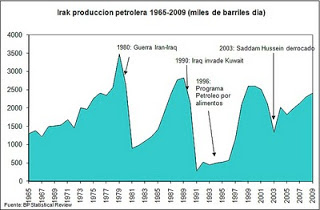
Iraq’s 11 deals with foreign companies should in theory help increase capacity to 12mbd by 2017. From my point of view, the goal of exceeding Saudi Arabia’s production is very ambitious. No one has managed to multiply by 5, as intended, the production of a country in 10 years. And Iraqi production hasn’t exceeded 3 million barrels/day since 1979. I think it’s much more logical to assume that production will rise to 3.5 million barrels per day in 2015, in line with the history of typical production recovery in this region (including Iran).

Of the reserve revision seen this week, the bulk of the increase comes from the West Qurna field, now thought to hold 43bn bbl compared to 21.5bn previously. Exxon signed the PSC for West Qurna development Phase 1, Lukoil for Phase 2. The next largest source of uplift is Zubair (up from 4.1bn to 7.8bn bbl), where ENI is leading the development consortium. On the flipside, Rumalia (BP-CNPC) was revised downwards slightly from 17.8 to 17.0bn bbl, and Majnoon (Shell) from 12.6bn to 12.0bn bbl.

And the problem now is the costs, estimated at $19/barrel (F&D), plus an additional fee of nearly $2/barrel. The contracts allow the oil companies to cover costs up to a minimum production level. Until there is a contract typical of the industry,within what is called a PSC(production sharing contract). And IRRs can vary significantly, but in most cases only surpass 16% if ramp-up is in a straight line.

But if minimum production targets are not met, oil companies will suffer from profits lower than the average cost of capital, or even losses. The Zubair field, won by ENI and their partners, for example, will likely generate an internal rate of return of less than 20% below $55/barrel, while requiring investments in excess of $20 billion over 20 years. In total, the capex will exceed $100bn, and a lot needs to happen in terms of services (still small relative local presence), infrastructure and administration (there is no real government to manage the process and give the approvals).

We see most of the rates of return for the companies involved in the Big Six Iraqi oil fields fall within the 10%-18% IRR range, with higher returns for the pre-existing PSCs and government-owned entities. The key Kurdistan operators get very high IRRs under the Kurdish PSC, which has much more favorable terms than the Iraqi TSC. However, the Kurdistan situation is less than clear, and Iraq still considers all these contracts illegal. It is very difficult to believe that the contracts will be validated after elections.

For Iraq, the increase in gross domestic product, infrastructure and wealth for the country that these projects, neglected or poorly managed so far, will generate, will be a giant leap for the country’s ailing economy. The investments to be carried out are astronomical, nearly $100 billion between 2009 and 2029, including infrastructure, water, schools, hospitals , almost the construction of entire cities. Consider that some of these fields require about 500 workers. And the fact that contracts are aggressive and costly conditions for oil is a minor problem, because for them it is probably the last opportunity to improve their low reserve replacement for once.

Update: Iraq reached 2.75 mbpd production in July 2011, the highest since 2003.