Where US Gas Prices Start To Be a Concern for Independent E&Ps

us gas (1)

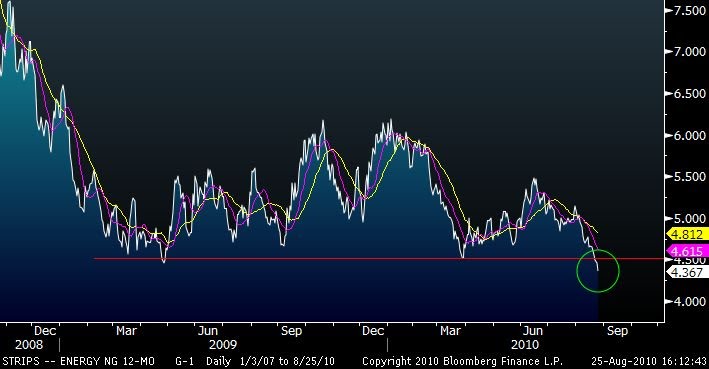
As I commented a few months ago, gas prices are at risk and have now fallen below $4/mcf on the Henry Hub 12 month strip, and we are at growing risk of a prolongued downturn in prices unless producer discipline is restored, as the weakness is occurring into shoulder season where marginal demand for power becomes very weak and its challenging to compensate the oversupply of gas by taking out coal of the merit order, so the risk is relevant until heating season. In the US total working storage is now at 3,052 Bcf versus the 5-year average of 2,875 Bcf and last year’s 3,250 Bcf level.

This is where finally I expect some producers to respond with a combination of capex cuts and asset disposals. This will drive prices back to more normalized $4.5/mcf levels. A few brokers are calling the seasonal nat gas trade this week (historically this is the low season for spot pricing which is what the equities trade off of). The only difference between this year and the last one is that the contango has weakened. This will make equities less reactive, but it will also make it less attractive to drill nonsensically and hedge as financial institutions will not be so keen when the curve flattens.

Yes, most of the independents claim to be the “low cost” producer, most will say they make money at $3.5/mcf, however, this is not 2008. On one hand, service charges have increased, and on the other hand, the benefits of scale achieved in the “fracking revolution” are becoming less apparent.

So in order to bring the market to balance we need to see a good cut to c62BCF/d from current 65-66BCF/d. I believe this environment will drive majors to look for M&A opportunities (they love their US gas acreage) and as such US gas independents are always a risk if you want to short them for more than 1-2 weeks. I would use this pull-back to play arbitrage winners (LNG) and look at those companies that remain disciplined, strong on balance sheet, low cost and well placed for M&A… and monitor the producer discipline very carefully. Unfortunately the rig count is not a good indicator any more (as we saw in 2009, rig count can drop severely and production still rises due to efficiency improvements). So it will all be about company messages.

One question to ask ourselves: What will Exxon do with XTO? Maximize production or be disciplined and look at high returns?. The new entity controls 15% of US gas production, and Exxon has been disappointing in results in the past four quarters. Surely sub-$4 gas is not ideal environment for mass growth in output for a company that prides itself in maximizing ROCE. I hope they will stick to that principle.

Salamander, a case of de-rating through exploration

Being an E&P the main catalyst for the company’s stock is its exploration campaign. However, when it comes to this, Salamander Energy has not had the greatest run.Out of 3 exploration wells dug by Salamander Energy in 2010, none were successful in finding commercial hydrocarbon flows.

Bang Nouan 1 well was spudded in April 2010 in Lao PDR. However, in May the company reported that the zones of permeability encountered in the primary objective were water bearing. All hopes were turned to the gas shows encountered in the secondary objective, which upon a well test, failed to be of commercial level. Thus, the well was plugged and abandoned in early August.

The next blow came from the high-risk Tom Su Lua prospect, Vietnam, where TSL-1X well was drilled. However, in late June the company announced that the well has been plugged and abandoned having failed to encounter any commercial hydrocarbon levels. It had been drilled to a total vertical depth sub-sea of 1,380mt and encountered both, potential seals and high quality reservoir sandstones, which were water-wet in the Tertiary clastic section.

The company then focused on drilling the THX-1X well on the Tom Hum Xanh prospect in Vietnam, 250km south of the TSL-1X well. Similar to its neighbour, THX-1X was announced a dry hole in late July and subsequently was plugged and abandoned as it failed to encounter significant hydrocarbons in the target reservoir sections. It is important to note that the acreage in Vietnam was previously unexplored and therefore was high risk.

The key risk to the share price is the company’s drilling results. Since the start of the year the company has drilled 3 wells, all of which have been subsequently plugged and abandoned as dry holes. Thus, the results of its next planned wells, Angklung and Dambus in Indonesia’s Kutai basin, are the key risks to the stock performance. Serica Energy, operator of Dambus, has assigned a 40% chance of success for the well, while Salamander Energy has estimated the geological risk for the Angklung at 24%. However, both wells are located in a heavily explored acreage, which already contains several producing wells.

Unsuccessful drilling campaign has cost the company in the loss of 40% of its stock value since the beginning of the year. However, although the stock is in a downward trend, it has not reacted greatly to the drilling updates.

The market’s reactions to the updates were positive. Thus, the stock rose on average by 2.00% on the day Salamander Energy plugged and abandoned its wells. Moreover, it seems that the market was reacting to the negative news a day before the announcement was made public. The company is currently trading at 34% above its core NAV (164p/sh) while E&A risked upside is at 116p/sh (632p/sh unrisked).

Overall, the Dambus well looks low-risk, while although the company claims the same about the Angklung, the failure of Unicol as well as the delay in project have put an increased risk on the prospect. Thus, the results of these 2 wells will be crucial to the future position of the company.

What the Dry Bulk tells us that markets might be ignoring

bdiy index

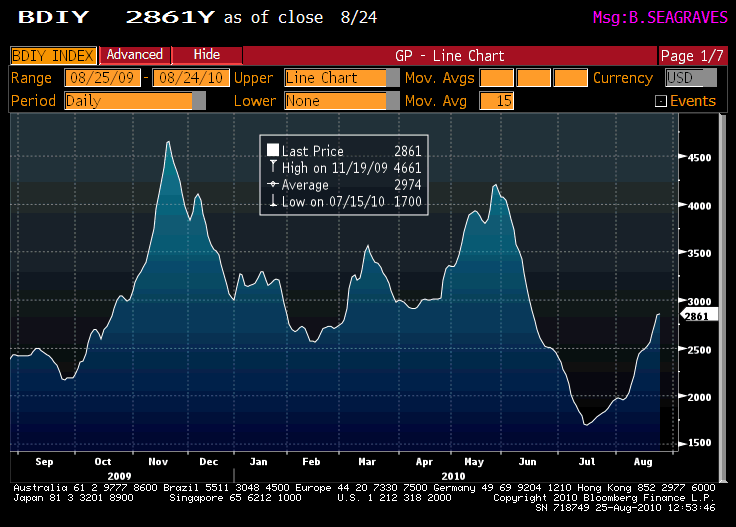
Dry Bulk is back to almost January levels. We have seen a consistent and improving number of datapoints pointing to a more bullish environment for exporting companies-countries and commodities. This is driven predominantly by movements ion oil and grain. Interesting that we have a combination of strength in dayrates (as pointed out below) and volumes (as Frontline mentioned yesterday, picking up 12% MTD). Mostly driven by Asia, as usual

In the Cape market the Pacific basin is particularly strong with some vessels being contracted at USD 12.25/ton for West Australia to China vs index of USD 11.8/ton. Data is from Pareto.

In the Atlantic charterers are bidding USD 28.5/ton and owners asking USD 29.5/ton for a Brazil to China trip vs index of USD 28.8/ton.

Brokers report of owners asking USD 60,000/day for a Fronthaul trip (Atlantic to the Far East).

In the Panamax market the Atlantic is the driving force with US Gulf grain drawing the most tonnage. Average Pmax TC rates gained 11.1% to USD 25,100/day in three weeks.

In general very positive for inflation (food in particular) and a pick up in exports in the year of the highest increase of new vessel availability since 1998.

The Debacle of Wind Turbine Manufacturers

(This article was published in Cotizalia.com on August 19th 2010)

I said it three weeks ago. Sell turbine manufacturers and buy wind developers. Turbine prices are plummeting, margins fall inexorably and the demand bubble, artificially created by the debt and subsidies of the OECD countries, has burst. And the only beneficiaries of this are the wind developers that centre on returns and not empire-building growth. They buy more turbines, cheaper and of better quality.

The turbine manufacturing industry is a great industry with great professionals and great engineers. But as an investment it is a disaster. It committed the sin of greed and the industry has been bloated with excess capacity for some time. Since 2006, the market has not seen anything but cuts to their own estimates for orders and margins. The industry positioned itself for excessive growth, undifferentiated returns and the hope that competition would never appear and are now paying the excess.

And it’s not a cheap sector in any shape or form. My readers who have access to Bloomberg can see that the stock market debacle has been entirely justified by falling estimates. And the sector is trading at 20x 2011 PER and average EV/EBITDA 7.5x. Not cheap at all for a sector that has proven to be more mature and cyclical than its managements and analysts would like to admit.

On Wednesday, Vestas, the largest turbine manufacturer in the world, fell 22% after they announced a downward revision of revenue estimates (for 2010!!) from €7bn to €6bn. The analyst consensus, who claimed that their average estimates were “conservative” (€6.7 bn), again had to slash estimates. This has happened six times in three years. The EBIT margin has been reduced by 50%, no less. Let us not forget that Vestas, like all turbine manufacturers, had given estimates for 2010 only a few months ago. And now they cut their estimates for this year … 50%. Then they say that it’s a temporary issue and that 2011 is fine. Again, something they said in 2007, 2008 and 2009. And some say that the market is speculative and short-term. Come on.

When a global leader is unable to estimate properly a year, THE CURRENT YEAR, how can they demand from us to make long-term valuations and investments? Come on. But what’s more important is that we are also seeing the cash flow fall and what is worse, a deterioration of the ratio of working capital/sales, which is what indicates the strength of the sector. Many firms take 20% WC/sales, which it is too risky,and shows that the industry is so desperate that they could be financing their own clients, in a downward spiral of financial weakness.

Gamesa, only a few weeks ago, further reduced, as it is almost a recurrent episode, its estimate of 2,700-3,000 MW of installations to 2,400-2,500, and their expectations for EBIT margin to 4.5-5.5%, compared with 6 -7% in January’s previous estimate. A very difficult process of adjustment to reality after the aggressive expansion plans and ludicrous expectations to compensate the falling Spanish business with Chinese and US growth.

As I told the CEO of one of these companies, who was asking what to do to mak the shares go up: “for once, please beat your own estimates. Simple.”

The turbine manufacturing sector faces three problems:

– The drop in demand, obviously. As I mentioned three weeks ago, the American green dream has faded. Expectations are for about 4 Gigawatt installed in the U.S. in 2010, less than half that of 2009. The European Union has very high electricity reserve margins. And the growth in renewables in other countries of the world is poor at best, and not enough to justify the “high growth sector” multiples. The bubble has burst.

– Production capacity is excessive. Turbine manufacturers themselves confirm that its plants operate at 50-55% capacity. This makes the need to reduce average prices to their remaining customers (10-12% decline in 2010, after a 12% in 2009) and compete aggressively with low margins. And what is worse, not only there have been no cuts in capacity, but it continues to increase both in European and America as well as Asia.

– Competition in the target market of China, which had been ignored with almost xenophobic arguments. “Not enough quality”, “customers do not trust them”, “European turbine prices can not fall and the Chinese have to accept it.” Well, Goldwind and Sinovel continue grabbing the Chinese market with prices 20% lower than European manufacturers, and what’s more improtant, better margins (12%).

The solution for the sector exists. “Shrink to greatness.” ROCE and margins. Easy. Reduce capacity, focus on margins, be less “engineers”, less empire-builders and more managers… And provide the market with realistic expectations. If we return to the bull market for renewable installations, and believe me, do not expect it, they will generate higher margins, better cash and have sustainable and profitable businesses. If the bull market does not come back, and it isn’t, they will be able to generate solid returns and correct the gradual and painful decline that we have seen since 2007. And do not cling to offshore as a salvation, as it’s more costly, less efficient and riskier… But, what’s most important, as replicable and technologically undifferentiated as onshore.

In an industry where the cost of replacement is reduced in absolute and relative terms every year as the technology is affordable and easy to replicate, basing a business on volume growth is crazy.

Turbine manufacturers should learn from the oil services sector, who suffered the lesson in the 80s when the same “GROWTH FOR GROWTH” and overcapacity issues occurred. Acciona, for instance, has seen this happening for some time. Its turbine manufacturing division is now a mere chain in their renewable business, which allows it to be integrated and manage the total cost in the projects it builds. Indeed, it does not provide the company any higher valuation, but at least they manage the business based on real internal demand, not on unachievable global growth expectations. Gamesa and Vestas have a tough road ahead. But a fascinating one nonetheless. As stocks, still a space to avoid except for very (VERY) short term beta trades. And to me, beta is better found elsewhere.