Unemployment inflection

From one of my colleagues:

As of today, looks like the unemployment rate peak is behind us, and this long disastrous road of job losses that started December 2007 has ended. Job creation and job attrition look about flat. Unemployment would be able to fall naturally in the future without adding jobs because unemployment benefits run out and long-time unemployed people stop filing or reporting data–this is a data quirk, not necessarily a big positive per se.. Further, in the next 3 months, we get the once-a-decade US census hiring, which can be several hundred thousand jobs (though lined out by economists). All eyes are pointing now to expectations in June-Aug employment.

Combined with ISM’s running >50 for 7 months, global GDP coming in strong, and leading indicators running well above average (though maybe already having peaked on the recovery), seems we are in for slightly better economic picture than expected a few months ago.

Gotta be bullish for oil prices, as well as many globalized commodities. Goldman reporting US power demand running slightly above expectation in the US already, that may continue now, but admitedly its rather a shallow recovery (
Interest rates not really reacting to this data, except modestly on the front end. Further risks remain: the double dip on housing activity appears a growing risk, and end of March marks the completion of the Fed MBS purchasing program (read: mortgage rates will move higher). The sheer magnitude of bank write-downs coming on home mortgages is really just getting warmed up (the Fed kicked that can down the road, and we’re near the cul-de-sac). No idea how Fannie/Freddie even function post Fed purchasing program, they can’t warehouse all these mortgages and the banks aren’t holding new ones at all (85% securitization to Fannie/Freddie last year!)

So + industrial activity, slowly moving inflection on employment (but loads of slack to keep wages low for a while), and – on banking sector, lending. Seems that is a net/net positive environment for commodities and equities, neutral for bonds.

Energy Independence? An Impossible Objective

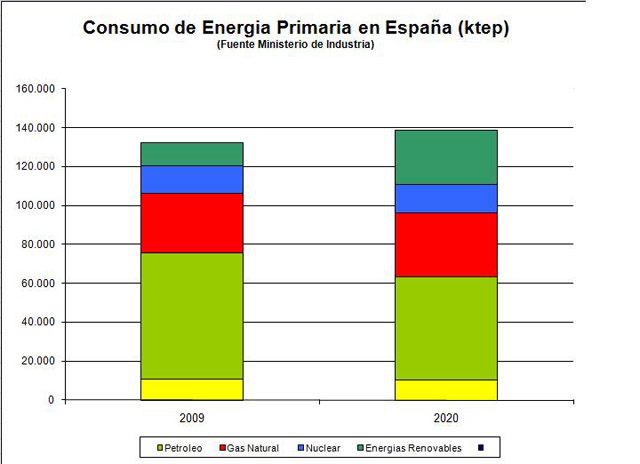
energía primaria españa640x
(This article was published in Spanish in Cotizalia.com on March 4th 2010)

For several months we have been listening to our governments talk of the goal of achieving the so-called “energy independence”, defined as absence of outsourcing of energy supplies given energy dependence on countries that are”not friends”, mainly the Middle East, is “bad” for the economy and security of supply. Truly outrageous.

Just looking at the different energy plans of OECD countries allows us to realize the political and strategic error of using aggressive rhetoric against producing countries. Indeed, the most optimistic of predictions of installation of renewable energy will not reduce the use of fossil fuels aggressively.

In Spain, for example, a country leader in renewable energy, we continue to import 1.1 million barrels a day, and the Government in a document published on March 1, estimates that in 2020 oil will remain at 38% of primary energy consumption , and natural gas by 23%. At European level the figure is very similar, 40% and 26%.

A study by Richard Heiberg (“Searching for aMiracle”) for the International Forum on Globalization, states that “Present expectations for new technological replacements are probably overly optimistic with regard to ecological sustainability, potential scale of development, and levels of ‘net energy’ gain — i.e., the amount of energy actually yielded once energy inputs for the production process have been subtracted”

This is not to deny or attack the innovation and the importance of alternative energy, essential to meet the needs of a globalized world where per capita energy demand in non-OECD countries will grow from 5 barrels of oil equivalent per day to 25 barrels equivalent per day in twenty years. Moreover, the argument of the gradual depletion of nature reserves is valid, although on a longer timeframe than some “peak oil” theorists would like to believe. This is about warning of the economic and strategic risks of this policy of negative rhetoric and to avoid losing competitiveness.

Economically, aiming for energy independence is not justifiable in the long term. The alternative energy bill in the EU exceeds $180 per barrel equivalent and is now between 1.7 and 2.3% of GDP in various OECD countries, considering only subsidies and grants. In its energy plan, the Spanish government estimates an additional cost from renewable subsidies of between €3.66bn and €7.42bn in 2011 (the equivalent of the entire country’s oil imports at $100-190/bbl). In addition, the wind blows when it wants to and solar is not viable as an alternative in a massive scale. Of course, hydropower is not enough either because it is also unpredictable. And at this point it is pointless to even think about building nuclear plants to fill the gap in fossil energy because it would be impossible to achieve in at least 65 years.

The Spanish Ministry of Industry in its plan published on March 1st says the following about the extra cost created by the need to increase premiums on alternative energy:

a) It does not quantify the benefits in employment, which has not been demonstrated in a country that builds 1.5 GW per year, where the alternative energy sector suffers from overcapacity and has virtually the same employees as in 2006),

b) It improves the balance of payments, which is not evident either since the technologies are predominantly foreign, so we switch from paying to producing countries to pay to Vestas, Siemens, First Solar and General Electric,

c) Benefits in CO2 reduction, which has not been proven either as the countries have barely reduced their emissions and continue to subsidize domestic coal and lignite.

Therefore, the only way to justify the extra cost is to estimate an annual GDP growth above 3% between 2010 and 2020. Scary.

Strategically, the impossibility of sharply reducing imports of fossil fuels, even assuming increased efficiency of 1.5-2% annually, as estimated by the US Secretary of State for Energy state, makes the rhetoric of “independence” highly dangerous. It does not seem advisable to me to “threaten” our suppliers and partners when the most optimistic outlook for the OECD countries continues to envisage between 30 and 50% of our primary energy consumption from fossil fuels. Additionally, the argument that the suppliers of oil, coal and gas are not reliable is not acceptable and. Pure economic xenophobia. There has been more interventionism, nationalism, supply cuts and interconnection problems among European countries and the US than nationalization in Venezuela, Bolivia or Iran. As an example, Spain has suffered decades of supply cuts from France and never one issue with Algeria. The UK has had more issues with gas supplies from Norway than from any Middle Eastern supplier.

I find it ironic to hear our governments demand from producing countries more investments, more contracts for our companies and more production while we threaten them with tendentious arguments about energy independence. Russia, India and China are betting on all forms of energy while still bet on the importance natural resources. Meanwhile in other countries we can continue to argue in favor of energy independence, but we are shooting ourselves in the foot. Just wait and see.

A Short Term Outlook For Gas Prices: Russia Calls The Shots (Again)

Gas prices have held up well, in part on the prolonged cold spell. However, in absence of weather support, by the summer prices will have to be lower in order to take the rise in LNG and Russian gas (161BCM) expected.

It is widely recognized that there’s a big build in LNG supply coming (extra 8bcf/d from the summer, ie three-quarters of UK consumption)) and that Gazprom is planning to increase its sales to Europe (by about 2bcf/d over the year = 20% of UK demand).

So likely that European gas storage will be filled relatively early. Unfortunately, storage levels are still relatively high (equal to almost 3bcf/d of extra supply if returned to normal levels over 3 months). Nevertheless, should storage still close to current levels rather than drop to 25-30% fullness, that would add 9bcf/d to demand over the next 3 months.

Economic recovery may lift demand, and Spain has started 2009 with January consumption up 4.2%. However, the industrial production is still more than 10% below 2008 levels.

The big mover for LNG would be a recovery in Japan, which looks encouraging even when industrial production is still 20% below 2008. South Korea and Taiwan are picking up but together these two countries are only half of Japan’s LNG demand.

Last year, in Europe, Gazprom’s gas buyers sharply reduced volumes early in the year. These are huge numbers – about 14-15bcf/d (ie almost the entire consumption of the UK and Germany combined). This was a”no-brainer” for the gas buyers. Their contracted price is based on oil prices with a 6-9 month lag. So deferring gas take until later in the year meant the gas would be cheaper.

Going forward, it looks likely that gas prices now are close to the lowest level for the year. Hence, the buyers are likely to want to take the gas now (saving about $2-2.5/mmbtu).

As a result of coal’s decline, gas at higher prices would no longer be the preferred fuel for generating power in the UK (where most of the swing occurs between coal and gas).

• Coal has come down as concern surfaced about the extent of policy tightening in China. The Australian coal price has been hit hardest, but clearly this has been the driver for South Africa (and European) coal over much of the past year.

• Marginal generation costs in the UK now favour coal dispatch.

So, gas prices will have to drop (or coal prices have to rise) in order to stimulate enough demand to take the Russian gas. Coal market fundamentals look positive once the trend of Chinese coal import data post-tightening is evident in 1 month time. So near-term, the market balance is more likely to be brought back into balance by falling gas prices enhancing power station competitiveness (along with Europe maintaining high storage levels over the summer), but more expensive coal and lower Russian gas might balance the equation.

So the x factor to bring gas markets to balance is Russia. Unless Gazprom allows a smaller off take, there could be as much as 10bcf/d trying to find a home in the UK/European power sector over the coming 3-6 months. That’s too much for UK/Europe to absorb; so up to 5bcf/d could end up headed for the US. I struggle to believe Russia will work on volume alone given they have a 6% decline in the base. If they allow a lower off-take, US pricing won’t get dragged down in this environment.

The current forward curve has Henry Hub some $0.5/mmbtu above UK’s NBP, so there is not much scope for UK prices to drop without impacting LNG flows and depressing US prices.

In summary, the picture is not that oversupplied if Gazprom volumes (161BCM) include storage and some level of flexibility. Chinese coal buying might keep gas prices more competitive than coal for power generation, and we are seeing LNG projects delayed (Shtockman, Australia) or sending lower volumes to Europe (Yemen). Looks like the picture of oversupply that the market discounts is too extreme. Not that my view will imply gas price appreciation, but the massive downside predicted by some looks less evident to me.

Can Spain afford to be "green"?

(This article was published in Spain’s Cotizalia on February 11th 2010)

What timing. After months preparing for a trip to Madrid, I arrived on Thursday 4th, amid the market and debt debacle. A day after the market crash and four days before the presentation of the Spanish Secretary of State for Economic Affairs here in London. The macroeconomic forecasts “from -0.3% GDP growth in 2010 to +3% in 2012 by doubling the exports” worry me. What country will Spain double its exports to in two years with the Euro at all time highs and competitiveness at historical lows?

I have the luck or misfortune of following the economy of 58 countries. What country in the world is forecasting to increase its imports from Europe between 2010 and 2011? No idea. And above all, how can Spain take away market share from other exporting countries in an environment of aggressive competition?

Amid all this, people wonder why the markets fell and different articles comment on the role of “short speculators”. Too bad no one called us “long speculators” or “saviors of enterprises requiring capital increases” in 2009.

Going back to the Spanish Government presentation… Imagine the CEO of any publicly traded company which had breached the consensus estimates for three years in a row submitted such bullish growth plan and think how much his companies shares would drop. Obvious.

Fortunately, my meetings on Friday left me much calmer. The companies are doing their homework and, as always, it will be the private sector which will rescue the economy. I hear no one expects a quick economic recovery and corporates, which are close to the customer and the export industry are preparing themselves for several years of less than modest growth. I hear excellent plans to cut costs by 30-40%, diversification efforts and, above all, restraint in capex and debt control.

And in this day an issue did pop up constantly. In Spain there is little more that can be done in infrastructure and renewable spending for a few years. The drastic cut of the civil works and infrastructure spending is imminent. Spain has invested in infrastructure like an emerging country, but with the demand of a mature market, and now it has an enormous excess capacity while it needs to digest, and pay, the national debt increased through a stimulus plan that brought debt to GDP to 11% devoted to infrastructure and civil work with no returns, ie spending that generates debt but does not generate GDP.

In this environment, power prices are at historic lows due to overcapacity and lack of demand, and yet the fact that renewables account for 40% of the electricity generated in some days make the premiums for these technologies (especially solar) to generate a tariff deficit of between €1bn and €1.2bn, a bill that is transferred to future generations.

This deficit is generated by the monstrous deception that is to have a government that raises electricity tariffs by a maximum 3-4% annually in one of the countries that pays less for electricity in Europe, while the real energy costs, including renewable premiums, is much higher. And this then becomes debt, owed to the power companies, that must be placed in the market to be securitised… And we have spent many months waiting for the tariff deficit securitization while the figure of debt rises month after month, which is unacceptable and introduces even more uncertainty in the power stocks. This is the national problem of Spain: to fix it all with debt, and now the bubble of debt is almost unbearable. The government has to refinance €60bn, saving banks and autonomous regions €150bn, etc … Let’s see just what kind of spreads will be required to place this paper.

Spain’s GDP is approximately €1.06 trillion, premiums for renewables account for 6 billion euros, 0.6% of GDP, and the accumulated tariff deficit is 11 billion, or about 1% of GDP. Additionally, the tariff deficit expected for the next two years is an additional €4 billion. Spain, at the same time, wants to install about 5,000 additional megawatts of wind generation and other 2,300 megawatts of solar by 2012.

Well, friends, do numbers. Either the government passes the real tariff to the consumer, which is unlikely given there is a 20% unemployment, or the bubble and its financing becomes unsustainable and with it the green economy model. Green energy costs. Let’s face it. Now it’s time to face whether the green energy model is sustainable in a weak economic and high debt environment.