The Oil Services Sector Continues to Show Recovery Signs

Tecnicas Reunidas

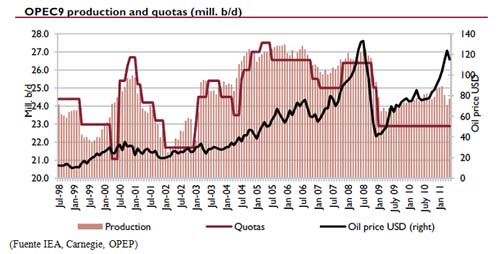
(This article was published in Spanish in Cotizalia on Thursday 2 Sep 10) The above graph shows the E&P spending in Europe, North America and Emerging Markets in $m.

If there is a sector that has surprised the market in the energy world this August it has been the oil services one. Not to us, as we already anticipated in March a very favourable environment for selected stocks in a highly fragmented sector, each in its speciality, such as Petrofac, Seadrill, Amec and Tecnicas Reunidas. And indeed, companies have shown an ability to increase margins and order book in a difficult macroeconomic environment. And in a sector,oil & gas, which is one of the worst performers of 2010 (deservedly, as we have explained on several occasions), these stocks are showing their relative strength.

And make no mistake, the environment is still difficult. Despite the overall increase in investment in exploration, production, refining and development the service sector still suffers from excess capacity in some of its segments (deep-water drilling, due to the ban at the Gulf of Mexico, or seismic and seamless pipes, for example) . The oil services industry, on average, still works at 65-70% capacity, but there are companies that take advantage of this situation to gain market share and increase margins at the same time. How is this done? Thanks to historical better cost control, better execution of projects, specialization and focus on improving returns.

When companies do not not commit excesses in the top of the investment cycle and focus on a segment of highest profitability and best suited to their technical strength, is when you get to have a winning combination at the bottom of the cycle. Petrofac, for example, increased its order book between 2007 and 2008 with investments in the oil sector, its customers, falling by 12%. Now that the big oil companies expect to increase investments by 13% and 12% in 2010 and 2011, companies that lived the crisis as winners are ready to generate superior returns. So a company like Seadrill, which specializes in drilling platforms, can pay dividend yields of 10% and still deliver backlog growth.

The services sector is an indication of the anomaly we see in the market. Large companies are swimming in cash, generating good returns and reducing costs, so their ability to invest through the cycle has improved significantly from previous troughs. However, the market is still seeing more risks than rewards despite this. Furthermore, NOCs (national oil companies) are in a much better position financially than the international quoted peers and do not need to preserve cash to pay gigantic dividends, so this allows them to invest more and more aggressively through a down cycle.

What is the main risk to the sector? Obviously a slash in investments in the oil sector. The two main drivers would come from either new episodes of drilling bans as Macondo (that affect the entire capex chain), or from oil price (and therefore revenue) falls. If oil prices were to drop below $60/bbl it would cause the cash surplus in the oil sector to shrink to a level where we would see significant cuts in investments. In my view, this could mean going back to 2008 levels of capex, and possible renegotiation of conditions and margins with service companies. But 2008 also taught us that it is very difficult to reduce these investments well below the $200 billion annually, and that costs are sticky throughout the chain as projects become more complex, larger and more labour intensive. And labour remains a big challenge in the industry, as skilled professionals are still relatively scarce. And if we consider the cost of developing Brazil, Iraq, Greenland, East Siberia and West Africa, the five frontiers of the future for the sector, it is very difficult to predict a negative environment for service companies in the key niches.

In August we have seen the oil sector fall 1.2%, 13% annualized. Meanwhile, Petrofac has risen 45% in 2010, Amec by 16% and Seadrill by 5%. Amec, an engineering and project developer from nuclear and renewables to oil, published results 8% above consensus and raised its margin expectations for 2010. Petrofac, which specializes in large engineering and construction projects, increased results by 52%, 7% above consensus and broke its own record of order intake. Seadrill, key company to look at for its exposure to drilling, published results 6% above consensus and improved margins, with the market for premium jack-ups continuing to show relative strength as the utilization of such units remains above 90% with dayrates around 130k$/day, and in the underwater market getting $450-495k/day, a negligible drop from the 2006-07 peak of day-rates.

On top of this we are seeing consolidation coming back. This underpins an environment in which it will be difficult for large companies to try to negotiate costs down, as the most inefficient players are absorbed and the industry re-focuses. If we add that Brazil will spend $224bn in the next years to develop its offshore fields, it is difficult to see a sustained environment of overcapacity.

With minimal debt and 13x PE 2011 average, a 9% discount compared to average cycle multiples of the sector, the services industry looks still relatively cheap, and in a relevant number of cases consensus has to raise estimates for 2011 and 2012 between 4% and 7%, just as the investment process resumes its cruise speed . So, as we said in March, look at companies that can increase orders and margins, well capitalized and with low costs. They will continue to surprise.

Where US Gas Prices Start To Be a Concern for Independent E&Ps

us gas (1)

As I commented a few months ago, gas prices are at risk and have now fallen below $4/mcf on the Henry Hub 12 month strip, and we are at growing risk of a prolongued downturn in prices unless producer discipline is restored, as the weakness is occurring into shoulder season where marginal demand for power becomes very weak and its challenging to compensate the oversupply of gas by taking out coal of the merit order, so the risk is relevant until heating season. In the US total working storage is now at 3,052 Bcf versus the 5-year average of 2,875 Bcf and last year’s 3,250 Bcf level.

This is where finally I expect some producers to respond with a combination of capex cuts and asset disposals. This will drive prices back to more normalized $4.5/mcf levels. A few brokers are calling the seasonal nat gas trade this week (historically this is the low season for spot pricing which is what the equities trade off of). The only difference between this year and the last one is that the contango has weakened. This will make equities less reactive, but it will also make it less attractive to drill nonsensically and hedge as financial institutions will not be so keen when the curve flattens.

Yes, most of the independents claim to be the “low cost” producer, most will say they make money at $3.5/mcf, however, this is not 2008. On one hand, service charges have increased, and on the other hand, the benefits of scale achieved in the “fracking revolution” are becoming less apparent.

So in order to bring the market to balance we need to see a good cut to c62BCF/d from current 65-66BCF/d. I believe this environment will drive majors to look for M&A opportunities (they love their US gas acreage) and as such US gas independents are always a risk if you want to short them for more than 1-2 weeks. I would use this pull-back to play arbitrage winners (LNG) and look at those companies that remain disciplined, strong on balance sheet, low cost and well placed for M&A… and monitor the producer discipline very carefully. Unfortunately the rig count is not a good indicator any more (as we saw in 2009, rig count can drop severely and production still rises due to efficiency improvements). So it will all be about company messages.

One question to ask ourselves: What will Exxon do with XTO? Maximize production or be disciplined and look at high returns?. The new entity controls 15% of US gas production, and Exxon has been disappointing in results in the past four quarters. Surely sub-$4 gas is not ideal environment for mass growth in output for a company that prides itself in maximizing ROCE. I hope they will stick to that principle.

Salamander, a case of de-rating through exploration

Being an E&P the main catalyst for the company’s stock is its exploration campaign. However, when it comes to this, Salamander Energy has not had the greatest run.Out of 3 exploration wells dug by Salamander Energy in 2010, none were successful in finding commercial hydrocarbon flows.

Bang Nouan 1 well was spudded in April 2010 in Lao PDR. However, in May the company reported that the zones of permeability encountered in the primary objective were water bearing. All hopes were turned to the gas shows encountered in the secondary objective, which upon a well test, failed to be of commercial level. Thus, the well was plugged and abandoned in early August.

The next blow came from the high-risk Tom Su Lua prospect, Vietnam, where TSL-1X well was drilled. However, in late June the company announced that the well has been plugged and abandoned having failed to encounter any commercial hydrocarbon levels. It had been drilled to a total vertical depth sub-sea of 1,380mt and encountered both, potential seals and high quality reservoir sandstones, which were water-wet in the Tertiary clastic section.

The company then focused on drilling the THX-1X well on the Tom Hum Xanh prospect in Vietnam, 250km south of the TSL-1X well. Similar to its neighbour, THX-1X was announced a dry hole in late July and subsequently was plugged and abandoned as it failed to encounter significant hydrocarbons in the target reservoir sections. It is important to note that the acreage in Vietnam was previously unexplored and therefore was high risk.

The key risk to the share price is the company’s drilling results. Since the start of the year the company has drilled 3 wells, all of which have been subsequently plugged and abandoned as dry holes. Thus, the results of its next planned wells, Angklung and Dambus in Indonesia’s Kutai basin, are the key risks to the stock performance. Serica Energy, operator of Dambus, has assigned a 40% chance of success for the well, while Salamander Energy has estimated the geological risk for the Angklung at 24%. However, both wells are located in a heavily explored acreage, which already contains several producing wells.

Unsuccessful drilling campaign has cost the company in the loss of 40% of its stock value since the beginning of the year. However, although the stock is in a downward trend, it has not reacted greatly to the drilling updates.

The market’s reactions to the updates were positive. Thus, the stock rose on average by 2.00% on the day Salamander Energy plugged and abandoned its wells. Moreover, it seems that the market was reacting to the negative news a day before the announcement was made public. The company is currently trading at 34% above its core NAV (164p/sh) while E&A risked upside is at 116p/sh (632p/sh unrisked).

Overall, the Dambus well looks low-risk, while although the company claims the same about the Angklung, the failure of Unicol as well as the delay in project have put an increased risk on the prospect. Thus, the results of these 2 wells will be crucial to the future position of the company.

What the Dry Bulk tells us that markets might be ignoring

bdiy index

Dry Bulk is back to almost January levels. We have seen a consistent and improving number of datapoints pointing to a more bullish environment for exporting companies-countries and commodities. This is driven predominantly by movements ion oil and grain. Interesting that we have a combination of strength in dayrates (as pointed out below) and volumes (as Frontline mentioned yesterday, picking up 12% MTD). Mostly driven by Asia, as usual

In the Cape market the Pacific basin is particularly strong with some vessels being contracted at USD 12.25/ton for West Australia to China vs index of USD 11.8/ton. Data is from Pareto.

In the Atlantic charterers are bidding USD 28.5/ton and owners asking USD 29.5/ton for a Brazil to China trip vs index of USD 28.8/ton.

Brokers report of owners asking USD 60,000/day for a Fronthaul trip (Atlantic to the Far East).

In the Panamax market the Atlantic is the driving force with US Gulf grain drawing the most tonnage. Average Pmax TC rates gained 11.1% to USD 25,100/day in three weeks.

In general very positive for inflation (food in particular) and a pick up in exports in the year of the highest increase of new vessel availability since 1998.