China, Exxon and the war for resources

ep valuations

Graph above shows the valuation of independent E&Ps (EV/Core NAV) compared to Brent.

(Published in Cotizalia on November 19th 2009)

What an incredible week. Warren Buffett buys $60 million in Exxon shares, the independent E&P stocks (Dana, Dragon) rose to near-all-year highs on takeover speculation and we witness the evidence of what PetroChina said recently: the war for natural resources has only just begun. And the EU is losing.

While large European oil companies still fail to know what they will do to keep their businesses afloat if prices fall $1 or $2/bbl, the world is experiencing a revolution. So far in 2009, China has invested $16.5 billion to acquire oil assets. And what some disdained as excessive valuations has proven very reasonable, as PetroChina, Sinopec and CNOOC have demonstrated an exquisite discipline buying, but also by refusing opportunities.

Following are the Top-10 acquisitions by Chinese companies in the oil and gas sector so far in 2009. (Billions of US dollars)

RANK VALUE ACQUIRER TARGET

  1. 7.15 Sinopec Addax Petroleum Corp
  2. 3.30 China National PC OAO MangistauMunaiGaz
  3. 1.73 PetroChinaAthabasca Oil Sands
  4. 1.30 CNOOC, SinopecBlock 32 Offshore, Angola
  5. 0.93 China Investment CKazMunaiGas Expl & Prodn
  6. 0.87 Sinochem ResourcesEmerald Energy PLC
  7. 0.41 Petrochina South Oil E&D Co Ltd
  8. 0.31 CNOOC Talisman Energy Inc (gas)
  9. 0.27 XinjiangNew Energy
  10. 0.13 XinAo Gas Holdings Various oil reserves

You see, Europe’s efforts to invest in alternative energy and the electric car are very laudable and very necessary, but also very expensive, and even in the best case we should not lose sight of the importance of increasing access to natural resources . Especially when the International Energy Agency estimated that the use of electric vehicles in 2050 will not reach 35% of the worldwide fleet.

For me the problem is that the major oil companies are losing the best chance they ever had to buy relatively cheap assets and businesses in the OECD (see graph). For years we heard from Big Oil that E&P companies were too expensive, that they should wait for lower valuations to acquire assets. But that moment came in 2009, with the big oil companies full of cash and independents trading at historical lows … and they missed it.

However, China is demonstrating belief in the value of increasing its resources. But Exxon is now armed and ready. It has already placed a bid, rumoured at $ 4 billion for the assets of Kosmos in the Jubilee field in Ghana and continues to pursue attractive assets. As Rex Tillerson said, the company does not pursue crazy acquisitions, does not invest in political occurrences or areas that do not generate superior returns. And history shows it in their focus on the core business, a return on capital employed of 35%, share buyback of “only” $ 55 billion between 2008 and 2009 ($ 2 billion this fourth quarter!) And no debt, $2.9 billion net cash.

As Warren Buffett, Exxon knows that investing in cyclical assets with high debt clouds the ability to create long term value. And that’s what Warren Buffett has bought: a dirt-cheap stock, as he pays the total resources (72 billion barrels) at $4/bbl and pays zero for the chemical and refining businesses … but especially with the option to grow and buy without destroying the balance sheet.

In 2010 the figure of mergers and acquisitions, according to several companies and analysts, will reach $35 billion and may exceed $50 billion. Between PetroChina and Exxon they already have more reserves than all European listed companies together. The large integrated oil companies from France’s Total to Russia’s Rosneft, are unable to replace their reserves. 80% of global proven reserves are held by the producing countries. The little, very little that is left available, the independent companies with high exploration potential, will gradually fall inexorably. Those companies that lose this opportunity should not complain afterwards.

Happy Birthday, Oil

(published on August 28)
The modern oil industry began as a result of the search for inexpensive lighting. Until 1859, most people obtained artificial light by burning animal fats in the form of beeswax candles or whale oil.
In order to take advantage of the high prices of illumination, a group of investors hired a railroad conductor named Edwin Drake to head to a location close to where traces of crude oil had been observed on the surface. After a nervous few weeks in rural Pennsylvania, Drake struck oil on August 27, 1859. The 69 foot deep well on a salt dome rock formation yielded around 15 barrels a day.
The petroleum that flowed from this well in what became known as Oil Creek, near Titusville, Pennsylvania, started the modern oil industry we know today (oil had been produced in other parts of the world, but the Titusville well kicked off industry on a large scale).
The new industry was gradually consolidated and monopolized by the Standard Oil Company. In 1911, Standard Oil was split by anti-monopoly legislation into several competing firms. Esso (“S. O.” for Standard Oil), which later became Exxon and then ExxonMobil, remains the most well known of the Standard Oil children and the largest company in the S&P 500.
A few statistics:
Global oil production reached its highest figure in 2006.
Two companies, Exxon and Petrochina, control more oil and gas reserves than the entire rest of the quoted oil and utility companies.
OPEC and Russia control 77% of global oil reserves (including oil sands).
In 1991 global years of demand covered by proven reserves was 15 years. In 2009 it is roughly 12.
In 2009, c$198 billion will be invested in E&P to produce c81,820kbpd (oil). The highest figure (inflation adjusted) ever spent.
In 2008 global proven reserves fell 0.2% despite the addition of Tupi to proven status. Global reserve replacement ratio has been below 100% since 2004.
Global oil discoveries have declined steadily since the early 1960s despite periods of high prices and advances in exploration and production technology. The deficit has grown such that around the world we are now consuming roughly three times the amount of oil we are discovering each year.
The discovery deficit is now so large that the IEA estimates an equivalent of six additional Saudi Arabias need to be found and developed, requiring cumulative investments of US$26 trillion, to meet its expected 2030 global oil demand.

Before we start worrying about US Oil demand again… Non-OECD is the key

DOE data trading is starting to be both irrelevant and more importantly, dangerous. We are seeing oil price swings on a weekly basis worried about US demand. That should not be the focus. US demand peaked, according to Rex Tillerson in 2005 and OECD demand in 2006. This is also very logical given that oil production from OECD countries has been declining since 1997 and is now way below 23% of the world production. Therefore, it is normal that OECD demand tops out and declines as we see the effects of efficiency, maturity, saturation of the credit bubble model and Obama’s beloved electric car (the one we will all be forced to buy at $60k a piece).

Meanwhile, Non-OECD consumption grew from 40% of the world demand in 2004 to 45% in 2009. No wonder we are seeing reduced exports to the US.

How low can the OECD consumption go? At the moment, demand for the OECD excluding the US is around 12 barrels per capita per year (US is 25 barrels per capita per year). The IEA is predicting by 2015 a further consumption decrease toward 10 barrels/capita/year for the OECD excluding the US and toward 20 b/c/year for the US.

The key thing is that (unlike what we believe in US-EU financial markets), non-OECD countries are much less price sensitive than OECD ones, as their growth requirements and modernisation are much more “essential” and energy intensive, so the swings to price from demand drops depends on OECD. Therefore, oil prices will have to be high but not too high to keep the demand growth steady. Right now everyone, including the figures I saw recently, assume an impact of $20 per 1 mbpd of excess demand (and similar on the way down), from a “sustainable” $65/bbl break-even.

The elephant in the room: Producing countries demand growth. Many expect something close to an “export extinction” with a decline in exports (below the 2006 level) of between -33-46% by 2011.

The second elephant in the room: Energy intensity of “infrastructure plans to move away from evil foreign oil”. According to Chevron, the stimulus packages and infrastructure plans are adding 2mmbpd of oil demand while supplyis slipping 5%. Hard to argue when, in Spain, the example of renewable overbuild, with demand down 7% and renewables blowing out all technologies, oil imports have not fallen significantly (1.2mmbpd).

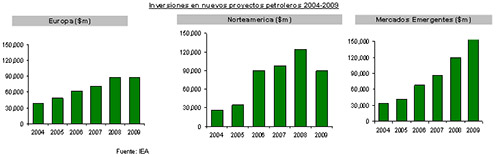
The third elephant in the room: Oil investments peaked in 2008. All energy agencies estimate that capex required to maintain production is slipping. Below $220bn a year, decline (currently at 5%) accelerates.

The fourth elephant in the room: non-OPEC growth is overestimated. See today Lukoil.Interfax reports Lukoil’s strategic development plan for 2010-2019 with a drastic slash on previous 10-year growth targets (only 0.3% average growth versus previous of 2.2%). Wait for Rosneft to do the same.

Bye bye Yen?

Just a thought, only marginally out of the energy sector, but given the surprise change of government in Japan, and what appears to be a growing sense in the market that this government is more focused, finally, on fiscal restraint (or least this threat of massive debt overhang to deal with) and less concerned about maintaining the weak-policy on JPY and even stating their ability to intermediate has declined, it looks like the JPY is keeping its bid. The market—big vocal guys like Jim O’Neil at GS for example—have been pounding the table that the JPY would decline back to 120 eventually on failing demographics and a larger global recovery, and it’s on its way, but slower. Maybe it’s because the US has usurped Japan as the ultimate source of funding and itself is now in a fiscal death spiral; maybe it’s these demographics and the start of deleveraging a bit, I’m not sure, it’s complicated. But whatever the root cause(s), the implication of a stronger than expected JPY (particularly against the $) absolutely HAS to be a weaker domestic industrial and manufacturing economy in Japan. Until China de-pegs, Japan’s opportunities for exports (at least market share risk) seem to be declining; in fact, what we are seeing are Japanese companies setting up shop in China (or elsewhere) instead, similar to the US. Therefore, the Japanese ‘equity market’ might be able to do ok, particularly if this increased JPY leads to a bit of insulation on domestic consumption, but the Japanese economy could be fairly troubled. Utilities would be in the cross hairs of declining consumption.

The key to figure out is: is this a currency issue primarily, or is it something else structural? We know that Japanese energy companies are short Yen in revenues and long Yen in expenses, eg, their costs fall when the JPY is strong, but now perhaps the JPY relative strength is enough to have structurally interrupted volumes and we know what slack does to prices on top of that!…