Tag Archives: Energy

Oil Is Cheaper Than Water. Feedback From The Oil Money Conference

(Published in Cotizalia in October)First, excuse the interruption in posting in the past month.

I’ve spent the last weeks busy with the launch of my new fund, The Ecofin Global Oil & Gas Fund, and traveling, visiting some of the most significant discoveries of the last decade, from Moccasin in the Gulf of Mexico to Jubilee in Ghana, through oil shale assets in Texas, and culminating with the most important annual meeting of the global oil industry, theOil & Money Conference . An exceptional event, with the participation of people like the secretary general of OPEC, Abdalla Salem El-Badri, the Saudi Prince Turki Al Faisal, the directors of the largest oil companies, major financial institutions and some investors. If I remember correctly, one of the very few representatives of hedge funds was me.

Well, what I promised to my Twitter followers is debt. Here are the main conclusions of the conference.

The main concern of the producers is demand. Saudi Prince Turki Al Faisal stressed it several times. “We will not increase production of 9.2 million barrels per day to 15 million when demand is well covered by all producing countries . We’re not going to invest billions of dollars to see barrels unsold at the port. ” Still, Saudi Arabia maintains its investment program of $129 billion and the projects that would guarantee that production cushion if needed. I myself have seen the development of the Kursaniyah and Khurais fields and these can produce much more when they want … if they want. I have also seen Ghwar and the much criticised decline is being addressed through new technology and improved recovery.

According to estimates from several industry leaders at the conference, up to 15% of current world oil demand is “credit bubble” driven, that is, generated by low interest rates. If we add to this that much of the industry leaders question the sustainability of demand in China, it is normal that during the meetings there were strong calls for a cut in quotas in OPEC’s next meeting in December. We’ll talk about it here if I’m invited to Vienna this year.

The problem is not the quantity and quality of resources available, but the increasingly onerous demands by producing countries , either excessive regulatory level U.S. and European legal uncertainty or lack of political certainty in others. Christophe de Margerie, CEO of Total, in a brilliant intervention, made ​​it clear. To invest for 30 years $720 billion annually (global capex) the industry must have an environment that will generate adequate returns to capital cost and risk.

Worldwide, De Margeries stressed that today there are over 100 years of demand covered with proven reserves of conventional oil, heavy oil and oil sands.The problem is not of available resources, as evidenced by recent discoveries, 500 million barrels in French Guyana less than a month ago, for example, but that the industry is allowed to generate an adequate return and develop those resources safely and effectively. And there I agree. After twelve years accepting poor returns, and seeing their shares do nothing, it is logical that a ROCE (return on capital employed) of 25% at $ 80/bbl has to be a minimum target when the average cost of capital is nearly 9% and projects last 20-25 years.

One of the most critical areas in the conversations came from the optimistic estimates of demand growth of the IEA. Everyone agrees that these will be difficult to achieve, especially in regard to the return to growth in the OECD, as estimates don’t take into account the de-industrialization and dramatic increases in efficiency, but also in regard to emerging countries. At the end of the day, the projected demand of the agencies is always “diplomatic” and tends to err in excess.

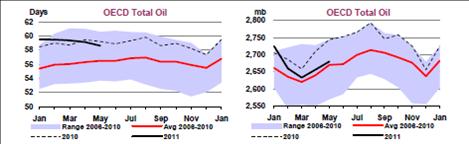
Many participants reiterated that the optimistic estimates of demand, added to some apocalyptic estimates on  supply, give a sense of tightness and urgency that the physical market does not see anywhere . After all,  OECD inventories are comfortably within historical average. In this sense, many criticized the exaggerated estimates saying that they generate an unnecessary investment bubble. Of course, make no mistake, no one complained that the price of oil was too high. “Doomsday predictions are making a huge favor, and free, to the industry” said a friend.

In this sense, all industry leaders criticized the monetarist policies and inflationary stimulus plans and low interest rates, as the main cause of increased commodity prices (oil has risen less than sugar and rice, for example, in 2011). Jeff Currie of Goldman Sachs noted that the impact of financial positions in the oil price has proven to be imperceptible, and that the price is not a question of lack of supply, because the commodities where there is no shortage or are cultivated have risen as much or more than oil, and reiterated the impoverishment of investment conditions as the great problem of the sector.

One of the most interesting parts was the analysis by geologists on the process of reducing the decline in production from mature fields field by field, with decline reductions of up to 30%. Petrofac is going to implement this in Mexico with Pemex. It’s all about price. With high oil, tertiary recovery is very attractive.

The Secretary of OPEC, Abdullah al-Badri, summed up the situation: OPEC does not seek to “defend” oil prices . The current price is justified by cost inflation added to a shortage of rigs available to rent that reach $ 450,000 a day, and the shortage of qualified personnel. “All the engineers are in hedge funds” a friend of Kuwait Petroleum told me.

The average price where OPEC needs to balance their budgets is an average of $ 75-85/bbl, as the social costs of the countries are increasing and therefore the average price can go up as well.

The 2010-2020 plan of the twelve OPEC countries includes 132 projects, $150 billion investment and 20 million additional barrels a day of production .The spare capacity of OPEC now stands at 5 million barrels a day , which has proven to be an excellent cushion when Libyan exports were interrupted, which is not expected to recover to pre-war level until 2013.

On Iraq, Issam Al-Chalabi, former minister of oil in the country, said that production forecasts have improved thanks to the improvement of some contracts to make the investments more attractive, and thanks to lower cost ($ 6 to $ 11 million per well), but lack of infrastructure and legal structure, as there is still no oil law, will make it difficult to reach 3.8 million barrels per day of production in 2013. Still, Iraq is exporting 2.2 million barrels / day and large projects generate returns of 23-25% (IRR).

I’ll stick with the following conclusions:

1 .- Demand is inflated and probably will not reach 92 million barrels a day if the debt reduction process of the global economic system is carried out, finally. The best thing that the industry has learned over the past 25 years is to avoid flooding the market. Seeing what has happened to other industries, it is logical that the oil industry puts back into the center of their investment decisions a decent return on capital employed, and not capex based on optimistic forecasts on demand.

2 .- Although the world is more complex today than ever and the geopolitical situation can always get worse , the industry is not going to stop investing, as it did in 2007-08 or 96-99. Annual investments to produce 90-95 million barrels per day of production (including unsold surplus capacity) will remain.

3 .- Exploration investment will not increase over the $150 billion annually but industry will intensify the investment in non-conventional oil in the United States, being of low political risk and high profitability. The industry will continue to explore and develop the frontier areas, especially West Africa, where there are no production constraints imposed by OPEC membership, crude oil quality is very high, the wells are under-explored and regulatory and legal conditions are very attractive.
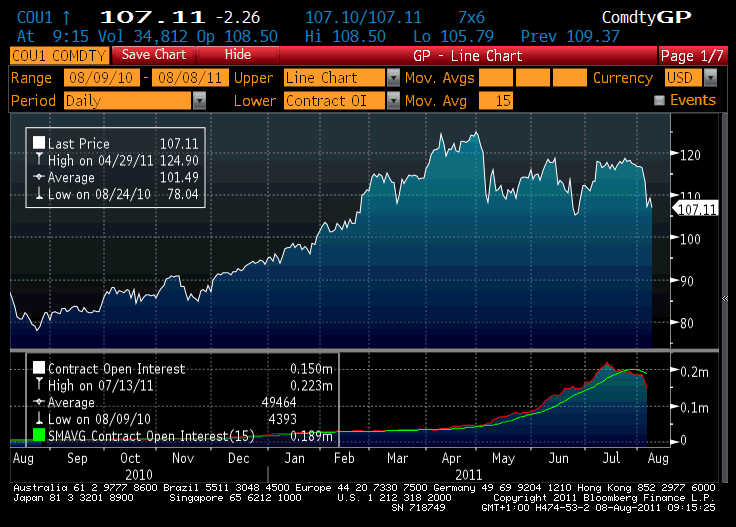
Is oil is expensive? Less than mineral water, platinum or silver. As Europe gathers 65% of the price of gasoline from taxes, and their companies collected $ 6/barrel from refining margins, you know what governments have to do to improve competitiveness . Lower taxes. Blaming the producers who invest $400 billion in developing their resources, is a lot of rhetoric and little reality.
Detailed feedback below:
HRH Prince Turki Al Faisal:
No other country can compete with the Kingdom on proven reserves. If it added unproven, as Iran and Venezuela do, it would still rank #1 in oil resources worldwide.
9.2mmbpd of current production with spare capacity of 2.3mmbpd having 20% of all proven oil reserves.
The Kingdom is pushing projects that will be able to deliver 15mmbpd.
However, Saudi Aramco has no intention to boost production to 15mmbpd because demand is being well supplied by other countries. This target is self imposed, given the billions of dollars spent on increasing capacity to see unsold barrels of oil in the port.
However, Aramco keeps its $129bn capex program still ongoing.
The Kingdom covers 40% of domestic needs through gas and will look at nuclear and other options but costs are not acceptable today.
Saudi Arabia is a picture of health and stability compared to any other country in the region… Even several European ones.
The Kingdom continues to be a leader in the region supporting Bahrain, Oman, Egypt and other countries with twelve packages of $8bn each an another eight aid packages of $4bn each.
Saudi Arabia GDP per capita $23k, higher than any other BRIC country.
Issam Al-Chalabi, former minister of Iraq oil.
Current production 2.7mmbpd and 2.2 exported. Tough to get to 3.8mmbpd and above 3mmbpd exports due to lack of infrastructure. Maximum 5.5mmbpd by 2020.
Lack of proper rehabilitation of existing facilities, putting at risk the reservoirs.
Costs range from $6mm to $11mm per well.
The increase of reserves to 143 bn boe needs more credible proof.
Iraq still without complete government (min defense, interior, etc).
For Kurdish minorities KRG main issue is to legitimize the Kurdistan contracts which are deemed illegal by Iraq. Also look to get recognised the “disputed lands” which is twice as big and oil-rich as the old Kurdistan.
Oil and Gas Law. Six drafts submitted. None approved.
Iraq will be affected by what is happening in Syria as they are supporting Assad.
. Shokri Ghanem, former minister of oil, Libya.
Warehouses, contractor camps, cars, spare parts and facilities have been looted.
Says the war has not ended, and attacks continue.
Says return to production onshore virtually impossible.
Almost 2000 4WD cars needed just to move personnel.
Production: 550kbpd end year, 1mmbpd in June. Pre-war levels at best two years.
Staff unrest at oil fields a big concern.
Also a big concern on whether TNC will re-negotiate all contracts.
Gabrielli (Petrobras CEO)
“The modern world cannot live without oil and gas, and this will not change”.
10x more financial contracts than physical.
Pre-salt $45/bbl breakeven.
Demand down in OECD, up on EM. More efficiency expected.
Climate change targets will likely be abandoned in OECD, and impossible to implement in EM. However, efficiency improvements will continue to bring demand lower than GDP growth.
10-25% of demand to be serviced by biofuels.
More challenging production, not more expensive.
Christophe De Margeries (Total)
“Of course there are plenty of reserves in the world, but it’s harder and harder to access them as countries want to keep them for their own people” “not a question of oil resources but exportable capacity” “there are more and more resources but not available at the same time”
Fossil fuels to represent 76% of energy supply in 2030. After Fukushima gas to become second largest energy source by 2030.
Gas increased by 24% from previous analysis, nuclear down 5%. Solar +17% pa to 2030 and Biofuels +5% pa.
Significant resources yet to be produced:
. 3,000 billion barrels. More than 100 years of demand of oil available including oil shale and heavy oil.
. 2,500 billion barrels of gas. 135 years.
“Fight with contractors is not anymore here. The current framework works”
“Price of oil will have to stay high to justify investments or these will collapse as returns are pretty average”
Libya to full production in 2012
“The oil and gas industry is the most heavily taxed in the world, with up to 80% tax from production country to up to 60% in consumption country”

Some August Thoughts On Oil, Brent-WTI and NatGas

brent
A few thoughts on Oil and Gas prices

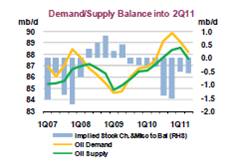
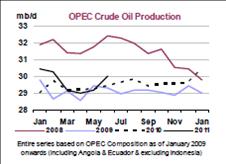
A) Oil demand is still above supply by c400kbpd but this could be short-lived if an OECD slowdown brings GDP estimates down by 2%. Given OPEC spare capacity is still at 5mmbpd and inventories in the IEA countries are in the upper range of the 2006-2010 average level, there is no small risk of entering an environment of oversupply if OPEC countries continue cheating on quotas (producing 27.5mmbpd versus 24.5mmbpd quota).

iea inventories
iea demand
B) New OPEC President, Iranian Rostam Qasemi is beyond hawkish towards the West. He was the commander of Iran’s Revolutionary Guard and one of Ahmadinejad’s most active advisors.
C) Venezuela surpassing Saudi Arabia in proven oil reserves has been ignored by the media, but has very significant implications on the balance of power between “hawks” (Iran, Venezuela, and Angola to a certain extent) and “doves” (Saudi Arabia, EUA, Kuwait). This, added to an Iranian president, means more power to the hawks not only in the decision making, but also in the quota split (as quotas are based on proven reserves, and Venezuela has surpassed Saudi Arabia).
D) Kuwait, traditionally supportive of benign oil pricing, is already giving messages of “supporting the current price”. This means that either their budget balance requires a higher price than we think ($75/bbl) or that they start to acknowledge that the downside could be more significant and that prices could overshoot on the downside as they did in 2008.
opec supply
D) Reduction in net length across the petroleum complex has been aggressive and not surprising in view of recent macro developments. The change in the crude position reflected a sharp reduction in Managed Money net length (~23k contracts) BUT overall positioning remains towards the upper end of the historical ranges.
I think oil (Brent) settles below $100/bbl in September (putting at risk the budget balance of Iran, Venezuela, Russia and Angola, who all need $90-95/bbl to balance), and this might trigger a supply response, but only then.
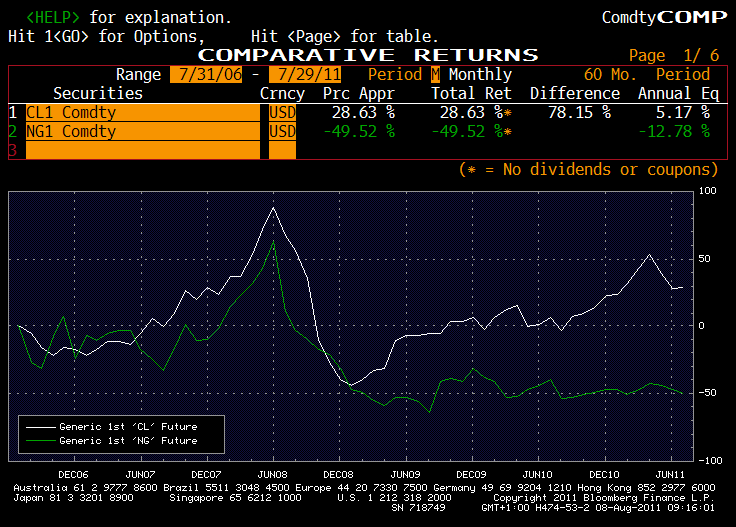
Meanwhile, weakness in WTI will continue (the gap between Brent and WTI is at $21/bbl), and the lower WTI goes, we can see a risk to the hedging availability of liquid-rich companies in the US.
wti gas
Careful, because too many US gas companies are saying that “even at $80/bbl we can hedge all our liquids production” but the hedging cost is soaring and the last time they gave that message banks started to be cautious about counterparty risk, particularly with natural gas below $4/mmcfd on the other side of the cash-flow spectrum.
Further read:
Venezuela surpasses Saudi Arabia in oil reserves
WTI-Brent Spread… More fundamental Than Most Think
Iran Grows Output Despite Embargo
The Increased Isolation of Iran
China Slows Down as Saudi Arabia Accelerates
Peak Oil? Demand Weak Supply Concerns Overdone

Peak Oil?… Demand Weak Again, Supply Concerns Overdone

contango 2011

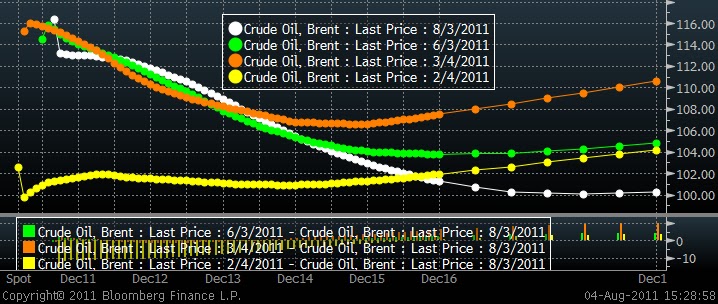
As we have said in this blog, over and over, IEA and consensus estimates of oil demand growth were too optimistic.

Now we have the proof. See the chart above. Oil (Brent) has gone from steep contango to a deepening backwardation in six months. What’s more important is that the backwardation has deepened as the Libya conflict intensified and prolongued.

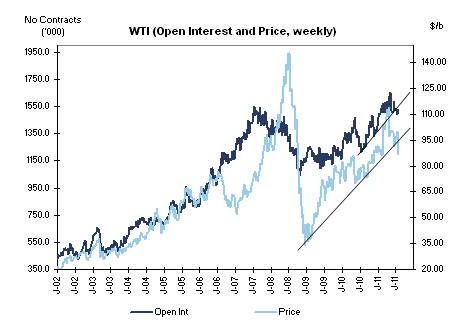
Additionally, net length from financial investors is healthily slowing down. The latest change in the crude position reflected a sharp reduction in Managed Money net length (~23k contracts) but overall positioning remains towards the upper end of the historical ranges.

open interest
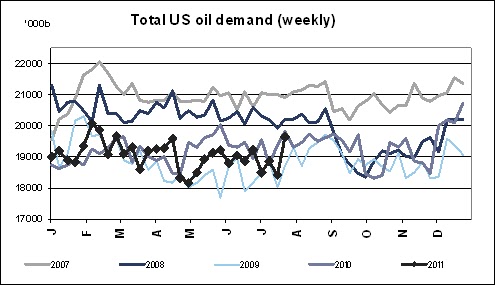
And we said it a few times. Chinese demand slowdown is not seasonal. And US demand is down on the year, same as Europe. And these are the countries that buy the goods from emerging countries. Next step, given the monster debt crisis that we are witnessing all over Europe and the US, is emerging market slowdown.

us oil demand

And this happens as the Oil markets puts 158 projects close to end of pipeline that target 11mm bpd of supply.

If we add to this that Venezuela and Iran are pushing for higher quotas (see my article about it) and Saudi Arabia is pumping 600kbpd more than in January, we have the same recipe as in 2008… a financial crisis and a supply response that comes too late.

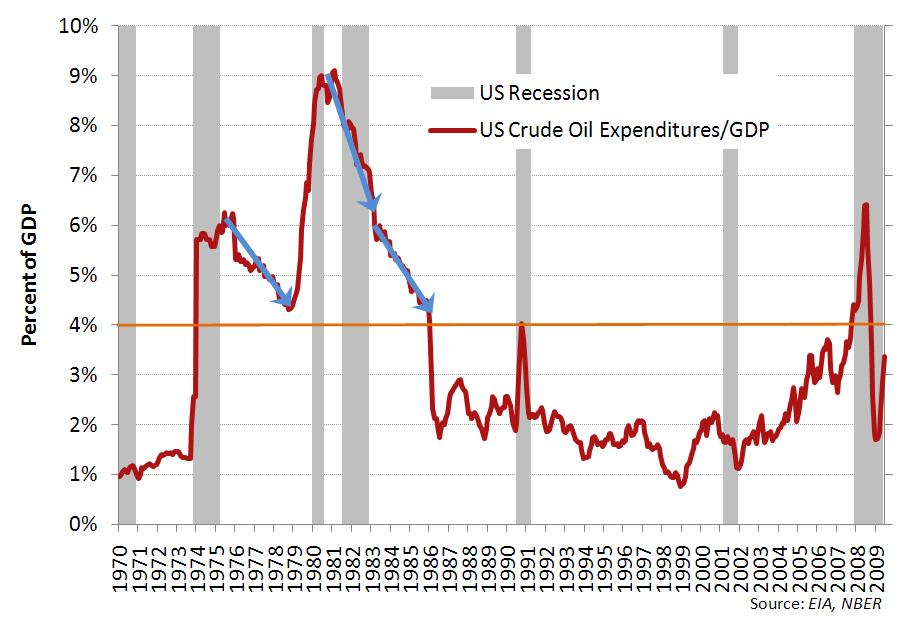
Is this financial crisis due to the high oil prices, as some argue?. No, this time it isn’t. The OECD debt crisis comes from the massive stimulus packages and printing money. Oil strength has not been a cause this time. It has been a consequence.

With EU countries running at 120% of debt to GDP in some cases and the US at 100%, the austerity measures and cost savings that we will inevitably see will bring GDP growth down. And 1% cut in global GDP means $10/bbl on oil prices, with or without Libya.

As China looks to reduce inflation and sees its banks running their own debt issues, we will also see a reduction of Asian demand.

Therefore, a simple calculation leads me to believe that OPEC spare capacity can rise back to 6mmbpd only on a 0.3% global GDP revision. If global GDP growth estimates fall by 1%, this spare capacity would rise to 6.8mmbpd at the same time as Iran, Venezuela and Saudi Arabia look to increase output by 300-600kbpd each.

The good news is that an oil price closer to $100/bbl will be equivalent to an entire QE2 on the economy, so the fear of recession might be offset by lowering energy prices. And obviously, in the US that situation will continue to be more benefitial for the economy as WTI differenctial is expected to remain at the $15/18/bbl level to Brent (see my article here).

usoilconsumptionaspercentofgdp1970-20091

Further read:

http://energyandmoney.blogspot.com/2011/06/china-slows-down-as-saudi-arabia.html

http://energyandmoney.blogspot.com/2011/06/iea-releasing-strategic-reserves.html

http://energyandmoney.blogspot.com/2011/02/brent-wti-spread-more-fundamental-than.html

Natural Gas Vehicles… An Interesting Alternative

2011072786cuadro-lacalle-def
28th july 2011
Yesterday two things happened that we will remember for a while:
First, RWE, the German utility, abandoned the world’s most ambitious project of tidal energy as it is economically unviable. The project, Siad Wave, says “wave goodbye, goodbye sir”, quoting the great Patti Smith. The project ends leaving £6 million in subsidies behind without having generated a kilowatt/hour . How wonderful.

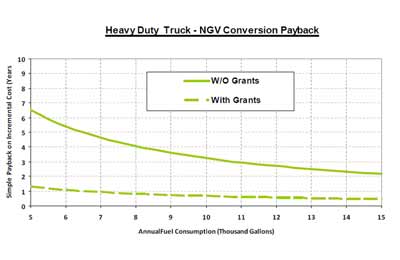
But the second I’m more interested in. Natural gas cars . The companies exposed to this sector  soared in the stock market on the news that the U.S. government (if it survives) will keep the tax deduction for these vehicles. But the interesting thing is that, even without tax grants, converting vehicles to natural gas is attractive.

The advantages of the natural gas vehicles are:

– Access to an abundant source of energy, six times cheaper than oil . Even after all costs, the difference between diesel or gasoline and natural gas in the U.S. is 2 to 1.

Very low infrastructure needs . Compared to the trillion dollars needed to adapt the country for electric car infrastructure, the U.S. already has converted service stations in almost all states.

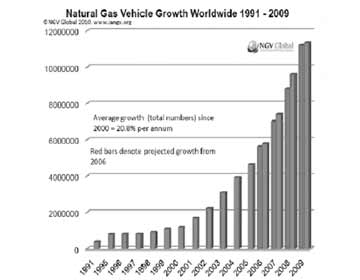
It’s a proven technology for vehicles of all types of tonnage. In Brazil, for example, 9% of the fleet runs on natural gas liquids.

Does not require subsidies . A truck that consumes 15,000 gallons of gasoline a year saves $ 22,500 a year in fuel and recovers the cost of converting to natural gas in 2.9 years. If tax deductions are not approved, it would recover the investment in 4.5 years.

They are not ugly like crazy. Unlike other unconventional vehicles, they do not need to look like clones of the Atom Ant helmet to have the autonomy of a traditional car.

2011072756cuadro-daniel-2T. Boone Pickens , the billionaire American, has been saying it for a long time. It makes no sense to keep the huge fleets of trucks travelling up and down the U.S. using gasoline/ diesel when the country imports $ 1 billion per day of oil from foreign sources, while the US produces abundant natural gas cheaply and with a local industry.
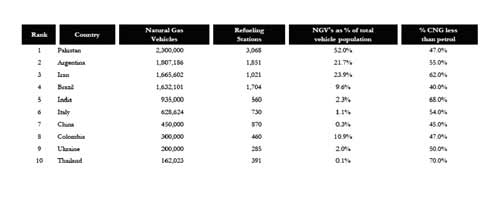
Therefore, in a country where, thanks to shale gas the industry can benefit from abundant natural resources, low prices and a daily production of 58-60 Bcf / day, it makes perfect sense to convert a substantial portion of the fleet from gasoline to natural gas.

But most importantly, if we assume that these vehicles, the same way that electric cars, absorb 9% of the total fleet, the additional demand in 2020 (2.5 Bcf / day) would be less than 3% of the domestic production of natural gas, making the price impact of additional consumption quite limited.

Disadvantages of the natural gas car in Europe:

In Europe we still reject to develop our reserves of shale gas, as we stated here , so the cost benefit may be lower, since the country depends on gas import from Russia, Qatar and Algeria, for example. However, even assuming the price of gas in Europe (NBP), which is two times more expensive than in the U.S., the savings compared to petrol or diesel is still relevant (38%).

2011072782CUADRO-4-DANIEL

In Europe almost all countries have near-monopolies on natural gas, some state-owned, with market shares by country ranging between 60 and 80% (E.On-Ruhrgas in Germany, GDF- Suez in France , ENI in Italy, Gas Natural SDG in Spain , Galp in Portugal ) which prevents strong competition. In the U.S. there are hundreds of independent companies and none has more than 15% market share. Even after the merger of ExxonMobil with XTO the group only has 12% market share in gas.

In Europe, unlike in the U.S., the final price of gasoline and diesel include between 55% and 60% tax . If you apply a similar tax to natural gas, and believe me it would happen, say goodbye to the benefits of conversion. But that risk, intervention and government hands in the consumer’s pocket, is going to happen in every technology, electricity included.- The main disadvantage is that if demand soars for electric cars, hybrids and natural gas vehicles, added to the  “start-stop” engine that giving an additional 15% fuel efficiency, then demand for oil will collapse, making the price of crude more competitive. Obvious. But in principle, assuming a 10% penetration of the fleet in the OECD in “unconventional” transport, it seems that the impact on oil demand will not be greater than 3% overall.

What I love to see is more companies, from my dear Better Place (Israel) in electric vehicles, to EQT, Westport Innovations, Clean Energy Fuels Corp. and others in the U.S., whose business model is already beginning to sound very promising when it includes the sentence “without subsidies.” That’s enough to get me interested.

Data Source: Clean Energy Fuels, NGV, Lazard, Exxon, EQT

Further reading:

http://energyandmoney.blogspot.com/2011/05/who-killed-electric-car.html

http://energyandmoney.blogspot.com/2009/12/observations-on-arrival-of-electric-car.html

http://energyandmoney.blogspot.com/2011/07/european-crisis-falling-demand-and.html

http://energyandmoney.blogspot.com/2011/06/shale-gas-in-europe-poland-and-energy.html