Tag Archives: Energy

Harnessing the energy boom (II): Independent Explorers

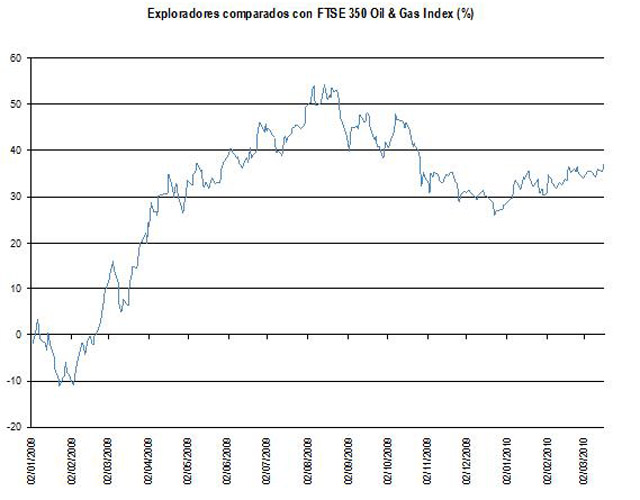
Exploradores vs FTSE 350 Oil Gas index(Article published in Cotizalia in Spanish on Thursday 25th March 2010)

These few weeks have been very relevant to the oil sector. On the one hand we have seen the acquisition by BP of Devon’s assets in Azerbaijan and Brazil at a price 15% higher than initially indicated by Devon. India is looking to establish a sovereign fund of no less than $245 billion to buy oil and gas assets and compete with China. Gulfsands Petroleum and Statoil’s assets in Brazil are also in focus. And finally, China’s CNOOC has acquired 50% of Bridas Corporation in Argentina for $3.1 billion, which implies that if we apply that assessment to Repsol’s assets in the same country, the valuation of YPF would be $15 billion, 25% higher than the average estimated by the market consensus.

Two weeks ago we talked about services. Today we will focus on one of the most volatile and exciting subsector in oil & gas. Independent explorers.

These companies are attractive for two reasons. First, there are very few independent companies with attractive natural resources, which makes them almost inevitable “targets” for predators. Second, their exposure to high-potential exploration assets causes the values to move upwards and downwards faster than other sectors. These are also companies where there is only one objective: to find and monetize reserves. No plan for 50 years, no political strategy, no obligations towards the media. Pure economic value. The sector has generated an average appreciation of 19% in 2010 and 72% in the past three years, including the stock market debacle. And between 2007 and 2010 independent companies worth $75 billion have been acquired, according to Wood MacKenzie.

For the uninitiated, let me briefly explain how they are valued.

Independent explorers buy assets with an attractive potential for exploration, drill them and, once they are assured that the wells are commercially viable, either they develop the portfolio or farm-out to Big Oil. Normally they keep a series of wells that will ensure production, access to financing and cash and use the financial resources to explore more and sell again. The key factor to value for an investor is the history of exploration successes. It is not the same trust Tullow Oil, for example, with 77% of exploration success track-record, and Soco, with 60%, or Lundin or Premier Oil, with a much lower track-record.

The independent companies are valued on an estimate of their core assets (“core NAV”) and an estimated percentage of future exploration success on their portfolio of wells. A percentage assigned by the market depending on the geology and seismic interpretation. Then, as they start conducting their exploration program, the market assigns value to the reserves encountered, or subtracts it from the pre-estimated value given to those assets if what they find is a dry hole (non-commercial).

If you are interested in the sector, pay attention to companies with little debt and exposure to areas of strong interest for predators, but also to those with better opportunities to acquire and explore reserves in attractive areas: West Africa, North Sea, Gas in the U.S. and Gulf of Mexico.

In Africa, the war for the control of reserves in Uganda and Ghana has made Tullow Oil one of the most successful stocks of the industry, but we must not forget the possibilities that arise in Nigeria for Afren Oil. Elsewhere, Anadarko, the leader in the Gulf of Mexico, gave one of the biggest successes of 2009 in Sierra Leone.

In gas, the main candidates to develop large reserves in 2010 are some of the few remaining independents in the North Sea, Dana and Premier.

In shale gas in the United States always look for companies with low costs and an intensive exploration program, from Range, Ultra Petroleum, Petrohawk or Quicksilver. Obviously they are exposed to a complex environment of gas prices in the U.S., that falls almost 2% per week, but also the least affected thanks to their low costs and attractive position to make alliances or mergers.

These are stocks that are highly correlated to oil and gas prices, but also very exposed to the credit environment, as they have to maintain a very low level of debt while financing large exploration programs. These are stocks to buy when there is a point of entry, either a capital increase to finance a drilling program or the announcement of a non commercial well of low relevance before an intensive program of exploration. A sector that is not suitable for risk averse investors or fans of dinosaurs with high dividend yield. But exciting as few.
Harnessing the energy boom (I): The oil service companies

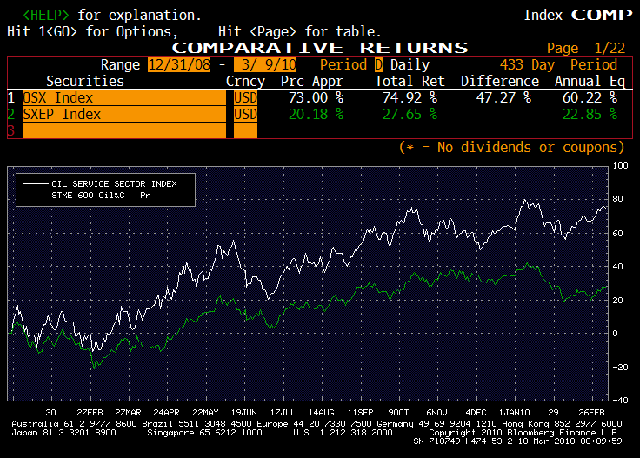
oil services vs sxep(Article published in Spanish in Cotizalia on 11/03/10)

In the last twelve months the merger and acquisition activity in the oil world has accelerated. $45 billion in acquisitions so far, and this only just begun.

In this environment, I have seen little written in the press on oil services companies. And meanwhile, investors lose money by investing in large integrated oil, which is like watching grass grow. However, it’s in services where the opportunities might be.

Let me be concise. Big Oil’s capex is rising again. $170 billion of investments will be devoted to upstream this year globally. New contracts are being awarded to the more efficient, aggressive and flexible service companies. And if something has been demonstrated in the 2008-2009 period is that, despite the large drop in oil prices, oil service costs did not fall more than 15% over the same period. This is the proof of the power of this sector over its customers. Competition is relatively low barriers to entry and specialization is very high and oil companies (clients) do not jeopardize safety and efficiency to save a little money.

Oil services companies are the key to maximize the performance of the fields and avoid expensive delays and technical problems. And they generate spectacular returns. Groups such as Petrofac, in the UK, and Subsea 7 and Seadrill in Norway charge their customers between $200,000 and $400,000 a day for their rigs(see footnote), generating annual growth of over 10% on their backlog.

Also, it’s worth mentioning the companies that specialize in large complex projects. Among the latter, Halliburton and Schlumberger have proven their ability to carry out giant projects from Saudi Arabia to Nigeria and generate very strong returns. In Spain, a much more modest play is Tecnicas Reunidas, an example of performance and competitiveness.

U.S. companies have woken up and now seek to attack the juiciest segment of the oil market: large contracts to exploit giant fields, both in deep water (Gulf of Mexico, Brazil) and the three that open borders for the coming decades : Alaska, Iraq and West Africa.

We have seen the recent deals between Schlumberger and Smith International, followed by Baker Hughes and BJ Services, and the market is already beginning to speculate about the possibility of a merger between Halliburton with Weatherford. If the latter merger is completed, be prepared to witness the creation of a genuine global leader. Meanwhile in Europe, it is rumored that Seadrill could buy Pride.

For the uninitiated investor, let me recommend that if you’re interested,you should concentrate on the following three characteristics:

– A Company’s ability to maintain or increase their prices to customers and increase its order book. This is a highly specialized industry and the weak fish die quickly.

– Avoid semi-state owned and over-diversified firms that often face execution risks, or are too dependent on one customer.

– Focus on independent and well capitalized companies with expertise in a specific segment that is of interest to predators. From my point of view, these are the deep-sea drilling and seismic companies.

The service sector is an area for investors with risk appetite who want exposure to oil prices, as one of the few sub-sectors that generates double-digit growth and high margins in the oil world. As the world continues to need $170 billion dollar annual investment in oil and gas, and I think we have many years ahead like this, oil service industry leaders will maintain the capacity to increase margins and orders.

Note:

Land Rig: manufacturing cost $10-15 million, then hired for $ 15-20.000/day

Jack up: Cost of production $75-175m, then hired for $ 100-200.000/day

Semi submersibles: Cost between $200-400 million, then hired for $ 200-400.000/day

Drill ship: Cost of construction: $300 – $500 million, then hired for $ 250-500.000/day

Unconventional Gas Developments

Our team has attended a few seminars on non-conventional gas. I thought it was worth compiling a few thoughts.

US breakeven costs have further to decline (easily 15%) taking breakeven economics to sub $5.0-5.5/mmbtu. Additionally, internationalization of the unconventional gas outside North America will be slow, with the possible exception of China.

1)North American insights:

a. Currently there is an abundance of plays that make sense at sub $6/mmbtu.

b. Technological advances are still ongoing and Take-up of known practices will cut costs by 15%, bringing breakeven costs to sub $5-5.0/mmbtu. The latest example is the deployment of “zipper” frac’ing.

c. These advances are offsetting a general rise in service costs, even though that rise is being accentuated by the withdrawal of some service capacity (early deployment overstretched rig capability, and those rigs are now failing).

d. Canada has potential to be a significant unconventional gas producer, and will keep downwards pressure on US gas prices into the medium-term.

e. Against that, the pace of drilling/development will slow as the majors become more involved.

f. WoodMac forecast US shale gas adding at least 1.5bcf/d per year through to 2020 on current drilling plans.

2) Outside North America:

a. Service companies are gearing up to take unconventional technology outside North America (eg Schlumberger buying Smiths and Baker Hughes).

b. European plays will be slow to develop:
i. Resource basins are relatively small.
ii. Regulatory issues have to be overcome (eg not only has PGNiG the exclusive rights to drill but all crews must speak Polish).
iii. No infrastructure to support rapid development.
iv. Exxon drilling 10 wells in Germany is a bit of a sidetrack – need to drill over 50 wells to get any understanding of the resource.
v. Costs are intrinsically higher – breakeven today is nearer to $10/mmbtu, but with 20% cost reduction/productivity improvement, there are several basins that can produce at $8/mmbtu.

c. China will be big as an unconventional gas play, and sooner than Europe:

i. Chinese policy has failed to hit coal-bed methane targets (but gas price higher now!).
ii. Resource basins have the right characteristics (big and tectonically stable, silicon strata).
iii. Fiscal terms can be supportive.
iv. Labour can be directed into sector.
v. The second East-West gas pipeline could unlock reserves along that route.

Energy Independence? An Impossible Objective

energía primaria españa640x
(This article was published in Spanish in Cotizalia.com on March 4th 2010)

For several months we have been listening to our governments talk of the goal of achieving the so-called “energy independence”, defined as absence of outsourcing of energy supplies given energy dependence on countries that are”not friends”, mainly the Middle East, is “bad” for the economy and security of supply. Truly outrageous.

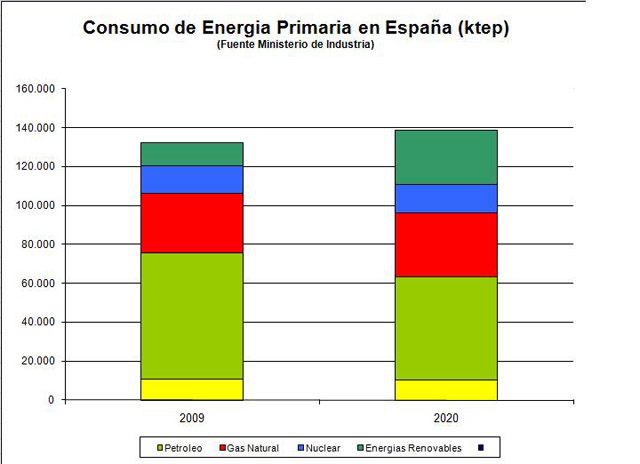
Just looking at the different energy plans of OECD countries allows us to realize the political and strategic error of using aggressive rhetoric against producing countries. Indeed, the most optimistic of predictions of installation of renewable energy will not reduce the use of fossil fuels aggressively.

In Spain, for example, a country leader in renewable energy, we continue to import 1.1 million barrels a day, and the Government in a document published on March 1, estimates that in 2020 oil will remain at 38% of primary energy consumption , and natural gas by 23%. At European level the figure is very similar, 40% and 26%.

A study by Richard Heiberg (“Searching for aMiracle”) for the International Forum on Globalization, states that “Present expectations for new technological replacements are probably overly optimistic with regard to ecological sustainability, potential scale of development, and levels of ‘net energy’ gain — i.e., the amount of energy actually yielded once energy inputs for the production process have been subtracted”

This is not to deny or attack the innovation and the importance of alternative energy, essential to meet the needs of a globalized world where per capita energy demand in non-OECD countries will grow from 5 barrels of oil equivalent per day to 25 barrels equivalent per day in twenty years. Moreover, the argument of the gradual depletion of nature reserves is valid, although on a longer timeframe than some “peak oil” theorists would like to believe. This is about warning of the economic and strategic risks of this policy of negative rhetoric and to avoid losing competitiveness.

Economically, aiming for energy independence is not justifiable in the long term. The alternative energy bill in the EU exceeds $180 per barrel equivalent and is now between 1.7 and 2.3% of GDP in various OECD countries, considering only subsidies and grants. In its energy plan, the Spanish government estimates an additional cost from renewable subsidies of between €3.66bn and €7.42bn in 2011 (the equivalent of the entire country’s oil imports at $100-190/bbl). In addition, the wind blows when it wants to and solar is not viable as an alternative in a massive scale. Of course, hydropower is not enough either because it is also unpredictable. And at this point it is pointless to even think about building nuclear plants to fill the gap in fossil energy because it would be impossible to achieve in at least 65 years.

The Spanish Ministry of Industry in its plan published on March 1st says the following about the extra cost created by the need to increase premiums on alternative energy:

a) It does not quantify the benefits in employment, which has not been demonstrated in a country that builds 1.5 GW per year, where the alternative energy sector suffers from overcapacity and has virtually the same employees as in 2006),

b) It improves the balance of payments, which is not evident either since the technologies are predominantly foreign, so we switch from paying to producing countries to pay to Vestas, Siemens, First Solar and General Electric,

c) Benefits in CO2 reduction, which has not been proven either as the countries have barely reduced their emissions and continue to subsidize domestic coal and lignite.

Therefore, the only way to justify the extra cost is to estimate an annual GDP growth above 3% between 2010 and 2020. Scary.

Strategically, the impossibility of sharply reducing imports of fossil fuels, even assuming increased efficiency of 1.5-2% annually, as estimated by the US Secretary of State for Energy state, makes the rhetoric of “independence” highly dangerous. It does not seem advisable to me to “threaten” our suppliers and partners when the most optimistic outlook for the OECD countries continues to envisage between 30 and 50% of our primary energy consumption from fossil fuels. Additionally, the argument that the suppliers of oil, coal and gas are not reliable is not acceptable and. Pure economic xenophobia. There has been more interventionism, nationalism, supply cuts and interconnection problems among European countries and the US than nationalization in Venezuela, Bolivia or Iran. As an example, Spain has suffered decades of supply cuts from France and never one issue with Algeria. The UK has had more issues with gas supplies from Norway than from any Middle Eastern supplier.

I find it ironic to hear our governments demand from producing countries more investments, more contracts for our companies and more production while we threaten them with tendentious arguments about energy independence. Russia, India and China are betting on all forms of energy while still bet on the importance natural resources. Meanwhile in other countries we can continue to argue in favor of energy independence, but we are shooting ourselves in the foot. Just wait and see.