Tag Archives: Energy

A Short Term Outlook For Gas Prices: Russia Calls The Shots (Again)

Gas prices have held up well, in part on the prolonged cold spell. However, in absence of weather support, by the summer prices will have to be lower in order to take the rise in LNG and Russian gas (161BCM) expected.

It is widely recognized that there’s a big build in LNG supply coming (extra 8bcf/d from the summer, ie three-quarters of UK consumption)) and that Gazprom is planning to increase its sales to Europe (by about 2bcf/d over the year = 20% of UK demand).

So likely that European gas storage will be filled relatively early. Unfortunately, storage levels are still relatively high (equal to almost 3bcf/d of extra supply if returned to normal levels over 3 months). Nevertheless, should storage still close to current levels rather than drop to 25-30% fullness, that would add 9bcf/d to demand over the next 3 months.

Economic recovery may lift demand, and Spain has started 2009 with January consumption up 4.2%. However, the industrial production is still more than 10% below 2008 levels.

The big mover for LNG would be a recovery in Japan, which looks encouraging even when industrial production is still 20% below 2008. South Korea and Taiwan are picking up but together these two countries are only half of Japan’s LNG demand.

Last year, in Europe, Gazprom’s gas buyers sharply reduced volumes early in the year. These are huge numbers – about 14-15bcf/d (ie almost the entire consumption of the UK and Germany combined). This was a”no-brainer” for the gas buyers. Their contracted price is based on oil prices with a 6-9 month lag. So deferring gas take until later in the year meant the gas would be cheaper.

Going forward, it looks likely that gas prices now are close to the lowest level for the year. Hence, the buyers are likely to want to take the gas now (saving about $2-2.5/mmbtu).

As a result of coal’s decline, gas at higher prices would no longer be the preferred fuel for generating power in the UK (where most of the swing occurs between coal and gas).

• Coal has come down as concern surfaced about the extent of policy tightening in China. The Australian coal price has been hit hardest, but clearly this has been the driver for South Africa (and European) coal over much of the past year.

• Marginal generation costs in the UK now favour coal dispatch.

So, gas prices will have to drop (or coal prices have to rise) in order to stimulate enough demand to take the Russian gas. Coal market fundamentals look positive once the trend of Chinese coal import data post-tightening is evident in 1 month time. So near-term, the market balance is more likely to be brought back into balance by falling gas prices enhancing power station competitiveness (along with Europe maintaining high storage levels over the summer), but more expensive coal and lower Russian gas might balance the equation.

So the x factor to bring gas markets to balance is Russia. Unless Gazprom allows a smaller off take, there could be as much as 10bcf/d trying to find a home in the UK/European power sector over the coming 3-6 months. That’s too much for UK/Europe to absorb; so up to 5bcf/d could end up headed for the US. I struggle to believe Russia will work on volume alone given they have a 6% decline in the base. If they allow a lower off-take, US pricing won’t get dragged down in this environment.

The current forward curve has Henry Hub some $0.5/mmbtu above UK’s NBP, so there is not much scope for UK prices to drop without impacting LNG flows and depressing US prices.

In summary, the picture is not that oversupplied if Gazprom volumes (161BCM) include storage and some level of flexibility. Chinese coal buying might keep gas prices more competitive than coal for power generation, and we are seeing LNG projects delayed (Shtockman, Australia) or sending lower volumes to Europe (Yemen). Looks like the picture of oversupply that the market discounts is too extreme. Not that my view will imply gas price appreciation, but the massive downside predicted by some looks less evident to me.
Urgent: Refineries for Sale. Cheap… or Free

refineria

(This article was published in Spanish in Cotizalia on February 4th 2009)

The results of Shell, Chevron and BP have shown once again the extremely serious problem plaguing the oil industry: refineries lose more money every quarter and completely offset the positive results of exploration and production or gas trading. In fact, the refining sector in the OECD has generated returns of c3% below the cost of capital since 2003. Tony Heyward, CEO of BP, Europe’s largest oil company, was forced to acknowledge at the presentation of Tuesday’s results what has been a concern for the investment community for years.”Refining margins shall remain depressed for the foreseeable future.”

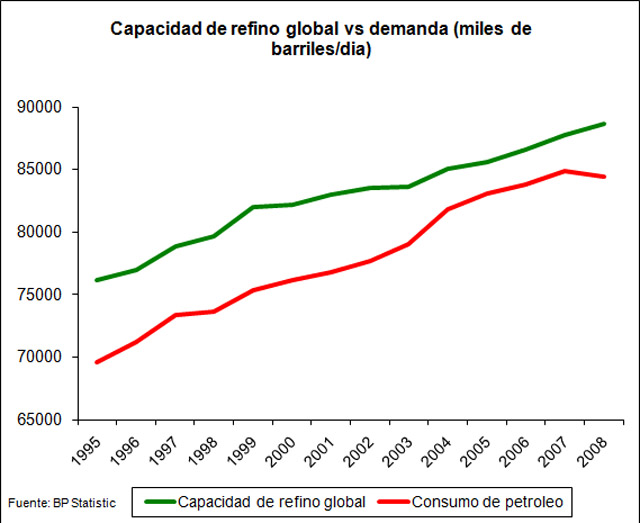
Indeed, the world finds itself with excess refining capacity of more than four million barrels a day. In addition, between China, India, Saudi Arabia, Russia and Korea there are planned refinery projects for more than 8 million barrels a day, many of them justified for purely political reasons. Even if half of them were canceled, the overcapacity will remain for at least 10 years. Meanwhile, Europe and the United States see the value of refining assets plummet every day, well below replacement cost, and no buyers. ENI has been unable to sell its refinery in Livorno and Total is not only unable sell its Flanders plant, but due to government intervention they are forced to keep it operating despite the fact that Total loses around € 100 million per month in the refining area.

The situation is desperate, even for companies like these, who do not have debt problems. As you can imagine, much of the refinery projects were built with the frightening words “security of supply” and “strategic” as a justification, regardless of the volatility, low return and very high investment requirements. We have not learned from the debacle of 1981-86, which led to curtail refinery capacity in the OECD by 20%.

In the past, integrated oil companies wanted to sell the message of their refining activity as an alternative to volatile oil prices, but it has proven to be a source of massive capex requirements and destruction of market value for the sector.

At the end of the day, a refinery creates value only if it can extract superior returns by using cheap and low quality oil (heavy) to produce high priced gasoline and products. Expensive oil, with the differential between heavy and light crude at a 10 year low, added to excessive costs, declining demand and efficiency improvements have led refining margins to plummet to $ 3.8/barrel on average, the lowest levels of the past 15 years. And this even when refineries are running at an average of 80% capacity. But the differentiating factor is that excess capacity far exceeds the most optimistic expectation of improving demand.

Some might say that this is scaremongering, that refining is a cyclical business and that when demand recovers everything will be fine (amazing to see how many times one hears this lately). I disagree. None of these large oil companies look to their activities on a short-term basis, and yet all of them seek to reduce refining capacity, the sooner the better. Apart from ENI and Total, Royal Dutch Shell aims to reduce its capacity by 15%, Valero has closed its plant to 200,000 bbl/ day in Delaware, BP wants to reduce its capacity by 14%, Chevron also … In summary, the 10% fall of demand in 2009, that all oil companies see as structural, not cyclical, will lead to the closure of at least 3.4 million barrels per day, up to 18% of the entire European capacity, between 2010 and 2020. And still capacity will be more than adequate.

Spain has refineries to bore, nine, with a capacity of over 1.1 million barrels a day. Within the complicated picture of the sector, some are reasonably profitable. For this reason, they could be sold without any problem at a price close to $1 billion per plant. The opportunity to raise cash and reduce investments has to be taken. But beware of waiting around for the return of the “golden age of refining” which may be decades away … or not return.

Energy Opportunities in Brazil

(This article was originally published in Spanish in Cotizalia.com)

Today I am writing from Rio de Janeiro, and while reviewing some news of the week, I am struck by the following: Jim Cramer recommends buying a bank, Santander, for their exposure to Brazil. Without questioning the merits of the financial institution as a stock, the first thing that comes to mind is: if you want to buy something, do not do it with hybrids. And I agree. It seems obvious to say but if you want to buy Brazil, buy Brazil directly. And there are many reasons to invest in the country: an expected increase of 5% of GDP, energy demand increase of 6% per annum, … And oil, a lot of oil. 14 Billion barrels in proven reserves and in the Santos basin, almost 7 billion barrels of resources, some of the largest discoveries of the decade.

On one side we have Petrobras, with increases of 6% p.a. in production. Petrobras also offers very competitive costs (average cost $ 13/bbl total F&D). However, it suffers from the forthcoming $55bn capital increase and, as Shell or Conoco, also suffers from the discount of large business conglomerates. It is cheap, but its huge investment needs in diversified businesses weigh on their return on capital employed.
Therefore, if you are interested in the almost 7 billion barrel discoveries in Brazil I would encourage you to analyze the two companies that offer absolute exposure in this area: Lupatech and OGX.

The first, Lupatech, as priority local oil services firm for Petrobras, is the great beneficiary of the investment needed to develop the discovered fields. It has an attractive balance sheet, expected growth of 12-15% and higher margins than their European competitors. And remember that Brazil needs to monetize quickly these discoveries, since the government sold in the last ten years oil concessions for a price of $1bn that today are worth approximately $50bn.

The second company, OGX, specialized in exploration, bought at 20 cents per barrel fields that seemed unproductive and nobody wanted and that have proven to contain at least 2.5 billion barrels recoverable, an amount that could be expanded to 7 bn as shown by the 3D seismic exploratory studies, which so far have been successful. OGX has $ 1.5 billion of cash to fund the exploration program of its five fields. And instead of gearing up to develop these reserves, with estimated costs of $ 14/barrel given that they are all shallow water finds, OGX is likely going to sell minority stakes to other investors. From a conservative standpoint, these 2.5 billion barrels could be worth between $10 and $ 12/barrel.
Brazil also offers opportunities in the electricity sector, which expects to increase its installed capacity from 102 GW to 153 in 8 years. 85% of generation is hydro while domestically produced natural gas will play a key role in the future. The sector delivers low-cost production and margin expansion as prices for electricity are higher than the Europeans (by more than 15%), also offering dividend yields above 6 -7%. There are more opportunities for low risk, high yield than the market would normally expect from an emerging country.

The Olympics and oil will be two factors to contribute to a dramatic growth in infrastructure investments. And energy companies are the major beneficiaries of this momentum. It is worth looking at Brazil in detail.

Iraq, the last hope for Big Oil

IRAK (1)

(This article was originally published in Spanish in Cotizalia.com)

We’ve talked on other occasions of the difficulties that big oil companies find to grow. The reserve replacement ratio is still more than disappointing, below 100% since 2004. But in 2010 the industry could change course. In my opinion, the true hope of the sector is Iraq, the third country in the world in proven reserves, 115 billion barrels of oil, behind Saudi Arabia, with 264 and Iran with 138.

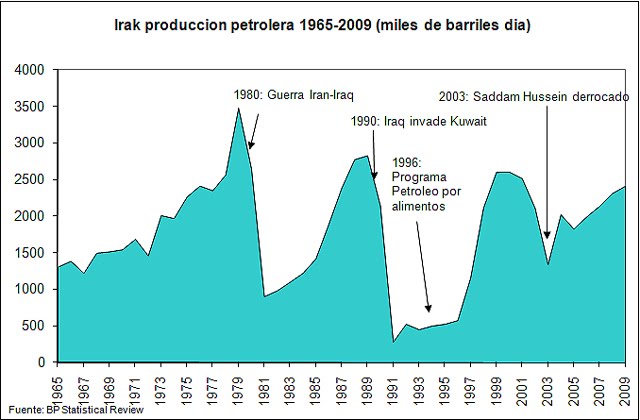
The country has generated much controversy in the press for the war but, since Saddam Hussein was overthrown, Iraq has achieved a production increase that was unthinkable under the previous regime, generating tax revenues for the domestic economy of almost $20 billion more that in the period 1980-2005.

Currently the geopolitical environment has improved substantially. Service firms are established, but the risks are not negligible, with nearby local elections, conflicts with the Kurdish minority and the gradual withdrawal of U.S. troops. For example, it remains unclear if the city of Kirkuk, home to a giant oil field, belongs to the Arabs or the Kurds, which prevents investment there.

The local government has advanced rapidly, licensing more than ten fields in the last year. After a false start in which the license auction was declared void (except the Rumaila field, BP -CNPC) because the conditions imposed by the government were too expensive, between the second half of 2009 and 2010 the government has auctioned licenses to operate up to 60 billion barrels in estimated reserves, with a national strategy to increase production from 2.5 million barrels per day today to a very ambitious target of 12 million. From BP, Shell, Statoil and ENI, to Russia’s Lukoil, China’s CNPC or Exxon, most big oil companies have participated in the process.

From my point of view, the goal of exceeding Saudi Arabia’s production is very ambitious. No one has managed to multiply by 5, as intended, the production of a country in 10 years. I think it’s much more logical to assume that production will rise to 3.5 million barrels per day in 2015, in line with the history of typical production recovery in this region (including Iran).

And the problem now is the costs, estimated at $ 19/barrel (F&D), plus an additional fee of nearly $ 2/barrel. The contracts allow the oil companies to cover costs up to a minimum production level. Until there is a contract typical of the industry,within what is called a PSC(production sharingcontract).

But if minimum production targets are not met, oil companies will suffer from profits lower than the average cost of capital, or even losses. The Zubair field, won by ENI and their partners, for example, will likely generate an internal rate of return of less than 20% below $55/barrel, while requiring investments in excess of $20 billion over 20 years.

If you have enjoyed Avatar (great movie, by the way) and the not-so-subtle allegory about the oil companies, you probably think that this whole process is abominable, but the increase in gross domestic product, infrastructure and wealth for the country that these projects, neglected or poorly managed so far, will generate, will be a giant leap for the country’s ailing economy. The investments to be carried out are astronomical, nearly $ 100,000 million between 2009 and 2029, including infrastructure, water, schools, hospitals , almost the construction of entire cities. Consider that some of these fields require about 500 workers. And the fact that contracts are aggressive and costly conditions for oil is a minor problem, because for them it is probably the last opportunity to improve their low reserve replacement for once.