All posts by Daniel Lacalle

About Daniel Lacalle

Daniel Lacalle (Madrid, 1967). PhD Economist and Fund Manager. Author of bestsellers "Life In The Financial Markets" and "The Energy World Is Flat" as well as "Escape From the Central Bank Trap". Daniel Lacalle (Madrid, 1967). PhD Economist and Fund Manager. Frequent collaborator with CNBC, Bloomberg, CNN, Hedgeye, Epoch Times, Mises Institute, BBN Times, Wall Street Journal, El Español, A3 Media and 13TV. Holds the CIIA (Certified International Investment Analyst) and masters in Economic Investigation and IESE.

Catalonia: bailout and junk bond

This article was published in El Confidencial on September 1st 2012

“When you blame others, you give up your power to change”
“A sense of entitlement is a cancerous thought process that is void of gratitude and can be deadly to relationships, businesses, and even nations.” Steve Maraboli

On Friday, Standard & Poor’s downgraded the rating of Catalonia to junk after the region made a bailout request to the Spanish central government of €5bn. S&P warned in its report of the “economic and credit deterioration of the region,” and added that “the region’s request to modify key institutional and financial aspects of its relationship with the central government raises uncertainties that we deem incompatible with an investment-grade rating.”

The report also warns that “Catalonia continues to show a poor individual credit profile, with a deteriorating liquidity position dependent on the support of the central government to repay its debt.”

The bailout of Catalonia has generated much controversy in the market, but it’s worth saying that my comments in this article are applicable to most of the regions in Spain.

Despite the huge amount of communication efforts towards investors conducted by the different regions, all with ‘more GDP than Luxembourg and less debt than Japan,’ all considering themselves entitled to borrow indefinitely, the fact is that regions have no access to capital markets. And this shows how, all across Europe, countries and regions continue to believe that credit is free, investor money is unlimited and deserved without questions. And there is no unlimited capital.

The excellent presentation to investors that the Catalan government, theGeneralitat, made in 2011, very complete and detailed, shows some of the common problems that Spain and the regions face, and the reason why investor confidence and interest are still low.

. Estimates that were very optimistic: “Our revenues cannot fall.” “In 2012, with very conservative estimates, revenues will increase by 10.5 percent.”

. A debt maturity schedule that implies annual needs of €3bn added to the current financing needs of nearly €9bn. Added to that, the habit of financing current expenditures with long term debt and weakening future revenues, as Catalonia has received advances on transfers of more than €10bn until June 2012 – advances spent today that will not be collected later.

. The average maturity of the Catalan debt is six years. More than 71 percent of its debt matures between two and five years. I always tell my readers of the importance of not accumulating short-term maturities in good times as risks accelerate exponentially in times of recession. Accumulation of maturities well above marginal institutional demand is a problem throughout the European periphery coming from the misperception that “there is plenty of available demand” in the credit market for all, when the United States and major countries account for nearly all of the debt market capacity.

. Expectations of international funding sources were not met and have only been partially covered by local retail investors.

. A primary deficit – the gap between income and expenses excluding cost of debt – which has done nothing but grow.
. The estimates that Catalonia provides of fiscal deficit – the difference between tax revenues received from Spain and paid out – which, even if we assume it to be valid, does not cover the hole of growing expenses. The problem is, therefore, the accumulation of previous debt and expenses and that, in any case, investors perceive the fiscal deficit figure as exaggerated, because it assumes no cost for Catalonia of EU transfers or value-added taxes to other regions. In addition, from 2007 to 2011, state tax collection in Catalonia plunged by 35 percent, while subsidies and allowances paid by the central government to Catalonia increased.. The estimates given of the Catalan economy forget the CatalunyaCaixa andUnnim bailouts (€2.3bn), which are not accounted as a cost incurred by the region.

The real problem, however – the reason why investors do not rush to buy Catalan bonds that give a return of nearly 12 percent in 2016 – is that it has been proven since 2004 that any increase in revenues is engulfed by the regional administration and as such, the risk of default is higher than implied by companies and the region’s financier, the Spanish central government or Germany.

I heard this a few times from colleague credit investors: “a country that doubles its expenses in four years while its revenues fall, either has oil, or gold, or it does not have my money.”

The 10-year-Catalonia bond has a risk premium –spread– to Spain of almost 600 basis points and 1,100 basis points over Germany. This difference is not because of Catalonia’s dependency on Spain, or the alleged fiscal deficit. It is caused by the massive deterioration of expenditure and revenues, and the accumulation of debt maturities far beyond institutional demand. And it is important to say this, Catalonia is one of the regions with better credit structure. So, imagine the rest.

In fact, if investors perceived the massive spread between Spain and Catalan bonds as unjustified by the fundamentals, they would take the arbitrage opportunity and load up in Catalan bonds. Any credit arb hedge fund would buy them in size. But they don’t.

Now the blame game heats up. Spain blames Germany, Catalonia blames Madrid, Andalusia blames the banks, etc. Meanwhile, with on-going downward revisions of the gross domestic product and failures in budget implementation, governments continue to believe in the mantra of eternal credit ‘because we deserve it,’ sinking the ship with the crew and passengers inside.

In the Spanish regions and the central government, each euro received of additional income, either through taxes or transfers and structural funds since 2004, has become inexorably a euro and ten cents of debt. Looking at the Spanish regions, all the money received has been spent, but all of them have expanded primary deficit as well. In 1993, the regions managed 20.1 percent of the country’s budget, today they manage nearly 60 percent, yet all of them spend far beyond their means and income, regardless of their business and economic differences. Here in Spain there is no poor state. No Alabama. We are the United States where everyone is Washington or California.

This leads us to a comment made ​​by my esteemed Xavier Sala i Martin, Spanish-American economist at Columbia University, who says that the problem of access to debt markets for companies is mainly because they are Spanish, and that if Catalonia were an independent country “it would be considered one of the world’s healthiest economies and financial markets would rush to lend it money.”

In this post, I am joined by my fixed income colleague to give readers an idea of ​​how the debt markets work, because it is false that the main indicators to buy bonds are just debt to GDP and deficit, and I remember the comments from one of the British investors when the premier of the Generalitat made the presentation of its bonds in London. “If Catalonia was an independent country it would have the same access to credit as Andorra,” he said.

But even more surprising to me, as an investor in equities and bonds, is to read that “financial markets would rush to lend money” to an independent Catalonia. That is not true, as we have seen from country after country that declared themselves independent, from Yugoslavia to the former Soviet Union. Either they have abundant energy commodities or credit evaporates until they have gained years of experience as independent states. Estonia, the example for independence movements, only saw some modest short-term credit because Germany broke the treaty rules and recognized the country quickly. Even with that, credit was modest and GDP collapsed by 14 percent in 2009 and 9 percent in 2010.

When investing in bonds – debt to GDP, which is an indicator, inflated precisely by government spending and real estate bubbles – is irrelevant. What matters is the institutional credibility, the acceleration of expenditure against income, the quality and predictability of that income, the weight of public spending, monetary stability and the primary deficit or surplus.

We assume that Catalonia has institutional credibility, but:

. An independent Catalonia would be an economy that depends by 57 percent on Spain for its “exports.” In fact, since the trade balance with “non-Spanish” countries is negative (Catalonia imports more than it exports), Catalonia’s exposure to “Spain” would remain the same if not higher, particularly on the risk of the bonds of the alleged independent Catalonia. The cost of belonging to the EU, however, which Catalonia does not pay today as a region, would expand its deficit. Add to this that an independent Catalonia would have to absorb 18 percent of Spain’s national debt on the way out, and Catalonia would have debt to GDP higher than 100 percent. In a Spanish recession, the independent Catalonia bonds would also aggressively discount that same recession.

That’s why, despite the huge attractions and exceptional positive elements of Catalonia – dynamic, open economy – the investors perceive as the biggest problem the structure of a state that swallows any extra income received as it has done since 1996, making the solvency and liquidity ratios very tight, and this will continue to impact their access to credit. In fact, it is precisely the liquidity ratio, even assuming the previously mentioned tax deficits, which scares investors. Because the deterioration of income – with the deindustrialization of the region into more competitive and less bureaucratic countries, like Morocco – is accompanied by expenditures which can only rise, and do not take into account that the economy of Catalonia is very cyclical.

We end with a note on the “negative impact of being Spanish” to finance large companies. Sala i Martin says that ”the reason (for not having access to credit) has nothing to do with the sector in which they operate or the state of their economic health. The reason is simply that they are Spanish companies.”

First, we have seen debt issues, divestitures and hybrid access by several of these companies (Gas Natural, BBVA, Telefonica and other Spanish companies have issued €7.05bn in bonds with over 10 times demand in 2012), and all are trading at less risk of default than Spain or Catalonia. What we have said in this column many times is the real problem. The average debt of the Ibex is very high relative to its peers due to the orgy of strategic acquisitions at crazy multiples, but we have seen companies do an exercise that neither regions nor the central government have done. Prudence. Aggressively reducing costs, cutting unnecessary investments, cutting dividends, funding themselves long term since 2007 to avoid the “credit crunch.” That is, the opposite of what the governments have done. Companies have been preserving cash generation as an essential policy against an uncertain future, both in its core business as in its “growth markets.”

Surprisingly, Sala i Martin takes as an example of the ‘bad influence of the Spanish state’ three companies with almost monopolistic businesses in national services, telephone, natural gas, and construction-concessions. Great companies which have financed their international expansion with a lot of debt that they have been able to accumulate thanks to very high returns generated in Spain, which allowed them to enjoy better growth than their peers in the past, with full access to borrowing that could not have been there without the support of those domestic revenues and without a Spanish government that supported high risk cost strategic adventures.

No company is Spanish only for the good times and not for the bad times. These large companies, which enjoy a very comfortable monopolistic position in our country, do not suffer lack of credit “for being Spanish.” This is like saying that France Telecom, Veolia, EDP, Telecom Italia or Areva suffer lack of access to credit for being French, Portuguese or Italian rather than their strategic mistakes of expansion with debt.

Catalonia is wonderful and deserves all the good things that can happen there and more, and it is worth a bailout, or twenty, if needed. Spain has regions-nations – whatever you want to call them – with wonderful, huge possibilities. The problem was, and remains, having an unsustainable structure of administrations that absorb any extra income they get. Everyone has the right to claim independence for romantic reasons, or whatever, but we cannot say that the markets would be jumping to provide credit. In five years we would see Barcelona wanting to cut ties with Lleida or Madrid with Guadalajara, until the final implosion of a country with a level of public spending crowding out the real economy that looks like Argentina.

In Spain today, there is a golden opportunity to change, and to unite the country in the solution, not separate ourselves in the debacle. But let’s not blame the other. The solution is in our hands.

——

Here is Mr Sala i Martin’s original article and his reply to my post above

On fiscal deficits. here is the contrarian view to Catalonia’s government one.
Massive Subsidies Endanger Spanish Energy Reform

This article was published in El Confidencial on August 27th 2012 

“If technologies have economic merit, no subsidy is necessary. If they don’t, no subsidy will provide it”. Jerry Taylor.
“Governmental subsidy systems promote inefficiency in production and efficiency in coercion”. M. Rothbard

This week the press has highlighted the discrepancies between two of Spain’s top ministers regarding the much delayed electricity sector reform. The shares of many of the companies involved have moved between +7% and -6% depending on the words of one minister or another.
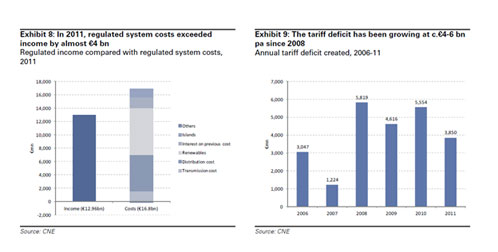
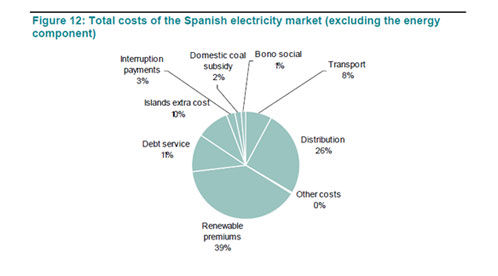
Let me begin by saying that I do not find anything wrong when a company hires a consultant to defend its interests and that, when they do, they do it with the best. And I believe this controversy creates a great opportunity for the government to demonstrate that their decisions are not influenced by one lobby or another, but focused on the only thing that matters: that Spain cannot continue destroying its competitiveness with a massively subsidized and inefficient energy sector, where the electricity bill has soared by 40% while demand fell and where excessive renewable subsidies count for 39% of the costs (excluding energy component) of the system.
renewables II
To eliminate the tariff deficit accumulated until 2012; electricity bills will have to go up by an estimated 35%.
The Spanish tariff deficit is the difference between the real system costs and those recognized in the tariff, where the result is an IOU from the government that is financed in the balance sheet of the companies until it is settled. This tariff deficit is part of the infamous “Spanish private debt,” which is in no small part made of outstanding commitments from the government and funded by the balance sheet of private companies. It is also the consequence of a highly optimistic central planning of the system that incentivised overcapacity and massive new build that has made companies more indebted, with or without acquisitions, and less and less profitable.
renewables I
The tariff deficit myths are:
“Companies make billions out of it” We must differentiate between accounted and real profits. We sometimes forget that companies account for the tariff deficit as a “receivable” so their profit and loss is not made of real cash. As such they generate no free cash flow and borrow more and more. Investments in Spain, from generation to distribution, generate less than 7% return on capital employed. However, companies are told by governments to undertake massive investments, but without legal certainty or acceptable returns. And there is always someone willing to build more for less.
–  “It is a temporary problem that goes away with the latest measures.” The latest government measures to reduce the costs of the system seem to look to collect from the efficient and cash generating businesses to cover inefficiency errors, but these measures do not solve a problem of subsidies and overcapacity, as they have been mainly applied on one-off costs, with a maximum impact of 2 billion euros, yet they do not take into account that in 2013 renewables subsidies will rise by another 2 billion to almost 9 billion a year in 2014 due to the plants that are coming on stream, bringing the tariff deficit up again.
–  “Renewables are unfairly demonized.” This is true, in part. The tariff deficit is not an issue created by renewable energy, but by the excessive cost of certain subsidies-particularly solar photovoltaic- where massive premiums were given to build 400 megawatts, ending with 3000 megawatts built – the consequences of an extremely generous aid system and a poorly controlled approval system, where all regional governments gave permits to plants regardless of the 400MW limit. But who pays that “tiny” 5 billion per annum mistake?. No one has anything against renewable energy. I love to read that Spain will build nearly 600 megawatts in solar PV without subsidies. The problem in Spain is the accumulated upfront cost of those subsidies, the fact that the excess cost is not paid but deferred in the tariff, and the claim from some operators to continue with the same scheme of subsidies and installations when all 2020 targets have been fully met. Many renewable companies in Spain have followed a model of builder-developer entering a country, and maximizing capacity to move on and grow in others. But there is no eternal growth in each market.
“Coal generates no deficit because it is a social cost.” Other subsidies maintain inefficient capacity alive, like coal, which gets 600 million a year. If the rationale to keep coal is “social” it should not accumulate costs to the power bill, but be paid by the regional governments like healthcare or social services. The problem is the habit of subsidizing outdated technologies while building up the deficit that is generated by other new technologies.
–   “The renewable subsidies are offset by the fall in wholesale prices.” The cumulative net reduction in wholesale power prices between 2005 and 2011 was less than 9.2 billion euros, according APPA- while accumulated subsidies to renewable energies shot to 25 billion in the same period. In any case, talking about the benefits of renewable energy on price is almost comical when the power tariff to consumers has risen almost 40% in four years.
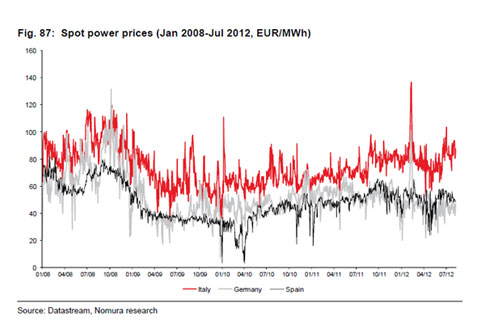
–   “The tariff deficit is created by the manipulation of wholesale price by large utilities”. It would be the most disastrous manipulation ever, when wholesale prices have remained exactly in line with the energy mix, below Italy’s, France’s and Britain’s, and in line with Germany.
renewables III
–  “Nuclear and hydro should pay the deficit.” They do, but it makes no sense to use cheap sources of energy to subsidize more expensive ones. And let’s not forget the string of regional and national taxes that traditional utilities suffer.
–   “If nuclear capacity is shut down, there would be no overcapacity.” Sure, and if EDF and France dismantle their 58 nuclear reactors, there would not be any overcapacity there either. And if Saudi Arabia closes Ghwar and Khursaniyah there is no oversupply of oil. We have to take advantage of technologies that are cheap while they work, and work well, because we need cheap, non-interruptible power. We forget that solar and wind are interruptible and cannot be installed exponentially because the land occupied by megawatt is finite. And the cost of adding a network connection is not properly taken into account.
renewables IV
What has led to this problem? 
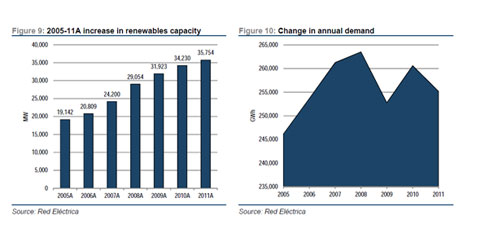
An optimistic central planning based on demand expectations -2% pa growth- which were completely unjustified, an increase of generation capacity and infrastructure -25 000 megawatts of additional capacity in gas and 35,000 megawatts of renewable- and the joy of subsidies to every technology without control –renewables, coal subsidies, capacity payments, island grants…
As subsidies mounted over each other, capacity rose and demand collapsed, we find a power system in which the annual costs -guaranteed by the state- exceed revenues by c4 billion euros … and regulation has always been modified to tax the efficient to subsidize not only “nascent” technologies, but also “dying” ones.
The solution
The solution to this issue will have to be a compromise between the industry, the entire sector-traditional and renewable-, the State and the consumer, and cancel future subsidies in all technologies. From the existing deficit, part will have to be absorbed by the energy sector, the state-responsible for the optimistic planning- and consumers, who wildly applauded the green economy and coal-mining subsidies without knowing its costs.
The German model is simple: subsidies are paid 100% by retail consumers, so people know the true costs of green energy – and 70% strongly agree- while industries, many highly energy intensive as BASF or BMW, do not pay the cost of those subsidies. Therefore, competitiveness does not sink and the country doesn’t suffer from industries closing down due to excessive power costs. Additionally, unnecessary capacity is removed, while inefficient companies go bankrupt, as they should.
The American model is interesting. Investors are given tax incentives, not direct subsidies, for renewable projects. Thus, if there is no investor interest or projects are not economically viable, the system will be reducing unnecessary capacity by the law of supply and demand and, of course, if a company has to file for bankruptcy, it does.
Spain needs to be absolutely clear in its power sector regulation, guarantee legal certainty and avoid changing rules retroactively to solve past mistakes. But the consumer cannot support all costs if everything is subsidized and if there are no market mechanisms that enable cheaper and more efficient technologies to displace the expensive inefficient ones. Our excellent renewable companies are competing exceptionally well in the previously mentioned international models. So let’s not ask at home what we don’t need abroad.
Seizing revenues from the efficient to give it to the inefficient does not help. More importantly, a couple of years later the need for revenues will make the inefficient of today suffer as well.
I commented a few months ago in my article “the problem of fixing the price of power in government offices and not in markets” that Governments and some companies do not like to liberalize. They live very well asking and giving favours while the bill is either not paid or sent to the consumer. Amazingly, while governments see power costs soar, they are surprised to see that the country’s industries close down and that demand falls.
Mistakes in planning –always from excess, of course- have led to a power sector overcapacity that has many similarities to the housing bubble. The generation fleet overcapacity in Spain is enough to cover demand for years. Let us use this opportunity to end the current tariff deficit through market mechanisms.

The myth of “financial terrorism”

This article was published in El Confidencial on August 20

“The phenomenon of economic ignorance is so widespread and its consequences so frightening that the objective to reduce that ignorance becomes a personal goal”, Israel Kirzner.

I spent eight years of my career in the area of ​​Investor Relations and despite suffering the Latin American crisis and others, I never saw the Spanish media insulting investors and spreading conspiracy theories of British attacks on Spain as I am seeing today.

In those days we didn’t approach everything from a sense of entitlement. We had to earn the interest of a market with limited capital. We learned especially from those who criticized us. Today, the global deleveraging process is making capital even more scarce, but our country seems to invoke a right to receive “unlimited capital” unconditionally.

Blaming the waiter for the bad food of the restaurant

Today, the national sport of blaming everyone except ourselves for our problems has reached delirious levels, peaking with articles in the mainstream media accusing the United Kingdom and the markets of “financial terrorism.” It is a handy scapegoat, to use a diffuse entity, the market, as a sort of “evil Dr No” behind our troubles.

This “market” is nothing but our savings, operators which are a secondary consequence of the real causes of a crisis created by ourselves, the states with reckless spending and their central banks. An economic policy based on monetary expansion that generates structural inflation, artificially low interest rates that create bubbles and masses of debt, which ultimately becomes unaffordable, leads to defaults and devaluations that impoverish the entire population.

These media commentators demand every day that the European Union prints, devalues, and raises taxes. However, afterwards the same journalists wonder why inflation rises, and food and raw materials rocket. And their conclusion is obvious: It is the fault of some “evil conspirator” in Westminster or ‘traders’ in London that envy Spain and want to make it fail. Easy. Of course, the hedge funds all together handle a fraction of the funds that the EU manages, but in our ostrich policy of “pretend and extend” the media repeats over and over that hedge funds attack us. Reminds me of my parents’ village, where every time there is a robbery, the people blame the tourists.

Now Spain needs investors like oxygen.

It’s funny that we complain of our unfair bond yields “when the UK is in much worse condition”, the “Perfidious Albion attacking us because of envy”, as the press said of Britain in the Franco times.

When Spain multiplied its debt in four years from €390bn to €734bn and all its regions increased their debt from €60bn to €140bn no one in Spain branded the reckless spending as ‘financial terrorism’, despite squandering money that the country didn’t have. Spending is always justified, and citizens presume good intentions behind it, while now the mainstream media and many politicians attribute dark evil motives and invent conspiracy theories to explain why investors do not trust the country and decide not to buy bonds. Not purchasing, by the way, is not attacking. The country cannot force anyone to “buy.”

In terms of sovereign debt management, Spain should learn from the UK

Let me clarify one thing first. No one is more critical of the UK economic policies than me, I live in London and have been vocal about the very erroneous policy of the previous government of excessive spending and believe the current QE and monetary expansion policy is no solution for recession. But the British ten-year bond is perceived as a solid investment, and there are fundamental reasons for it.

Let me summarize the ongoing debate all over Spain’s economic media. It says: “Spanish bond yields are unreasonably high and the UK’s are unreasonably low despite the fact that the UK is in worse financial shape because the London financial institutions and media attack and exploit our weakness”. Right?, No.

Let’s start with what creates mistrust in the Spanish debt, which needs to be tackled urgently:

-The concerns when accounts do not match. Spreads started to widen aggressively despite ECB interventions with the increase in government spend (the failed 35bn “Plan E” stimulus, the 125bn injected in the savings banks) and the well-known unpaid bills, debts not accounted, while deficit figures had to be revised twice.  If Spain does not give credible and consistent economic data, bond investors, by definition the most conservative and long-term driven, will simply avoid the risk. The UK on the other hand has been detailed and clear not only about swift cuts but stimulus and about budget limitations.

-Institutional credibility and credit responsibility. Everyone knows who to blame for the deficit in the UK, and there is one body and one chancellor who can act on it. There are no debates between parties of “who is less corrupt” than the other, and institutions and their responsibilities are clear and enforced rigorously. Another problem is lack of credit responsibility. In Spain, between savings banks and 17 regional communities with 17 decision centres, each with its vested right to default and be rescued, there is no real political responsibility for the consequences. Regions miss debt targets and then “rebel” against the state. How do they rebel? Not paying their suppliers.

The perception that reforms are cosmetic. Spending cuts in Spain so far have been reductions in expected increases, not real cuts, while the UK has made very deep cuts. Therefore, ahead of uncertainty in the economy, Spain can only count on improving revenues to achieve its targets and that’s a huge risk.

The acceleration of spending. In Spain spending has doubled while revenues stagnated. This acceleration is very relevant. What creates more distrust among investors is the evolution of dynamic solvency ratios (increased costs versus revenue growth), not static (debt / GDP) and also future refinancing needs over the global supply of debt. In the UK, for example, issues tend to be made with very long maturities, and always seeking to avoid saturation of supply. Spain has to refinance, between 2013 and 2015, 259 billion euro, almost the same amount as the UK, 320 billion, but with less than half of GDP and much lower revenues.

The unhelpful messages on default and exit from the euro. If an opposition leader says “if Spain was out of the euro our risk premium would be 300 basis points,” a leader of a majority party says “debt must be declared odious and stop payments” and a minister says “the German banks also benefited from our bubble”, they are unconsciously highlighting in public the risk of default. And investors do read those statements.

Of course, the UK is a country that attracts capital, maintaining investor’s interests as the State’s primary policy, the economy is extremely flexible, and with 8.6% unemployment. The challenges in Spain remain in a regulation that makes investment and job creation extremely bureaucratic, onerous and slow, and an unusually restrictive and cautious approach to foreign investment.

To think that the UK bond yields are low only because the state devalues the currency and monetizes debt is another mistake.

If the panacea to lower bond yields is to print money and have an active central bank easing, Zimbabwe or Argentina would be the countries with the lowest bond yields of the world. Without institutional credibility and credit responsibility, legal certainty and a suitable investment environment, the impact of interventions are temporary and ultimately irrelevant.

The BoE has bought less than half of the debt issued by the UK between 2009 and 2010, the other half was bought by institutions and banks, including, surprise, surprise, a few big Spanish banks.

In Spain the ECB has injected over 400 billion euro to banks, used mainly to buy sovereign debt, more than the Gilt purchases of the Bank of England in 12 months. If the monetization of debt is the reason given by the media to explain low bond yields, Spain has seen a much larger EU-funded program of bond purchases –through its domestic banks- relative to its GDP and its refinancing needs.

Without institutional trust and credit responsibility that prevents default risk on Britain’s debt, the country’s yields would also soar despite BoE purchases.

Bond yields are a reflection of the secondary bond market, ie the investor appetite for the country’s debt. Nobody profits or attacks the country by not buying bonds.

I read that the Spanish government will make a diplomatic offensive to attract investors and I think it’s a wonderful idea.

Three ways to improve:

Stop issuing short-term debt to finance long-term spending, it will take bond yields to stratospheric levels, with or without ECB purchases. It would be positive to see lengthening maturities and a national agreement to attempt the conversion of debt held by domestic entities-nearly 70% of total-to long-term debt.

Attracting capital, as the City of London does. Issue debt to investors who can also have access to assets. One reason for the distrust of investors is because in Southern Europe they are allowed to buy debt but not companies or assets. A national regulation that encourages investment and stops trying to keep out foreign capital would be very productive.

-Enforce compliance and responsibility to those regions and banks with problems. Irrevocable, immediate and demonstrable. If investors see that the money is given out but not controlled, they will not invest.

Strengthen laws to defend creditors and debt repayment. It is not worth changing the Constitution as last year and then a few months later deny of such agreement.

The problem of wasteful spend disguised as ‘real’ economy

I’m getting used to read in the mainstream media that useless investments, duplicate administrations and cronyism are not so bad because they “maintain GDP and employment” and, after all, unnecessary investments in infrastructure “at least are spent in something tangible –real”. Furthermore, these “wasteful activities also generate growth”. This belief is part of a monstrous mistake that began to take shape in the mid 90s when Spain started to see money pouring in from Europe. It had to be spent to get more afterwards. It’s the widespread belief that money is free and that the right side of the balance sheet does not matter or does not exist. “Public money belongs to no one”

This is not true because it assumes that the “money” spent is capital and not debt. If it was capital, I would partially agree. That is, if I’m rich and I spend a significant part of my salary in drinks it is my decision, but it does not have a direct negative impact on my finances. But when it is debt, bad economic decisions cost a lot. That is, if I’m poor and I have two mortgages and I spend a significant part of my salary in drinks I create a double negative effect, the cost of debt and the futility of my expense. The money squandered is not only wasted but it costs, because debt and interest have to be paid by a declining percentage of the profitable and productive part of the economy.

The popular perception in Spain is that if a bridge, a phantom airport or a ghost city that is not needed is built, at least there is something real and valuable. Like China but without its economic power and wealth. The idea that the economic use of those “things” is irrelevant just because some jobs were temporarily created, when in fact there is not only an asset, but an associated liability, and the cost must be covered with the productive returns of another activity or through taxes, or more debt. Therefore, unnecessary infrastructure is not only wasted borrowed money that does not create “real activity”, but it crowds out and eventually erodes the real productive activities, enlarging the debt balloon. The useless bridge-airport-city would only have zero cost to the economy if it were funded with surplus wealth or a donation. And Spain has neither one nor the other.

In summary, Spain must attract capital, learn from its more financially mature peers and forget to support GDP with hot air. No one is attacking Spain, if anything we attack ourselves by scaring investors. The day that the country learns that inflating GDP based on useless spending generates debt that cannot be paid with air; we will start to end our problems.

The Impossible “Soft” Rescue Plan for Spain

(This article was published in El Confidencial on August 11th 2012)

‘I never understood why it is considered selfish to keep the money you’ve earned, but it is not considered selfish to take other people’s money. “- Thomas Sowell

“Our debt is what it is” – Jose Antonio Griñan (President of the Andalucía Region)

I have read during these two weeks many comments criticizing Rajoy for not making a formal request of a rescue package. I will not be one who criticizes that decision. Because those who demand an EU rescue mistakenly expect donations, and those don’t exist. And because the placebo effect of kicking the can forward for a few months just multiplies the negative impact later.

The new term spread all over the press is “soft bailout”. Ludicrous. There is no such thing.

I said it yesterday. You wanted ECB? You got ECB. “Draghi demands lower wages, cuts in social benefits and lower corporate margins” in Spain, a country where wages have only come down in real terms where 23 of the 35 largest companies generate returns below their cost of capital.

Congratulations! We have achieved it. That is the implication of a rescue plan. Cuts everywhere except where needed. Look at the list of recommendations from the ECB to Spain. It is not mentioned even once to cut the monstrous political spending. And this is very important to understand. Neither the IMF nor the ECB nor the Troika will dismantle a hypertrophied state unless it is decided by the democratically elected government, which has been given an absolute majority to make the tough decisions and comply with what they stood for. Budget control.

Bond yields can rise further with or without the ECB

If Spain does not tackle the real problems –excessive spending- we are heading straight towards default, with the resulting consequences of further tightening our access to funding, after sinking our creditworthiness by ourselves.

I commented almost two years ago that there would be a day when Spain would be celebrating bond yields at 6.5% and the spread to the Bund “eased” to 500 points. Sad. And a round of massive purchases of bonds by the ECB is useless without cutting the waste political spending and subsidies, without attracting capital, without curtailing cronyism and duplicated administrations, because Spain will generate less real wealth, less economic activity and therefore lower tax revenues, running the risk of seeing bond yields rising further and spreads to the Bund at 700 bps in 2013, if the differential between income and expenditure exceeds 120 billion.

However, commentators continue to ask the ECB to intervene to save us, when we explained a few weeks ago in my article “Markets expect a full Spanish bailout ” that it does not work with the examples seen in the past. But above all it is worth repeating:

Purchases of bonds from the EFSF or ECB will not lower spreads to normal creditworthy levels (50 points), so asking favours to artificially lower bond yields “a little” is useless and will not attract needed private capital. Spreads will not reach anywhere near 50 bps while Spain is constantly breaking the principle of credit responsibility and rescues saving banks and regions which rebel against the state, after receiving the money -of course-.

Artificial purchases of bonds discourage real final demand (secondary market), and the cost of debt will increase after the short term placebo effect, if the system remains with a structural deficit. The ECB, which is already heavily indebted- or the ESM-EFSF –debt with more debt- cannot buy all the outstanding debt of Spain, and anyway it would not matter because we would still continue the reckless spending and sinking our creditworthiness. These measures temporarily lower bond yields artificially, but the yields rocket again afterwards, as we have seen many times, as if you threw a stone to the water.

These measures don’t “buy time”. They “borrow” even more and create perverse incentives- to keep unproductive spending. But more than anything, these measures do not generate confidence, rather the opposite. All European bailouts have ended up in junk bond. In fact, the bailouts so far generated no new demand for bonds, or improvement in credit for the real economy.

There are no “soft” bailouts, they are a hoax. Given the avalanche of comments from the press that will be talking about a national success because Spain received a “soft” bailout, the reality is that there is no money to rescue Spain and conditionality clauses will be very aggressive. The so-called “soft” bailout would actually be a series of small “lifelines” in a Greek way, to see “how it is going” … accompanied by constant “demands” on the economy, especially taxes, depressing GDP. Look at each and every single bailout since 1978 and its impact.

Artificially reducing bond yields does not solve our problem of competitiveness, or the monstrous primary deficit and the problem of subsidies and political spending. In fact, high bond yields have been critical to prevent the government from dusting off the cronyism check book, and go back to subsidize civil works, unions, parties, new useless trains, solar farms and ghost airports. As I told a friend, “every time I see spreads tightening I imagine a government official signing a check.”

Spain is not Greece, it is several Greeces. As Antonio España said in El Confidencial. If we surrender to a rescue we will go down the same road, but with the huge problem that no EU money or the ECB can extinguish this fire. We are not as important to be too big to fail, but we are too large to be rescued.

And just in case we wanted ECB, here’s some more. Moreover, inflation increases if the ECB carried out the monetization of the debt. Because “printing” increases the cost of raw materials and food, see the case of the U.S. or the UK. And the U.S. “exports” inflation. The EU imports it.

It seems incredible that we continue to demand to do the same as the US-stalled despite the monstrous spending and the push of the oil and technology industry- or the UK-in a recession despite massive stimulus-, when such stimuli did not generate any benefit to the real economy. Six trillion dollars spent globally in “stimulus” to generate a real GDP growth of… 0% (source Boenning & Scattergood) and a decline in lending to the real economy.

In fact, it is proven that increased public spending and borrowing does not generate a multiplier effect and that it cannibalizes the private sector. According to IMF figures, in the U.S., an increase of 7.3% of public spending between 2007 and 2009 to generate an 8% drop in real GDP (not nominal), in the UK an increase of 6.9% over the same period to generate a fall in real GDP of 11%, and all this debt by devaluing the currency impoverishing savers. Of the 34 OECD countries, those that stimulated the economy the most were the ones that generated a slower growth of real GDP.

All this shot of adrenaline to “reduce” bond yields for a few months, last time it lasted less than three months, only to continue spending so that the Spanish regions can all have a debt of 16% and to try to force a stock market rise before the string of capital increases. Pretend and extend.

… And then nothing will be done and commentators will say again that “we need time.”

Of course, there are positive recommendations from the ECB such as open competition reduce bureaucracy and invest in R&D, but those are all long-term policies that will not be likely to take place when there are seventeen governments fighting over the cake of crony-ism.

The recommendations of the ECB, or the IMF, are recommendations of a lender. And as we mentioned in this column over and over again, the ECB does not donate. And as a lender, it demands.

The solution was, and is, the private sector. Show that we are a good investment

There is nothing more entertaining than a manipulated market. And in one we are. But while we pat ourselves on the back for the temporary placebo effect, we are throwing away investment capital, which is what we need. More than 163 billion euros have left Spain in the first five months (source BoS).

Lower taxes now, curtail the ridiculous bureaucracy and attract capital to create businesses, generate jobs and tax revenues, not to consume them as the public sector does. In Spain, a country with interesting assets and modern cities, we could get billions of investment from financial and venture capital funds if all efforts were not focused on limiting foreign investments.

Demonstrate that investment in government debt is attractive. How? Exceeding –not meeting- our objectives. Cutting off useless political spending as the majority of voters have asked, reducing the primary deficit. Do not ever fall back into the temptation of “meeting targets hiding and not paying bills”.

Absolute conditionality. No bailout of savings banks and regional communities. And if they happen, they must meet the same rigorous conditions that the ECB or any lender demands. Now. Not in 2015.

Stop moaning of revenue assumptions that may have been, fictitious and invented figures of tax fraud, and excuses of “we expected” and “we could have”. Focus on what the government controls: spending. Revenues will come, as always, when the economy grows.

I read an article this week accusing Bill Gross of PIMCO and other large investors to be the evil hand not wanting to invest in Spain, when the problem is that we have made Spain uninvestable to many funds through the habit of manipulating and pretending. If there is a bad policy it is to insult those that can fund us, and to think that without private capital, asking for impossible bailouts, we will get out of this, when the state, our banks and our businesses have to refinance, increase capital, and make divestitures of hundreds of billions in the next three years.