All posts by Daniel Lacalle

About Daniel Lacalle

Daniel Lacalle (Madrid, 1967). PhD Economist and Fund Manager. Author of bestsellers "Life In The Financial Markets" and "The Energy World Is Flat" as well as "Escape From the Central Bank Trap". Daniel Lacalle (Madrid, 1967). PhD Economist and Fund Manager. Frequent collaborator with CNBC, Bloomberg, CNN, Hedgeye, Epoch Times, Mises Institute, BBN Times, Wall Street Journal, El Español, A3 Media and 13TV. Holds the CIIA (Certified International Investment Analyst) and masters in Economic Investigation and IESE.

Markets expect a full Spanish bailout

(This article was published in El Confidencial on July 23rd 2012)”Defeat? I do not know the word”. Margaret Thatcher.Here come the shorts. It was obvious. Everyone prepared for a dose of QE from the Fed and the ECB, and when it didn’t happen, on Friday 75% of orders were better to sell.

Spain moves closer to a full bailout. Congratulations, we did it. Years of nonsense saying “we don’t have a problem of public debt” and “we have less debt to GDP than Japan” while our ability to repay was destroyed with wasted money on phantom airports, irrelevant statues, and high-speed trains with no passengers. The Ibex 35 plummets; no one invests in our bonds and the spread to the Bund rockets to 610 basis points. But do not think everything is discounted and that a bailout will be positive.

“There is no money”

The Spanish government in 2011 had fiscal revenues of 377 billion euro, about 7 billion more than in 2009. That means that in the middle of the crisis, with tens of thousands of businesses closing and unemployment rampant, revenues not only remained at a monstrous 37% of GDP, but increased. I estimate revenue of 385 billion in 2012. In other words, there is plenty of money. And there is liquidity, with hundreds of billions provided by the ECB. The only thing where there is no more money for is the public spending bubble, which has soared to 470 billion.

The recent demonstrations, which are perfectly legitimate, must take into account this problem. Today’s cuts come from past excesses.

It is amazing to see that citizens throughout the entire EU seem to presume “good intentions” to those rulers that bankrupted countries through reckless spending, but accuse of “bad faith” to those that deal with paying the bills and cleaning the accounts. The widespread perception that money is free, that spending is good and saving is bad.

Slash political spending now
Maybe it’s a matter of perspective. Arthur Laffer said that he would reduce the deficit in one hour. I am more conservative. Give me the Spanish budget and a red pencil, and I will reduce the deficit to zero within a week. I accept getting paid in government bonds.
What terrifies me is that everyone in Spain seems to have given up and just looks for excuses. It is irresponsible to dismiss as alarmists those who alert of the gravity of our problems. In fact, those who continue to say that “we are on track”, “we need more time” and thinking that this crisis is temporary are doing a huge disservice to the country. The VAT and tax increases will not be “absorbed by companies without affecting consumption” because corporate margins are at bear minimums, and we saw that consumption does fall as in 2010 with the previous VAT increases.

Has Spain given up?
The market does not “put pressure on Spain.” Investors do not buy because the risk of default is too high. Just look at the number of contracts traded on Spanish debt. Less than 40% compared to historical levels.

From a market perspective, there are three issues that concern me tremendously, issues that differentiate us from Italy, and unfortunately place us in the same risk as Greece or Portugal, but with a much larger corporate debt:

-Spanish governments always focus their economic measures on revenues (taxes). 61% of the measures adopted so far are expected increases in fiscal revenues.

The cuts are not real cuts, but slowdown of the increase in spending. I read that the changes in the implementation of the Dependency Law “will allow a slowdown in cost increases estimated at about 3 billion euro”. I repeat, “a slowdown in expenditure growth”. Not cuts.

-Even with the new measures deficit is set to be around 6.5% in 2012, and the government continues to listen to advisers who say that everything will improve next year, as exports will help the economy and they need time to carry out reforms. It’s not true. The economy will not improve in 2013, nor will Spain export enough to cover the structural primary deficit- a key difference with Italy. And no, we have no time.

The perception that this is a temporary issue that can be sorted out increasing revenues is a huge mistake similar to that made by those who said in 2009 that “the worst of the crisis is over.”

¿Full bailout? No thanks. The example of Greece, Portugal and Ireland
We have seen this week a disastrous debt auction which, at the close of this article, has put the 10-year bond touching 7.2% and the spread to the Bund at 610 basis points. And I hear voices crying out for a full bailout and the ECB buying bonds as a great idea.

However, a full bailout does not involve anything positive. Do not expect an intervention to dismantle the bloated regional governments or to encroach on political spending. Moody’s had doubts on Thursday that Spain has any real chance of taking harsh measures on the regions. In fact, the Budgetary Stability Law itself establishes “hard” corrective measures that involve publishing a report and s written warning to the President of the region. Hardly agressive.

Intervention? Once the 10-year bond is up to 7% …
Unfortunately, the bailout process – including the “placebo” effect of useless massive purchases of bonds by the ECB- neither solves the crisis, nor calms markets, nor lowers bond yields unless the economy returns to competitiveness and political spending is slashed. Interestingly, political spending was not touched at all either in Portugal or Greece.

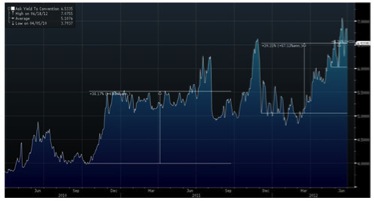
Greece and Ireland acted immediately and asked for a bail-out. Portugal took over five months to officially request one. In all three cases, the ten-year bond soared to 8 to 8.5% when the bailout was requested.
2012072194grafico1But once the bailout was in place, ten-year bonds just kept rising and the rating agencies downgraded the three countries to junk status. None of the countri


The few debt issues in Portugal and Greece were meagre 3-6 month paper, and Ireland was only able to return to the market almost two years after the bailout also with short-term paper, and that was after cleaning aggressively its banking system. The Portuguese 10-year bond is today at 10%, and the Irish is still at 6.3%.
es had access to the credit market.

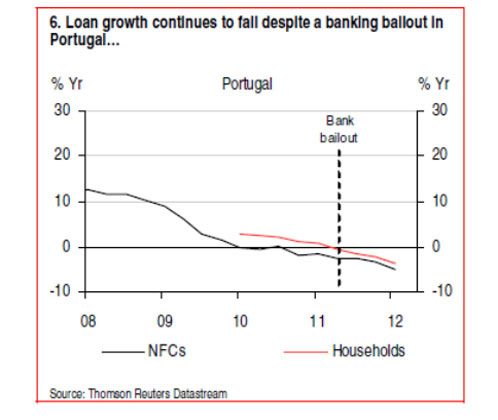
The time from applying for pre-bailout to downgrade to junk bond lasted between four and ten months for the three countries mentioned. Today, none of the bailed-out countries has seen a recovery of credit to the real economy.

Stocks are not discounting a bail-out
There are no “defensive” stocks with “exposure to emerging markets” and “low PE” when a country is bailed-out. Stock markets in Portugal and Greece fell by 44% and 65% respectively, a collapse almost as large as the pre-bailout fall. And we must bear in mind that, despite the poor performance of its stock market year-to-date, Spanish companies are still highly leveraged, a 200% of GDP in private debt, which comes in many cases from IOUs of the state for unpaid invoices.

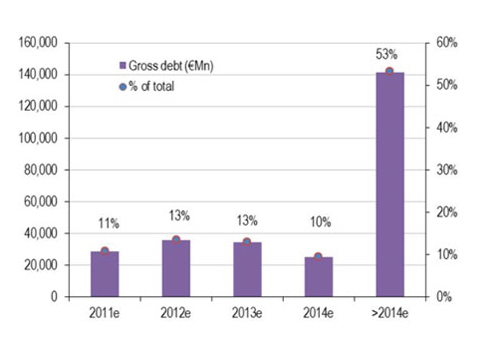
The effect of a bailout for Spanish companies could be much higher than in Portugal or Ireland because of the huge refinancing needs in 2014, accounting for almost 35% of all corporate bond issues in Europe in said year. Without access to credit markets, companies would be forced to do more asset sales, dividend cuts and dismissals.

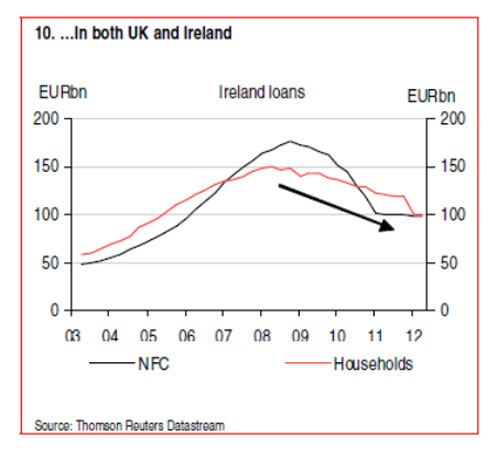
And watch out for the “positive example of Ireland.” The Irish Stock Exchange is the only one that has “recovered” because its index is mostly comprised of net exporters with low debt, no utilities and hardly any listed bank (less than 3% of the index), ie almost no companies subject to the intervention of the State. And despite this, the index collapsed.

Bail-out means massive cuts
Do we want the ECB to buy Spanish debt? More “pretend and extend”. Pack and disguise. We did not learn from the past and the subprime crisis.
2012072178grafico2What has been the benefit so far of the massive purchases of Portuguese, Spanish, Italian and Greek bonds than loading the ECB with losses of 56 billion?, Nothing else but making the ECB the most indebted central bank … and no positive effect either on bond yields or the economy of the countries. “Watering the wine” to make it appear that there is more quantity in the barrel.

Want a full bailout? Not if we look at the example of our comparable countries. If you think that what we have now in Spain is “austerity”, when there is at best a modest adjustment, a full-scale rescue implies all social costs are axed. Severe cuts in pensions and the number of civil servants, raising the retirement age, much higher tax hikes and a collapse in GDP of between 3% and 3.5%. Do not forget that Ireland, the “good example”, suffered a fall in GDP of 7% in a year.

Internal bailout
What Spain needs is an internal bailout. If the government is right and there is “no money” and there is a national emergency then they have to be consistent and cancel the aid to banks, imposing debt to equity swaps to its debtors, cancel all subsidies and grants provided by the government (close to 14 billion a year), close all duplicative councils and pay politicians 50% of their salary in government bonds. Curtail spending now. Immediately.

I do not want a bailout because we do not need it if we cut spending. I do not want the ECB infected with Spanish bonds in exchange for giving away sovereignty because we can show that investing in Spanish debt is a good idea if we adapt expenses to income and stop calling for default and “odious debt”.

Spain can solve its problem, which was and is excessive spending. And then we will see the huge positive qualities of the Spanish economy, with excellent companies that can continue to export and can create jobs if we lower taxes and attract capital, not if we throw investments away.

We must not surrender Spain to the lenders. The ECB and the troika do not rescue, they do not support, and they do not donate. They lend in exchange for much larger cuts. And it doesn’t work, it only impoverishes. It has been proven by previous bailouts and all interventions of the IMF since 1978.

The red pencil to slash unnecessary spending is needed now. I provide the pencil if needed.
Rescued banks and subsidized companies, a bad combination

(This article was published in El Confidencial on July 17th 2012)

The market had high expectations ahead of the announcement from Spain of new economic measures, but the comments in London are almost unanimous. The measures to reduce the deficit and the ones leaked for the electricity sector follow the same principle: take funds from the efficient to maintain the subsidized. It’s easy, as value-added tax revenues have disappointed due to alleged “cheating,” all citizens who do not cheat must compensate for the lost revenues.

Raising VAT is a measure that does not work as seen with previous VAT increases, which generated less revenue. However, it would have been acceptable if it had been accompanied by immediate cuts on the political spending that is choking the Spanish economy.

Instead, nothing substantial has been done about the large subsidies and grants, duplicate government agencies and the unsustainable weight of a bloated state created on the back of the housing bubble.

“Government’s view of the economy could be summed up in a few short phrases: If it moves, tax it. If it keeps moving, regulate it. And if it stops moving, subsidize it.” Ronald Reagan

A government apparatus that is still above the peak levels of the bubble in 2007 has been cosmetically cut ever so slightly and those cuts are deferred throughout three years. As an example, of the 600 loss-making public enterprises that had to be closed, only two have been closed. No hurry. Meanwhile Spain became the fourth country in Europe with higher taxes .

I hear that the reason for these soft measures on spending is because the government “relies on exports” and expect that gross domestic product will not fall “as much as currently estimated”, and as such it will not be necessary to reduce the weight of the state, which is currently “only” 50 percent of the economy.In my opinion, Spain runs the risk of following in the footsteps of Portugal. “We’ve done our homework,” said Vitor Gaspar, Portugal’s finance minister. Yes, all but cutting the weight of political spending. In Portugal, the weight of the state in the economy rocketed and bond yields rose again after the cuts to historic highs.

2012071699grafik 1

The impact on the economy of constantly rescuing and subsidizing entities is brutal because it discourages the efficient, weakens the non-problematic companies and kills the perception of economic freedom, but above all, because it makes “socializing losses” a habit when it should be a truly exceptional measure and limited to extreme cases.

This is important because when we see that the €100bn “loan” to bail out banks includes the following demands:

– A clause that requires banks to have a capitalization (core capital) of 9 percent. This means a larger “credit crunch” than currently seen unless we liberate financial resources currently absorbed by the government, forcing banks to buy sovereign and subsidizing zombie companies.

– Requirement to divest industrial holdings. If tax increases, lack of security and regulatory uncertainty weaken companies, stocks collapse and capital losses of these holdings will be extreme.

– Requires the creation of “agencies to sell troubled assets” – bad banks – in which the taxpayer runs the risk that the price paid by the state for these assets is “far from a bargain.”

When public resources are allocated to bailouts and subsidies constantly and in numerous sectors the crowding-out effect not only hurts the real economy but it also forces taxpayers and investors out. Who will create wealth and tax revenues if we end up with a country of rescued banks and subsidized firms?

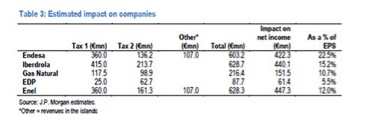
The electricity sector regulation that has been leaked seems equally wrong-footed, aiming to seize revenues from any company that generates positive cash flow. After a decade of planning as if demand were to grow by 2 percent per annum, giving subsidies everywhere. Now that the tariff deficit and the cost of the system have ballooned, the solution is to tax everyone with the risk of bankrupting the whole energy sector, which would be loss-making in generation and distribution in Spain.For reference, I wrote an article a few months ago about the numerous mistakes made by Spain in its energy policy called “The problem of fixing the price of electricity in government offices and not in the market.”

2012071650grafik 2

In a nutshell, we have a problem when most technologies are subsidized and over-capacity is not sorted through market dynamics. Subsidized coal, capacity payments, “restriction” markets, unsustainable premiums to renewables, etc. Overcapacity in the entire system… But who cares when the taxpayer pays for generous subsidies and planning mistakes?

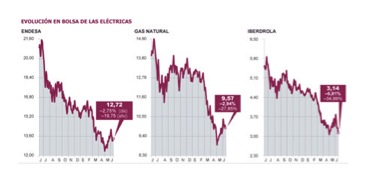
We risk losing investors in Spanish debt and the Ibex 35
If we rescue the inefficient and those who eternally generate losses, we will continue pushing out investments and capital, hurting small and medium enterprises, which generate 70 percent of value added in our country, making it impossible for businesses to grow due to restrictive legislation, high energy costs and an onerous tax burden.The policy of “pretend and extend” of the government aims to help different lobbies, but the problem is that cronyism just makes zombie companies, not strong ones. As the government slowly runs out of other people’s money, even lobbies end up suffering the tax collection greed. Everybody loses.

2012071635grafik 3

The state cannot limit and supplant the private sector. Just looking at the average returns made by government investments in the past eight years is painful. Negative, on average, compared with the cost of capital.

The bank bailouts and unproductive subsidies are two very similar problems arising from the habit of governments of intervening in business decisions and then “try to solve” their mistakes through confiscatory measures. And it’s very easy to do when there is too much money available, but when the government runs out of other people’s money, funding inefficiency and subsidies means more debt.

And then we have a problem with 320 percent of GDP in private and public debt, 20 percent of the total private debt of Spain in the balance sheet of 15 companies of the Ibex, and refinancing needs in 2014 that account for 35 percent of the total “supply” of bonds in Europe.

We must stop intervening wildly. The solution for Spain cannot be trying and failing to recover the tax revenues from the real estate bubble, as I mentioned in this Wall Street Journal article.

I read that the Spanish government is very worried about the possibility that the companies in the Ibex 35 could be taken over. However, through a myriad of taxes, regulatory changes and legal uncertainty, Spain seems to be making its companies unattractive and weaker, massively indebted, uneconomic and subject to the whims of the state both from the investment side (“you have to build at any cost”) and from the side of profits, which are seized from time to time.

It is sad to say, but more and more funds are not allowed to invest in Spain. I hear it constantly. “Spain is uninvestable.” If I were a member of the government, I would worry less about trying to “protect” through intervention and I would worry more about attracting capital.

Blaming the ECB. Better to sink the fleet than to repair the boat

(This article was published in El Confidencial on July 8th)
 
‘Everything is subject to conditionality. There is nothing without conditionality. Conditionality is what gives credibility to these measures’, Mario Draghi, president of the European Central Bank.
 
The new mantra in Spanish media is that the European Central Bank is attacking us. Before, it was the Anglo-Saxon press, then the markets, then,Germany… Now, according to some commentators, it is unquestionably Mario Draghi, president of the ECB, who is to blame for Spain’s misfortunes.
Draghi, obviously, is to blame for the reckless spending, for doubling the national debt, for the most convoluted regulation of the Organisation for Economic Co-operation and Development (OECD), the ghost airports and the phantom cities. Evil.
We have spent a week hearing: “Draghi will connect the printing machine,” and it seemed everyone was shocked when it didn’t happen. The debt threshold is at its limit even at the ECB. Quoting the famous South Park…”Aaaand it’s gone.”
Debt is a drug. And like drug addicts in the infamous crack supermarkets of Harlem, we were looking forward to the ECB to saving us from our debt problem with more debt in order to keep spending. And like drug addicts, even if the ECB lowers rates to indecently low levels, the effects last less and less.
We blame the ECB, which after lending 288bn to Spanish banks and lowering interest rates to 0.75 percent does not “do more.” What more do we want it to do? A donation. Ah, no, my friends, there are no donations.
The ECB does not help. It lends. The ECB doesn’t rescue. It lends. The ECB does not donate. It lends.
When people hear that the ECB should buy Spanish debt they should also know that it’s not a favour, and that there are strict conditions attached to the agreement. But more importantly, people should know by now that the ECB buying bonds does not solve anything, as evidenced by previous purchases, which have not lowered bond yields for more than a very short period of time. 
 
These bond purchases of the past have done nothing but infect the ECB’s balance sheet the same way as the sub-prime debt packages of 2007, without attacking the underlying problem, which is excessive spending.
20120709370709-grafico-1
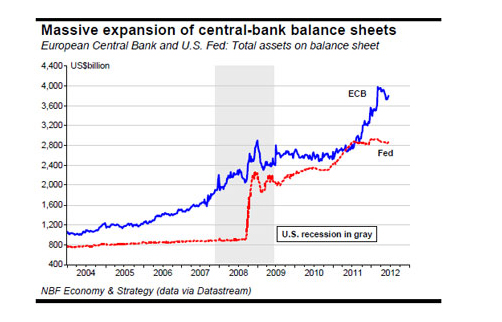
The ECB balance sheet has ballooned to 30 percent of gross domestic product of the Eurozone. The Federal Reserve‘s and the Bank of England’s balance sheet is 20 percent of the GDP of their countries. The Fed and BoE loans are paid back. In Europe, however, no one pays back these loans.
What is a little more debt between rich friends?
The ECB, which has nearly 40 percent of its assets in toxic bank debt, and has lowered interest rates again, has to do “more”. But who contributes to the ECB when all others ask for help? No wonder that Finlandand the Netherlands say: “Me? No, my friends.”
Spain demands “more” from the ECB even when Spain has received the equivalent of two Marshall Plans in aid since 2009. After two injections of liquidity (LTROs) that have crippled the ECB to 3bn of debt, we demand “more”. Expand the balance sheet, they say, which is nothing else than packaging and hiding debt. We demand donations. Well, no.
We live in a manipulated market and the more it is manipulated, the less the placebo effects last, because the real problems are not solved. A manipulated market to benefit the states. Financial repression.
It is curious to hear more and more people demanding financial repression, because that is what they ask for when citizens demand more inflation and mutualisation of debt. And it’s funny because media and citizens demand these measures as if everything was not going to be paid by the taxpayer in the end.
 
Financial repression
 
We claim our undeniable right to be robbed of our savings by lowering interest rates and to sink our financial capacity through inflation.
Commentators tell us insistently that there is no inflation threat. We hear over and over that this is a deflationary spiral, and meanwhile American economist Paul Krugman tells us that “a little bit of financial repression is not that bad.” However, inflation is there and it is a tax, an unfair and accumulated tax created to pay the excessive government debt.
However, the media repeats that there is no risk of inflation. Of course, anyone who pays for groceries, gas, utilities and bills sees prices going up every year while their net income after taxes plummets. Inflation according to “official figures” is 2 percent, yet the real increase in the cost of living is 5 percent per year. I recommend you read this report on the actual inflation in the United States compared to the official.
20120709950709-grafico-2

Every day, I read more suggestions from politicians, economists and other commentators calling for an “audit” of public debts and to consider “illegal” those debts incurred by a state and regional governments that have been democratically elected and supported by the majority.

When one reads “audit,” “revise debts,” or “lenders must bear some of the cost,” one needs to be aware of what it means. It means default. Because then none of us can complain that bond yields are too high. If we call for a restructuring, then bond yields are actually very low, as leaders are telling the market that here is a very high risk that one of them is elected and then defaults.
The consequences of a default are devastating:
 
. The country loses international support. The cost of the remaining debt after default would soar, as has happened in Greece and other similar countries.
. It does not reduce the need to make huge cuts. Spain has a primary deficit of almost 7 percent. Cuts would be even more severe after default, given that the funding of the structural primary deficit would be prohibitive.
. The credit crunch would be enormous. Forget lending to the real economy. The crunch would destroy growth and employment, but as the government would continue spending beyond its means, the crowding-out effect of the state would increase.
. Private companies would suffer immensely. Refinancing needs of non-financial Spanish firms are concentrated in 2014, and many would find it impossible to get financing on the market, which would lead them to cost-cutting and massive restructurings.
20120709510709-grafico-3

One of the most important sentences Draghi said on Thursday was: “What if all countries need help?” The ECB cannot bail out the big Eurozone countries. With what funds? We are talking of infecting the ECB’s balance sheet at 500bn annually if it needs to help Spain, Italy and those who have sought bailouts, when the latest could be Slovenia.

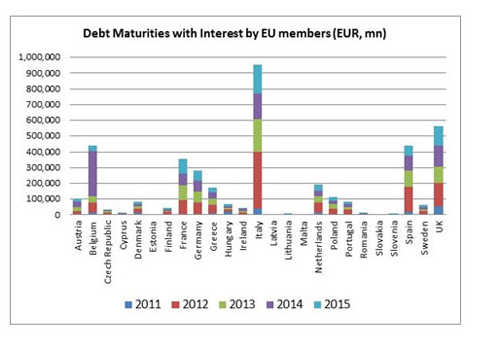
The ECB cannot buy debt without first seeing that countries have carried out drastic reforms that will prevent this debt crisis from happening again in 2014, because Europe faces 800bn of sovereign debt maturities every year over the next three years.

Spain has to solve its structural problems of competitiveness and high spending. To do that there is plenty of support and funding, but there are no donations or quick exits to a structural problem. 
Converting the ECB into the cockroach motel, where what comes in doesn’t come out, would cost much more to all – businesses, citizens and states – instead of doing what should have been done years ago. Align expenses to revenues. What everyone is doing except the state.

Watch the documentary Fraud, Why The Big Recession here:

http://www.youtube.com/watch?v=PTpKGiVwKHY&feature=youtube_gdata_player

Further reading:

http://online.wsj.com/article/SB10001424052702304782404577488283442408896.html


Between junk bond and intervention

(This article was published in Cotizalia on July 1st 2012)

The EU summit concluded with a surprise note. The strategy of Spain and Italy to corner their partners has been a masterstroke and it buys both countries time. Unfortunately, these agreements have had a very modest impact on the Spanish 10-year bonds, still at 6.25 percent, and the spread to the German Bund, which is around 475 basis points.

Why? Because it is still a patch. As someone in Twitter noted ” A decisive solution, using a fund that doesn’t exist to buy debt that won’t be repaid via a mechanism that hasn’t been agreed.” I’ll try to explain it as simply as possible going through the main comments from readers.

Why more uncertainty?

It doesn’t matter which entity we think will provide the funds, be it the European Central Bank, the European Financial Stability Facility or theEuropean Stability Mechanism. They will have to finance themselves in the secondary market, with capital from foreign investors, SWFs, etc. These investors see that the legal structures, mandates and limits of the European mechanisms are discussed, threatened and redesigned almost every month, generating tremendous uncertainty. Therefore, neither the EFSF nor the ESM, when approved, will enter the benchmarks used by funds to decide where to invest.

In short, threatening legal structures that underpin these mechanisms scares investors away, precisely when they are most needed. Would you invest in a fund in which each month the managers threaten to change the prospectus?

We have discussed in previous weeks the enormous difficulties faced by these mechanisms. The ECB’s balance sheet already exceeds 30% of the GDP of the Eurozone, compared with 20 percent of the US Federal Reserve or theBank of England. The European countries that contribute to these mechanisms and the ECB are extremely indebted. In addition, as time passes,there are less “net contributors” because the number of troubled countries grows. Portugal, Greece, Ireland, Spain … and Cyprus, which after four years in the EU, needs a bailout of €10 billion with a GDP of 18 billion.

France already has 89 percent public debt to GDP, Spain surprised negatively on Tuesday with a much higher deficit than expected, German default risk rose 30 percent in a month and meanwhile almost all eurozone economies are in recession or stagnation, while the vast majority of those countries are increasing their debt.

There is no money to continue this “ostrich strategy “of avoiding tackling the debt problems and kicking the can down the road in an EU that feels more isolated from the rest of the world each day.

Why bond spreads keep widening

The spread of the Spanish bond with the Bund is a reflection of the secondary market, ie the investor appetite adjusted by a certain risk. We can complain and make European entities intervene, but if markets don’t see reliable, verifiable and sustainable economic figures and an improvement in the ability to repay debt, investors will not buy bonds. That is why on Friday we saw fund flows of 3 to 1 better to sell.

Imagine a quoted company that is posting weakening results and a major shareholder buys 5 percent in a defensive move. The share price might stabilize for a few days, but then it continues to fall because institutional investors still do not trust the strategy and the profit generation ability of the company. We see the same effect on bond yields after the placebo effect of ECB purchases. Bond yields rise again, due to lack of confidence.

Grand public statements and good intentions are not enough. Until Spain publishes figures showing clear and sustainable improvement of credit qualitywe will not see bond yields fall.

201207019grafico 2

Are markets attacking us?

Investors are not buying Spanish debt. That is not attacking. It is not buying. We should analyze why an investor in bonds, which seeks the lowest risk and the longest duration, prefers to buy bonds at 0 percent yield, the Germans or Swiss, rather than bonds with 6 percent yield, the Spanish. They avoid high yield bonds because they worry more about whether the principal is ever going to be repaid. As Jim Rogers used to say “I am more interested in the return of my money than the return on my money”

With the level of uncertainty about Spain’s public finances, investors feel that 6 percent is not an attractive risk-reward. Spain has destroyed its credibility with changes in deficit figures, broken promises and hidden data for years, and now it has to bring back confidence with facts.

Bond investors do not distinguish between one political party or another, or one government or another. It is a sovereign matter. And if the state doesn’t meet its own targets, investors don’t risk their capital. Would you do it? Would you invest in the debt of a country where targets are not met or are made up? This is what Spain has to solve, now. slashing expenses.

Doesn’t Spain have less debt than Japan?

The spread of Spanish bonds is not high by coincidence or injustice. As a country, Spain always talks of its low debt to GDP, which is a misleading indicator, as GDP, for example, can be artificially inflated by borrowing to build useless things -phantom airports, ghost cities, etc.

What matters to investors is the deterioration of the public accounts, revenues falling and costs rising. Spain’s debt has doubled between 2008 and 2012 but the country has not done enough to stop the escalation of spending while tax revenues coming from the “housing bubble” disappeared. But the expenditures have remained untouched, most of all subsidies and bureaucracy. Spain had three major bubbles: Debt, Housing and State size. Of those three, State size is the one that has not been burst.

Imagine having a credit card for which one pays interest. If expenses double, but income stagnates, first one sees the interest rate rise, and if expenses don’t fall the credit card will be cancelled. And this does not mean that the issuer of the card is “attacking”, it just means that the card holder becomes an unreliable debtor.

Many will say that a country is not a credit card and that “we deserve” to be funded at lower costs. Fine, then, as a country, we should do what households and sensible companies do. Cut expenditures.

Intervention, let’s go

What happens when the credit card is cancelled? That one has to go to a lender of last resort that will solve the liquidity problem, but will demand cuts and high interests. Like those TV ads that say “reduce your monthly payments”, “we consolidate debts into one comfortable monthly payment”… at exorbitant interest rates and with severe penalties.

The problem of using the word “bailout” or “intervention” is that it has a positive connotation, almost humanitarian. I would recommend that when you hear the word, change it in your brain for “mortgage” and when you hear ECB think of “lender”. It shows a completely different meaning.

Some readers tell me they prefer an intervention than keeping our corrupt politicians. I do not know what to say. Changing politicians who have been elected to bring others who are not elected from Brussels? I am not sure, particularly when the latter have a track-record as poor as that of our own leaders.

Blame it on Germany for financing our real estate bubble

As a Finnish member of parliament said to me, “the fact that I have lent to a friend €1,000 and he has wasted the money in parties does not mean that I have to continue lending him or that he doesn’t still owe me my money”. Responsibility must be shared, but donations should not be expected.

But what if we are rated junk bond?

Rating agencies, I’ve said it many times, act always late and poorly. With Spain, investors have assessed its credit risk well below what rating agencies said since March 2011 at least. I always say that a rating agency is an entity that charges Paul McCartney to inform him that the Beatles split up.

First, Spain is not junk bond. But the risk of downgrades cannot be tackled by promising income that never comes, or by giving excuses for poor data, as any rated quoted company can tell. It is tackled by cutting costs and showing better numbers than estimated.

But if we cut spending, we lower GDP

Sure, let’s put more debt into the economy to build useless things until we have the GDP of China and let’s see how we do.

Of course cutting expenditures lowers GDP, but it also slashes the deterioration of our debt problem by a bigger percentage. Spain needs to cut political spending, duplicative administrations and unproductive debt that only generate impoverishment. We are talking of tens of billions per annum.

Print money?

It’s a unanimous cry. Let’s print money. The ECB must buy the debt of our wasted years and monetize it, creating inflation. Let’s do like the United States which “only” has a debt of $50,500 per citizen.

Print money in the EU, when the euro is only used in 25 percent of global transactions would generate high inflation. To begin with, we would have to see if our partners accept to drown the ECB in more debt. But I am surprised that people cry for inflation mentioning an “adequate” level of 5 percent-official, as real inflation would be 8 to 9 percent. I am shocked to hear people calling for their own impoverishment to allow the government to continue spending recklessly. If citizens think that raising VAT is a disgrace-and it is-inflation is the same, but “undercover” and cumulative.

Then there is no solution

Of course there is. Cut spending, duplicative administrations, subsidies and grants, be a serious country, open the doors to free market, and stop thinking that everything is arranged in the Eurozone web of cronyism, patronage and debt.

This week I wrote an article in the Wall Street Journal detailing the four points which, in my opinion, would help Spain to reduce bond yields. None of those points is to “solve a debt problem with more debt,” and the agreement of the EU is exactly that. It gives Spain and Italy time to accelerate and deepen reforms, but is nothing more than a loan.

Of course Spain will be helped and the country will emerge from this mess, but it will not be by going “back in time” like Huey Lewis & The News. It will be through cuts in spending and liberalizing the economy.