All posts by Daniel Lacalle

About Daniel Lacalle

Daniel Lacalle (Madrid, 1967). PhD Economist and Fund Manager. Author of bestsellers "Life In The Financial Markets" and "The Energy World Is Flat" as well as "Escape From the Central Bank Trap". Daniel Lacalle (Madrid, 1967). PhD Economist and Fund Manager. Frequent collaborator with CNBC, Bloomberg, CNN, Hedgeye, Epoch Times, Mises Institute, BBN Times, Wall Street Journal, El Español, A3 Media and 13TV. Holds the CIIA (Certified International Investment Analyst) and masters in Economic Investigation and IESE.

Anti-climatic Change, and UK Nat Gas

(This article was published in Cotizalia in Spanish on December the 8th)

UK Gas balance

In May 2010, gas inventories in England were at a truly low level, with storage almost empty, at a level of 35%. The country decided not to take the opportunity of having gas prices at a minimum to fill storage for the winter. Why, You may ask yourselves. Two reasons. On one side, a group of scientists who had advised the ministry and the industry that “climate change would create one of the warmest winters of the last hundred years”. On the other, the view that would have “radically hot and dry” winter(The Guardian, July 2010) due to the effect of La Niña.

Additionally, the Uk decided to play “commodity trader”, and clung to the estimates of CERA (Cambridge Research) and Wood Mackenzie about a bubble of gas in Europe from 2010 to late 2012 . According to these estimates, the Qatari government was going to flood Europe with cheap liquefied natural gas, the Russians were going to get nervous and cut prices aggressively, and the Norwegians would have to sell below cost price. Even agreeing that the gas market has spare capacity, and I have written about it several times, is very imprudent to take a bet on prices to fall, not to secure supply, when the price can move dramatically depending of many factors.

Of course, today at 2 degrees below zero, the British gas system is in deficit of between 15 and 25 million cubic meters (see graph). Of course, the “scientists” were wrong by as much as 170% in their projections of climate, and thus gas consumption. Of course, gas producers have not foolishly flooded the market. And nothing happens here, no one said it had been wrong, while England and the continent are desperately trying to buy more gas …. 41% more expensive than three months ago.
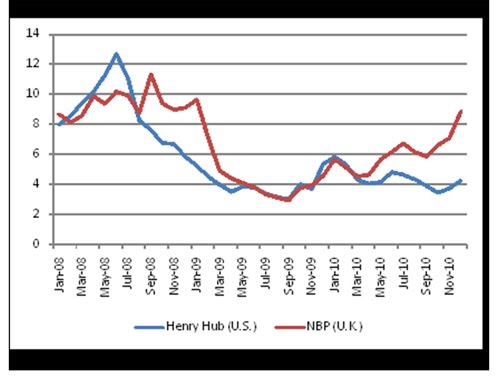
UK Gas vs Henry Hub

In Europe we have spent more than a year complaining about the oil-linked formula of long term gas contracts with Gazprom and Statoil. Of course, when gas has decoupled aggressively from oil, as gas demand growth has slowed down dramatically, we have seen governments and E.On-Ruhrgas, GDF-Suez ENI and others force the machine to renegotiate their contracts with major gas producers. Perfectly acceptable.

Anecdotally, I remember the CEO of Gazprom say in London that for eight years, when long-term oil-linked gas contracts were very competitive compared to spot gas, no one complained. And he said if it was not possible to renegotiate the contracts but with retroactive effect, ie, all they had lost between 2002 and 2008 subtracted from what buyers have lost between 2009 and 2010.

Well, now that they have renegotiated up to 20% of contracted volumes to be linked to the price of spot gas… Surprise. The spot price ($8.8/MMBTU) exceeds the long term, compared with the price of Gazprom ($7.8/MMBTU) and Statoil ($7.5/MMBTU). These things happen. And of course, solar and wind energy can not cover the difference in consumption, and the bill of the average consumers in the UK, for example, will rise by 20% when it would have only risen 9% if the measures had been taken to ensure supply and maintain the reserves filled in summer with gas prices 41% lower.

Of course, they forgot that the gas market is also global and is one of the most rapidly adjusted given supply is focused in very few countries. And the liquefied gas, LNG, and especially the spot part, which is still less than 12% of total gas, is sent to that market that pays the highest. Asia, in this case. So again, companies and politicians, instead of worrying about security of supply and proper planning, decided to play the market. A lesson to be learned by all European countries.

The Independent states that despite the low temperatures and having been a 346% wrong in their estimates of 2002 about the melting of the Arctic, global warming is a looming problem that will cause one million deaths in 2030. With this track-record of successes, I can not help but tremble.
Africa, The Most Promising Frontier Area for Oil

AfricaConference_FINALCall_for_papers

(This article was published in Spanish in Cotizalia on Thursday 2nd December 2010)

The oil world is preparing for a new capex super-cycle. In the past 14 years I hadn’t seen a building activity in rigs and seismic vessels as significant as this one. As the world seeks to reduce investment and reduce debt, the oil industry is expected to increase 15% its capex in E&P. And as for new equipment built, it might not reach the 1982 peak, but it’s getting close.

The oil world post-Macondo not only has not slowed down in activity, but every day we see more companies increase its drilling capacity. Three reasons:

a) The oil companies can not develop the recent discoveries fast enough.

b) The industry has finally realized that the era of cheap oil prices is over and we can not continue planning at $25/bbl.

c) Tightness in deep water rigs and equipment has increased as companies seek to accelerate the development of discovery in Brazil … and Africa.

The event that many companies expected (prices to come down and oil service costs plummeting after the moratorium in the Gulf of Mexico) has not occurred. And it has not happened because not only Petrobras is almost monopolizing the market by placing orders for oil rigs at breakneck speed to meet its development program in deepwater fields, but because independent companies are doing absolutely outstanding discoveries in Africa.

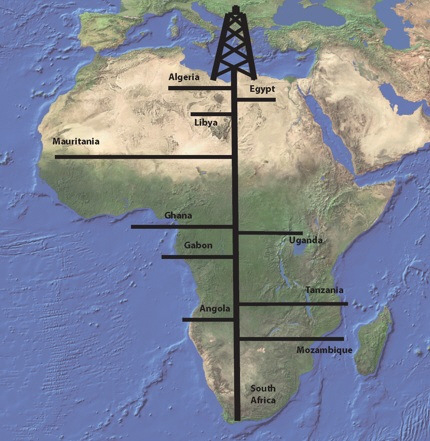
Africa overall has about 10% of proven reserves in the world. Not much. But new discoveries have increased the possibilities to advance in the basin of Guinea-Sierra Leone-Liberia-Ivory Coast and Madagascar, and Mozambique-Tanzania-Kenya, which is estimated to be as productive as Tupi in Brazil. There are three factors that differentiate Africa from other areas of the world:

a) Crude oil of very high quality.

b) Geological areas relatively close to the water and ports (so no need to build huge pipelines and infrastructure).

c) Oil outside the influence of OPEC (ex_Nigeria and Angola, of course).

d) Very favourable economic and administrative conditions.

Even the most sceptical would agree that the negative naysayers have had to reduce the estimated cost of development in areas like Uganda and Ghana and expand the reserve estimates (Wood Mac Kenzie has been a clear case of erring on the side of caution in their estimates). And this has been proven, as always, by the independents.

Both in Uganda and Sierra Leone, Liberia, Tanzania and Mozambique, independent explorers have shown that not only the accumulation of hydrocarbons was much higher than originally estimated, but the capacity and speed of development of these discoveries is better than initially expected. Over the past five years, the discoveries in Africa are proving to be of really attractive quality and strength.

Now, once that independents have tested these areas, the big oil companies are re-launching the African region programs with total investments estimated at over $150 billion in the next three years. From Kenya, which was almost forgotten by the industry, to Mozambique, including Madagascar, the geological structure is already estimated, by many companies as AFREN, to be very similar to Tupi in Brazil. In meetings with exploration companies since 2004 I have been following these discoveries and today I can say that all expectations have been exceeded, so the sceptics should at least give them the benefit of the doubt or to take a breath.

Anadarko’s CEO, Al Walker, estimates more than 1 billion barrels of oil equivalent in their recent discoveries in Africa. And BG just discovered the equivalent of 2 billion cubic feet of gas reserves in Tanzania.

Since 2001 there have been more than 15 billion barrels of oil equivalent discovered in non-OPEC Africa, and 2 billion of those barrels only in 2010. In 2015 it is expected that 20% of world production will come from Africa (ex-Nigeria). Cheap oil, of high quality, free of restrictions from OPEC and with lower administrative and political problems. No wonder that the U.S. considers Africa (ex-OPEP) as a strategic frontier in the war over natural resources.

Update:

Ophir provided higher-than-expected gas resources in Jodari in Tanzania (3.4tcf vs pre-drill estimate of 2.2tcf) de-risking concerns about the pace of gas discoveries needed for an LNG development.

Shale Oil: 600 years of abundant energy supply?

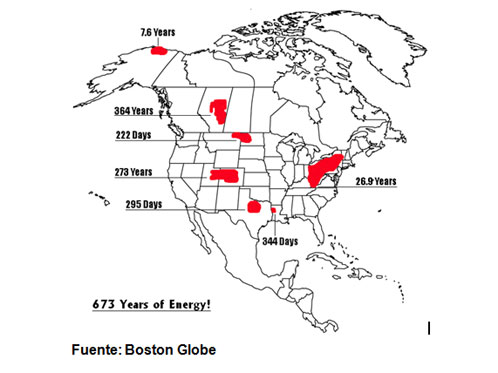
US map shale oil(This article was published in Spanish in Cotizalia on November 25th 2010)

Imagine the following scenario. We are in 2020. China has captured 15% of world reserves of conventional oil and gas from its own resources and acquisitions in Africa and Latin America, Middle East and Russia control 60%, the U.S. controls 20% … and the EU? 1%. Nothing.

This is the geopolitical landscape that a good friend, geologist and energy expert who advises the U.S. administration, painted over breakfast in New York, commenting on the recent study by Sanford Bernstein on the electric car.

In this study, assuming the most optimistic forecasts of the U.S. administration, the introduction of electric cars will only increase electricity consumption by 0.4% and my friend told me that the analysis of the U.S. administration expected a “conversion oil-electricity “… that is negative!.

That is, 4.1 million electric cars (about 5,700 MW of load) will not only increase power consumption by a tiny fraction, but will not reduce oil consumption as the energy intensity of the process of network investment, re-industrialization and adaptation of the park ($14.8bn pa for 10 additional years) means increasing the consumption of oil and gas by almost a million barrels a day.

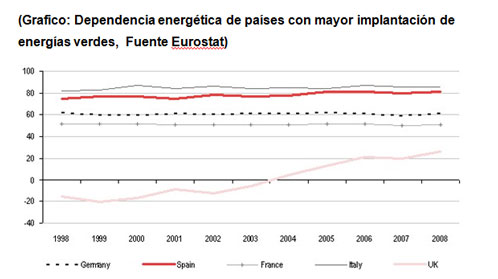
Some of my readers have rightly commented on the risk of energy policies that do not take into account the in-out cost (energy consumed per kilowatt hour generated). In the UK this has been particularly evident (see above graph showing the evolution of energy dependence in countries with strong “green policies”)

Do you know what is the solution? Interestingly, the Obama administration, that criticized the “drill, baby drill” messages sees only one way to mitigate the effect. Increase drilling permits (+75%!) And double-check the possibilities of “Shale Oil” with 143 drilling licenses in North Dakota, where there are more than 4,000 active wells, surpassing the record of 1981.

electric car

It is worth recalling that the concept of “Shale Oil” is not new (has been investigated since 1920) and until recently had been considered too expensive to be commercial … Until the price of oil stabilized at $80 a barrel. Besides, the horizontal extraction technology has seen a giant step in terms of cost and efficiency and the war for natural resources has accelerated. With more than $100 billion in oil and gas transactions worldwide, 39% more than in 2009, nobody can ignore new options to accumulate resources, and above all in the OECD.

The United States accounts for 72% of the world’s Shale Oil reserves. With an organic-mineral ratio of 1.5 to 5, similar to crude oil and about three times higher than coal, the challenge is to continue to explore and determine the commercial potential and the average lifting cost, estimated at c$10-15/barrel.

Unresolved issues

Shale Oil still has many unknowns. One of them is access to sufficient water to fracture the rock and the typical environmental restrictions. But it sums to potential reserves. And after the success of horizontal drilling technology in shale gas, no one should dismiss the possibilities.

In the Bakken formation, one of the most commented in the American press, which extends from Dakota to Montana, there could be an estimated 1.5 trillion boe of shale oil reserves. Around 600 years of abundant energy … if we get to perfect the technology to make production economical.

For now, the latest round of oil concessions in Bakken, Eagle Ford and Niobrara have attracted more than $72 billion of private investment. And taxes and costs so far are not low. There could be an estimated 400,000 barrels per day of production over the next five years.

Only five years ago many people dismissed shale gas saying that it was not economical below $6.5/MMBTU and would never be a real alternative to conventional gas. Today the shale gas revolution has taken gas prices (Henry Hub) to $4/MMBTU levels, and companies are still drilling and generate solid returns of 12-15% IRR without debt.

Now we see the revolution of shale gas reach Europe, starting in Poland, as we mentioned here. So beware of dismissing shale oil. Hess, Williams, PetroHawk, Noble, EOG and others are betting hard on it. At $83/barrel and with horizontal drilling technology improving every year, it is something worth bearing in mind.

This will make you think twice about your long gold

This is an email sent by Cave Montazeri of Barclays Capital doing the rounds all over the market. Great piece and deserves to be read:”You could take all the gold that’s ever been mined, and it would fill a cube 67 feet in each direction. For what that’s worth at current gold prices, you could buy all — not some — all of the farmland in the United States. Plus, you could buy 10 Exxon Mobils, plus have $1 trillion of walking-around money. Or you could have a big cube of metal. Which would you take? Which is going to produce more value?” – Warren Buffett

Being a geek from the Golden State, I figured I ought to check those numbers:

Gold is traditionally weighed in Troy Ounces (31.1035 grammes). With the density of gold at 19.32 g/cm3, a troy ounce of gold would have a volume of 1.61 cm3. A metric tonne (equals 1,000kg = 32,150.72 troy ounces) of gold would therefore have a volume of 51,762 cm3 (i.e. 1.61 x 32,150.72), which would be equivalent to a cube of side 37.27cm (Approx. 1′ 3”).

According to the world Gold Council (www.gold.org), at the end of 2009, the total volume of gold ever mined was approximately 165,000 tonnes. That is equivalent to 8,540,730,000 cm3; or about 300,000 cubic feet, which matches that Warren Buffett said (“You could take all the gold that’s ever been mined, and it would fill a cube 67 feet in each direction”). At current price of gold ($1,361) that is a total value of $7.2trn

Exxon Mobil’s market cap is $340bn so 10 Exxon Mobils would cost you $3.4trn (for ease of computation this is assuming to takeover premium). Alternatively, for $3.4trn you could also take 100% ownership of ALL the following companies: Exxon Mobil, Apple, Microsoft, Berkshire Hathaway, Walmart, Google, Procter & Gamble, IBM, J&J, GE, AT&T, Chevron, JP Morgan, Oracle, Coca-Cola, Pfizer, Wells Fargo, Cisco Systems, and Intel

Finally on his last point, according to the USDA, there is 922m acre of farmland in the US, of which 406m can be used for crops (the rest includes woodlands, pastureland, ponds, wastelands, etc…) at an average price of $3,500 per acre; for a total purchase price of $3.2trn (for ALL the farmland)

So the math adds up: $3.4trn worth of S&P 100 companies (10 XOMs for example) + $3.2trn for all the US farmlands + some pocket change left to spend on ipads and parties. Good job Warren Buffett. I’ll buy some farmland REITs.

http://www.ritholtz.com/blog/2010/08/i-love-gold/