Category Archives: On the cover

On the cover

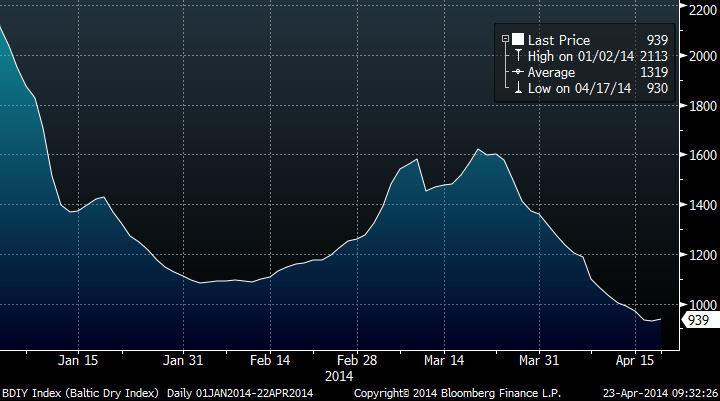
Baltic dry Index falls 58% YTD

BDI April


I mentioned it here. The Baltic Dry is showing that global trade is not improving while the fleet continues to grow.

It’s the same old scene… as Roxy Music would say. Too much supply, too little demand.

. Fleet growth +6-7% in 2014 and 4-5% in 2015. Roughly 16M DWT (dead weigh tonnage) of capacity was delivered in the first quarter of 2014 (annualized growth of 8%). A huge number not absorbed by demand.

. Spot  rates in the 6 major global routes have averaged $10kpd YTD, down $4-5kpd from last year’s levels.

Demand slowdown:

. Reported chartering data have been relatively flat compared to last year. Chartering has grown less than 1% pa in the past two years while fleet grwoth has exceeded 2.5% pa.

Capesize rates continue their free fall. Despite a solid number of new charters to China, mostly from Australia, spot Capesize rates are now at $9kpd (-64% MTD).  Brazilian activity is still low and Chinese steel demand remains poor despite stockpiles of flat and construction steel products falling, now -15% YoY.

Some positive support short term:

China continues to show strong demand for iron ore imports. Credit Suisse counted 27 iron ore fixtures last week, which is up 20% over the trailing two month average.

… But overcapacity is not addressed

The overall picture for the next two years is a moderation in the overcapacity increase, not an imprvement in the supply-demand balance. It is hard to see dayrates improving dramatically in such a scenario even if global chartering increases 5%.

Commodities Update

Now Ukraine is making a real impact on commodities. UK gas is up 4.2% MTD. Europe has three months of gas demand covered in case of disruption and 65 days of demand in oil inventories, according to ENI CEO.

Brent is up 0.6% MTD at $107.28/bbl, while WTI is up 2.75% at $103.48/bbl. The geopolitcal risk has cranked up with the Kiev government giving Russian separatists until this morning to disarm & leave public offices while there continue to be reports of a large Russian troop presence on the Ukraine border. Libya’s western export terminal Zawiya has re-opened after being vacated by protesters. CFTC data released on Friday saw money manager long positions in futures & options for the week to 8 April rise by 24,310 to 380,000 contracts. North Dakota oil production averaged 951k b/d in February, +16k b/d from Jan & +170k b/d y/y.

Coal is up 49bps at $81.30/mt. Indonesian thermal coal exports dropped to 32mt in January, the lowest level in 5 months and down 9% YoY, according to official customs data. Steel inventory continues to be drawn down rapidly in China, with reported stocks held by traders falling 3.9% over the last week. Trader stocks are now 15% lower than a year ago. Inventory of rebar on the Shanghai Futures exchange also dropped sharply, falling by nearly 240kt to 2.5mt, the lowest level since the rebar contract started trading in June 2009.

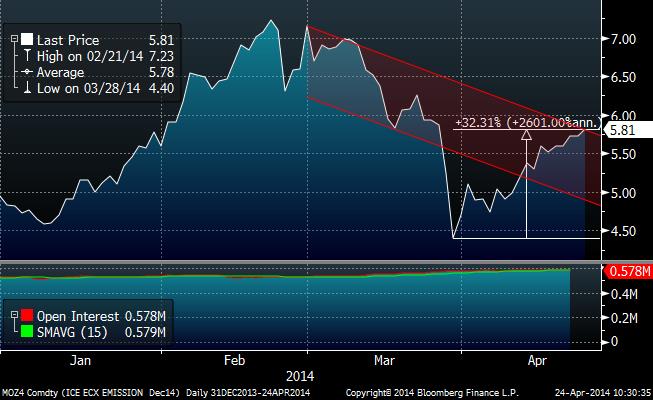
CO2 is up 15% at €5.39/mt driven by higher coal and gas utilization in Europe on security of supply measures and expectations of EU backloading to withdraw 9m tonnes of oversupply.

US gas is up 5% at $4.65/mmbtu as the weather trade slowly unwinds after inventories rose 4 Bcf, below consensus expectations of a 15 Bcf injection. However, strength is derived from the fact that inventories are now 826 Bcf, widening the deficit vs the 5-yr avg to 994 Bcf.

UK gas opens is up 4.2% at 53.20p/th driven by the Ukraine dispute and Gazprom threatening to cut supplies to Ukraine. Inventories are still above 4,000 mcm.

Power prices reacted positively to gas spike. UK power is up 40bps at 50.40£/mwh, German power is up 58bps at €34.55/mwh and Nordpool up 0.16% at €29.65/mwh.

High Frequency Trading and ‘Market Rigging’

My interview and debate on CNBC about High Frequency Trading.

By my colleague and friend Mike Earlywine @MEWINO, senior trader and options expert:

As you may have heard Michael Lewis has a new book out called Flash boys.  It is about High Frequency trading,(HFT) and it is creating quite the fire storm in the financial media and among the various market participants.

Michael Lewis has been in the press promoting his book by saying that the market is rigged.  Surprisingly, for how easy as it is to vilify wall street, there has been some push back.  Part of the problem is that HFT means different things to different people.  It is often confused with computer based trading or algorithmic trading.  Often it is spoken about in conspiratorial tones that make is sound illegal or something out of a bad Hollywood movie.  But his claim that the market Is rigged has galvanized many people to defend what is right about our market.  Either way,  It is a complicated topic and I hope this summary helps.

In the first part I use the Open letter from Charles Schwab to opine on what I think the real concerns are, and in the second part I give an example of HFT in its truest and simplest form

The controversy –

Like many I think the current market structure is flawed and rife with unintended consequences but I am hesitant to vilify the firms that take advantage of the fragmented market that has evolved over the past 10 years.

This letter from Charles Schwab really sets out in detail what a lot the controversy is actually about.

* My comments on the letter are in inverted commas.  http://www.aboutschwab.com/press/issues/

  • Advantaged treatment: Growing numbers of complex order types afford preferential treatment to professional traders’ orders, most notably to jump ahead of retail limit orders.
  • Unequal access to information: Exchanges allow high-frequency traders to purchase faster data feeds with detailed information about market trading activity and the specific trading of various types of market participants. This further tilts the playing field against the individual investor, who is already at an informational disadvantage by virtue of the slower Consolidated Data Stream that brokers are required by rule to purchase or, even worse, the 15- to 20-minute-delayed quote feed they have public access to.
  • Orders that jump ahead? What are these order types? I am still working with limit and market orders?!? There are no special order types just for HFT, but there are many SEC approved order types that are only used by the HFT type traders.  It can cost upwards of $50mil to put the infrastructure in place that would make some of these order types useful.

  • Is this what people mean when they say HFT guys can see an orders coming?  Are they monitoring the high-speed feed and then transacting in front of it against what are about to be stale quotes? YES that is exactly what they are doing.  The SEC is aware of and allows exchanges to sell this different feeds. After consolidating the ticker plants the high speed feeds are only 1.5milliseconds faster than the regular, but that is enough for these guys to pick off stale quotes.  (this is why co-location is so important. Every millisecond counts when your stealing fractions of a penny).


  • Inappropriate use of information: Professionals are mining the detailed data feeds made available to them by the exchanges to sniff out and front-run large institutions (mutual funds and pension funds), which more often than not are investing and trading on behalf of individual investors.
  • Can’t fault firms for taking advantage of all the information they are buying… but just what are they buying? How detailed and what data points are in there.  I can sniff out big order just watching the tape so I’m not sure how hard it would be to do if I was getting special data points. But whatever it is, it is not illegal or even surprising.


  • Added systems burdens, costs and distortions of rapid-fire quote activity: Ephemeral quotes, also called “quote stuffing,” that are cancelled and reposted in milliseconds distort the tape and present risk to the resiliency and integrity of critical market data and trading infrastructure.  The tremendous added costs associated with the expanded capacity and bandwidth necessary to support this added data traffic is ultimately borne in part by individual investors.
    • Posted shares don’t accurately reflect what can be truly transacted – HFT have a very low risk tolerance so they fade any move. They don’t stand still, they only transact when their model says they can get the offset.  I am the same way, I only transact when I think it benefits me, but I think in 5 and 10 cents increments. HFT math is done in fractions of a penny and includes rebates – my math leads to finding other intuitions with different opinions or a different urgency on timing.  Their math leads to small trades with little valuation component – rather it is based on their ability to close out the trade at a profit or flat.

    • I am constantly trying explain how I can struggle to buy 100k shares of a stock that has traded 1mil on the day.. but HFT can have that kind of effect, both through fading and because their activity can move a stock to a price level where the institutions don’t want to transact.  For example, it is not uncommon to see a stock move multiple percentage points on  HFT like activity, but when I come in to sell at that price there really is no contra side (there was no real price discovery, it was instead a temporary price inflation due to mechanical HFT strategies.)

  • This is the part that drives me crazy – I think it is probably market manipulation -They try to overwhelm the system in an effort to push the market to certain levels.  BUT the worst part of this gets little attention. By quote stuffing they are excluding participation by other investors. It is no longer about finding the right price or taking advantage of what you consider mispricing it is more about protecting turf and bending the rules to protect their access to liquidity.  The original rules of the NYSE included a rule that held an order up for a specific time so traders could match and bid or offer. It was just 1min and  allowed anyone to participate in the trade. It was there to make sure the biggest and fastest didn’t monopolize the exchange…they had it right and we have lost something in our quest for instant execution.

  • An Example and some further comments on this point:

Basic HFT example– a simplistic look at HFT trader strategy – This is an example of what they do, but it’s not what is causing the controversy


  • Exchange A pay a few basis points if you take liquidity  – business model promotes activity

Exchange B pays a few basis points for posting trades – business model incentives providing liquidity


Example


My super-fast computer sees that Exchange A   has  100 ABC offered at $20


HFT – step one –  buy the 100 from exchange A  get paid fractions of a penny on rebate

HFT – step two – offer 100 shares of ABC on exchange B at the same price or a higher price depending on my strategy and or risk tolerance

HFT – step three – hopefully someone buys those shares and I get paid again because exchange B pays for liquidity

HFT – step four – repeat thousands of times a day in hundreds of different stocks


NEED for SPEED


  1. Once I open a position I need to get in the front of the book to post my closing position to reduce my risk exposure
    1. No free lunch I am still exposed to the market and could lose money
    2. My models might have all kinds of stats on likely hood of execution  but I still need to be first to market to get paid
    3. I am competing not so much against traditional institutions but against other HFT players!
      1. I have to compete to buy or sell the opening position and I have to complete to close it too
      2. Being late can expose me to market risk that my strategy is not designed to manage
The challenges of Europe

Here is my interview on CNBC discussing the risk of complacency, lack of reform, governments intervention and debt in Europe.

We have started to see signs of optimism in Europe supported by a macroeconomic environment that, far from being attractive, is showing some encouraging data. But the fragility of the recovery is still high.

  • Industrial production indices are approaching expansive levels.
  • Corporate margins are improving, quietly, thanks to exports and cost control.
  • Private debt has been reduced to 2006 levels.
  • Financing costs for small and medium enterprises, including Spain and Italy, have fallen to two-year lows.Gas imports have increased for the first time since 2008, which is very relevant to industrial activity.
European Recovery

European Recovery

(Courtesy Morgan Stanley, SocGen)

All these elements themselves should not lead us to be overly optimistic, but neither should be ignored.

Recovery is extremely weak since, at the same time, countries persist in tax rises and attacks on disposable income that depress consumption. And if we don’t see an improvement of consumption, all other variables are simply smoke.

Unemployment and consumption are the two great scourges of Europe. With all the government support and a highly interventionist state, unemployment in France has reached three million people. In Spain, above 5.8 million, it has  shown a moderate slowdown in job losses. But job creation is only going to happen when consumption recovers, and that will not happen in an environment where disposable income is curtailed and taxes destroy families and SMEs. The fiscal burden in the European Union is already about 40%.

Threatening to raise taxes on big business now is another huge mistake. They’ve been a pillar of internationalization and growth, and thanks to them we now have global multinationals, employing tens of thousands. But these strategic moves cost a great effort in debt and weak balance sheets.The cleaning of such balance sheets has not been completed in full, despite cost savings and divestitures, and to raise taxes is a dangerous move that creates more harm than good. Because these large corporations are also big employers, generate the bulk of private investment in the countries, and their social security contributions are one of the main guarantees of the financial sustainability of the welfare systems. Further tax changes would also delay the entry of foreign capital until conditions are stable and attractive.

The European Union has warned France that it can not go higher in its tax burden. Unfortunately, as always, tax hikes delay the recovery and do not generate the desired revenues.

The tax increases are not helping consumer or employment, but also do not improve the borrowing countries. Keep in mind that at the end of 2013 the debt to GDP in the euro area might exceed the current 90.6% by at least 1%, and that the state deficits continues to rise above 4%. In this environment of low interest rates and moderate risk premiums, there seems to be little problem, but low interest rates and strong bond demand do not last forever.

But the relative calm in Europe can not mask the huge debt problem across the eurozone, and should be used to prepare a challenging winter.

European countries, and peripherals in particular are going to have to face excessive deficit budgets, and three risks :

  • Italian debt ratios that are much higher than expected.The financing needs of the public sector in 2013 already almost double the figure of 2012.
  • A current account deficit in France of nearly 60 billion in 2013, and a debt to GDP that is on its way to 100% in a short period of time (currently 91.7%).
  • A deficit in Spain that, despite the recovery, is exceeding all targets at 6.7%.

So why be optimistic?

Since the problem can be short-term financing and that Germany and the paying countries will continue to press for the much needed structural reforms, it is likely that, as I have commented in CNBC a few times, the European Central Bank might conduct another liquidity injection (LTRO) to help the financial system to face the risk of higher interest rates and possible bumps in the huge portfolio of government debt that banks accumulate. Only in Spain, more than 213.6 billion. European banks accumulate up to 20% of Europe’s sovereign debt and that weight is monitored constantly by the European Central Bank.

But, like other liquidity injections, the problem will be generated if it is used to give another kick to the can and take this slight recovery as an opportunity to increase tax pressure and delay the reform of governments that spend between 10 and 50 billion more than they collect structurally. Because then we will find the same problem as in previous periods of slight improvements: the bureaucratic machine crushes the recovery.

Read further: http://www.cnbc.com/id/101544281