Category Archives: On the cover

On the cover

Is CO2 dead?. Down 47% YTD, and Durban will do nothing for it

It’s the end of CO2 as we know it. And we said it here months ago. It was a fake commodity and a manipulated one by the way. The EU accounts for 16% of the CO2 emissions of the world but bears 100% of the cost. By manipulating demand and supply the EU forced up prices to €30/mt, and the scheme seemed to work nicely until the rules of demand and supply deflated the artificially created price. Of course the beginning was to assume an industrial and power demand growth that was wildly optimistic, but the most important part was that the EU issued emission permits and carbon-offsetting credits as if there was no tomorrow. No wonder that expensive carbon and widespread EUA grants have killed what seemed like a nice little niche of indirect tax to the economy. Unfortunately, it didn’t work.

Prices of CO2 emissions (EUAs) have slumped 47% ytd driven by oversupply and the Europe crisis, driving debt-ridden countries to dump their excess of EUAs in the market at any price as we mentioned here (http://energyandmoney.blogspot.com/2011/06/co2-collapses-20-in-two-days.html)

A record 1.5 billion tons of EU carbon permits were traded on the ICE Futures Europe exchange between July and September even as the price slump cut the value of the transactions. Trade in UN carbon credits was a record 348 million tons in the same period. Why? Permit holders are rushing to monetize their EUAs on the fear that the system will collapse under a recessionary environment where the EU will issue even more permits for countries while industrial demand and GDP fall.

And as carbon collapses, all those projects that were sanctioned globally, from CCS to other carbon neutralizing projects, are rushing to monetize before the scheme becomes barely economical. In fact, according to our estimates c56% of those projects will be loss-making at €7/mt CO2 price.

At the bottom of this disaster of CO2 permits lies the planning of the EU, which assumed that every country would follow suit and decide unilaterally to kill their competitiveness and increase the cost of its goods and services. It didn’t happen.

UBS says the European Union’s emissions trading scheme has cost the continent’s consumers $287 billion for “almost zero impact” on cutting carbon emissions, and has warned that the EU’s carbon pricing market is on the verge of a crash next year. In a recent report, UBS said that had the €210bn ($287bn) the European ETS had cost consumers been used in a targeted approach to replace the EU’s dirtiest power plants, emissions could have been reduced by 43% “instead of almost zero impact on the back of emissions trading” (courtesy http://indefenceofliberty.org).

Now the climate summit in Durban is going to put the last nail in the coffin of CO2 and the “green EU” over-subsidized and uncompetitive scheme. In the middle of a recession it is virtually impossible to see the US, which is seeing its economy thrive out of recession partially thanks to shale oil and gas, or China, which is seeing GDP growth weaken by the quarter, take anything but moderate measures to curb emissions. But entering a crazy scheme of CO2 pricing like the EU has done? No.

The Durban conference ran overtime throughout the weekend. The two most important outcomes were agreements to:

1. Extend Kyoto Protocol for 5 years from 2013 to 2017 after its first commitment period expires at the end of next year (but without Russian, Canada, Japan);

2. Reach a legally binding deal by 2015 to cut greenhouse-gas emissions, covering all major emitters including the US, China and India. This is the first time all major emitters have agreed to negotiate legally-binding emission cuts. The deal, however, is to be implemented by 2020. And there are NO penalties involved. So if a country doesn’t comply the deficit is passed to the next period.

Details for both of these agreements still need to be fleshed out, and a working group for reaching a 2015 legally binding deal should commence in the first half of 2012. The main result is that China, US and India have agreed in principal to sign a legally binding agreement to meet emissions targets from 2020 onwards. Until then, all emissions reductions remain voluntary. And by then… we will see. The deal looks to me worth the paper it is written on.

Canada has given notice at the Climate Change talks in Durban that it intends to withdrawal from the Kyoto protocol however it will work towards reaching new emissions targets. Canada’s PM said “to hit targets (the country) would have to take every single car off the road or else shut down every hospital and factory”.  Canada may save as much as $14 billion as a result of not having to buy offset credits starting in 2015 when Kyoto becomes legally enforceable. This is the first of 191 signatories to the Kyoto Protocol to annul its emissions reduction obligation.

This week Goldman Sachs published a note on CO2, “Carbon: Political and fundamental upside risks outweigh downside”. Goldman expects a policy intervention to support prices but agrees with me that fundamentals of supply and demand are atrocious. Not easy or feasible to see aggressive policy to support CO2 prices from dying when Europe has to deal with more pressing issues. An upcoming recession, massive austerity packages, and a monstrous debt burden that needs to be sorted out.

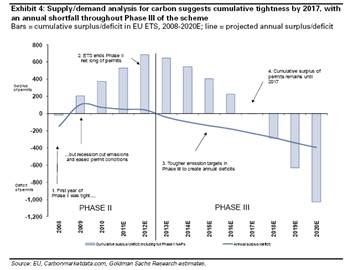
Despite the collapse of CO2 the immediate risks are:- Risk that carbon prices remain depressed due to weak economy and selling pressure as new permits are auctioned. A balance in the supply-demand is not expected until 2017. This could put CO2 easily at €3/mt before it even rebounds, and that is if (and only if) demand for power generation recovers above 2007 levels in Europe, something I do not see happening easily.

co2 chart 1

– Not even political intervention will help. Two amendments to the structure of Phase III are currently discussed:

  1. The first is the option to remove or “set aside” a number of permits from the system (restricting supply).
  2. The second is to increase the 2020 target by reducing the cap (consistent with a step up in the EU’s emissions reduction target from the current 20%). Shortage would still only happen if Europe has been able to recover the path to growth, and even then it would happen at best in 2017.
– What if the EU simply kills the Cap and Trade scheme and introduces of a carbon price floor? . The UK floor was set at £16/tonne in 2013 (€19), more than double current market price. This would effectively bust the scheme, making the new permits worthless and accelerating the sell-off between 2012 and 2014, particularly as the redemption would not be guaranteed by any solvent entity.

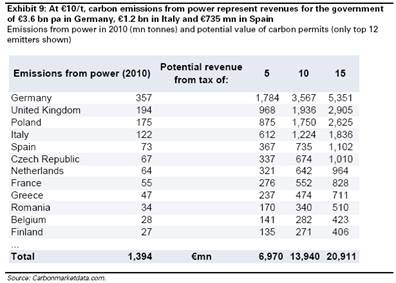
These interventions could be explained by budget deficits and government need for money. Sure, only a problem. GDP and competitiveness collapses and EU loses even further in industrial demand. From 2000 to 2010 CO2 impact on GDP in the Eurozone has meant an annual loss of GDP of 0.5% net of the fiscal profit of CO2 in taxes. Even more, in Spain and countries where the cost of CO2 has been internalized by companies, it has meant a loss of competitiveness of c10% (2004-2010).

Here are the effect of carbon permits:

co2 chart 3

In summary, the mistake of creating a  Cap and Trade scheme instead of a straightforward carbon tax has made the EUAs collapse as oversupply first, and the likelihood of the zero value of the permits of carbon-offsetting projects second have proven that the Cap part was based on ridiculous assumptions of industrial demand. And now there is oversupply already from permits that are issued (let alone the new ones to come) until 2017. Then there is the Trade part, which created a Boom and Bust cycle that is impossible to unwind now that financial investors, companies with free permits and projects are all on fire-sale. And if the EU was going to buy the excess credits… at what price would it do it?  with what money with all countries struggling with debt? who takes the counterparty risk?. I still think we see CO2 get to €3-5/mt. The world need a new framework that is still growth friendly and allows companies to respond with more certainty and stability, carbon pricing is inefficient, ineffective and hopefully on the way out.

Update:

The Euro Council, Parliament and Commission on Energy Efficiency discussions were meant to begin on March 26th but have been pushed back to Apr 11th as countries were not ready to start talks. Chairman of the environment committee says issue of a CO2 floor will certainly not be resolved this year.

OPEC Meeting Ahead: Concerns About Oversupply?

(December 2nd 2011)The December OPEC meeting in Vienna is coming and the picture of the oil market is mixed at best:

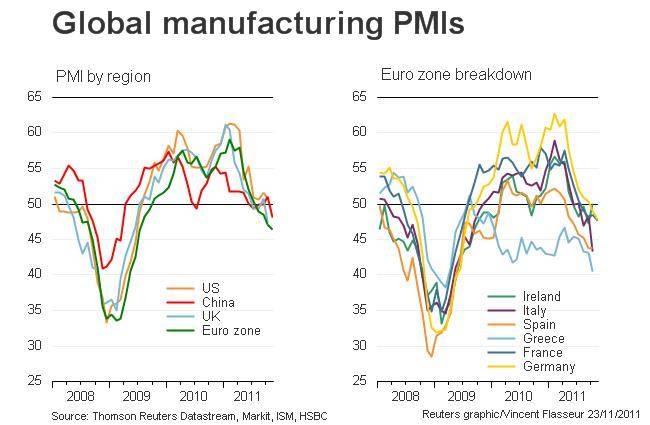
1) China PMI below 50 for the first time since Feb 2009. Global manufacturing PMIs remain weak as the table below shows, particularly in Europe.
2) Bearish US DOE weekly with high inventory build and very low implied demand. The EIA’s monthly revised oil demand numbers for September came in at 18.8m bpd, which was down from 19.05m bpd. It was also down 0.7m bpd y-o-y.
3) OPEC production in November: came in at 30.35m bpd, up 390,000 bpd from October, according to Bloomberg. The increase was led by Libya (155k bpd), Saudi Arabia (65k bpd) and Iraq (50 k bpd).

pmi global

Earlier this month we had additional evidence that the slowdown in activity is seriously reaching emerging markets now. India’s industrial output declined 5.1% y/y in October, the first decline since June 2009, with a 6.0% y/y fall in manufacturing, and with capital goods output down 25.5% y/y.

In the meantime, geopolitical concerns surrounding Syria and Iran, added to the inflationary pressures of the constant reduction of interest rates in Europe and Australia more recently, have kept oil prices at a very strong level, with Brent at $109.6 at the close of this post.

To me, one of the most interesting trends is that heavy oil continues to re-rate and that Tapis (Asia) remains at a healthy premium to Brent, proving that Asian demand remains solid despite the relative weakening in the recent data.

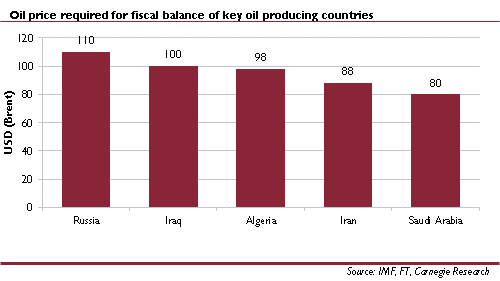
In this environment, another interesting trend is shown by the significant increase in the break-even price required by producers to balance their budget. At $80/bbl, Saudi Arabia’s commitments to invest in social peace and support the MENA stability is starting to prove costly. But still very comfortable versus the market price. Otherwise, Russia’s $110/bbl is a reflection of the strong investment commitments of the country, which are likely to slow down in the next years, so the headline number of break-even price might be overstated in the mid-term.

Break_even_oil_price

Considering this, it is not hard to understand why the OPEC World Outlook Reference Case oil price assumption has been increased from last year. It is assumed that, in nominal terms, prices stay in the range of $85–95/b for this decade, compared to $75–85/b in last year’s expectation.

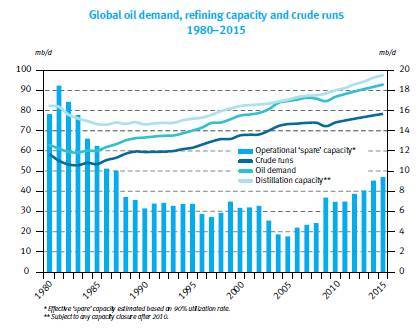
At the same time, global refining capacity is soaring and excess capacity is likely to reach 10mmbpd. This will have a significant impact on refining margins and, as such, high oil prices might be cushioned for the final price paid by the consumer by lower refining margins.

OPEC Refining Capacity

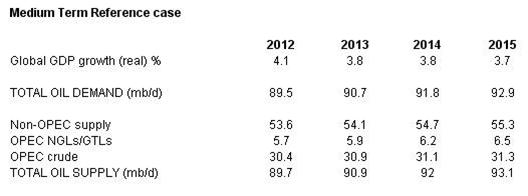
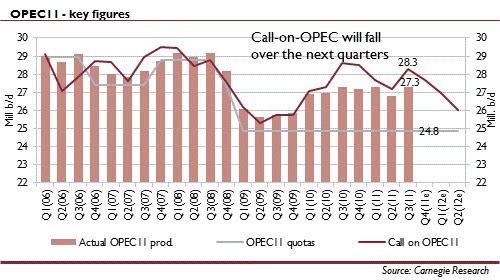
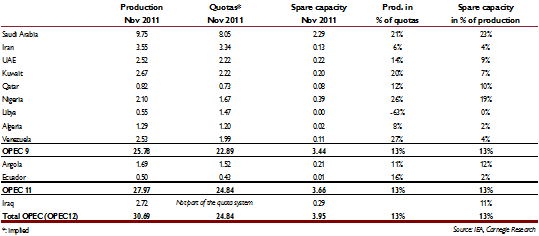
While Russian production stays afloat at 10.3mbpd and OPEC supply stands firmly above 30mmbpd (remember OPEC quotas are 24mmbpd) I continue to think that demand growth estimates are exaggerated, and not consistent with a slowdown in global GDP growth, so until I see a strengthening of the two main demand centers, China and US, I fail to see how emerging markets will offset the decline in OECD demand to reach a total of 92mmbpd demand in 2014. I think we stay pretty much flat at 88mmbpd for a few years.  Worth analyzing Chinese implied oil demand. In November it was 9.5 mm bpd, but this excludes inventory adjustments which are not published, driven by strong diesel demand which comes from regional shortages as a result of refinery maintenance and turnarounds. Crude imports were 5.52 mm bopd, +8.5% y/y but starting to show a slowdown from previous years.

OPEC supply demand

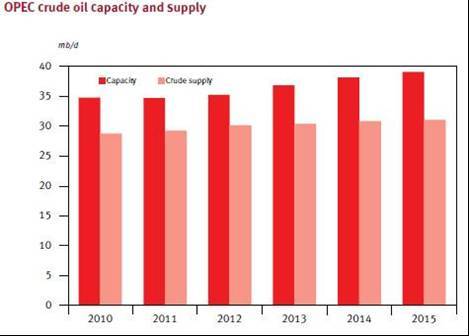
In this context, even if we assume that oil demand rises to 92mmbpd, spare OPEC crude oil capacity is set to reach around 8 mb/d over the medium-term, and in the high case of demand around 4 mmbpd in 2011. Even if I assume no OPEC production growth, spare capacity at OPEC countries is unlikely to go below 3mmbpd, which according to my estimates is pretty much a super-tight market.

OPEC capex spend

Obviously, the big question mark in this picture is how will capex be affected by any weakness in oil prices.

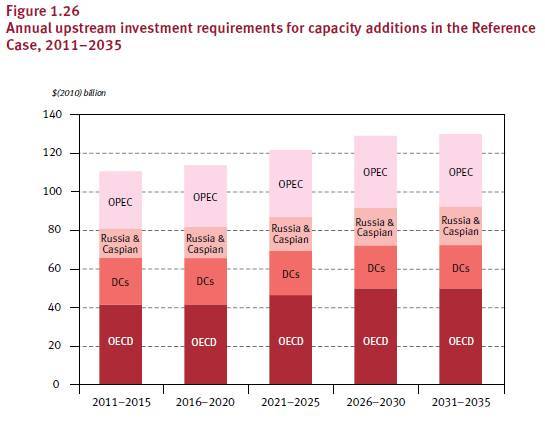
The table below shows the OPEC annual upstream capex required to reach the capacity additions assumed in their base case. Interestingly, this annual capex is unlikely to be affected by a global downturn in the case it happens given it’s such a small proportion of the total global capex including downstream and midstream. So prices would have to dramatically fall below the $80/bbl level to curtail the spending.

So spending is not the issue. The issue is execution and a stable framework that allows this capacity to be added on time and on budget. This is much more difficult than spending and drilling.OPEC Capex Spend II

I think it is safe to assume that we will likely be negatively surprised by capacity additions in the system, probably assuming that around 75% of that capacity is actually added as expected. This, in any case, doesn’t impact the base case of OPEC spare capacity moving between 4 and 8mmbpd in the next five years.

So what is the OPEC meeting going to approve?. Very unlikely to see a production cut given the very high oil prices, even with pressure from Venezuela and acting president Iran to do so. It is more likely that OPEC alerts to a risk of oversupply mid-term, tries to enforce the current quotas, as every country is producing above quotas except Saudi Arabia, and extends the decision to cut or to take action on quotas to a meeting where they can assess the true impact of the Euro and debt crisis on global demand. OPEC could offer an increase in quotas that sets the limit at the current level, so basically making no impact to global supply, just recognizing the real volumes. The risk is that countries will continue to “cheat” on the new quotas, but geo-political concerns might prevent that from impacting prices.
opec quotas

Iran’s role as president of OPEC here is critical, in the middle of the aggressive rhetoric with Israel. If Iran is perceived as anti-West in its proposals to OPEC the moderate side, led by Saudi Arabia, are likely to continue to act as buffers of the oil market. If Iran leads the meeting in a conciliatory and open way, the conclusions will likely be more firmly implemented. The last OPEC meeting gave the impression of countries “against” each other in some instances. This one could be the opportunity for a constructive approach that sends a positive message to consumers and producers alike.

OPEC_production
 

Eurobonds? No, Thanks. Debt Isn’t Solved With More Debt

(Published in Cotizalia on Nov 26th 2011)The image of Merkel as an evil monster because she rejects Eurobonds increases by the hour.The collapse ofthe Eurostoxx and the markets in general, shows why. Investors have positioned themselves long in risky assets waiting for a rally that is not justified by fundamentals, after the poor results of the third quarter, or by macroeconomic expectations, with three banks slashing global GDP estimates again.

In this environment, why are 65% of investors overweight in European equities in their portfolios? Easy. Waiting for a shot of adrenalin, a glass of whisky to the alcoholic, a new vial of crack to the addict. We demand more debt, Eurobonds, or a massive stimulus plan, now. And who are the strongest supporters of these Eurobonds, demanding that the ECB infects its balance sheet with more peripheral euro-debt and to expand the EFSF, the stabilization fund? Surprise, the French, Italian, Spanish banks and so on. Entities”so cheap” that only have an average of 25 times debt to assets, and need €250 billion to stay afloat in the “running to stand still” race of exponential debt.

Why are Eurobonds a bad idea?

Imagine if all the companies in the Ibex 35 or the CAC or the Mibtel, with different managers, different businesses and different balance sheets, decided to issue a common bond to meet their refinancing needs. The interventionists and their media messengers would tell you that it is a great idea because the most indebted companies would benefit from the credit rating of the strongest, right? Well, no. It is the opposite.

We learned nothing from 2008, the sub-prime mortgage crisis, the mega mergers of savings banks or the tech bubble. Risk is not dissipated by accumulation, it spreads and it is contagious.


Those who are rubbing their hands waiting for a transfer of wealth from Germany and Central Europe to the peripheral countries of €134 billion euro (the difference in cost of financing if we use the average spread between the bonds) do not realize that the transfer would be the reverse. Negative for all.

In the same way that a solid and attractive stock collapses if the company acquires a poor quality asset even if it is “small”, the implied yield of Eurobonds would rise between 35% and 40% compared to the current underlying asset (the German bund). Furthermore, the risk premium of these Eurobonds would increase to match most of the default risk of the weaker economies.

The Eurobond not only does not protect in bad times, but in times of economic prosperity it does not allow emerging economies to benefit. Are we confident that when Spain or Greece or Portugal recover, Italy or Ireland are going to follow? And do these see a benefit of merging growth prospects with Greece or Spain risk? Imagine if the United States and Mexico launched a joint bond. In a recession, the bond would discount a very significant Mexican risk, and in economic growth times, it would discount part of the relative unattractiveness of a mature country.

I wonder why in Spain the local politicians feel so happy to accept the perspective of a Eurobond, when they know and can quantify the risk and opportunity that the Latin American crisis gave, which today saves the balance sheet, growth, and risk premium of Spanish companies.

It’s even worse. If one country accepts the Eurobond and the economy starts to take off, as it happened in Spain between 1990 and 2005, the cost of funding will be negatively impacted by the economies that now seem very solid and that weigh in times of growth. Do we forget when Germany and France were in technical recession and peripherals grew 3% pa?From the standpoint of the stock market and the refinancing of corporates, Eurobonds are extremely negative. European companies have 1.1 trillion euro to refinance between 2012 and 2013. Most of them have a much lower risk premium compared to their home countries, thanks to a policy of internationalization, debt reduction, cost saving and active management of cash flows. Well, a Eurobond would not only mean an increase in sovereign risk of the underlying higher quality asset (German risk in this case), but the cost of refinancing of companies would also rise proportionally all over Europe, regardless of the country, losing all the advantages of the policy of corporate austerity applied since 2007.

In addition, the route to Eurobonds, perfectly planned from Brussels, is a route that uses the years 2012 and 2013, in which the peripheral countries have more debt maturities, to curtail economic sovereignty in favour of three entities, the IMF, the ECB and the EU, which have shown no ability or track-record of doing things better than the disastrous individual governments . Changing a bad manager for three bad ones is not only to lose sovereignty, but to become an “experimental” economic province. From Islamabad to Islamaworse.Eurobonds would be the ” big short ” of 2012

Read Michael Lewis’s book “The Big Short”. Packaging and disguising risky assets into a conglomerate sold artificially as low-risk is creating an enormous short opportunity. Specially when they would “rate” them as Top Quality probably on their own, as Europe doesn’t want “foreign” rating agencies meddling in its pretend-and-extend scheme. Nothing better than over-priced over-valued assets with huge hidden risk to put some shorts of spectacular magnitude. I assure you that if Eurobonds were approved I would try to launch a Short Only fund the next day. Oh, and if the interventionists ban shorts, there will be a stampede of capital outflow out of Europe again. And goodbye Eurostoxx.

Let me give an example, courtesy of the great John Hussman. Almost all European media and analysts tell us that the ECB does a great job and must infect its balance sheet more and more with debt from countries at risk. We have to print money and borrow more. Of course, they do not tell us that all that money will be paid by European citizens through taxes. But what they definitely never tell us is that if we inject risk, the weakness of the stabilization fund bond grows, becoming even less attractive for investors. Look at the graph below, which shows the differential of stability fund bond with the German bund, which has been rising enormously despite the positive messages from the friends of interventionism. Debt cannot be solved with more debt.

The solution

I repeat. A debt problem is not solved with more debt. A problem of liquidity, not solvency, as the present one is, will not be resolved in any other way than increasing revenue and reducing costs and through saving, which has plummeted by 11 points of GDP in Europe. But above all, by reducing costs, after the orgy of public spending of the past decade, shown in the graph below (courtesy http://blog.american.com and kpcb.com).

The solution is to maintain Europe focused on budgetary control, something that already exists in the treaties approved. No need to change anything, all that has to be done do is to comply with the treaties. Therefore, to cede fiscal and economic sovereignty to a European Union that has never reduced its budget and has no track-record of success in managing costs is ridiculous. I do not doubt at all that the peripheral countries, which have solved dozens of bigger problems, will be able to put their accounts in order, stop spending on stupid subsidies 3% of GDP per year, reduce bureaucracy and duplicated administrations and attract foreign capital.

The solution is that Europe learns once and for all that it’s more attractive to invest in countries that grow less but manage expenses according to their income than to finance a silly soup of subsidies that destroy jobs, GDP and competitiveness in the hope that markets forget, Eurobonds are issued and in a typical “greater fool theory” move, they can place the package of sub-prime debt to someone new.

The solution is to attract non-bank financing, private funding, which will be delighted to support the reconstruction process, and also to generate a legal, administrative and regulatory framework that is stable and efficient to make Europe a commercial partner not only between the EU countries, but for the rest of the world. Borrowing massively from each other to sell to each other is simply unsustainable.

From an economic and investment standpoint, it is suicidal for peripheral countries to cede sovereignty in their weakest moment just because they don’t want to make the necessary cuts. It is a “devil’s pact” that ties them to an organism with no better track-record than their own governments for decades just to keep, maybe for a few years, not more, the Roman Empire “bread and circus” policy of the lost decade we have lived.

Further:

Here is a link to my analysis of the Euro crisis and Spanish elections on CNBC http://video.cnbc.com/gallery/?video=3000058799

The Market Doesn’t Attack, It Defends Itself. Spain, Short Positions And The Lost Decade

Here is a link to my analysis of the Spanish elections on CNBC http://video.cnbc.com/gallery/?video=3000058799(The following article was published in Cotizalia on November 19th)If there is a chilling fact of this past week is the result of last week’s Spanish Treasury auction. There was no institutional demand. The market is scared seeing again how on Tuesday the government revised downwards the expectations of GDP growth for 2011, no less than about 40% less from +1.3% to +0.8%. € 180 million less of GDP every time they revise it, and there have been six times, while expenditures are not trimmed. So one can understand the reaction of the markets in a country which shall spend 3% of GDP in financial expenses, issues debt to pay interests and each year spends between 1 and 2% of GDP in subsidies. How is Spain going to pay that debt?

Amid all this, the media in Spain constantly mentions “attacks against the country debt” without realizing that the only thing the country has done has been to introduce risk and uncertainty for investors.Regulatory uncertainty, planning and legislation swings and turns. There is no attack. Because no one wants to invest. The market is closed. Imagine that the management of any listed company that has breached its own estimates for years demanded more funding and more support, and think how much its shares would fall. That’s the situation.

The elections have been a first step towards the solution. At least the new government has absolute majority not only at the State level, but also in 95% of the regional communities, which have been responsible for a very large part of the spending binge of 2004-2010, multiplying their budget by 3x.

Part of the solution is the famous “confidence” that the popular party advocates, and that is nothing more than credibility. Give the real figures of expenditure, deficit and exceed targets. Stop the ostrich policy of “pretend and extend”, which has been the country’s economic policy since 2008, hoping that people forget the announced estimates and forgive the mistakes.

A serious problem is the brutal installed overcapacity generated in the orgy of stimulus plans and expenditure. Ghost-airports in every region, ghost towns, a giant real estate bubble, billions in energy infrastructure and renewable subsidies optimistically estimating annual growth of 2-3% … In Spain there is little to do in the field of infrastructure for a few years. The scissor on civil works is unavoidable. Spain has invested in infrastructure like an emerging country, but with the demand of a mature country. Now it has massive spare capacity and the country has to digest, and pay, the debt created by the construction of unnecessary assets.

The good news: some companies are doing their homework and, as always, the private sector will rescue the economy. We’ve spent too much time attacking the capital markets and investors, scaring them with constant revisions of the legal framework, changing regulations in the middle of the period and looking for patch solutions to long-term problems. And while public saving has fallen by 12 percentage points of GDP, private savings reached 11 points. This saving is essential, added to a policy to attract investment capital, to boost the economy.

Well, now that the Ibex has lost all its gains in the “lost decade”, in part because many companies have spent the last ten years looking away, it is worth focusing on companies that can benefit from a situation that on one side will be incredibly complex, without growth, but in which the country and investment risk is lower.

The table below shows the companies in Spain with the largest short positions.

The first surprise is that, contrary to what people in Spain think, short positions in the IBEX are nothing special compared to other global indices. Not much of an “attack” then, even if we look by sectors. But the interesting thing is to look at the ones with the highest short interest and understand why it remains so high.

When media and banks say that stocks are cheap, the key to understand this table lies in something that no one is looking at. Namely, the outstandingly high short interest (look in the table at the ones with more than 1-1.5% of market cap) is due to a massive deterioration of working capital. The reason why hedge funds increase their short positions in some of these companies even when the stocks go up is because the cost of “survival” of these companies is rising as working capital deterioration accelerates. With a ratio of annual working capital to sales that in cases exceeds 20%, those stocks ​​are called “living dead” (it costs more to maintain the activity than to stop it).

But there are three important points to argue:

a) In spite of strategic errors, especially those damn “acquisitions to diversify” that have destroyed so much value, several of these companies are demonstrating that their core business is being managed very well. Therefore, if they manage to stop working capital deterioration and focus on the areas where they have real competitive advantage, the market will reward them.

b) Companies should not fall back into the mistake of “diversifying” and growth for growth sake. Reducing size and being a cash machine is more attractive in the medium term, leaving the balance sheet breathing. The small, focused and efficient companies are worth more than the inoperative conglomerates.

c) No one appreciates debt reductions if they are due to financial engineering, changing of accounting parameters and other tricks.So do not try. The short covering will happen only when margins, cash and balance sheet is restored. Not because of changes in accounting.

There is nothing I like more as an investor than a stock where there is a large short interest, recommendations of analysts are neutral or negative but the company is in the process of recovering quickly and efficiently. These are treasures stocks. And nothing I like more as a short than stocks where the working capital is soaring, returns plummet but have many Buy recommendations. These diamonds are the “short on strength” stocks that gave us so much joy in 2009 and 2010.

While many executives and directors are blinded by accumulating many Buy recommendations from sellside and are pleased with themselves adding revenues purchased in acquisitions at massive multiples, they should realize that the market values ​​organic cash generation, margins, and balance sheet. Not imperialistic adventures. I was head of investor relations for several years in public companies. There is nothing better than to win the interest of bears on your stock and to prove the company is delivering and exceeding expectations of ROCE (return on capital employed) and balance sheet strength. Companies should focus their communication efforts on those investors that currently do not want to buy their shares or are short, not those who already have them, as these are the first to sell in this market. They will learn a lot.

Companies can continue blaming their share price on attacks and justifying themselves, depending on subsidies and grants, or revive. “Shrink to Earn”. It is in their hands.