While the IMF has estimated the capital needs of banks at 40 billion euro and Spain has requested an EU credit lifeline of 100bn, I will try to give some ideas that can help answer those questions.Today’s Spanish banking system bailout poses more questions than answers. The financial assistance will be provided by the EFSF/ESM yet these entities are barely capitalized, so the debt of Europe will rise. Also following the proposal, which the Eurozone highlights is a maximum of 100bn, an assessment should be provided by the commission, in liaison with the ECB, EBA abd IMF, as well as the necessary “policy conditionality for the financial sector”. What will those conditions be?. What will this new line of credit –debt- do to Spain’s public debt and borrowing costs?, as investors will add this new line of credit to Spain’s debt pile even if the EU allows the country to account for it separately, and also how will the clean-up of the banks impact on credit to the real economy, which is likely to decrease further?.
Why did Europe not act more decisively on the Spanish problem?
The week has given us interesting surprises added to the aforementioned report of the IMF, which highlighted that the core of the Spanish financial system is solid, but draws attention to persistent vulnerabilities in the system. A couple of things:
- The President of the Chinese sovereign wealth fund, China Investment Corporation, Lou Jiwel said that they will not buy more European sovereign debt until the EU takes radical measures to solve its problems. I would highlight his comment “the risk is too high and the returns are too low.” This sentence, similar to that made by Russian officials, helps to provide an answer to a question I get from many readers “is there suddenly no money for Spain?”. Indeed, the availability of foreign investor money is limited after a decade of excess borrowing.
- In the UK the rumour is that the British government may not accept an unconditional bailout of Spanish banks with European funds, as it could require a change of the Brussels Treaty . Why? Because the UK spent 31% of its GDP rescuing its banks on its own. Being the second largest net contributor to the EU after Germany (12 billion euro), financing the bailout would almost double the UK contribution, after a 74% increase in 2010. Holland has also warned of the possible need to review, and approve, a new EU Treaty. Watch out for vetoes, which could be likely.
- The borrowing capacity of the European Stabilization Fund (EFSF) is increasingly questioned. Bond trading desks have mentioned that their investors no longer consider it in their benchmarks, given the systemic risk, according to Daily Telegraph.
If we add to the above issues the considerable difficulties of the European Central Bank and the International Monetary Fund, as we mentioned in this column in the past two weeks, the only real alternative for Spain seems to be the European Stabilization Mechanism (ESM), but, alas, the fund will not be operational until July, and funds are also limited. The funds that the press mentions over and over, 500 billion euro, will not be available until 2014. The ESM’s capital is less than 16 billion euro, which implies that its maximum leverage capacity is 107billion euro until October 2012.
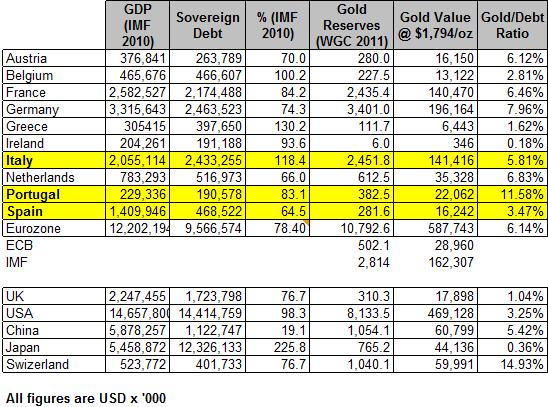
Even if the ESM leverages its balance sheet its maximum capacity does not cover a third of the potential risks of Greece, Spain and Italy. That is if we ignore the small insignificance that all this means to try to solve a debt problem with more debt and with no meaningful access to non-European investors. In the end it seems it will be the indebted countries of Europe lending themselves money in a kind of circular pattern.
Why has Spain taken so long to ask for a bailout ransom?
First, and this is obvious, to avoid the word “rescue” and the enormous negative political implications involved, and to try to force a combined solution combining private banks bail-ins and a European credit line. Basically to prevent a “Greek bailout” headline in favour of a “sweet and soft bailout” that does not affect sovereignty and only addresses banks liquidity needs.
Spain’s unwillingness to ask for a full bailout looks to prevent the negative consequences for the economy of a full-scale intervention, the famous fear of “the Men in Black” coming to impose massive cuts and tax increases. I personally think that the fear of technocrats is a bit of a memory of the past, from the intervention of Spain in the late 50s. And it might be unjustified as Italy and Spain’s own history shows that in many cases technocrats can be quite positive for the economy.
Too big to fail and too large for bail-out.
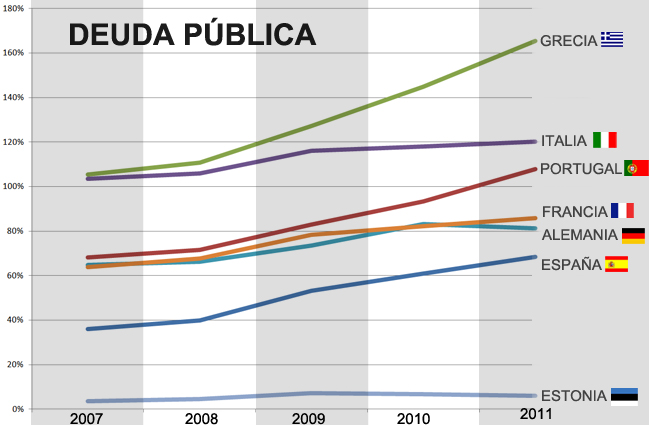
We must not forget that Spain also faces the need to calibrate very carefully the amount of help it needs, because, even if it is not accounted as public debt, the market will immediately add it to the country’s already huge external debt, and therefore its ability to reduce the deficit in the future. Most analysts fear that unless banks undertake the much needed capital increases quickly and efficiently, the burden of the new debt on the public accounts could be a real issue, deficit targets would be difficult to achieve and that borrowing costs will remain high.What we have seen with Spain and the EU is a negotiation to secure a compromise that is best suited to Spain knowing that if Spain falls, the entire EU collapses. A tense game of “poker”. The risk of these negotiations would be that if everyone plays to push the opponent to the edge, the entire table falls apart.
Why does no one really know the true figure of Spain’s banking hole?
Banks in Spain have a capitalization problem, not a liquidity issue. After the 23.5 billion euro requested by Bankia and the possible need of another 9 billion from Catalunya Caixa and Novagalicia, the estimated figures range between 40 and a 100 billion. The IMF estimates are in the
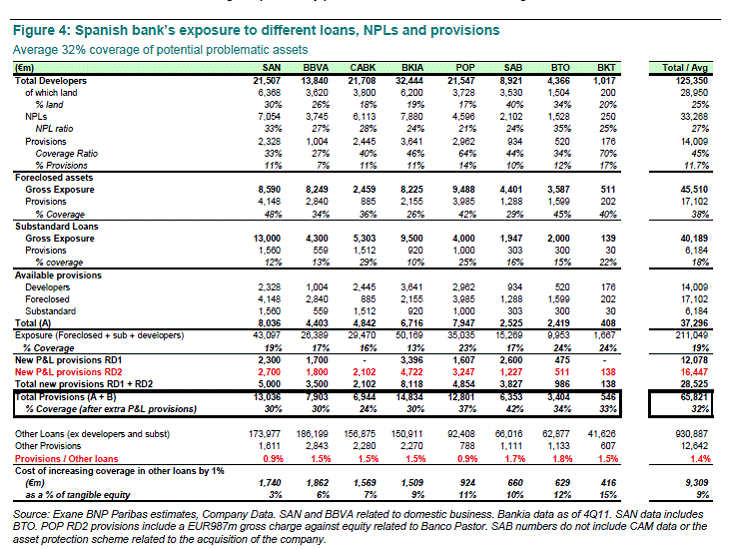
The first thing that surprises analysts is the low figure of provisions made so far .Less than 20% of the toxic assets (which thankfully will be increased to 32% after the recent legislation approved in Spain) but less than 1.4% of “other loans”, ie the “non real estate” that amounts to almost 1 trillion euro. The market has trouble believing the famous sentence repeated over and over in Spain saying that banks have made excessive provisions, particularly given the huge number of businesses closed and the large unemployment level. Minister De Guindos seems to doubt it too, and that is why I believe with the new management at the Central Bank Of Spain we will see a more thorough clean-up process.
The reasons why it is not easy to quantify the magnitude of the banking hole are mainly the following:
- “My village is worth more than Detroit”. The inability to certify actual transaction values on land and housing loans. When there are no significant transactions since 2008, maybe loans are simply valued at the banks’ self assessment. Same with the empty ghost towns and homes built in areas without meaningful recent sales. The lack of transparency and real transactions makes the valuation process a “because I said so” problem, which is partially what led to the Bankia disaster, a conglomerate of savings banks overpricing their assets and underestimating the risk of their loan portfolio to improve their ratios in the merger.
- “You Never Give Me Your Money You Only Give Me Your Funny Papers”. One of the main issues is the sheer complexity of a giant web of loans that are considered “performing” but which are “lifeline” loans to avoid the bankruptcy of zombie companies. We are talking of massive loans to regional companies, government entities, developers and concessionaries which are technically bankrupt but are kept “alive” artificially.
- “I Call The Shots, I Say The Prize”. There is a huge amount of properties that are not sold because the owner says that “the price is the price” and never lowers it although there is no demand. But banks extend the owners their credits in order to avoid foreclosures which would increase the already large portfolio of unsold homes in the balance sheet of banks. Many of these loans remain in banks’ balance sheet valued at 80% of the “price”. But what is the real price of those homes when disposable income, wages and savings are falling in Spain?.
- “A Little Bit country, A Little Bit Rock n Roll”. The web of interests between banks, indebted firms and regions is a real issue. One of the reasons why the government has been forced to hire independent auditors is that there is a network of interests to keep asset values at high levels, preventing actual losses from emerging. From desalinization plants that are woth a third of the invested capital, to uneconomical solar and wind projects and a web of cross-shareholding isn industrial stakes that are valued many times higher than market prices.
For example, if a region has requested a loan of 300 million to build a city for a circus –real case-to a savings bank, but the construction company has not been paid, and a bank has been forced to buy the saving bank, it now has both loans. Is there a vested interest among the three-saving bank, construction company and regional community-to defend that the project is still worth those 300 million?.
Today’s move from Spain finally asking for help for a figure -100bn- that addresses the top end of market estimates of the banks’ recapitalization needs is a step in the right direction.
However, when you realize that of the potential $100 billion to spend, 22% of that has to be provided by Italy, and their lending to Spain is at 3% but Italy has to borrow at 6% the questions continue to arise.
It is essential that the independent auditors put on the table a realistic figure of banks’ toxic assets, that Spain gets enough funding to support the recapitalization of the banks, but it is absolutely critical that banks finally behave responsibly and clean up the balance sheet so that there is no doubt about the strength of their accounts. Better to err from excess than to make the mistakes of the past.
The government in Spain seems to be determined to fix the financial hole created in the times when the country believed things like “we are the best and the world envies us”, “Spain has no subprime”, “we have the best financial system in the world and the best regulation”, “prices cannot fall”. The Irish clean up of its financial system cost them around 40% of GDP. Spain has to make that effort and finally emerge from the nightmare of its massive real estate bubble. Realistically, not with promises and prayers.My interview on Al Jazeera here
http://www.aljazeera.com/programmes/insidestory/2012/06/20126126534386935.html
This article was published in Cotizalia on June 9th 2012
Official Statement from the EU: The Eurogroup has been informed that the Spanish authorities will present a formal request shortly and is willing to respond favourably to such a request.
The financial assistance would be provided by the EFSF/ESM for recapitalisation of financial institutions. The loan will be scaled to provide an effective backstop covering for all possible capital requirements estimated by the diagnostic exercise which the Spanish authorities have commissioned to the external evaluators and the international auditors. The loan amount must cover estimated capital requirements with an additional safety margin, estimated as summing up to EUR 100 billion in total.
Following the formal request, an assessment should be provided by the Commission, in liaison with the ECB, EBA and the IMF, as well as a proposal for the necessary policy conditionality for the financial sector that shall accompany the assistance.
The Eurogroup considers that the Fund for Orderly Bank Restructuring (F.R.O.B.), acting as agent of the Spanish government, could receive the funds and channel them to the financial institutions concerned. The Spanish government will retain the full responsibility of the financial assistance and will sign the MoU.
Beyond the determined implementation of these commitments, the Eurogroup considers that the policy conditionality of the financial assistance should be focused on specific reforms targeting the financial sector, including restructuring plans in line with EU state-aid rules and horizontal structural reforms of the domestic financial sector.
We invite the IMF to support the implementation and monitoring of the financial assistance with regular reporting.