Category Archives: Sin categoría

In Memory of Matt Simmons

This article was published in Spain’s Cotizalia.com on 08/12/2010

Last Monday I received a short email from Matt Simmons’ institute. Mr. Simmons, oil guru, visionary of clean energy and author of one of the most fascinating and controversial books of the recent past, “Twilight In The Desert”, had passed away at the age of 67 years old. I was shocked.

For those of us who study oil and energy, Matt Simmons was always an essential reference to understand the complex world of energy. To me, he was an amazing personality and an absolute master in his field. Matt was humble, open, always ready to discuss different theories and innovations in the field of energy, and what’s most important, always interested in other people’s opinions. Matt didn’t speak from an altar to share his wisdom. He engaged in dialogue and open debate. And listened. Patiently. To everyone.

His loss is immense but his legacy is outstanding. Let me centre this article on some of his many achievements.

On one side, his analysis of the oil fields in Saudi Arabia was groundbreaking not only for the wealth of detail and clarity of the arguments, but also because it was the first time that someone had questioned official information with solid data. It might seem strange to my readers, but before “Twilight In The Desert” no one really questioned the official figures of reserves provided by the producing countries. Only a few years before Matt’s book Newsweek was warning of an “oil glut” based on precisely those official numbers!. Today, all of us who study oil and gas try to make an effort to challenge official numbers and study the issues that might impact the figures of proven and probable reserves in countries like Saudi Arabia, Iran, Iraq, Brazil, Russia, etc. Thanks to Matt Simmons we are all a lot more cautious with predictions of new production and, most of all, in estimating decline curves. And this caution has proven to be right when, delay after delay and revision after revision, we can all see that global oil production does not reach the 89mboepd mark even counting with Iraq and Tupi.

It is true that some of the predictions of “Twilight in the Desert” have been delayed, mostly due to the global recession’s impact on oil demand. But even the Kingdom of Saudi Arabia is now showing an unusual level of transparency and recognizing the need to preserve current reserves and monitor the declines of Ghwar, Khurais or Khursaniyah.

Many have criticized the “Peak Oil” theory, but reality has proven that supply issues are only growing and even those who criticize the theory must admit that it has been essential to help promote innovation and alternatives. Even the IEA admits that the “deficit of discoveries” is so large that the world will need investments of $26 trillion to replace consumed reserves by 2030.

But Matt Simmons also left us a tremendously interesting analysis of the opportunities provided by shale gas when analysts and companies said it was uneconomical at $10/mmbtu. Matt was proven right when he mentioned that costs would drop aggressively and proving that profitability of shale gas in Marcellus, Barnett or Haynesville was solid at $4.5/mmbtu.

Mr Simmons’ analysis of the new paradigm of natural gas as a clean, abundant and profitable source of energy and his studies of other alternative sources were also essential for the US administration’s advances in energy policy.

The last time I spoke with Matt Simmons he came for a chat at my fund. We spoke about the challenges of the electric car as a viable alternative to traditional vehicles, the difficulties to develop a coherent and sustainable energy policy in the US and the Macondo oil spill, where Matt was right as well when he warned of a much worse spill at a time when most analysts and experts still spoke of 5-10kbpd. His last comments to me were about the work he was doing on alternative energies that would be efficient and viable without massive subsidies. I am sure his team will continue the good work.

To all my readers, I recommend you to read or re-discover “Twilight in the Desert”, and if you can, read some of his papers from the Ocean Energy Research Institute in Rockland, Maine. I will remember the chats and debates and his lively and open personality, and as soon as I can, I will enjoy a wonderful Maine lobster in his memory. Rest in Peace.
Careful: The Five Risks Of Big Oil

(This is a November update of an article published in Cotizalia in Spanish)

I have read several analysis reports recommending to buy large integrated oil companies versus the market because they have underperformed. Careful.

Yes, in the last weeks the market has risen considerably and the brokers dust off the “Buy” recommendation machine and recommend laggards. I have nothing against it. But I, just in case, would list the reasons why Big Oil, as stocks, generate more risk than return.

1) Big oil is not a good way to play the oil price. The average price realization of their basket of crudes has fallen inexorably to stand at an average of $65-68/barrel, while oil contracts and licenses underpinning the future growth are very restrictive in terms of taxes and profit sharing between the producer and the company (production sharing contract). Moreover, most of Big Oil’s mid-term growth is heavily weighted to gas. This has led to most of Big Oil to generate returns of 33% in “legacy assets” and much lower, close to 15% on new projects. Therefore, to reinvest cash generated at 33% in projects that generate 15% returns destroys shareholder value, even if it’s a decision of business survival.

2) An industry that invests 33% of its capitalization to replace less than 100% of its reserves. One reason why the sector “does not work” is that multiples seem cheap (PE 8.5 x, Dividend yield 6%), but what really matters is the cash flow generation in a sector as capital-intensive as this one. Free cash flow yield has fallen year after year from 7% in 2003, with oil at $30/barrel to a very poor 3.6-3.8% in 2010 with oil at $80/barrel. Since depreciation of assets is still lower than the capital invested, the real PE (the “Economic PE”) is much higher, close to 9.5x … no longer so cheap, right? If we add that such investments can hardly replace the reserves consumed, it adds to the sector problem: “running to stand still”.

3) Diversification does not add value (to shareholders.) Another typical argument is that mega oil companies are trading at prices far lower than their sum of parts. As we have discussed other times, the conglomerate discount of about 30% is justified when the generation of returns of some of the parts is much lower than the core business. For example, one of the major listed companies invests 15% of their capex in areas (refining and power) that generate a return on capital employed of 5.5%. Then it is justified that the valuation of such activity does not add up, but substracts to the remainder of the valuation of other activities.

4) Lots of reserves does not mean value. The valuation of big oil based on reserves is not valid, unless the company, like E&Ps, was for sale. If, in addition, it appears that these companies do nothing more than buy new reserves to replace those consumed, the value of the conglomerate does not exceed $4/barrel (proven and probable) until they start generating cash. That is the reason why Big oil trades on traditional PE multiples, EV/DACF and free cash flow yield.

5) Beware of dividends. The last argument is that Big Oil pay a great dividend. Right. But it is also true that since the fall of free cash flow we have discussed, much of that dividend is paid with additional debt. So it is difficult to see that dividend as increasing in US$ terms, unless we consider that debt is too low. And at first glance, it seems like it. With 20-30% debt to capital (equity) on average, companies seem to have very little debt. But if we add working capital requirements, and turn to the equation “free cash-capex-dividend “, it is difficult to be positive, as these enormous dividends are not sustainable in a cyclical environment. Additionally, with a Free Cash Flow yield at around 3.6-3.8% for 2011 for US and Euro names and heavy requirement to ramp up capex on exploration, high dividends should not be considered as sacred.

Integrated oil companies appear attractively valued on 12-month forward P/Es relative to the market. However, once we adjust for the sector’s under-depreciation, they no longer look as attractive. The 12-month forward P/E adjusted for under depreciation shows US and European majors trading above historical norms relative to the market. As I mentioned before, the adjusted 12m forward P/E of Euro Big Oil, for instance, at 9.2x, is in line with that of the market, not 20% cheap, as the unadjusted number suggests.

In my opinion, Big oil does not provide defensiveness vs market turmoils. So, you can only buy for the very short term. A typical case of “value trap” of stocks that seem cheap, but they are not. After a 17% stock market crash in 2010, the surprise is that they are not cheaper looking at forward estimates. I am more interested in “restructuring story” stocks such as Repsol (July 2010), so disliked by my readers and by analysts and, like the national team, rocking, driving value through the simplification of business, or in independent explorers. In my opinion, to invest in oil, it seems obvious, we must invest in companies that have real exposure to oil. Or not invest at all. Washed down hybrids are only a waste of capital and a headache.

BP, the Oil Spill and the curse of media

One has to admit it. What is susceptible of getting worse, will likely do it.

The CDS of BP rose on Wednesday from 260 to c400, which implies a 20% probability of default in a company that generates a $40bn EBITDA. BP, Anadarko, Transocean have lost c49% of market cap. Those, like me, who thought the first 20% as overdone, were wrong, and it’s worth mentioning why.

1. The spill is larger and taking longer to solve than initially estimated by top geologists and analysts from the industry, or Energy and Capital to Wood Mac. The press is now happy to take the largest figures for liabilities out there, clean-up costs and other risks, up to $35bn. Even if the figure looks too high based on all previous precedents (Exxon paid only $500m in damages from the Exxon Valdez), it is an undoubted risk that no one can clearly identify. And BP, let’s face it, is not Exxon in terms of agressiveness and PR concerns.

2. On the other hand, the decision to install a 24h webcam in the BOP was, in my view, a strategic mistake. Analysts, media and investors are watching this reality show every minute and it doesn’t calm nerves, while making people provide new theories of the magnitude of the spill.

3. Reputational damage on a company that has been branded as a key investment in sustainability funds, sold itself as the “greener” alternative to Shell, and which traded with a “Management Premium” to peers. The capitulation trade of most of these investors has just started, having bought agressively the stock on dips ahead of the failed Top Kill, Junk Fill and clampings.

The two areas that concerned investors the most were the maximum clean-up cost and liability that the company will pay and the security of the dividend. Tony Hayward, BP’s CEO, is not as drastic as Lee Raymond, ex-Exxon CEO, and in BP’s conference call last Friday he was vague and diplomatic. BP trades at a 10% dividend yield 2010, but the market clearly discounts this will be cut either because of political pressure (BP is, and has been always very conscious of this), or because of accounting prudence (if they pay the dividend + a provision for damages of $10bn they will exceed their 28% net debt to equity target)

Technically BP is doing what it can, recovering 15k barrels a day, but the reputational damage on the “green big oil company” is making the stock trade below Book Value and $3/barrel for its resources even if we asume zero value for its US business and a $35bn liability. All of it doesn’t make the stock a buying opportunity, and that’s where analysis has been a mistake. It is impossible to assess now which equity multiples are valid because the uncertainties are enormous. It is also fundamentally challenging to short a stock that trades below 5xPE unless we consider bankrupcy… But even in the case of mass liabilities, BP’s peers will be eagerly awaiting to take over the assets (TNK in Russia, Azerbaijan, Irak, even Amoco are highly desirable assets). Does it make ita takeover candidate now? No. Big Oil is similar to a cartel, and they will help and wait before even hinting at corporate action.

The spill will likely last til August, and BP will pay for all claims in ten-fifteen years time, after strong litigation and numerous lawsuits, but the economic implications will be difficult to assess short term. In the meantime, catching a falling knife no matter what fundamental calculations are made is a very risky job. And too many long term investors and pension funds have been at it recently.

Harnessing the energy boom (II): Independent Explorers

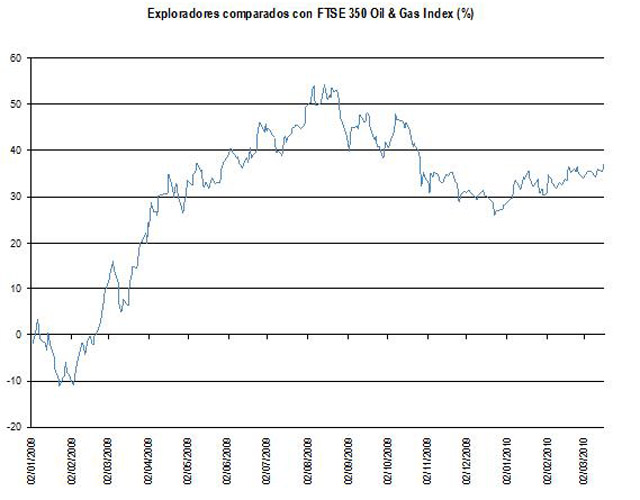
Exploradores vs FTSE 350 Oil Gas index(Article published in Cotizalia in Spanish on Thursday 25th March 2010)

These few weeks have been very relevant to the oil sector. On the one hand we have seen the acquisition by BP of Devon’s assets in Azerbaijan and Brazil at a price 15% higher than initially indicated by Devon. India is looking to establish a sovereign fund of no less than $245 billion to buy oil and gas assets and compete with China. Gulfsands Petroleum and Statoil’s assets in Brazil are also in focus. And finally, China’s CNOOC has acquired 50% of Bridas Corporation in Argentina for $3.1 billion, which implies that if we apply that assessment to Repsol’s assets in the same country, the valuation of YPF would be $15 billion, 25% higher than the average estimated by the market consensus.

Two weeks ago we talked about services. Today we will focus on one of the most volatile and exciting subsector in oil & gas. Independent explorers.

These companies are attractive for two reasons. First, there are very few independent companies with attractive natural resources, which makes them almost inevitable “targets” for predators. Second, their exposure to high-potential exploration assets causes the values to move upwards and downwards faster than other sectors. These are also companies where there is only one objective: to find and monetize reserves. No plan for 50 years, no political strategy, no obligations towards the media. Pure economic value. The sector has generated an average appreciation of 19% in 2010 and 72% in the past three years, including the stock market debacle. And between 2007 and 2010 independent companies worth $75 billion have been acquired, according to Wood MacKenzie.

For the uninitiated, let me briefly explain how they are valued.

Independent explorers buy assets with an attractive potential for exploration, drill them and, once they are assured that the wells are commercially viable, either they develop the portfolio or farm-out to Big Oil. Normally they keep a series of wells that will ensure production, access to financing and cash and use the financial resources to explore more and sell again. The key factor to value for an investor is the history of exploration successes. It is not the same trust Tullow Oil, for example, with 77% of exploration success track-record, and Soco, with 60%, or Lundin or Premier Oil, with a much lower track-record.

The independent companies are valued on an estimate of their core assets (“core NAV”) and an estimated percentage of future exploration success on their portfolio of wells. A percentage assigned by the market depending on the geology and seismic interpretation. Then, as they start conducting their exploration program, the market assigns value to the reserves encountered, or subtracts it from the pre-estimated value given to those assets if what they find is a dry hole (non-commercial).

If you are interested in the sector, pay attention to companies with little debt and exposure to areas of strong interest for predators, but also to those with better opportunities to acquire and explore reserves in attractive areas: West Africa, North Sea, Gas in the U.S. and Gulf of Mexico.

In Africa, the war for the control of reserves in Uganda and Ghana has made Tullow Oil one of the most successful stocks of the industry, but we must not forget the possibilities that arise in Nigeria for Afren Oil. Elsewhere, Anadarko, the leader in the Gulf of Mexico, gave one of the biggest successes of 2009 in Sierra Leone.

In gas, the main candidates to develop large reserves in 2010 are some of the few remaining independents in the North Sea, Dana and Premier.

In shale gas in the United States always look for companies with low costs and an intensive exploration program, from Range, Ultra Petroleum, Petrohawk or Quicksilver. Obviously they are exposed to a complex environment of gas prices in the U.S., that falls almost 2% per week, but also the least affected thanks to their low costs and attractive position to make alliances or mergers.

These are stocks that are highly correlated to oil and gas prices, but also very exposed to the credit environment, as they have to maintain a very low level of debt while financing large exploration programs. These are stocks to buy when there is a point of entry, either a capital increase to finance a drilling program or the announcement of a non commercial well of low relevance before an intensive program of exploration. A sector that is not suitable for risk averse investors or fans of dinosaurs with high dividend yield. But exciting as few.