Category Archives: Sin categoría

Harnessing the energy boom (I): The oil service companies

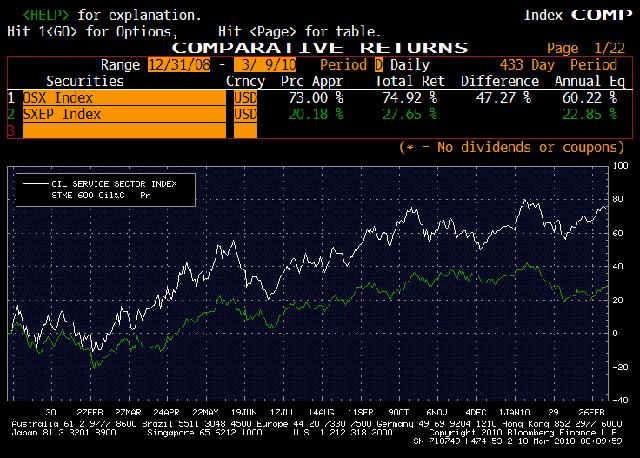
oil services vs sxep(Article published in Spanish in Cotizalia on 11/03/10)

In the last twelve months the merger and acquisition activity in the oil world has accelerated. $45 billion in acquisitions so far, and this only just begun.

In this environment, I have seen little written in the press on oil services companies. And meanwhile, investors lose money by investing in large integrated oil, which is like watching grass grow. However, it’s in services where the opportunities might be.

Let me be concise. Big Oil’s capex is rising again. $170 billion of investments will be devoted to upstream this year globally. New contracts are being awarded to the more efficient, aggressive and flexible service companies. And if something has been demonstrated in the 2008-2009 period is that, despite the large drop in oil prices, oil service costs did not fall more than 15% over the same period. This is the proof of the power of this sector over its customers. Competition is relatively low barriers to entry and specialization is very high and oil companies (clients) do not jeopardize safety and efficiency to save a little money.

Oil services companies are the key to maximize the performance of the fields and avoid expensive delays and technical problems. And they generate spectacular returns. Groups such as Petrofac, in the UK, and Subsea 7 and Seadrill in Norway charge their customers between $200,000 and $400,000 a day for their rigs(see footnote), generating annual growth of over 10% on their backlog.

Also, it’s worth mentioning the companies that specialize in large complex projects. Among the latter, Halliburton and Schlumberger have proven their ability to carry out giant projects from Saudi Arabia to Nigeria and generate very strong returns. In Spain, a much more modest play is Tecnicas Reunidas, an example of performance and competitiveness.

U.S. companies have woken up and now seek to attack the juiciest segment of the oil market: large contracts to exploit giant fields, both in deep water (Gulf of Mexico, Brazil) and the three that open borders for the coming decades : Alaska, Iraq and West Africa.

We have seen the recent deals between Schlumberger and Smith International, followed by Baker Hughes and BJ Services, and the market is already beginning to speculate about the possibility of a merger between Halliburton with Weatherford. If the latter merger is completed, be prepared to witness the creation of a genuine global leader. Meanwhile in Europe, it is rumored that Seadrill could buy Pride.

For the uninitiated investor, let me recommend that if you’re interested,you should concentrate on the following three characteristics:

– A Company’s ability to maintain or increase their prices to customers and increase its order book. This is a highly specialized industry and the weak fish die quickly.

– Avoid semi-state owned and over-diversified firms that often face execution risks, or are too dependent on one customer.

– Focus on independent and well capitalized companies with expertise in a specific segment that is of interest to predators. From my point of view, these are the deep-sea drilling and seismic companies.

The service sector is an area for investors with risk appetite who want exposure to oil prices, as one of the few sub-sectors that generates double-digit growth and high margins in the oil world. As the world continues to need $170 billion dollar annual investment in oil and gas, and I think we have many years ahead like this, oil service industry leaders will maintain the capacity to increase margins and orders.

Note:

Land Rig: manufacturing cost $10-15 million, then hired for $ 15-20.000/day

Jack up: Cost of production $75-175m, then hired for $ 100-200.000/day

Semi submersibles: Cost between $200-400 million, then hired for $ 200-400.000/day

Drill ship: Cost of construction: $300 – $500 million, then hired for $ 250-500.000/day

Unconventional Gas Developments

Our team has attended a few seminars on non-conventional gas. I thought it was worth compiling a few thoughts.

US breakeven costs have further to decline (easily 15%) taking breakeven economics to sub $5.0-5.5/mmbtu. Additionally, internationalization of the unconventional gas outside North America will be slow, with the possible exception of China.

1)North American insights:

a. Currently there is an abundance of plays that make sense at sub $6/mmbtu.

b. Technological advances are still ongoing and Take-up of known practices will cut costs by 15%, bringing breakeven costs to sub $5-5.0/mmbtu. The latest example is the deployment of “zipper” frac’ing.

c. These advances are offsetting a general rise in service costs, even though that rise is being accentuated by the withdrawal of some service capacity (early deployment overstretched rig capability, and those rigs are now failing).

d. Canada has potential to be a significant unconventional gas producer, and will keep downwards pressure on US gas prices into the medium-term.

e. Against that, the pace of drilling/development will slow as the majors become more involved.

f. WoodMac forecast US shale gas adding at least 1.5bcf/d per year through to 2020 on current drilling plans.

2) Outside North America:

a. Service companies are gearing up to take unconventional technology outside North America (eg Schlumberger buying Smiths and Baker Hughes).

b. European plays will be slow to develop:
i. Resource basins are relatively small.
ii. Regulatory issues have to be overcome (eg not only has PGNiG the exclusive rights to drill but all crews must speak Polish).
iii. No infrastructure to support rapid development.
iv. Exxon drilling 10 wells in Germany is a bit of a sidetrack – need to drill over 50 wells to get any understanding of the resource.
v. Costs are intrinsically higher – breakeven today is nearer to $10/mmbtu, but with 20% cost reduction/productivity improvement, there are several basins that can produce at $8/mmbtu.

c. China will be big as an unconventional gas play, and sooner than Europe:

i. Chinese policy has failed to hit coal-bed methane targets (but gas price higher now!).
ii. Resource basins have the right characteristics (big and tectonically stable, silicon strata).
iii. Fiscal terms can be supportive.
iv. Labour can be directed into sector.
v. The second East-West gas pipeline could unlock reserves along that route.

Unemployment inflection

From one of my colleagues:

As of today, looks like the unemployment rate peak is behind us, and this long disastrous road of job losses that started December 2007 has ended. Job creation and job attrition look about flat. Unemployment would be able to fall naturally in the future without adding jobs because unemployment benefits run out and long-time unemployed people stop filing or reporting data–this is a data quirk, not necessarily a big positive per se.. Further, in the next 3 months, we get the once-a-decade US census hiring, which can be several hundred thousand jobs (though lined out by economists). All eyes are pointing now to expectations in June-Aug employment.

Combined with ISM’s running >50 for 7 months, global GDP coming in strong, and leading indicators running well above average (though maybe already having peaked on the recovery), seems we are in for slightly better economic picture than expected a few months ago.

Gotta be bullish for oil prices, as well as many globalized commodities. Goldman reporting US power demand running slightly above expectation in the US already, that may continue now, but admitedly its rather a shallow recovery (
Interest rates not really reacting to this data, except modestly on the front end. Further risks remain: the double dip on housing activity appears a growing risk, and end of March marks the completion of the Fed MBS purchasing program (read: mortgage rates will move higher). The sheer magnitude of bank write-downs coming on home mortgages is really just getting warmed up (the Fed kicked that can down the road, and we’re near the cul-de-sac). No idea how Fannie/Freddie even function post Fed purchasing program, they can’t warehouse all these mortgages and the banks aren’t holding new ones at all (85% securitization to Fannie/Freddie last year!)

So + industrial activity, slowly moving inflection on employment (but loads of slack to keep wages low for a while), and – on banking sector, lending. Seems that is a net/net positive environment for commodities and equities, neutral for bonds.

A Short Term Outlook For Gas Prices: Russia Calls The Shots (Again)

Gas prices have held up well, in part on the prolonged cold spell. However, in absence of weather support, by the summer prices will have to be lower in order to take the rise in LNG and Russian gas (161BCM) expected.

It is widely recognized that there’s a big build in LNG supply coming (extra 8bcf/d from the summer, ie three-quarters of UK consumption)) and that Gazprom is planning to increase its sales to Europe (by about 2bcf/d over the year = 20% of UK demand).

So likely that European gas storage will be filled relatively early. Unfortunately, storage levels are still relatively high (equal to almost 3bcf/d of extra supply if returned to normal levels over 3 months). Nevertheless, should storage still close to current levels rather than drop to 25-30% fullness, that would add 9bcf/d to demand over the next 3 months.

Economic recovery may lift demand, and Spain has started 2009 with January consumption up 4.2%. However, the industrial production is still more than 10% below 2008 levels.

The big mover for LNG would be a recovery in Japan, which looks encouraging even when industrial production is still 20% below 2008. South Korea and Taiwan are picking up but together these two countries are only half of Japan’s LNG demand.

Last year, in Europe, Gazprom’s gas buyers sharply reduced volumes early in the year. These are huge numbers – about 14-15bcf/d (ie almost the entire consumption of the UK and Germany combined). This was a”no-brainer” for the gas buyers. Their contracted price is based on oil prices with a 6-9 month lag. So deferring gas take until later in the year meant the gas would be cheaper.

Going forward, it looks likely that gas prices now are close to the lowest level for the year. Hence, the buyers are likely to want to take the gas now (saving about $2-2.5/mmbtu).

As a result of coal’s decline, gas at higher prices would no longer be the preferred fuel for generating power in the UK (where most of the swing occurs between coal and gas).

• Coal has come down as concern surfaced about the extent of policy tightening in China. The Australian coal price has been hit hardest, but clearly this has been the driver for South Africa (and European) coal over much of the past year.

• Marginal generation costs in the UK now favour coal dispatch.

So, gas prices will have to drop (or coal prices have to rise) in order to stimulate enough demand to take the Russian gas. Coal market fundamentals look positive once the trend of Chinese coal import data post-tightening is evident in 1 month time. So near-term, the market balance is more likely to be brought back into balance by falling gas prices enhancing power station competitiveness (along with Europe maintaining high storage levels over the summer), but more expensive coal and lower Russian gas might balance the equation.

So the x factor to bring gas markets to balance is Russia. Unless Gazprom allows a smaller off take, there could be as much as 10bcf/d trying to find a home in the UK/European power sector over the coming 3-6 months. That’s too much for UK/Europe to absorb; so up to 5bcf/d could end up headed for the US. I struggle to believe Russia will work on volume alone given they have a 6% decline in the base. If they allow a lower off-take, US pricing won’t get dragged down in this environment.

The current forward curve has Henry Hub some $0.5/mmbtu above UK’s NBP, so there is not much scope for UK prices to drop without impacting LNG flows and depressing US prices.

In summary, the picture is not that oversupplied if Gazprom volumes (161BCM) include storage and some level of flexibility. Chinese coal buying might keep gas prices more competitive than coal for power generation, and we are seeing LNG projects delayed (Shtockman, Australia) or sending lower volumes to Europe (Yemen). Looks like the picture of oversupply that the market discounts is too extreme. Not that my view will imply gas price appreciation, but the massive downside predicted by some looks less evident to me.