What do you buy into market weakness? Big Oil… Big Cash

bp vs ftsee

The market has been using Big Oil and utilities (specially large caps) as sources of funds for their beta trades, especially financials and miners. I hear that short interest in BP is 12% of free float, for example.

As the mood in the market turns bearish and the concerns on balance sheets return to a market that forgot what net debt was, the focus, like in the past November, turns to real cash monsters.

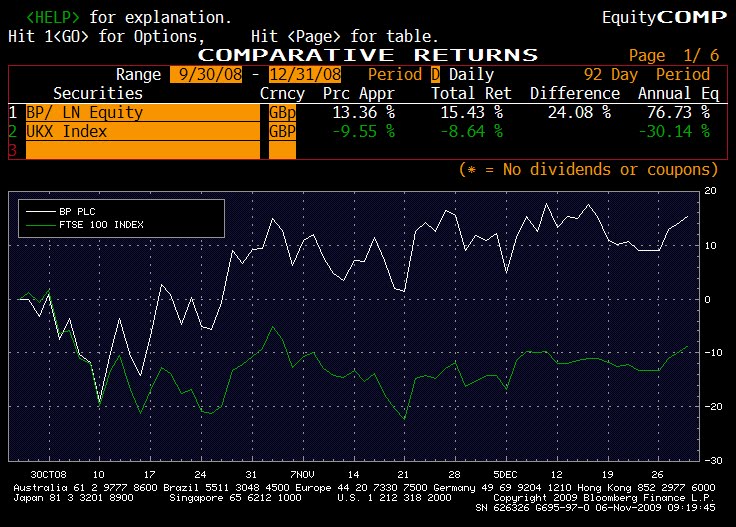
If we add to this that most of the market went short Big Oil after the 3Q results showed that growth was not appearing, and especially after lacklustre earnings from RDS and Total, we have a perfect storm. Last November, with oil going from $70 to $50 and the market disappearing downhill Big Oil outperformed the market by 12% into December.

Big Oil trades at 10x PE, 0.6x to the broad market (almost 15% from historical levels), generated 15% free cash flow yield last quarter (!!), delivers dividend yields that range from 6 to 7% and more importantly, has virtually no debt (Statoil 26% ND/Equity, BP 23%).

Into Megacap utilities, these have underperformed but now, ahead of 3Q in E.On and GSZ, the focus will turn back to free cash flow generation and balance sheet. Here the issue is that Enel, Iberdrola are massively debt constrained so the market opportunity is not as wide as in Big Oil (as utilities balance sheets are quite different, unlike in supermajors), so we are likely to see a move to real defensives, ie regulateds and megacaps.

The chart shows what BP did against the FTSE from Sept 08 to Dec 08 with oil falling and the market down.
Repsol’s challenge

repsol versus sxep

(Published in Cotizalia on Oct 29th 2009)

Interesting times for Repsol, with plenty of corporate rumors.

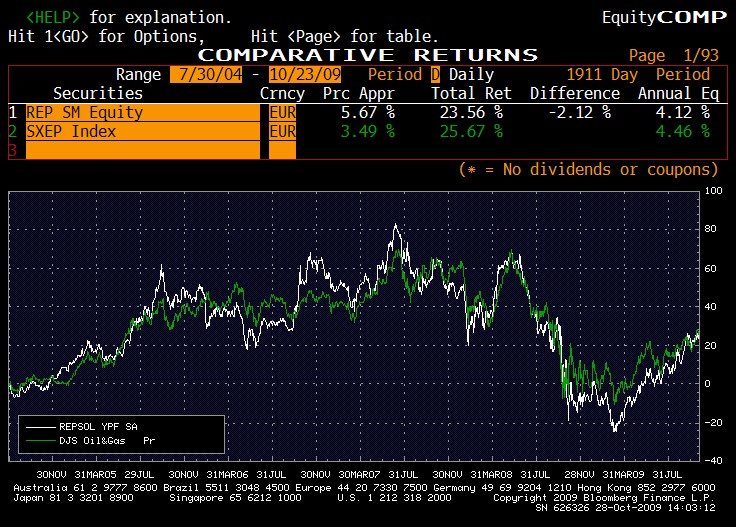
Since 2004 the company has focused primarily on controlling capex, in a group that needed to invest more than € 6 billion annually, almost 25% of its market capitalization to keep the net income flat, and find ways to sell YPF, trying to reduce the high exposure to Argentina, almost 40% of its assets. A similar problem to that of OMV in Romania, and to a lesser extent, BP with TNK (Russia). Still, the stock has behaved almost exactly with the rest of the industry, thanks to its exposure to Brazil, Venezuela, Sierra Leone and other assets of high exploration potential, which enabled it to be one of the few who will to replace 100% of its reserves in 2009. This despite the capital increase of Gas Natural Gas and Repsol’s Refining business unit, highly capital intensive and of low added value.

One hears rumors of a possible dividend cut, but this does not only affect Repsol. The industry tries to maintain a proper debt to the underlying asset, given its cyclical nature, can not afford adventures on its balance sheet. See the case of ENI, or OMV, with capital increase of € 1,000 million added.

The challenge of Repsol, and the integrated oil sector, is to create shareholder value, and that’s difficult in a sector as poorly differentiated. The integrated model has traded for years at 9-11x PE, with a discount on the sum of the parts which at the top of the cycle reaches 20% and at the bottom reaches 30%. A large discount to E&Ps or specialized services firms, for example, but also a lower-risk model due, in part, to the lower debt. It is difficult, as investor, to demand high multiples and dividend stability while seeking large investments and long term perspectives. More difficult, moreover, if Repsol requires € 3 billion per year in maintenance investments and € 15 billion to develop the fields of Brazil, since it has less margin than others, and needs high oil prices and refining margins much higher to generate free cash while developing these assets.

The stock appreciation of an oil company can only come from increasing the return on capital employed, which requires specialization and strict control of the return on investment, and crystallize value by separating assets. So it’s worth trying to sell YPF, refineries or Gas Natural with a premium, but it’s not easy, and political issues do not allow it in certain cases.

Repsol has before it the challenge of deciding what it wants to be in the next ten years. As British Gas or GALP are proving, it can not be in the whole energy chain at a time and maximize value in their growth areas. Controlling costs, develop the business of exploration and production, manage the portfolio of assets to avoid having more than 15% in each country, and reduce exposure to refining and regulated activities remains the appropriate strategy. If not, they must wait for the miracle of the expansion of multiples of the entire sector. And that is risky.

Oil and Nat Gas, two diverging commodities

oil vs gas

(Published in Spanish in Cotizalia on Thursday 15th Oct)

Oil has reached $80 a barrel. On the demand side, there has been an upward revision of estimates of the International Energy Agency, IEA and EIA. On the supply side, the fact is that in the last five years, increased investment in exploration and production ($220 billion per year), has not helped to replace 100% of the reserves consumed. Moreover, extraction costs are still too high and declines are affecting production in countries like Norway and Mexico, with falls of 6% and 3% respectively.

In natural gas, the situation is almost the reverse. The world has 60 years of life of proved reserves, which compares with fewer than 45 in oil, and to the estimate we must add large unconventional gas reserves. Proof of such excess is that in early 2009, British Gas decided to sell long-term 85% of its gas production expecting an environment of overcapacity in the medium term. Back then gas was trading at $ 7 per million BTU. Today is at $ 4.

On the demand side Eurogas expects zero growth in demand for gas in 2010, after a fall of 7% in 2009. This occurs while Qatar, Yemen and Australia, among others, are setting up more than 90 million additional tons per year of LNG capacity between 2009 and 2012. The projects in Qatar are competitive at $ 1.5 per million BTU, a level “only” three times less than the current one. This means nearly 9 trillion cubic feet per day of spare capacity. Um, does not look good.

As from 2013, the overcapacity created by excessive liquefied natural gas is reduced by lack of new projects. Since, according to international agencies, we will probably see a very moderate increase in demand in coming years, the supply of gas will remain ample. As for China, it can cover the vast majority of its gas demand with its own production, with the ability to have five times the current domestic production through its 756 trillion cubic feet of recoverable reserves.

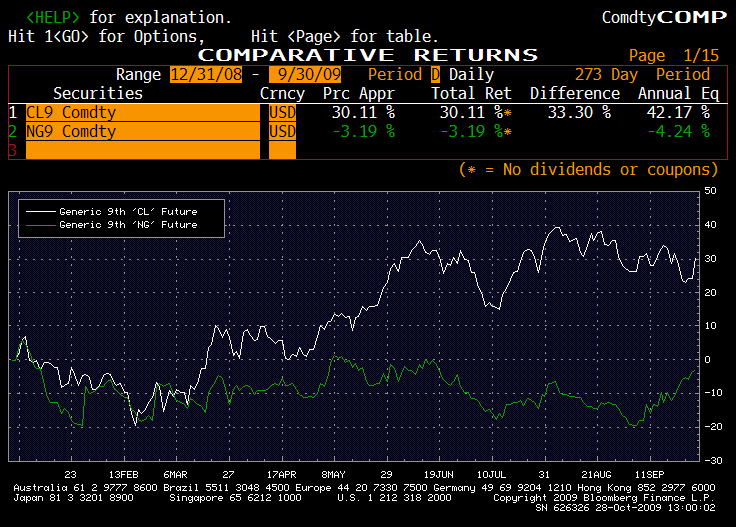
Interestingly, gas E&P stocks have performed in line with their of oil peers, although the oil price has risen by 30% and gas has fallen by 4%, showing the market is already anticipating a return of oil-gas convergence. I do not know on what basis. I just came from a few days with gas producing companies and the expected returns on their investments remain significant. Is that what investors buy? We’ll see if the results prove it and if valuations are justified.

A little love for the electric utilities

(published Thursday 22nd in Cotizalia)

What a bad two years of stock market behavior. The “utilities” sector (SX6E Index) is one of the worst performers in 2009 and also did not do well in 2008. Since the process of mergers and acquisitions was completed, the industry suffers the hangover of debt, falling demand, electricity prices stalling and, lest we forget, these European regulators that do so much damage to the investment process.From the UK to Belgium and Finland we read news of interventionism and regulatory decisions that make impossible the proper management of a business that has become more cyclical and capital intensive over the years. Here in the UK, the government has repeatedly threatened with windfall profit taxes. Perception of public service, it is called. But when the sectors of water or gas are drowned out by generating returns below their cost of capital, the only one who comes to the rescue is the market. As proof, three figures: €12bn euros in capital increases, €65bn in debt refinancing and €22bn in forced divestments due to the high debt in European utilities between 2008 and 2009.
In Spain it’s similar. It is almost impossible to manage long-term investments with fluctuations in something as essential as is the policy on nuclear power, delays in the collection of the tariff deficit, endless delays in regasification regulation and without a coherent policy and planning capacity. When the government is striving to manage the country’s reserve margin without the sector ends up having to give subsidies to coal generation.
But let’s look at the positives. For there are a lot. The sector is clearly oversold on technicals. Additionally, two recent reports from Merrill Lynch and Citigroup indicated that it is the most underweight sector in the portfolios of investors. It trades at a PE compared to the market of 0.8, the lowest level since October 2000 and gives an average dividend yield 5.5%. Moreover, debt is being corrected quickly with good divestitures.
In an industry that has seen a drop in earnings per share of only 10% on average during a period of recession, current multiples are not demanding. At a PE of 12x average, the lowest since 2005, investing in this sector is a low risk bet if investors anticipate the return of inflation and improving demand.

The market has done well to play the cyclical sectors anticipating a recovery, but, for example, the percentage of exploration and production (E&P) stocks that are trading at higher prices than those when oil was at $ 140/barrel is almost 100%. I still see value in the cyclical, but I get the feeling that it’s time to give a little love to the “utilities”.