Tag Archives: Energy

Oil Prices Reaching Breaking Point For The Economy?

I just came back from a trip to New York and investors concerns about energy and oil prices were clearly at the top of the agenda.

Who’s to blame for the current oil price?. Supply? demand?. Mmmm. I have a feeling that the blame this time is on Mr Draghi and friends in UK, Norway, Australia, US, with the ongoing mass liquidity injections and QEs, all driven to generate inflation one way or another, and driving investors to increase net length in crude.
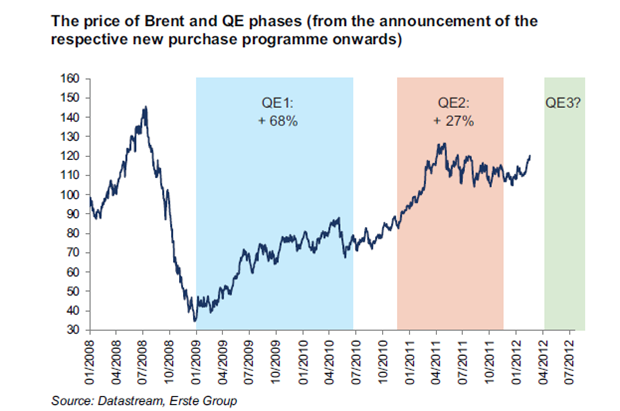
OIL QE

Oil prices reached all-time high in Euro and in GBP last week. All US media is mentioning high gasoline prices and it’s a permanent fixture in Europe news. If sustained, the price increase since December could trim 0.25-0.5% from annualized real GDP growth over the next year. Moreover, the combination of a stronger world economy, massive liquidity injections and quantitative easing programs with increased tensions in the Middle East suggest that a bigger shock is less of an issue than in the past.

Barclays highlights that “it is not necessarily the oil price itself that can pose a threat to economic growth but the pace of its growth that is more important. It is the sudden surge in oil prices that leads to an abrupt shock to consumer spending and economic growth. Consumer durable spending, the most sensitive component of spending, fell sharply when the 3-month annualised change in headline inflation exceeded 9%. In each case, the price of oil rallied in excess of 40% over a 3-month period. In contrast, the latest geopolitical fears have, so far, led to a 20% rally in oil” …and inflation is way below 9%, at 3-5%.
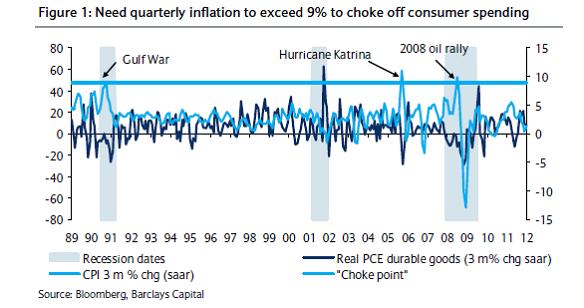
quarterly inflation

Let’s start with supply. Global oil supply, despite Iran, Syria and Lybia is at record levels. Not only Russia and other producers are keeping the pace strongly, but OPEC is producing at all time high, as per the figure below:
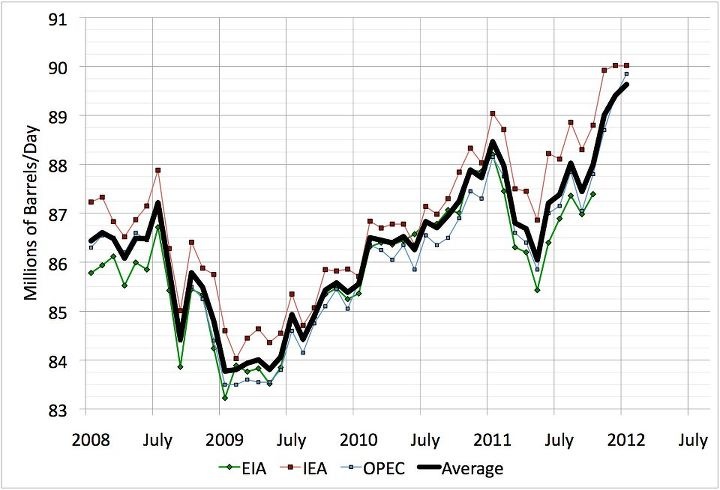
photo opec

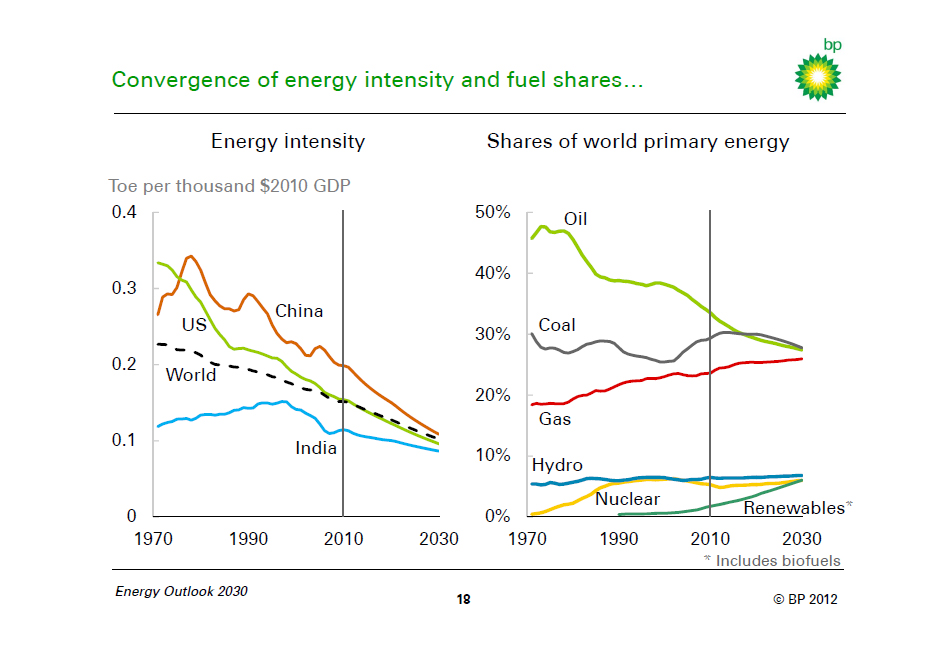
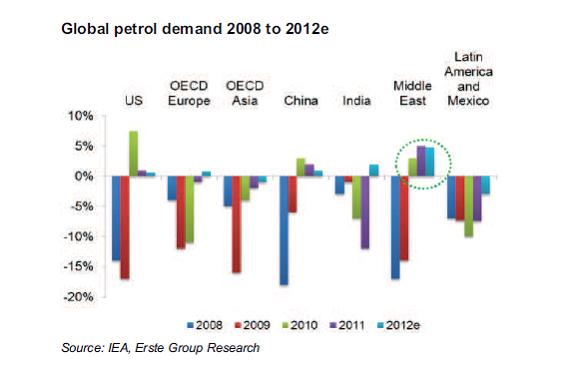
What is interesting is that, outside of the Euro crisis, the world’s economies are behaving much more strongly than expected but oil demand is not reacting. Efficiency comes to the fore. What many call “weak demand due to crisis” is in many cases, US being the clearest, a relentless improvement of efficiency. See below:
photo
Additionally, the US imports reached a 12 year low last year thanks to the shale oil and gas revolution we have mentioned many times in this blog. The US imported 8.91m barrels a day of crude oil last year, according to the US Energy Information Administration, the lowest amount since 2000. US and Europe implied demand is down between 5 and 7% yoy, while Asian demand is pretty much unchanged. Emerging markets are keeping global oil demand above the 87mmbpd, but every two weeks we read from the IEA or other agencies that they are lowering their demand estimates for 2012. The IEA said it expects oil consumption to rise a relatively poor 800,000 barrels a day, or 0.9%, in 2012, according to its latest monthly market report. That would be 300,000 barrels a day less than the IEA forecast just a month ago. As we said at the beginning of the year, I expect demand to be flat year on year.
Inventories at the OECD have been shrinking recently, but remain within the average band of the last five years, 57-60 days of demand covered. The market is tight but not excessively tight, as prove by the fact that demand is well covered despite geopolitical disruptions in Iran, Siria and Nigeria.
CFTC Non-Commercial long/short net positions (21st February)
CFTC MANAGED MONEY net positions (21st February)
ICE Brent long/short net positions            (14th February)
Crude
228,180 (prev 204,752)
215,802 (prev 202,222)
Non-Commercial
105,901 (prev 93,673)
Nat Gas
 -124,929 (prev  -126,157)
 -70,832 (prev   -72,314)
Managed Money
96,703 (prev 88,706)
Gasoline
90,298 (prev 87,696)
91,640 (prev 88,575)
Heat Oil
27,566 (prev 23,544)
43,207 (prev 39,379)


One of the areas that interests me the most is the growing net long interest in crude, reaching levels close to 2008. The inflation trade is on and the carry trade is guaranteed by the insane monetary policy and low interest rates “for the foreseeable future”.
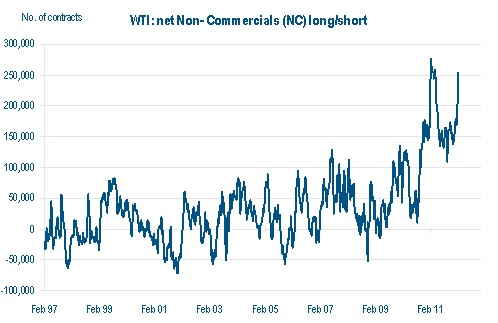
cftc february

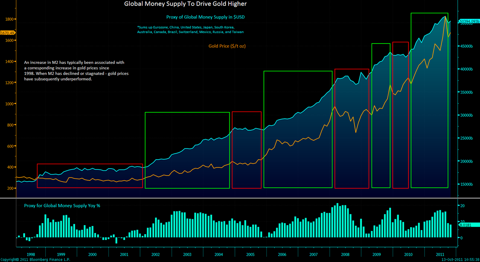
Think about it. Monetary supply is growing so fast, from China to Europe, because the developed world is worried about deflation, that we cause inflation in all commodities (except regional and local ones like US natural gas). The balance sheet of the ECB has multiplied by 3 since June. Monetary supply is twice as high as it was at the end of the past decade.
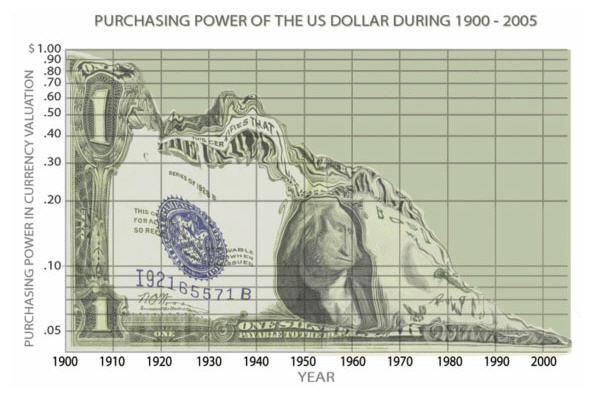
dollar weakeningAccording to seeking alpha (see link here): “Developing China’s M2 money supply has been rising by a large 20% and Russia’s by a very large 30%.Even developed countries such as Switzerland have seen money supply growth of 25%. Japan’s M2 is gradually moving higher after the ‘Lost Decade’ and after recent events exacerbating an already fragile situation. Global money supply growth is increasing by 8%-9% per annum”.
money supply

Then we go to the issue of “the oil burden” or the import bill versus GDP. It’s  currently close to 5%, but the share of the oil burden in the OECD is diminishing, making high oil prices less risky for the recovery. Meanwhile, in emerging markets, high oil prices are also a less of a problem as the oil consumption generates products, goods and services of much higher productivity and higher added value. Remember that most emerging economies do not “need” low oil prices, that is more an OECD construct. Those economies have lived with high energy prices for a long time. When the oil burden reaches 7% is when we can start to worry. So far, demand destruction is a concern but not a worry.
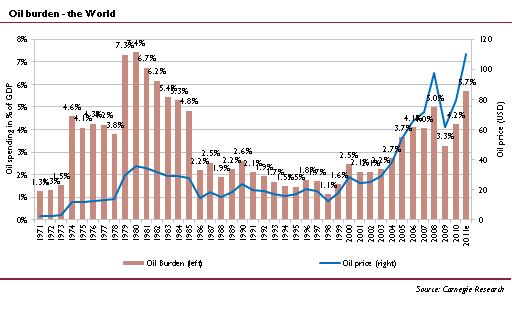
photo
Obviously, many of those emerging economies are also oil producers. Russia, Brazil, OPEC, West Africa and Asia are main beneficiaries of a wealth re-distribution out of US-Europe and into new markets.
OIL DEMAND
Brent-Urals has gone negative this week. In this environment, the trade is likely to be negative European refiners. Another trade starting to look attractive is long WTI short Brent as the tensions with Iran are played out and inventory issues at Cushing start to be solved. I do not expect the differential between Brent and WTI to go to zero, but closer to $10/bbl, which is more fundamental, as we mentioned in this blog here (http://energyandmoney.blogspot.com/2011/02/brent-wti-spread-more-fundamental-than.html).
Finally the other attractive trade that seems to be unwinding is a short European Big Oil after the companies showed no meaningful free cash flow generation at the 4Q results and poor refining and downstream margins added to sub-par production growth and upstream profitability. The sector is at the top of its trading range versus the market and the traditional strengths (balance sheet, dividend, safety) are still there but at much more demanding multiples. At 9.5xPE the sector trades at historical high EV/IC/ROIC/WACC. All above 1 (which means expensive).
Meanwhile the US is seeing the benefit of shale oil and shale gas in every part of its economy. Just a small calculation shows that the effect of WTI at $20/bbl below brent and Henry Hub gas at $2.5/mmbtu versus $8/mmbtu in Europe has the same effect as Bernanke’s trillion QE… annually. Read this. In Europe we continue to ban it. Someone in Washington must be laughing hard. The US refiners seem in the best place to take advantage of a strengthening economy and lower feedstock. So do the US oil names. As for US gas names, careful when asset (land) value collides with low earnings multiples, because M&A comes back…. except in joint-venture filled companies, because JVs are giant poison pills.
I believe the risk of demand destruction remains, but unlike 2008, the risk of a financial meltdown and a credit crunch is much lower, and in fact if there is any risk is that loose monetary policy will remain for the foreseeable future, keeping the commodity-led inflation high. Draghi, Bernanke and friends want the carry trade, and need it to avoid deflation in a japanese way. Supply and demand remain well covered, printing money is the wild card.

The IEA March report left 2012 oil demand forecasts unchanged, but highlighted OPEC’s ability to increase production, with OPEC volumes at the highest level since October 2008. OPEC supply in February was 1.3Mbpd ahead of the forecast call on OPEC for 1Q.
OECD inventories rose 13.6Mbbls in January and fell 26Mbbls less than usual in Feb. Furthermore, the IEA sees 625kbpd extra OPEC capacity by 3Q, adding to current spare capacity at 2.75Mbpd (Bernstein).

Data courtesy: Carnegie, Erste, Oriel, BP, BarCap, Bernstein and own research.

Here is my interview on CNBC:

http://video.cnbc.com/gallery/?video=3000076989

Worth a read:

http://energyandmoney.blogspot.com/2012/03/energy-disinflation-as-source-of.html#
http://seekingalpha.com/article/299410-global-money-supply-and-currency-debasement-driving-gold-higher

http://www.thenational.ae/thenationalconversation/industry-insights/energy/flawed-views-on-peak-oil-rear-their-ugly-heads-again

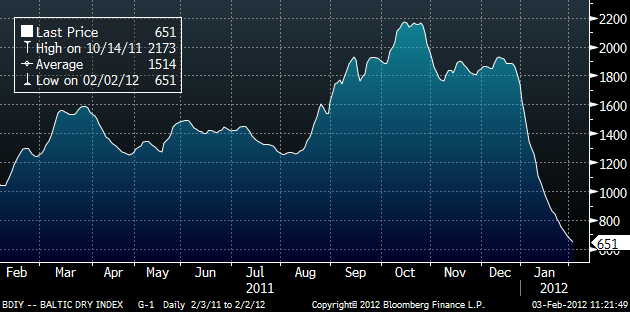
Baltic Dry Index down 65% YTD. The single clearest indicator of the global overcapacity problem.

Baltic 2012
The Baltic Dry Index is down 65% this year and at the lows of 1986.
Main reasons:
a) Oversupply of vessels. While supply has increased an average of 12% pa 2008-2012, demand has been weakening -3% pa.
b) Weaker demand from China, added to high levels of stockpiles all over the OECD, with lower iron ore demand after strong inventory build in December. Inventories stand at 5 year highs. Just the outlook of dire demand from aluminium smelters is a big worrying factor. Despite the cuts in capacity of Alcoa and Norsk Hydro, the outlook for aluminium production is weakening for 2012-2013.
c) Weather issues in Australia driving lower vessel utilization (coal supply disruptions).
d) Commerce trends weakening from LatAm to Europe (-7%) and Asia to Europe (-6%) at the same time as new building of houses, offices and infrastructure is slowing down all over the OECD as a result of the overcapacity created by the stimulus packages (mostly devoted to construction) of 2007-2010.
The Baltic Dry Index neeeds to reflect the weakening outlook for metals demand, with Chinese steel demand growing by 4% in 2012 from 10.5% in 2011 and significantly below GDP growth of 8.4%.
In addition, the delay of the 90mtpa Siere Sul iron ore project for 2016 (from 2014) adversely affects the shipping outlook.
However, brokers still expect c6.5% growth of seaborne bulk commodity supply in 2012-13, driven by 9%+ growth for iron ore and c7% for thermal coal.
On vessel overcapacity, consensus expect the fleet to grow by 13.5% in 2012 and c6% in 2013, suggesting that the shipping market will start to tighten ONLY towards the end of 2013 IF demand picks up.

Rates for Capesize have dropped below $6k and the Panamax spot at $6.5k/day can barely cover operating expenses. Rates are below cash break-even for the largest part of the sailing fleet, and China seems very happy about it, as they drive most of the excess supply and benefit at an aggregate level as a lower cost.

Going forward, we will likely see a small “dead cat bounce” on the Baltic Dry Index once we see the unwinding of the China inventory build that happened pre-New Year holiday and once we see an improvement in weather conditions in Australia, but the underlying deep problem, overcapacity in vessels and massive unused and unusable infrastructure and construction, remains. The fleet is built for a growth that is unsustainable and unreal. The world’s iron ore consumption is not going to grow 12% pa to offset the overcapacity. I believe the small uptick, unfortunately, will be used by some vessel owners to take out some capacity (not enough) and maybe raise marginal day rates, still nowhere close to 2007 levels.

OPEC Meeting Ahead: Concerns About Oversupply?

(December 2nd 2011)The December OPEC meeting in Vienna is coming and the picture of the oil market is mixed at best:

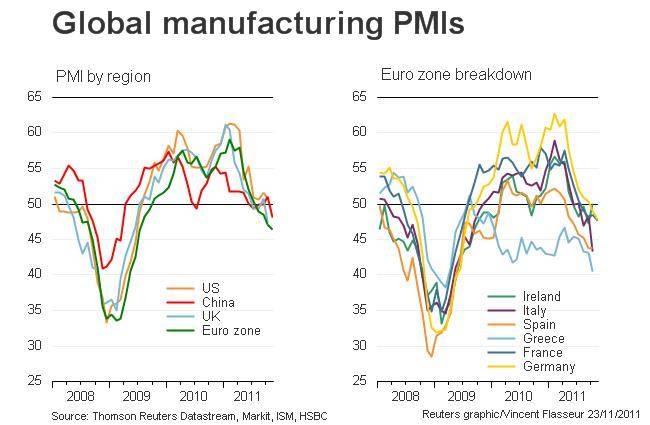
1) China PMI below 50 for the first time since Feb 2009. Global manufacturing PMIs remain weak as the table below shows, particularly in Europe.
2) Bearish US DOE weekly with high inventory build and very low implied demand. The EIA’s monthly revised oil demand numbers for September came in at 18.8m bpd, which was down from 19.05m bpd. It was also down 0.7m bpd y-o-y.
3) OPEC production in November: came in at 30.35m bpd, up 390,000 bpd from October, according to Bloomberg. The increase was led by Libya (155k bpd), Saudi Arabia (65k bpd) and Iraq (50 k bpd).

pmi global

Earlier this month we had additional evidence that the slowdown in activity is seriously reaching emerging markets now. India’s industrial output declined 5.1% y/y in October, the first decline since June 2009, with a 6.0% y/y fall in manufacturing, and with capital goods output down 25.5% y/y.

In the meantime, geopolitical concerns surrounding Syria and Iran, added to the inflationary pressures of the constant reduction of interest rates in Europe and Australia more recently, have kept oil prices at a very strong level, with Brent at $109.6 at the close of this post.

To me, one of the most interesting trends is that heavy oil continues to re-rate and that Tapis (Asia) remains at a healthy premium to Brent, proving that Asian demand remains solid despite the relative weakening in the recent data.

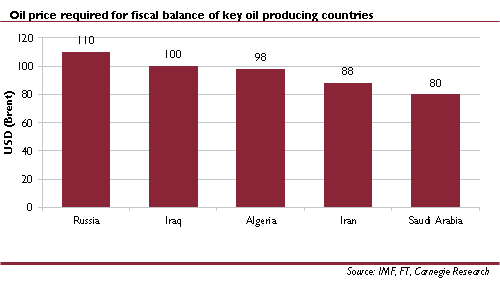
In this environment, another interesting trend is shown by the significant increase in the break-even price required by producers to balance their budget. At $80/bbl, Saudi Arabia’s commitments to invest in social peace and support the MENA stability is starting to prove costly. But still very comfortable versus the market price. Otherwise, Russia’s $110/bbl is a reflection of the strong investment commitments of the country, which are likely to slow down in the next years, so the headline number of break-even price might be overstated in the mid-term.

Break_even_oil_price

Considering this, it is not hard to understand why the OPEC World Outlook Reference Case oil price assumption has been increased from last year. It is assumed that, in nominal terms, prices stay in the range of $85–95/b for this decade, compared to $75–85/b in last year’s expectation.

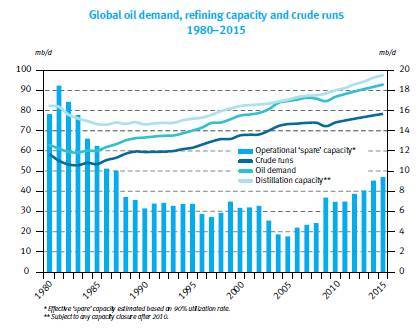
At the same time, global refining capacity is soaring and excess capacity is likely to reach 10mmbpd. This will have a significant impact on refining margins and, as such, high oil prices might be cushioned for the final price paid by the consumer by lower refining margins.

OPEC Refining Capacity

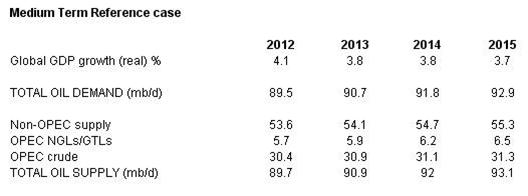
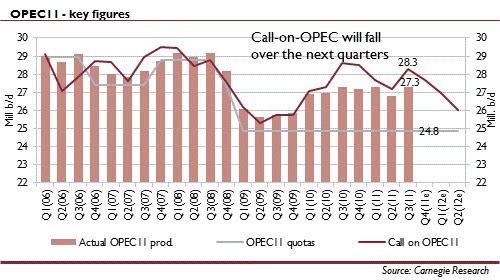
While Russian production stays afloat at 10.3mbpd and OPEC supply stands firmly above 30mmbpd (remember OPEC quotas are 24mmbpd) I continue to think that demand growth estimates are exaggerated, and not consistent with a slowdown in global GDP growth, so until I see a strengthening of the two main demand centers, China and US, I fail to see how emerging markets will offset the decline in OECD demand to reach a total of 92mmbpd demand in 2014. I think we stay pretty much flat at 88mmbpd for a few years.  Worth analyzing Chinese implied oil demand. In November it was 9.5 mm bpd, but this excludes inventory adjustments which are not published, driven by strong diesel demand which comes from regional shortages as a result of refinery maintenance and turnarounds. Crude imports were 5.52 mm bopd, +8.5% y/y but starting to show a slowdown from previous years.

OPEC supply demand

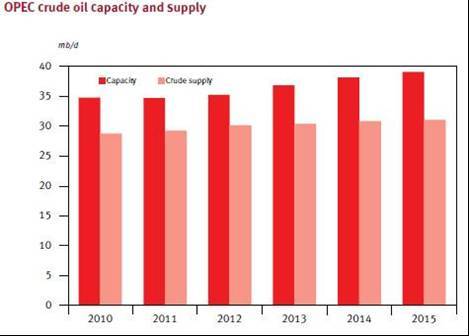
In this context, even if we assume that oil demand rises to 92mmbpd, spare OPEC crude oil capacity is set to reach around 8 mb/d over the medium-term, and in the high case of demand around 4 mmbpd in 2011. Even if I assume no OPEC production growth, spare capacity at OPEC countries is unlikely to go below 3mmbpd, which according to my estimates is pretty much a super-tight market.

OPEC capex spend

Obviously, the big question mark in this picture is how will capex be affected by any weakness in oil prices.

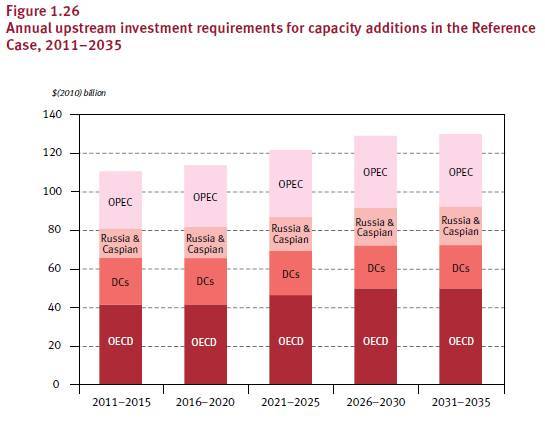
The table below shows the OPEC annual upstream capex required to reach the capacity additions assumed in their base case. Interestingly, this annual capex is unlikely to be affected by a global downturn in the case it happens given it’s such a small proportion of the total global capex including downstream and midstream. So prices would have to dramatically fall below the $80/bbl level to curtail the spending.

So spending is not the issue. The issue is execution and a stable framework that allows this capacity to be added on time and on budget. This is much more difficult than spending and drilling.OPEC Capex Spend II

I think it is safe to assume that we will likely be negatively surprised by capacity additions in the system, probably assuming that around 75% of that capacity is actually added as expected. This, in any case, doesn’t impact the base case of OPEC spare capacity moving between 4 and 8mmbpd in the next five years.

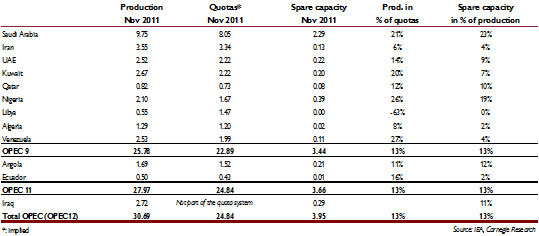
So what is the OPEC meeting going to approve?. Very unlikely to see a production cut given the very high oil prices, even with pressure from Venezuela and acting president Iran to do so. It is more likely that OPEC alerts to a risk of oversupply mid-term, tries to enforce the current quotas, as every country is producing above quotas except Saudi Arabia, and extends the decision to cut or to take action on quotas to a meeting where they can assess the true impact of the Euro and debt crisis on global demand. OPEC could offer an increase in quotas that sets the limit at the current level, so basically making no impact to global supply, just recognizing the real volumes. The risk is that countries will continue to “cheat” on the new quotas, but geo-political concerns might prevent that from impacting prices.
opec quotas

Iran’s role as president of OPEC here is critical, in the middle of the aggressive rhetoric with Israel. If Iran is perceived as anti-West in its proposals to OPEC the moderate side, led by Saudi Arabia, are likely to continue to act as buffers of the oil market. If Iran leads the meeting in a conciliatory and open way, the conclusions will likely be more firmly implemented. The last OPEC meeting gave the impression of countries “against” each other in some instances. This one could be the opportunity for a constructive approach that sends a positive message to consumers and producers alike.

OPEC_production
 

Oil-Gas Spreads Rocketing Again. Careful with the European Gas Majors

Most analysts keep in their numbers for 2012 and 2013 a massive improvement in profitability for those companies that buy long term contracted gas from Russia and Norway. The thesis on ENI, E.On, GDF-Suez and others is simple. These companies have been losing money on their long term contracts due to an agressive take-or-pay obligation. Basically these groups, in a strive to maintain giant market share and profit from their exposure to retail, reached agreements with the major suppliers of gas in conditions that looked very attractive ONLY if gas prices rose and demand continued to soar. As such, major suppliers locked in large take-or-pay contracts with oil-price-linked formulas based on the “conservative” bet that gas demand in Europe would rise by 2-2.3% pa from 2007-2020 and that gas prices would retain their historical link to oil prices.None of those things happened, and greed turned into loss. The accumulation of market share was part of the problem (most of these companies control c60% of market share in their countries), making them very exposed to GDP and demand growth.

… And demand growth vanished. European gas demand peaked in 2007 and is c9% below that level four years later.

The other problem was the bet on oil-gas link remaining, driving spot gas prices higher as demand soared. What happened is that spot gas prices collapsed by 15%, oil prices soared and the long-term contracts were overpriced versus flexible spot levels. This meant losses that reached levels of €1-1.5bn in 2010 for some companies. These losses are expected to turn to profit by 2013 through a combination of re-negotiation of contracts (mainly with Gazprom) and improvement of demand. Errrr…. not likely.

The bet was wrong on both sides (demand and price), and is likely to get worse mid-term, as demand growth estimates in Europe are overstated given the downward GDP revisions. Furthermore, Gazprom and Russia are in active discussions to build a 30BCM per annum pipeline to China, and the Yamal LNG project (where Total and Qatar are likely to be major players) will create a new export route for Russian gas. Therefore, Gazprom’s “urgency” to renegotiate the take-or-pay contracts is diminishing by the day. And their policy is now to preserve wealth (reserves) not to maximize volumes exported to Europe. Gazprom’s decline rates (4% pa, some see 6%) don’t justify a policy of “maximizing volumes at any cost”.

Well, see below a very interesting chart sent by Citigroup updating on the weakening environment for utilities as the oil-gas spread widens.

oil gas spread

According to Citi “the spread is now back up to €7/MWh as you can see from the attached chart mostly driven from the appreciation of the US$ on which the oil basket that drives long-term gas prices is based. Midstream gas players should now be nearly 100% locked in through October 2012 and ~50% locked in through October 2013 at what they estimate to be a ~€5-5.5/MWh spread. So any incremental volumes sold from now on would actually be at a higher cost given today’s prices, exacerbating loss-making positions”.

The issue, as highlighted above, comes mainly for the giant market-share owners. European demand is unlikely to recover to 2007 levels until 2015, the flexibility of LNG and Asian demand is keeping the gas market in better conditions, but still oversupplied, and the strategic decision of revising take-or-pays goes radically against the political role of these giant companies as “security of supply” providers.

Expect earnings revisions to go…down.

ENI

Consensus expects a return to profitability from demand recovery and re-negotiation of contracts generating an uplift in EBITDA of between €1.5bn and €2bn. However, with Italian gas demand down by 4% in 9M 11 and new gas volumes coming from Libya (16mcm/day, or 1.5bcm in 2012 due to the opening of Greenstream) prices are falling further while ENI may be required to assume some Russian take-or-pay obligations, equivalent to an additional 2 bcm in 2012e, unless we see a favorable outcome from renegotiation with Gazprom on both flexibility and price, something that seems unlikely.

E.ON

Consensus expecting gas midstream business to come back to profit in 2013 with approximately 50/60% contracts renegotiated by end of 2012 Bull case: +€1bn in Ebitda 2012 and +€2bn Ebitda 2013. In a no-renegotiation bear case -€850m in Ebitda 2012 and -€1.7bn in Ebitda 2013

GDF-SUEZ

Concerning GDF-Suez, new negotiations are starting now on contractual clauses (renegotiation every 3 years). Normalization is expected by 2013 with still a wide range in the consensus: (+€1bn – +€2bn) €1bn delta on 2012e Ebitda of Gas division from one broker to another.