Tag Archives: Energy

Anti-climatic Change, and UK Nat Gas

(This article was published in Cotizalia in Spanish on December the 8th)
UK Gas balance

In May 2010, gas inventories in England were at a truly low level, with storage almost empty, at a level of 35%. The country decided not to take the opportunity of having gas prices at a minimum to fill storage for the winter. Why, You may ask yourselves. Two reasons. On one side, a group of scientists who had advised the ministry and the industry that “climate change would create one of the warmest winters of the last hundred years”. On the other, the view that would have “radically hot and dry” winter(The Guardian, July 2010) due to the effect of La Niña.

Additionally, the Uk decided to play “commodity trader”, and clung to the estimates of CERA (Cambridge Research) and Wood Mackenzie about a bubble of gas in Europe from 2010 to late 2012 . According to these estimates, the Qatari government was going to flood Europe with cheap liquefied natural gas, the Russians were going to get nervous and cut prices aggressively, and the Norwegians would have to sell below cost price. Even agreeing that the gas market has spare capacity, and I have written about it several times, is very imprudent to take a bet on prices to fall, not to secure supply, when the price can move dramatically depending of many factors.

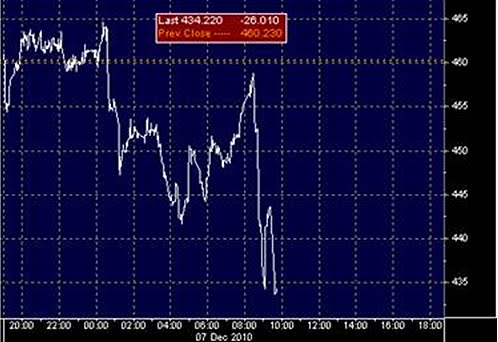
Of course, today at 2 degrees below zero, the British gas system is in deficit of between 15 and 25 million cubic meters (see graph). Of course, the “scientists” were wrong by as much as 170% in their projections of climate, and thus gas consumption. Of course, gas producers have not foolishly flooded the market. And nothing happens here, no one said it had been wrong, while England and the continent are desperately trying to buy more gas …. 41% more expensive than three months ago.
UK Gas vs Henry Hub

In Europe we have spent more than a year complaining about the oil-linked formula of long term gas contracts with Gazprom and Statoil. Of course, when gas has decoupled aggressively from oil, as gas demand growth has slowed down dramatically, we have seen governments and E.On-Ruhrgas, GDF-Suez ENI and others force the machine to renegotiate their contracts with major gas producers. Perfectly acceptable.

Anecdotally, I remember the CEO of Gazprom say in London that for eight years, when long-term oil-linked gas contracts were very competitive compared to spot gas, no one complained. And he said if it was not possible to renegotiate the contracts but with retroactive effect, ie, all they had lost between 2002 and 2008 subtracted from what buyers have lost between 2009 and 2010.

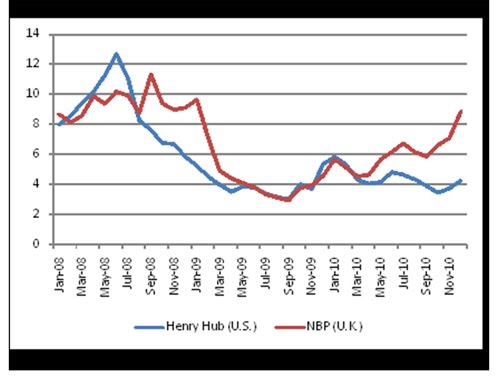
Well, now that they have renegotiated up to 20% of contracted volumes to be linked to the price of spot gas… Surprise. The spot price ($8.8/MMBTU) exceeds the long term, compared with the price of Gazprom ($7.8/MMBTU) and Statoil ($7.5/MMBTU). These things happen. And of course, solar and wind energy can not cover the difference in consumption, and the bill of the average consumers in the UK, for example, will rise by 20% when it would have only risen 9% if the measures had been taken to ensure supply and maintain the reserves filled in summer with gas prices 41% lower.

Of course, they forgot that the gas market is also global and is one of the most rapidly adjusted given supply is focused in very few countries. And the liquefied gas, LNG, and especially the spot part, which is still less than 12% of total gas, is sent to that market that pays the highest. Asia, in this case. So again, companies and politicians, instead of worrying about security of supply and proper planning, decided to play the market. A lesson to be learned by all European countries.

The Independent states that despite the low temperatures and having been a 346% wrong in their estimates of 2002 about the melting of the Arctic, global warming is a looming problem that will cause one million deaths in 2030. With this track-record of successes, I can not help but tremble.
Shale Oil: 600 years of abundant energy supply?

US map shale oil(This article was published in Spanish in Cotizalia on November 25th 2010)

Imagine the following scenario. We are in 2020. China has captured 15% of world reserves of conventional oil and gas from its own resources and acquisitions in Africa and Latin America, Middle East and Russia control 60%, the U.S. controls 20% … and the EU? 1%. Nothing.

This is the geopolitical landscape that a good friend, geologist and energy expert who advises the U.S. administration, painted over breakfast in New York, commenting on the recent study by Sanford Bernstein on the electric car.

In this study, assuming the most optimistic forecasts of the U.S. administration, the introduction of electric cars will only increase electricity consumption by 0.4% and my friend told me that the analysis of the U.S. administration expected a “conversion oil-electricity “… that is negative!.

That is, 4.1 million electric cars (about 5,700 MW of load) will not only increase power consumption by a tiny fraction, but will not reduce oil consumption as the energy intensity of the process of network investment, re-industrialization and adaptation of the park ($14.8bn pa for 10 additional years) means increasing the consumption of oil and gas by almost a million barrels a day.

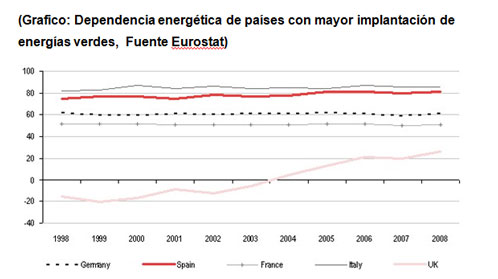
Some of my readers have rightly commented on the risk of energy policies that do not take into account the in-out cost (energy consumed per kilowatt hour generated). In the UK this has been particularly evident (see above graph showing the evolution of energy dependence in countries with strong “green policies”)

Do you know what is the solution? Interestingly, the Obama administration, that criticized the “drill, baby drill” messages sees only one way to mitigate the effect. Increase drilling permits (+75%!) And double-check the possibilities of “Shale Oil” with 143 drilling licenses in North Dakota, where there are more than 4,000 active wells, surpassing the record of 1981.

electric car

It is worth recalling that the concept of “Shale Oil” is not new (has been investigated since 1920) and until recently had been considered too expensive to be commercial … Until the price of oil stabilized at $80 a barrel. Besides, the horizontal extraction technology has seen a giant step in terms of cost and efficiency and the war for natural resources has accelerated. With more than $100 billion in oil and gas transactions worldwide, 39% more than in 2009, nobody can ignore new options to accumulate resources, and above all in the OECD.

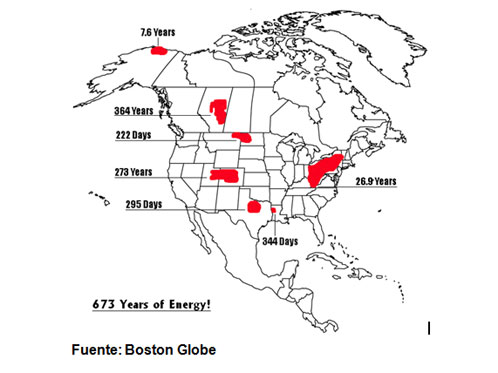
The United States accounts for 72% of the world’s Shale Oil reserves. With an organic-mineral ratio of 1.5 to 5, similar to crude oil and about three times higher than coal, the challenge is to continue to explore and determine the commercial potential and the average lifting cost, estimated at c$10-15/barrel.

Unresolved issues

Shale Oil still has many unknowns. One of them is access to sufficient water to fracture the rock and the typical environmental restrictions. But it sums to potential reserves. And after the success of horizontal drilling technology in shale gas, no one should dismiss the possibilities.

In the Bakken formation, one of the most commented in the American press, which extends from Dakota to Montana, there could be an estimated 1.5 trillion boe of shale oil reserves. Around 600 years of abundant energy … if we get to perfect the technology to make production economical.

For now, the latest round of oil concessions in Bakken, Eagle Ford and Niobrara have attracted more than $72 billion of private investment. And taxes and costs so far are not low. There could be an estimated 400,000 barrels per day of production over the next five years.

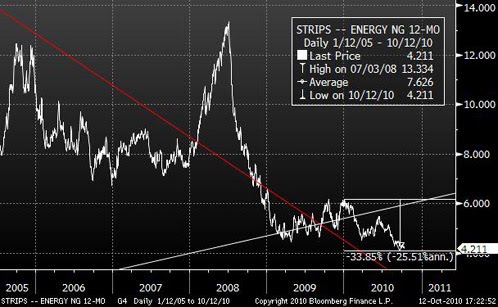
Only five years ago many people dismissed shale gas saying that it was not economical below $6.5/MMBTU and would never be a real alternative to conventional gas. Today the shale gas revolution has taken gas prices (Henry Hub) to $4/MMBTU levels, and companies are still drilling and generate solid returns of 12-15% IRR without debt.

Now we see the revolution of shale gas reach Europe, starting in Poland, as we mentioned here. So beware of dismissing shale oil. Hess, Williams, PetroHawk, Noble, EOG and others are betting hard on it. At $83/barrel and with horizontal drilling technology improving every year, it is something worth bearing in mind.

Has Cheap Gas Killed The Renewable Star?

cheap gas(This article was published in Spanish in Cotizalia on Oct 14th 2010)

I find it very interesting to see how in a globalized world, few have stopped to discuss the devastating impact that cheap gas has on the growth of wind and solar facilities, particularly in the U.S., and in turn the chilling effect posed by renewables on gas demand. However, companies on both sides, gas producers and renewable developers, are betting (praying, I would say) on electricity prices rising one day to generate acceptable returns again, even though the two sectors create a deflationary effect on prices. And without acceptable power and gas prices, investments are ruined. This is a war to see who loses more money, sooner and faster. In the European Union we are used to accept energy decisions that are not economically justifiable, as the decommissioning of nuclear power stations or coal subsidies, but in the U.S. this is not so easy.

The plummeting of natural gas prices in the U.S. continues. Not only it has broken the support of 2003 (Henry Hub), but production continues to grow by 1.5% per year and storage is at historic highs, 3.750 bcf. Thus, the price falls inexorably, from the 2006-2007 average of $8/mmbtu to $4 today.

The revolution of shale gas and a much more efficient and economical extraction process, hydraulic fracking, has led to reach 250 years of proven reserves and see the unit cost of production fall by 33%. Thus all producers, from Shell to Petrohawk, continue to increase production despite falling prices. Now that revolution is coming to Europe, as we mentioned here (May).

Of course, there are differences in the different gas prices in the world. NBP, the English natural gas, for example, is trading at nearly $7/MMBTU equivalent as the Norwegians are closing the tap at the Langeled pipeline at a rate of nearly 30 million cubic meters per day to avoid overcapacity. Being an island also helps.

But the general trend in all markets is clear: Very low likelihood of increased natural gas prices as the market continues to have a surplus capacity of 13-15BCM (billion cubic meters) annually, which is estimated to continue until 2014. And the producers of liquefied gas from Qatar to Yemen, will not cut production at these prices because most investments were made (FID, final investment decision) with an estimated gas price of $1.5/MMBTU.

However, the effect of cheap gas is essential to understand the drop in wind power installations.

The issue is as follows:

a) The price of electricity is set in a marginal system, like the U.S.one, by the price of gas (mainly) or coal.

b) The price of gas depends mainly on electricity demand to go up or down.

c) New technologies, wind and solar, when they exceed a critical mass, generate deflation in electricity prices because they add new baseload capacity at a low price (ex-subsidies).

d) However, to see further growth in renewable installations with adequate returns, wind and solar power plants need to see a higher price of electricity, which they themselves contribute to cap. Currently wind farms cannot sign long term PPAs, power price agreements, due to very low prices. This is the deflationary impact of renewables. And if electricity prices do not rise to reasonable levels, they will still require subsidies to survive, creating a vicious circle. Does the right hand eat the left?

e) So if they are eroding demand for natural gas and coal to generate electricity, they cannot expect prices to rise unless the taxpayer pays for a minimum return.

In short, renewables are needed and gas as well, but as from a certain critical mass and percentage of the energy matrix onwards, both engulf the same hand that feeds their returns.

Given this scenario, deflation, the only way to improve returns is to remove capacity (“coal? it is virtually defunct) or create more demand for electricity that, due to increased efficiency, is not easy.

Or promoting the electric vehicle, but when oil demand falls, oh surprise, the price of gasoline falls as well and remains much more competitive than the electricity including subsidies and aids. Unless we use the xenophobic argument that we do not like the country that sells us the commodity. That’s another story

To close the circle, the fact that the price of this invented and surreal “commodity” created by bureaucrats in the EU called CO2 is at rock-bottom prices (at €15.6/mt, oh surprise, also due to falling demand for gas and coal) does not help, and as it doesn’t add significantly to the costs of thermal power, it breaks the deck. Numbers don’t add up.

Trying to force the displacement of baseload commodities and technologies forces a downward revision of price, thereby wiping out the marginal technologies. That’s why they are commodities, because marginal cost adapts to demand.

Returning to the U.S., as the price of electricity is well below the price required to make a wind or solar power plant financially viable, the U.S. administration gives no more subsidies. Why? Not for political reasons, as many say, but for reasons of price, cost and demand. States are unwilling to accept price unreasonable rate cases when gas is abundant and very cheap.

Large power companies are beginning to seriously worry about the low returns on their investments, given their high gearing levels. And they witness the negative effect of over-capacity in the profitability of their businesses. Who would have thought that the enemy to beat, fossil fuels, was in turn essential to maintain a minimum return for their investments. Meanwhile, gas producers, with very low debt, accept the market price, as they always have, and produce more in a traditional suicide strategy to stifle the opposite sector. Now they would all have to find a way to agree to ensure that overcapacity does not continue to increase.

The day, a few years ago, when the energy sector decide to bet on “ever-growing demand” and forgot that “control and management of supply” is paramount, was also the day when we started to see the growing “running to stand still” strategies that have caused so much damage to the sector. Because governments do not care whether companies shoot each in the foot as long as the energy bill goes down. But this downward spiral will not end until we see corporate bankrupcies. And we might see them sooner rather than later.

China and the Brazilian Oil Land-grab… A Bubble?

(This article was published in Spanish in Cotizalia on October 7th 2010)

The Repsol sale of 40% of its assets in Brazil to China’s Sinopec has generated some controversy in the media all week. And in several cases we have seen the term “bubble” used for the transaction.

China has a very clear objective, which is to secure its energy future and build up reserves in new frontiers, from Uganda and Nigeria to Iraq and Latin America. The war for natural resources. In 2009 and 2010 YTD, China has acquired over US$115bn in international oil and gas assets. And while some companies and the analyst community are surprised by the prices paid, we still see the shopping spree accelerating.

Sinopec has paid $7.1 billion for 40% of Repsol Brazil. This implies a “headline” price of about $ 15/barrel for the reserves, and the market compared this to the price of $5/barrel estimated for the value of the Brazilian assets in January and with the $8.50 per barrel paid by Petrobras to the Brazilian State for their new wells last month. “Bubble?” Let’s figure by figure.

For starters, the media has ignored the fact that Sinopec retains a 40% interest in the cash injected in to the IPO. So the net transfer to Repsol is 60% of USD7.1bn in return for 40% of contingent reserves of 1.2bn. So $4.3bn for 480mb or USD9/bbloe (or USD7.1/bbloe including the net risked exploration resources).An excellent figure for Repsol in any case .

Additionally, we should not confuse the value of assets within an integrated industrial group (the $ 5/barrel above) with its selling price if they are disaggregated. All oil majors are trading at a huge discount on their sum-of-the parts of its assets. For example, BP has sold $7 billion of assets to Apache at an average of $7.8/barrel. This does not mean that these assets should be valued within the BP group at these multiples. It is the historic conglomerate discount of 30-40% of all the mega-cap integrated oils.

Also we should not confuse the value that the Brazilian state uses to transfer assets to their flagship company, Petrobras, the $ 8.5/barrel, with a private transaction.

The Sinopec deal is justified from the perspective of other similar transactions made by Chinese enterprises and state-owned companies with a long term vision. Sinochem, China, paid Statoil $15/barrel for their Pelegrino assets in deep water Brazil in May, Sinopec itself paid $16/barrel for Addax, high risk assets in Nigeria, and KNOC, Korea, has paid $12.5/boe for Dana Petroleum, with much higher gas content, which is obviously less valuable than oil.

On the other hand, Chinese companies start with a much lower cost of capital assumption than their American or European competitors. The Asian giants do not have to worry about their debt, and, of course, have no need to pay enormous dividends like the integrated oils, that neither has served them to generate share price appreciation or to better compete in the M&A arena. China has plenty of capital and lacks natural resources to ensure its long-term supply.

Is this a bubble? No. It is simply a different use of capital and a longer term horizon. And it is not, moreover, for three reasons:

a) Oil assets are very scarce. To have a bubble we would have to see a risk that these assets were multiplied or fall dramatically in value, but, as stated in this column, we must take into account the scarcity value and the undeniable truth of the gradual decline rates of the oil reserves. Proof of this is the race that has been generated to participate in the 11 licenses for Iraq, where the companies (including China) will invest up to $200 billion in the next ten years accepting returns not exceeding 12%, and with an enormous political risk.

b) Unless we believe the demand for oil from emerging nations will collapse, the cost of access to natural resources is irrelevant compared to the risk of losing supplies or lose competitiveness. Oil reserves, therefore, should be seen as a cog in the huge Chinese machine. Oil is an “input”, and the relative price of these reserves does not make the total cost of “China Inc.” less competitive when the variables are planned in detail.

c) State-owned enterprises plan their projects with oil price assumptions that are higher than those used by the integrated oil sector, which is still planning at $40-50/barrel. Therefore, these companies are more than happy to have access to returns of 12-16% at $ 80/barrel.

As a friend of mine reminds me, China has a problem of too much cash, their US dollar stockpile is a perishable asset, and they can see value in oil assets above what assets are worth to others not only because they use a higher oil price, but because in any planning they use a sizeable revaluation of the Rmb.

In summary, while the European Union continue to waste time with pointless debates, instead of securing oil and gas reserves and diversify our access to natural resources, the rest are winning the war for natural resources. We’ll see if this is a bubble. I doubt it.