Tag Archives: International

China, Exxon and the war for resources

ep valuations

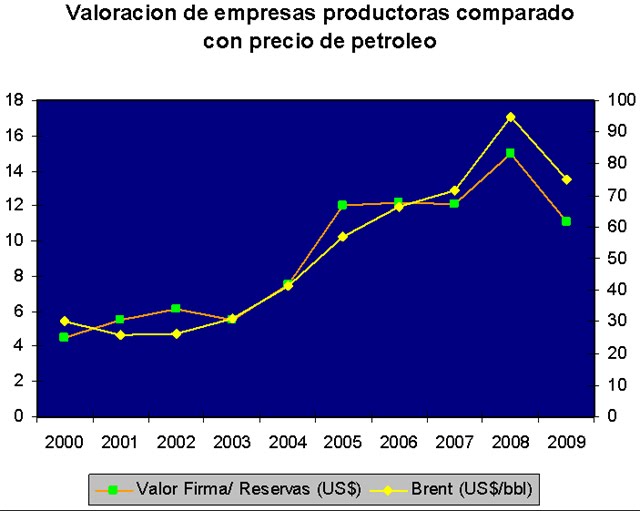
Graph above shows the valuation of independent E&Ps (EV/Core NAV) compared to Brent.

(Published in Cotizalia on November 19th 2009)

What an incredible week. Warren Buffett buys $60 million in Exxon shares, the independent E&P stocks (Dana, Dragon) rose to near-all-year highs on takeover speculation and we witness the evidence of what PetroChina said recently: the war for natural resources has only just begun. And the EU is losing.

While large European oil companies still fail to know what they will do to keep their businesses afloat if prices fall $1 or $2/bbl, the world is experiencing a revolution. So far in 2009, China has invested $16.5 billion to acquire oil assets. And what some disdained as excessive valuations has proven very reasonable, as PetroChina, Sinopec and CNOOC have demonstrated an exquisite discipline buying, but also by refusing opportunities.

Following are the Top-10 acquisitions by Chinese companies in the oil and gas sector so far in 2009. (Billions of US dollars)

RANK VALUE ACQUIRER TARGET

  1. 7.15 Sinopec Addax Petroleum Corp
  2. 3.30 China National PC OAO MangistauMunaiGaz
  3. 1.73 PetroChinaAthabasca Oil Sands
  4. 1.30 CNOOC, SinopecBlock 32 Offshore, Angola
  5. 0.93 China Investment CKazMunaiGas Expl & Prodn
  6. 0.87 Sinochem ResourcesEmerald Energy PLC
  7. 0.41 Petrochina South Oil E&D Co Ltd
  8. 0.31 CNOOC Talisman Energy Inc (gas)
  9. 0.27 XinjiangNew Energy
  10. 0.13 XinAo Gas Holdings Various oil reserves

You see, Europe’s efforts to invest in alternative energy and the electric car are very laudable and very necessary, but also very expensive, and even in the best case we should not lose sight of the importance of increasing access to natural resources . Especially when the International Energy Agency estimated that the use of electric vehicles in 2050 will not reach 35% of the worldwide fleet.

For me the problem is that the major oil companies are losing the best chance they ever had to buy relatively cheap assets and businesses in the OECD (see graph). For years we heard from Big Oil that E&P companies were too expensive, that they should wait for lower valuations to acquire assets. But that moment came in 2009, with the big oil companies full of cash and independents trading at historical lows … and they missed it.

However, China is demonstrating belief in the value of increasing its resources. But Exxon is now armed and ready. It has already placed a bid, rumoured at $ 4 billion for the assets of Kosmos in the Jubilee field in Ghana and continues to pursue attractive assets. As Rex Tillerson said, the company does not pursue crazy acquisitions, does not invest in political occurrences or areas that do not generate superior returns. And history shows it in their focus on the core business, a return on capital employed of 35%, share buyback of “only” $ 55 billion between 2008 and 2009 ($ 2 billion this fourth quarter!) And no debt, $2.9 billion net cash.

As Warren Buffett, Exxon knows that investing in cyclical assets with high debt clouds the ability to create long term value. And that’s what Warren Buffett has bought: a dirt-cheap stock, as he pays the total resources (72 billion barrels) at $4/bbl and pays zero for the chemical and refining businesses … but especially with the option to grow and buy without destroying the balance sheet.

In 2010 the figure of mergers and acquisitions, according to several companies and analysts, will reach $35 billion and may exceed $50 billion. Between PetroChina and Exxon they already have more reserves than all European listed companies together. The large integrated oil companies from France’s Total to Russia’s Rosneft, are unable to replace their reserves. 80% of global proven reserves are held by the producing countries. The little, very little that is left available, the independent companies with high exploration potential, will gradually fall inexorably. Those companies that lose this opportunity should not complain afterwards.

Careful with German power prices

Looking at the way German power prices have lagged other commodities over the past couple of weeks, German power looks to be heading into the low €50s/MWh… but NOT higher:

  • Gas prices have stalled and open cycled plants still meet peak demand needs inGermany; and
  • Coal looks solid given ongoing Chinese coal import data and current difficulties in exporting out of South Africa.

However, upside to the mid-€50s/MWh looks too much of a stretch:

  • French supply-demand balances are extremely tight but for transitory reasons;
  • South African coal export difficulties are related to the current expansion project which is said to be about to commission (some 4 months late).
  • Underlying clean dark spreads look high for the oversupplied power market we are currently experiencing.

So targeting a move to just €51-52/MWh makes sense (5-10% upside from 8th October) but not the 15-20% plus that there might be in some other commodities (from early 8th October).

Open cycle gas plants represent about one-fifth of the price setting merit order. Given the six month lag in contract prices, there could be about a €3-4/MWh rise in the contracted gas price (given the lag in the contracted price, it is easy to predict the German gas price going to €18-19/MWh in 3 months), which would equate to about €2/MWh onto the baseload power price. The gas purchase agreements that the German buyers have with Gazprom are under intense renegotiations currently (the buyers can’t take the volumes they’re contracted to take, let alone at the price they’re contracted at) which I expect to be resolved by reducing volumes whilst maintaining the oil price linkage.

Surging spot prices in France have helped German 2010 prices, but that may wane. Spot prices (within day) have hit several thousand euros per MWh in France as capacity failed to meet forecast levels this week. The week ahead French price is up 22% over the past ten days. This caused power prices to surge and has lifted the forward curve, so the French 2010 baseload contract is now over €6/MWh above the German equivalent. This level of premium is not unprecedented (especially for this shoulder period as demand builds seasonally and stations are slow to come back online from maintenance outages); however, a more usual level would be €2-3/MWh.

Clean dark spreads look a bit generous given the lack of capacity tightness in Germany. Clean dark spreads of around €20/MWh would be needed to justify new coal stations (if operators could get comfortable with the carbon risk) but no-one is racing to build so likely to see downside to the spread.

German power is in strong contango. This though can be explained by the contango in European coal. This does not make sense over the medium-term: (a) China will lift domestic thermal output so will no longer be a significant buyer on the seaborne markets, and (b) expansion plans in South Africa will mean exports rise by around 30mt annualized, and (c) renewables will take any medium-term load growth from fossil fuels. However, Chinese coal imports for September may not have fallen (last datapoint on third chart to be confirmed) and there’s no evidence that the export terminal problems out of South Africa have been resolved (the final chart shows how annualized exports out of South Africa have fallen, although the expansion project is lifting throughput capacity to 92mt). The combination of China importing at an annualized rate of 70-80mt (of thermal coal) and South Africa falling 20-30mt short of annualized supply, is likely to keep European coal prices high despite excessive inventory levels in the UK and Europe.

Afren: One to look into weakness

The way I see it the stock has short term downside to 80p on fund flows (some large hedge funds are sellers) and technicals… but enters FTSE 250 January or February, RDS are looking to sell them some really cheap assets, small 40-50mnbbls type assets currently too small for the big guys to work and which benefi from better fiscal terms under a Nigerian entity .. ie netbacks go from 2.50-5 per bbl .. so if you are RDS, why not give the assets to Afren, let them get $5 per barrel and take a royalty of around $2 ..less hassle, no political issues , everyone happy !. Ebok field could add 35p/sh unrisked and I am hearing solid things from RDS people. Obviously Addax must have strong views on it too.Expect 6 well exploration program next year targeting 685 bbls vs 129 bbls 2P today (easy 95p valuation then)
The stock, at 80p, will be at 8xPE and 3.4x EV/EBITDA 2010 at $70/bbl, so looks undemanding once we pass the 2009 cornerstone.

Calling the bottom on power prices in Europe

Although overcapacity in Europe plus excessive renewable installations remain the biggest threat to power prices, and a quick price recovery seems highly unlikely, these are the main reasons why i believe we could be reaching a bottom:

  • . I believe CO2 has reached a very strong support level at €13/MT. Utilities keep adding to their hedges at this level despite demand concerns. Even with -1% demand in 2010-2011 a CO2 price of €12-13/MT is widely accepted as a solid risk-reward price (basically the NPV of 2013 €23/MT with a 10% discount).
  • . I believe demand is showing some small but encouraging signals of bottoming. We have seen encouraging data from the countries with highest overcapacity like Spain and Italy. Demand data for Spain for June is down only 2.7%, versus down 8% in May. This is temperature and working days adjusted, so not influenced by external factors. Same trend was seen in Italy with June figures only down 3% adjusted.
  • . Capex cuts could reach 15% in 2010. Moody’s and S&P are demanding (expecting) power capex cuts in 2010 to reach up to 15% in Europe’s rated power groups. I had a chat with Neil Bissett from Moody’s yesterday in which they believed that generation companies should start thinking about moving closer to more cyclical company-type of gearing. That is c30% net debt/nd+equity!. Not only large groups are facing higher pressure to control capex and gearing, but smaller power companies are likely to be unable to finance agressive growth plans in current conditions. The effect is likely to be evident in 2011 and will hopefully bring reserve margins to tighter levels in Europe.
  • . Gas prices look well supported into summer by ongoing Norwegian supply discipline (and more worryingly, inability to offset decline) and revamped Russia-Ukraine dispute risk. However, winter looks uncertain. The gas market is the key uncertainty to this picture as it looks awful considering LNG.
  • . …But maybe the threat of LNG could be less agressive. You know me, I always trust Exxon, and so far it works. BP, Exxon and BG are seeing enough Asia demand to close large long term contracts. Additionally BP believes through TNK that Russian gas production could be peaking as reserves could be overstated. Exxon wants LNG in the US for two reasons: a) lower US gas prices benefit them and b) lowers the valuation of gas assets which they would takeover gladly.
  • . In coal we are seeing supportive data from recent broker comments of a tender for met coal out of Australia completed recently at US$132/t, which is the first deal above the benchmark price of US$129/t. Spot prices have rebounded from US$115–118/t last month, due to months of strong purchasing activity by the Chinese. Strong Chinese steel production, signs of an end to steel destocking in the world ex-China, as well as infrastructure constraints in Australia (Dalrymple Bay vessel queues up from 25 to 40 ships), have contributed to the move upwards.