Tag Archives: Macro

Euro Crisis & Credit Default Swaps. The Market Doesn’t Attack. It Defends Itself.

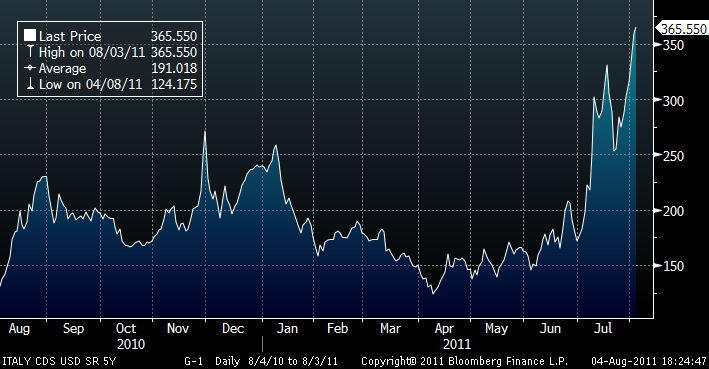
Italian CDS

Graph above shows Italian 5 yr CDS.

Deja Vu? As in 2008, governments in Southern Europe are blaming everyone except themselves. “The sovereign risk premium goes up because of the attack of speculators.” 

I look forward to the day when I hear “risk premium rises because institutions can no longer absorb more debt than they already have”.

One quick glance at Europe’s financial institutions and the numbers are staggering. SocGen’s entire core capital is comprised of Euro sovereign bonds, for Unicredit, 121%, Intesa 121%. In Spain, BBVA, 193%, SAN 76%. And all this is before another $200bn of Euro debt refinancing requirements.

As in 2008, the blame now is placed among hedge funds . And wait, soon we will see European governments or the ECB making interventionist decisions. Ban Credit Default Swaps. Or ignore rating agencies. Kill the dog to get rid of the flees. Blame the customer for the restaurant food. Does anyone remember what happened in 2008 when Europe banned short positions? The market plummeted another 30%. Because that is when selling REALLY starts. So far it’s only protection seeking. Trust me.

The risk premium does not rise because of any attack. It rises because the holders of government bonds, who see the risk of economic stagnation and increasing debt, can not sell their holdings and seek protection (hence the CDS widening).

96% of the market for sovereign CDS (credit default swaps or the cost of insurance against a default) is absorbed by the European largest institutions, most of them country “flagships” or semi-state-owned entities, who are flooded with  €250 billion of European sovereign bonds in their books. These entities, from DB to SocGen, the Spaniards or the Italians, seek protection and can not sell because of low liquidity, there are no buyers, and in any case they will receive the call to participate in the the next auction of debt. With a problem. The purchasing power is reduced by saturation, but also due to the increasingly stringent requirements of core reserves… While at the same time refinancing needs of indebted states are increasing. According to JP Morgan, Italy will have liquidity problems in September, and Spain in March 2012.2_20110519085443Hedge funds don’t attack. We would be happy to invest against the rise of the risk premium if it were not justified . But that is not the case. The trend is clear and normal. It is re-evaluating sovereign risk. A sovereign debt that for decades we have been told had no risk. As the swindle of “house prices never go down.”The sovereign debt crisis has many similarities with the housing bubble. An “over-priced” asset (in this case sovereign debt, regarded as an unwarranted risk-free asset), a brutal increase in inventory (all countries issuing, using pension funds, domestic banks and social security to buy more debt) and a bubble burst, when borrowing capacity is maximized. At the same time, the pool of capital allowed to invest in sovereign debt evaporates as the CDS rises and the cost of borrow rockets, because most fixed income investors cannot take the risk and volatility implied by the high yield sovereigns.
The end in this case, as in the sub-prime crisis (read “The Big Short”) is the same. A devaluation of the underlying asset (sovereign debt) and an appreciation of its risk factor according to real actual demand and true likelihood of repayment. 
The phases are typical: “shock, anger, denial, acceptance”. First, shock (“but our financial system is the strongest in the world”), then anger (“Spain/Portugal/Italy is not Greece”), then denial (“the premium rises due to external causes/US debt-ceiling deal/speculation”), and finally acceptance . And that’s where the solution begins. Countries will be less “easy” about leveraging up as debt will be more expensive, the states will learn not to squander and the growth-through-debt policy, ie, fund the privileges acquired by a decadent society with the income of future generations, will be over. And it will come.
It’s funny that we care so much about the cost of debt of Spain or Italy and whether the 10 year bond stands at 6.3% or 6.2%. We are only concerned because the governments want to return to the Debt-for-all-party and pay less . If the state model was to build and maintain a surplus, these moves would not worry so much.We forget also that the free-debt oasis is a recent invention. Less than twenty years ago South European states financed themselves at twice those rates, but then they had growing economies, were not indebted to 120% of GDP, and unemployment rates were assumable, not structural.
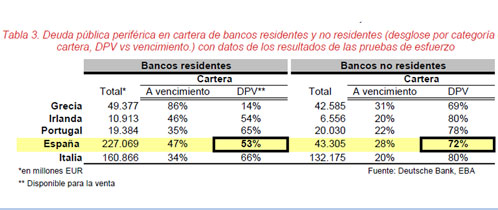
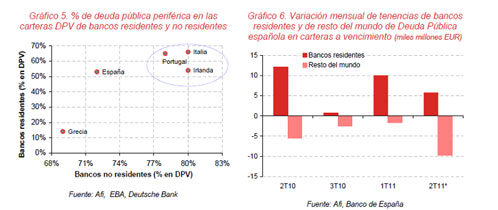
The following graph shows the % of peripheral public debt in the portfolios of domestic (resident) and foreign (non-resident) banks.

2011080258lacalle-1

2011080261lacalle2

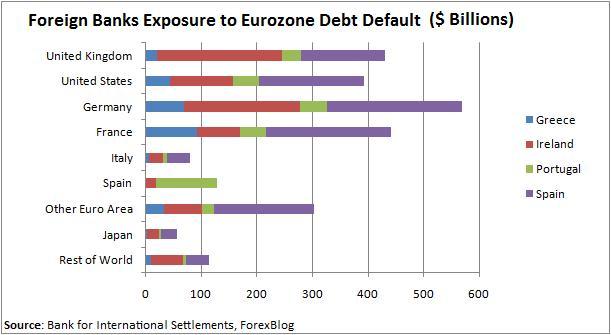
Countries and institutions thought the CDS market, $60 trillion, was more than enough to ensure credit risk. Why? Because they only thought there was risk in corporate bonds and, therefore, the sovereign debt market would not need large default insurance contracts. That was OK until countries started to issue debt like crazy, creating a huge bubble of bonds that are almost impossible to insure, while at the same time GDP growth stalled and unemployment rose. And who takes the risk to insure this debt while state banks and credit institutions are struggling to remove themselves of their debt hole?

For those who blame the wicked capitalists, do not forget that over 50% of the Spanish financial system is public, the saving banks, and in Italy, Portugal and Greece the percentage is also in the region of 50%.But let us review the elements that make the snowball grow, despite the “messages” to calm the market, because actions, I must say, few. In Spain, Italy and the peripheral economies they have not implemented many of the measures announced with great fanfare.1) The precedent of “stress tests” in which banks have taken significant haircuts in the valuation of their assets, has proven to be self-indulgent and inadequate, but also has shown to the eyes of the public the very low core capital of the institutions, particularly the semi-state-owned ones.

2) The rating downgrades, which no one in any government expected, are a reality. The agencies have taken two years to reflect on their “ratings” what the market already knew. The economic fragility of the indebted countries. And its is not the “evil doings of Anglo-Saxon agencies attacking the poor European countries with imperialist tactics” as some politicians say. It is rather the opposite. Rating agencies have been monstrously generous in the past.

3) The successive bailouts of Greece and Ireland have left the financial system without “gunpowder” to address similar risks in other countries, but also these bailouts have weakened the balance sheets of the entities that hold the bonds.

4) The optimistic estimates of growth and deficit reduction . Each month we see new revised estimates of GDP in 2012. And they are too optimistic. The IMF indicates that Spain, Portugal, Italy and Greece will not meet the government forecasts of deficit for 2014. Spain will be at -3.9%, versus a target of -2.14%, as growth will probably be very low. If GDP is not growing, unemployment rises, funding costs rocket and debt goes up.But what is more important, without measures to incentivize  job creation and support entrepeneurs, government revenues will be eaten by interest charges and costs that do not generate any return (GDP). Some call these costs “social” but they are just borrowing from our children’s future income.

While governments gave themselves pats on the back on the success of the last auction of sovereign debt, no one wrote the headline “the latest debt auctions have only been covered by domestic institutions.” Foreign entities were flying away from peripheral sovereign debt (see graph above, sorry it’s in Spanish). And while Southern European leaders took advantage of their last months in office before an election debacle to sink the economy of their regions by increasing the debt by 43% amid economic pre-stagnation, the states were dangerously close to a level of risk country that is not acceptable for any investor. Today, the premium  that Spanish ten year bonds have to offer for investors to buy them instead of German bonds is up to 6.2%. Italian one is 5.8%. If Spain or Italy reach the 7% level, many institutions simply will not be able to buy them for being too risky. The pie of available capital for investment is not only smaller and with more countries stalking it, but some countries will simply be unable to access a part of it.
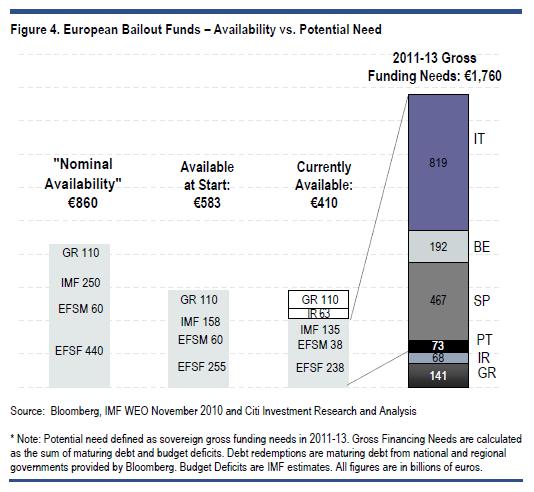
citiefsfThe warning signs have been there since 2008 . Many of us have said this in writing. Meanwhile, the system has continued to sink into debt at a more expensive interest rate each time, while no one cared that almost 60% of peripheral countries’ state revenues are used to pay interest expenses. This year, the cash deficit reached by Spain will be 14.5 billion euros. The balance of income over expenditure is negative before paying interests.

And now governments demand cheaper and more credit when they are borrowing money to cover interests only. No capital. The result is that after the cuts already announced, peripheral countries will need a spending reduction of 30% to cover the cash deficit and interest. “Blame it on the wicked investors” who have the fastidious desire to recover their investment and request an interest that is appropriate to the risk. Outrageous.

The market, that evil entity that causes so much hatred among interventionists, reacts because it has been lied to. And reacts by selling equities and seeking protection on bonds.

Do the interventionist European States want to get rid of the alleged “dictatorship of the markets” that they claim is the problem? Perfect. Do not allow leaders to borrow again like crazy. No more deficit and they will not have to worry whether the blame is of hedge funds , Merkel, Fitch or the new U2 tour.

PS: Pier Luigi Bersani, Italy’s opposition leader said to Berlusconi on Wednesday: “it’s not speculation, it’s about investors and our creditors that don’t trust us any longer”. “Investors are asking a legitimate question… how can these guys pay their debt if they don’t grow”

Further read:

European crisis, falling demand more debt

http://energyandmoney.blogspot.com/2011/07/european-crisis-falling-demand-and.html
Thoughts On The European Crisis

EUROSTOXX (1)

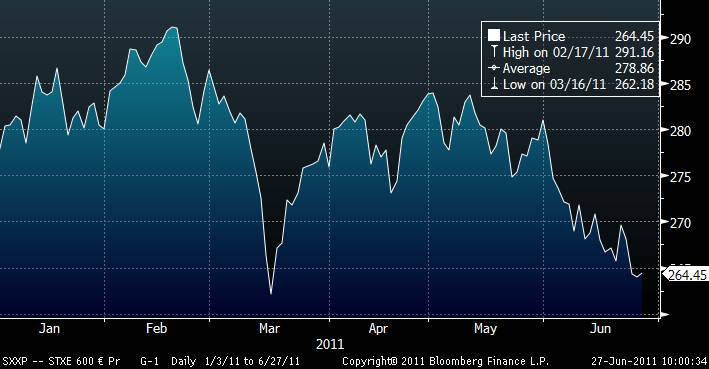
(Extract from an interview with me published in the Spanish press on June 20th, 2011)

How do you see the situation in Europe?

Complicated. On the one hand, Europe has a powerful engine, Germany and the Nordic countries, and sometimes we forget that this engine has the same GDP as China.However, industrial demand from the rest of Europe is deteriorating, and countries have not used the crisis to reduce debt dramatically.

A strong euro, driven by the European engine does not help, and differences between countries have increased. A strong euro means that the over-indebted economies, which are also big exporters, become less competitive.

In my opinion, the estimates of GDP, especially for 2012, are still very high and the estimated deficit levels are relatively optimistic in the peripheral countries. Italy could be a negative surprise, but this crisis can also be a great opportunity to eliminate the weight of the low productivity and high debt  sectors (construction, civil works) and support high-productivity sectors (technology, energy, services) that have been behaving really well under the circumstances.

What can happen if finally Greece has to restructure its debt?

So far the European crisis has been suffered by citizens, equity investors and businesses, but not by the bondholders. This paradox is curious. Europe has an entire economic and financial system that is supported by the fallacy that sovereign debt has no risk. This affects everyone from private investors to governments (local and state) to banks, their investment criteria and their perception of risk, and has generated a disproportionate percentage of sovereign bonds in portfolios. The CDS widening has been perceived as an opportunity to buy “no-risk assets but with high return”, not as a warning sign.

Going back to the Greek debt, to keep bonds as if nothing was happening, when these are already discounting a “default”, only prolongs the agony of a story whose end can only be to restructure. Once the debt is restructured in a proper way, it will be the time to see the beginning of the recovery in Europe and the peripheral countries. It will likely be a tough process and austerity plans will be much more demanding than current estimates, but it will also be the beginning of the solution, because the new governments that will manage Europe between 2013-2015 will no longer have the same vision of the problem of debt which so far has been to “hold on and wait for the issue to solve itself.”.

If it were in your hand … bail-out or restructuring?

Restructuring always, in an orderly manner and agreed with the financial institutions. Bailouts only encourage bad government behaviour , because there is no penalty for poor managers. Citizens end up paying anyway through higher taxes and worse working conditions because, as we have seen with Greece, that received a massive bailout already two years ago, a few months later the economy is in the same same poor situation, if not worse.

And Spain, is it better than the market thinks or, as some say, the situation is worse?

The big question is the debt of the regional communities and the State’s ability to join community after community to solve the debt problem and tackle unnecessary spending. Investors do not know exactly what the real indebtedness of the state is, and how much of all the enormous “receivable” items are simply bad debt and will never be paid.

Spain today is a bit better than the market thinks, and has positively surprised, because high productivity sectors of the economy have pushed in a very difficult environment, but that process can slow down or stop short if the real debt of the country is much higher, and deeper and more drastic reforms are not implemented because of a period of prolonged political uncertainty, because investment will stop.

What will we see in the markets short term?

The market discounts a very optimistic scenario for corporate earnings in Europe for the following two years, and especially a scenario of extremely optimistic cash-flow generation. EPS momentum is very weak. Consensus should review not only their earnings estimates, but target prices, because in some cases the latter ones are simply amazing.

A market correction that lowers the real PE (the revised one, not the current one) of the market to more reasonable levels will be a very attractive opportunity to buy, considering that the next cycle will probably be longer in duration (if countries do the right thing about debt) and less aggressive than the 2009-2010 one. The mistake, in my opinion is to seek refuge in index heavy weights or betting on companies that pay optical high dividends, when those are financed with debt.

Given that interest rates will not be low forever, it still makes sense to stick to well-capitalized stocks, growth companies that generate superior returns in the bottom of the cycle, and focus on high-productivity sectors.

External link: http://www.cotizalia.com/galeria/daniel-lacalle-20110620.html

Brent-WTI Spread…. More Fundamental than Market Perceives

brent wti
(This article was published in Cotizalia on Feb 17th 2011)

I write to you this week from Oman. Impressive country, producing 900 thousand barrels of oil a day, and 9% of GDP from oil revenues, which finances amazing investments in infrastructure and civil works from Musqat to Salalah and other cities that are downright impressive.

As a country, it’s an example of how different the countries of the area are, despite the Western media efforts to put them all in the same basket of so-called risk of Egyptian contagion.

Another week and now that the Egyptian crisis has been solved, the market continues to focus on that country and the risk involved in the Suez Canal for crude supplies. And there is no real risk. The importance of the Suez Canal for the transportation of crude oil has fallen sharply in recent decades. During the 60s and 70s, almost 10% of global oil traffic passed through the canal. Today, it’s less than 1%. Moreover, as the three largest companies working in the channel say, the traffic is roughly balanced, with 55% of oil on ships heading north (992 thousand barrels/day) and 45% (about 850 thousand barrels/day) due south. Any problem in the Canal is, first, negligible for the transit of oil and, second, very easy to re-route around the Horn of Africa, an increase of transit time of less than 15 days.

For those who care about Egypt and the Sumed pipeline, just remind them that it only moves 1.1 million barrels per day despite having a capacity of 2.4 million barrels per day. And as a good friend of EGPC told me, there are few safer places than this pipeline, where the army has more troops than any city in the country except Cairo.

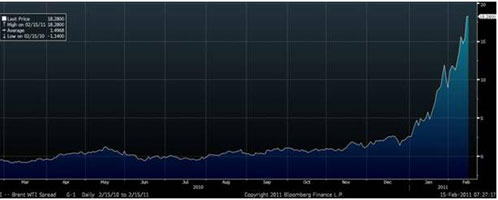
And in this environment we find the Brent and WTI spread at historical highs. Two clear effects: first the inflationary impact on Brent added to the deflationary impact on WTI to create the largest differential between the two ever seen: $14.5/bbl. Also very wide differential relative to other crude, Bonny Light (Nigeria), in particular, and Asian Tapis.

Let’s start by explaining what justifies the weakness of WTI:

Inventories at Cushing (at Oklahoma) are at historically high levels. 50% higher than the average for the past five years (25022). The problem is that the WTI weakness shows the growing isolation of the North American market and infrastructure problems to evacuate excess oil.

WTI crude trades on the basis of inventories at Cushing, in the middle of the American continent, and it is hard to move oil out of the area (called PAD II) or the large refineries on the Gulf.

1) There is enough transport capacity to carry crude from the Gulf to the center of the continent, but not vice versa. The fact that the Enbridge pipeline has had problems has increased the glut of crude in Cushing.

2) There has been an increase in exports of crude oil (oil sands) from Canada to the U.S., which increases the overcapacity in Cushing. Transcanada launched the second phase of its Keystone pipeline, which attracts even more crude to Cushing bottleneck.

3) The increase in U.S. domestic production, including Bakken, is also filling the stores in Cushing. The over-production in the U.S. is partly because the gas companies take advantage of high oil prices to produce more natural gas liquids, whose price is close to oil, in order to fund production of natural gas which today at $4/mmbtu, is not giving the best economics, actually very poor returns. Therefore they compensate for the low profitability of the gas with the price of associated liquids.

Add the fact that three refineries have been closed for maintenance, and we have the perfect storm. Excess production of high oil prices, withdrawal of the American system because of lack of infrastructure, and reduced refinery demand .

Meanwhile, Brent is affected some powerful inflationary forces:

1) The decline of production from Norway and North Sea, that previously functioned as a cushion against price increases, and does not produce that effect anymore.

2) The increase in OPEC oil transit to Asia, and rising domestic demand in exporting countries have reduced the oil for export. Saudi Arabia expects to increase its exports by 1 million barrels per day, but, for now, demand does not justify it.

3) The perception of geopolitical risk and the effect that we mentioned of transport cost increase. The market assumes that the cost of transport must rise. We are already seeing freight day rates recover, particularly in the VLCC segment, as I commented with Oman Oil. Having seen the Baltic Dry Index tumble to record lows due to excess spare capacity of ships, we could start to envision a horizon of recovery. Very gradual, and certainly not to be bullish, because overcapacity still exists (especially in the Capesize and Panamax segments.) And if freight costs rise, the chance to evacuate American crude to Europe is reduced.

As I mentioned two years ago on the differential between gas (Henry Hub) and oil, it is very dangerous to play against a very clear structural effect of isolation of a market, the American, in which the administration has no intention of promoting improvements in the system, and as a result, crude oil and domestic gas (WTI and Henry Hub) at lows is a clear boost from the country’s competitiveness.

Further read:

http://energyandmoney.blogspot.com/2010/01/revolution-of-shale-gas.html

http://energyandmoney.blogspot.com/2011/06/iea-releasing-strategic-reserves.html

Salamander, a case of de-rating through exploration

Being an E&P the main catalyst for the company’s stock is its exploration campaign. However, when it comes to this, Salamander Energy has not had the greatest run.Out of 3 exploration wells dug by Salamander Energy in 2010, none were successful in finding commercial hydrocarbon flows.

Bang Nouan 1 well was spudded in April 2010 in Lao PDR. However, in May the company reported that the zones of permeability encountered in the primary objective were water bearing. All hopes were turned to the gas shows encountered in the secondary objective, which upon a well test, failed to be of commercial level. Thus, the well was plugged and abandoned in early August.

The next blow came from the high-risk Tom Su Lua prospect, Vietnam, where TSL-1X well was drilled. However, in late June the company announced that the well has been plugged and abandoned having failed to encounter any commercial hydrocarbon levels. It had been drilled to a total vertical depth sub-sea of 1,380mt and encountered both, potential seals and high quality reservoir sandstones, which were water-wet in the Tertiary clastic section.

The company then focused on drilling the THX-1X well on the Tom Hum Xanh prospect in Vietnam, 250km south of the TSL-1X well. Similar to its neighbour, THX-1X was announced a dry hole in late July and subsequently was plugged and abandoned as it failed to encounter significant hydrocarbons in the target reservoir sections. It is important to note that the acreage in Vietnam was previously unexplored and therefore was high risk.

The key risk to the share price is the company’s drilling results. Since the start of the year the company has drilled 3 wells, all of which have been subsequently plugged and abandoned as dry holes. Thus, the results of its next planned wells, Angklung and Dambus in Indonesia’s Kutai basin, are the key risks to the stock performance. Serica Energy, operator of Dambus, has assigned a 40% chance of success for the well, while Salamander Energy has estimated the geological risk for the Angklung at 24%. However, both wells are located in a heavily explored acreage, which already contains several producing wells.

Unsuccessful drilling campaign has cost the company in the loss of 40% of its stock value since the beginning of the year. However, although the stock is in a downward trend, it has not reacted greatly to the drilling updates.

The market’s reactions to the updates were positive. Thus, the stock rose on average by 2.00% on the day Salamander Energy plugged and abandoned its wells. Moreover, it seems that the market was reacting to the negative news a day before the announcement was made public. The company is currently trading at 34% above its core NAV (164p/sh) while E&A risked upside is at 116p/sh (632p/sh unrisked).

Overall, the Dambus well looks low-risk, while although the company claims the same about the Angklung, the failure of Unicol as well as the delay in project have put an increased risk on the prospect. Thus, the results of these 2 wells will be crucial to the future position of the company.